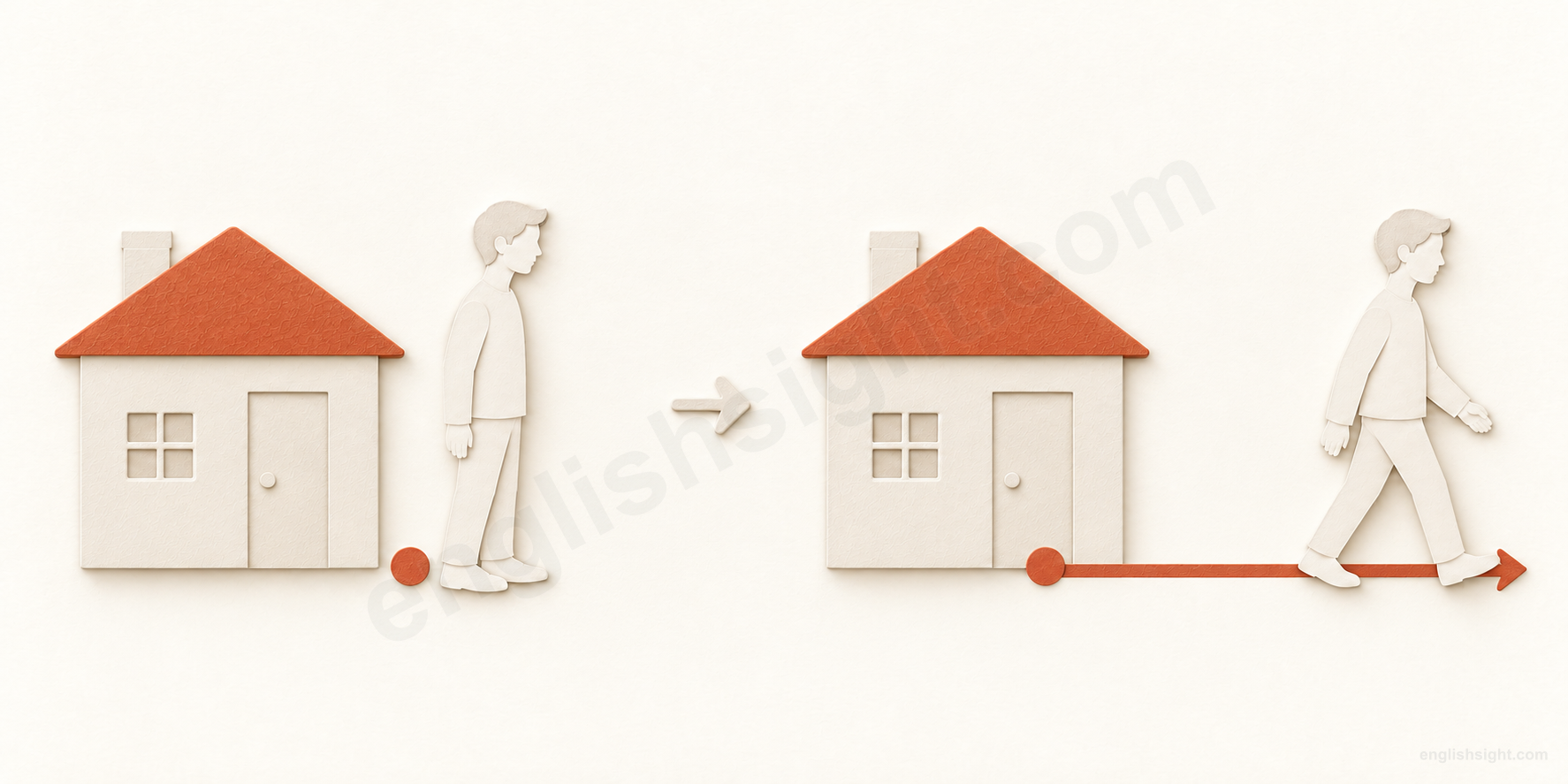
Use from to name a source, a starting boundary, or a point of separation.
Find the source or starting reference
Find the source or starting reference
A person stands beside the house where the journey starts.
from
The person is farther away, while the house remains the departure place.
The person walks to the right; the orange path stays linked to the house as the starting reference.
From names the departure place here. The walking and arrow show movement; other uses of from need not involve movement.
Follow the line back: a place, person, time, material, state, or cause may supply the starting reference.
The arrow helps with origins and starting points. Static distance, hanging, prevention, and idioms need the surrounding construction; they do not all describe movement.
From often directs attention back to a reference point: where a journey begins, who supplied a message, or what a result arose from. The surrounding verb, noun, or adjective tells us what relationship matters.
The sketch offers a teaching connection, not a picture shared by every English speaker. Some fixed expressions need to be learned as complete units.
01
Origins, senders, and sources
Ask where someone belongs, who supplied something, or what an object or idea came from.
01
be / come from + place / background
be / come from
have a place or background as an origin
Situation / reference
You ask about a family’s roots.
Relationship / result
The town identifies their origin.
Origin need not describe a journey happening now.
Be from and come from can describe someone’s home region or background. A product from Italy was produced there; a quotation from an old book has that book as its source. Where are you from? asks about origin, not necessarily your present address.
In a sentence
My grandparents come from a small coastal town.
Watch the difference Come from can state an enduring origin; it does not always mean travel from.
02
noun + from + sender; hear from + person
a message from / hear from
identify a giver, sender, or representative
Situation / reference
Maya sends you an update.
Relationship / result
You receive communication from her.
From names the source of the communication.
A gift from Maya identifies the giver. Hear from Maya means receive her communication, including an email or call, not just hear her voice. A visitor from the council represents or works for it. In a passive, by usually names the doer: the report was written by Maya.
In a sentence
I heard from Maya this morning.
Watch the difference Hear from her concerns contact; hear about her concerns information about her.
03
be made from + material
made from
name the material used to produce something
Situation / reference
Used paper is processed.
Relationship / result
It becomes material for a notebook.
The material is treated as the production source.
Made from often presents material as input to a process; made of often describes what an object consists of. Compare juice made from apples and a ring made of gold. This is a useful tendency, not a rule that the material must always become unrecognizable.
In a sentence
This notebook is made from recycled paper.
Watch the difference Made by names a maker; made in names a production location.
04
learn from + source; tell / judge from + evidence
learn / judge from
use experience or evidence as a source
Situation / reference
You notice her smile.
Relationship / result
It supports your interpretation.
The source may supply knowledge rather than an object.
Learn from a teacher or from mistakes identifies a source of learning. Tell from her smile and judge from the evidence identify grounds for a conclusion; they do not guarantee it is correct. Benefit from practice likewise identifies what produces an advantage, not something you physically leave.
From what I heard means “based on the information I heard”: what introduces the information used as evidence. From memory means using what you remember, without consulting the original; it does not guarantee accurate recall.
In a sentence
From her smile, I could tell she liked the surprise.
Watch the difference From her smile gives evidence; because she smiled gives a reason more directly.
02
Journeys, distances, and positions
The reference point may be a departure place, a viewing position, or a support. Actual movement is not always involved.
05
move / travel / return from + place; from A to B
from home to work
mark where a journey begins
Situation / reference
The station is the departure point.
Relationship / result
The beach is the destination.
From supplies the start; to supplies the destination.
A train from Leeds can be named by its departure point. Return from work and be back from work describe coming back after being there; back supplies the return meaning. From does not say you were inside: out of specifically emphasizes movement from an interior.
In a sentence
We cycled from the station to the beach.
Watch the difference Do not reverse the endpoints: from the station means starting there.
06
distance + from + reference place
two kilometres from
measure separation from a reference point
Situation / reference
You locate the campsite relative to the village.
Relationship / result
The gap is two kilometres.
The place after from anchors the measurement.
A distance phrase with from can describe a fixed location, with no journey. Far from home means a long way from home; away from home means not at home and need not imply a long distance. How far is it from here? asks about the distance using here as the reference point.
In a sentence
The campsite is two kilometres from the village.
Watch the difference Two kilometres from the village does not specify a compass direction.
07
see from + place; from + viewpoint
from here / from my point of view
name the position or perspective of observation
Situation / reference
You stand on the balcony.
Relationship / result
The harbour is visible from that position.
The reference point belongs to the observer.
From the balcony locates the viewer, not the harbour. From above presents a higher viewing position. From my point of view introduces a personal perspective; from a safety point of view limits the aspect being assessed. These abstract viewpoints do not require a physical move.
In a sentence
From the balcony, we could see the harbour.
Watch the difference In my opinion is also natural; do not translate it as in my point of view.
08
hang / dangle from + support
hang from
identify what supports something hanging
Situation / reference
The lamp is attached overhead.
Relationship / result
The ceiling supports it.
The line starts at a support; nothing has to leave it.
Hang from names the support of a suspended object. The lamp may stay attached throughout. This use shows the limit of the “moving away” metaphor: from can trace a connection back to a source or attachment point without implying separation.
In a sentence
A small lamp hangs from the ceiling.
Watch the difference Hangs on the wall describes a different mounting position; from is natural for suspension.
09
from + place expression
from under / from behind
give a more precise starting position
Situation / reference
The cat is under the table.
Relationship / result
It runs away from that hiding place.
Under locates the start relative to the table.
From can precede another place expression: from under the table, from behind the curtain, from inside the bag. The second expression locates the starting point. From under does not mean that the movement itself must continue underneath something.
In a sentence
The cat ran from under the table.
Watch the difference From behind the curtain starts behind it; behind the curtain alone gives a location.
03
Starting times, ranges, and changes
A starting point can be a time, a number, or a state. The rest of the construction supplies the endpoint or continuation.
10
from + starting time; from… to / until…
from Monday
state when a period begins
Situation / reference
The opening period begins at nine.
Relationship / result
It continues until six.
From names a starting boundary, not a duration.
From works with past or future periods; to or until can give the end. From Monday onward leaves the endpoint open. For a situation continuing up to now, since commonly goes with a perfect form: I have lived here since 2020. For two years gives a duration.
In a sentence
The library will be open from nine to six.
Watch the difference Do not replace since with from in I have lived here since 2020.
11
from + time + on / onward(s)
from now on
continue beginning at a stated time
Situation / reference
A new instruction starts now.
Relationship / result
It applies on later occasions too.
On adds continued application after the start.
From now on applies from the present onward. From then on looks back to a past starting point. From day one means from the beginning, often informally. These expressions can describe repeated conduct, not necessarily an activity happening without any interruption.
In a sentence
From now on, please save a copy.
Watch the difference From now on means starting now; for now means temporarily.
12
amount of time + from + reference time
a week from now
locate a later time by counting forward
Situation / reference
Now is your reference time.
Relationship / result
Completion is one week later.
Here from marks the origin of a time measurement.
A week from now means one week after the present. Two days from Monday counts forward from Monday. In a week can also locate a future event; for a week instead tells how long something lasts. This is a time gap, not an activity continuing since the reference time.
In a sentence
The repairs will be finished a week from now.
Watch the difference A week from now does not mean throughout the coming week.
13
from + one endpoint + to + another; prices from + amount
from ten to fifty / prices from
state limits or a starting price
Situation / reference
There are different ticket prices.
Relationship / result
The stated range has two limits.
The endpoints frame a range; no change is required.
From ten to fifty gives a price range. Tickets from ten euros names only the minimum advertised price. Everything from books to bicycles gives examples of a broad range, not necessarily just two items. From A to Z and from start to finish emphasize complete coverage.
In a sentence
Tickets cost from ten to fifty euros.
Watch the difference A price from ten euros is a minimum, not the price of every ticket.
14
change / turn / translate from + original + to / into + result
change from… to…
name the original state before a change
Situation / reference
The signal is red.
Relationship / result
It becomes green.
The verb supplies change; from identifies the original state.
Change from red to green contrasts two states. Translate from French into English similarly distinguishes a source and a result language; to is also used with languages. From bad to worse is an established description of deterioration, not an improvement just because movement occurs.
In a sentence
The light changed from red to green.
Watch the difference From marks the original state or language; to / into marks the result.
15
vary / change from + unit + to + unit
from day to day / from person to person
compare successive periods or different individuals
Situation / reference
You compare the hours on different days.
Relationship / result
They are not always the same.
Repeated units make comparison, not one fixed endpoint.
Vary from day to day compares days; differ from person to person compares individuals. The singular nouns usually have no article in these patterns. Live from day to day has a further established meaning: manage the present without planning far ahead. It need not mean conditions change daily.
In a sentence
My working hours vary from day to day.
Watch the difference From time to time means occasionally; from day to day does not.
04
Removal, protection, difference, and cause
Read the governing verb or adjective: from can mark what is removed, avoided, distinguished, or responsible for a result.
16
remove A from B; be absent from + place / event
remove / be absent from
separate something from a place or activity
Situation / reference
Your shoes are on the sofa.
Relationship / result
They are taken away from it.
The verb supplies removal; from names the previous connection.
Remove the shoes from the sofa and take a break from work separate something from a location or activity. Be absent from a meeting describes non-attendance rather than a movement. Resign from a job ends membership or employment; no literal journey is necessary.
In a sentence
Please remove your shoes from the sofa.
Watch the difference Absent from a meeting does not mean the person attended and then left.
17
subtract / deduct + amount + from + total
subtract five from twenty
remove an amount from a starting total
Situation / reference
The original total is twenty.
Relationship / result
Removing five leaves fifteen.
The amount after from is the starting total.
Subtract A from B means B minus A. The word order matters. Deduct a fee from a payment uses the same starting-total relationship in everyday money matters. This is numerical removal, so the direction of subtraction comes from the full construction.
In a sentence
Subtract five from twenty and you get fifteen.
Watch the difference Subtract five from twenty is not five minus twenty.
18
prevent / stop / keep + person + from + -ing
prevent someone from doing
stop an action from happening
Situation / reference
You intend to play outdoors.
Relationship / result
The rain blocks that activity.
From introduces the blocked action.
Prevent us from playing and keep us from playing identify an action that is stopped or made impossible. Use an -ing form after the preposition. The passive is also natural: We were prevented from entering. The whole verb construction supplies prevention, not from alone.
In a sentence
The rain prevented us from playing outside.
Watch the difference Use from playing, not from to play; keep playing means continue playing.
19
protect / save / free + someone / something + from + noun / -ing
protect / free someone from
shield something from harm or release it from a burden
Situation / reference
Heat could damage the table.
Relationship / result
The cover provides protection.
From names the danger or unwanted condition.
Protect from heat names a hazard; save someone from falling names an avoided event. Free someone from worry describes release from an existing burden. Protection need not mean the harm occurred, while release normally presupposes an unwanted constraint. Learn the governing verb with its complement.
In a sentence
This cover protects the table from heat.
Watch the difference Free from worry describes absence of a burden; free of charge means costing nothing.
20
be different from; tell / distinguish A from B
different from / tell A from B
mark a contrast or distinguish two things
Situation / reference
The two objects look similar.
Relationship / result
You try to identify which is the original.
Separation can concern categories rather than space.
Different from compares qualities; tell A from B means recognize which is which. Different to is also used, especially in British English, and different than occurs, especially in American English. Different from is a broadly useful choice; the alternatives are not universally wrong.
In a sentence
Can you tell the copy from the original?
Watch the difference Tell A from B is about distinguishing; tell someone about B is about informing.
21
suffer / result from + cause; recover from + illness / setback
suffer / recover from
identify a cause or an adverse starting condition
Situation / reference
She is exposed to cold.
Relationship / result
The cold makes her shake.
The surrounding word determines the causal relationship.
Shaking from cold names a cause. Suffer from an allergy names an affliction; result from a mistake and stem from a misunderstanding trace a result to its cause. Recover from flu instead names the condition being overcome. From is not a general replacement for because: it normally takes a noun phrase or -ing form.
In a sentence
She was shaking from the cold.
Watch the difference Use because she was cold or from the cold, not from she was cold.
05
Familiar expressions with their own meanings
Learn these complete expressions. A source-and-starting-point sketch is a memory aid, not a way to calculate every idiom.
22
start (again) from scratch; build / make + something + from scratch
from scratch
begin without a ready-made foundation or previous work
Situation / reference
There is no existing site to reuse.
Relationship / result
You create it from the beginning.
The whole expression supplies the “starting at zero” meaning.
From scratch can describe learning without previous knowledge or building without using earlier work. Start again from scratch means discard the earlier attempt and begin anew. For food, it often contrasts using basic ingredients with using a prepared mix. It does not mean scratching a surface.
In a sentence
We built the website from scratch.
Watch the difference From scratch does not mean quickly, cheaply, or without tools.
23
far from + adjective / -ing; Far from it.
far from / far from it
strongly deny a description or expectation
Situation / reference
Someone might expect an easy task.
Relationship / result
You reject that expectation.
An imagined distance becomes strong contrast.
Far from easy means decidedly not easy, rather than a measured distance. Far from helping, it caused problems says the result was contrary to helping. Far from it is a conversational reply rejecting a previous suggestion: “Are you bored?” “Far from it!” Its reference comes from the conversation.
In a sentence
The task is far from easy.
Watch the difference Far from it rejects the description being discussed, such as “bored”. Use the context rather than translating it as a fixed yes or no.
24
from time to time + clause; verb + from time to time
from time to time
say something happens occasionally
Situation / reference
You do not meet on a fixed schedule.
Relationship / result
Lunch meetings happen now and then.
The whole phrase expresses occasional frequency.
From time to time means occasionally, without specifying a regular interval. It is not the same as all the time or from now on. You can place it at the beginning or end of a clause. The phrase does not tell us how long each individual meeting lasts.
In a sentence
We still meet for lunch from time to time.
Watch the difference Do not interpret it as every time or continuously.
25
apart from + noun / -ing
apart from
make an exception or add another point
Situation / reference
You evaluate the desk.
Relationship / result
You exclude one defect from your positive claim.
Context chooses between exception and addition.
Here apart from means except for. In Apart from teaching, she also writes novels, it means in addition to; also helps make that reading clear. These are two established functions of the whole expression. Aside from is a common alternative, especially in North American English.
In a sentence
Apart from a small scratch, the desk is perfect.
Watch the difference Do not assume apart from always excludes: also often signals an additional point.
26
thank / apologize + from the bottom of + possessive + heart
from the bottom of my heart
emphasize sincere feeling
Situation / reference
Someone has helped you greatly.
Relationship / result
You express wholehearted gratitude.
The heart is a figurative source of sincere emotion.
From the heart means sincerely; from the bottom of my heart adds emphasis. It often accompanies thanks or an apology and can sound deeply emotional. The possessive matches the person whose feeling is expressed: she thanked us from the bottom of her heart. This is an idiom, not an anatomical description.
In a sentence
I thank you from the bottom of my heart.
Watch the difference Use my / your / her heart to match whose feeling is being expressed.
Read the relation and the whole construction
Grammar and pronunciation
From is a preposition, not an inflecting verb. It commonly takes a noun phrase, an object pronoun (from me, from them), or an -ing form. Unstressed /frəm/ is common; strong forms vary by accent. Questions may end with it: Where are you from?
The governing word matters
Passive voice, tense, and causative constructions belong to the governing verb; from itself does not inflect. A message from Maya names a source; written by Maya names an agent. Prepositions in familiar combinations are not interchangeable, and not every verb followed by from is a separable phrasal verb.
Choose the relationship
Check the reference point and the words around from.
1. You start with twenty and remove five. Which instruction fits?
2. You moved here in 2020 and still live here. Which sentence is the usual choice?
3. Rain stopped your outdoor game. Choose the standard complement.
4. In “Apart from teaching, she also writes novels”, what does apart from mean?
Sources and teaching notes
Usage was checked against the dictionaries below. Explanations, examples, and the diagram are original teaching material; the visual connection is a memory aid.
The diagram explains a relationship; it does not claim a shared mental picture.