Find the front, place things in relation to it, and recognize what faces the public.
An oriented side and the space ahead
An oriented side and the space ahead
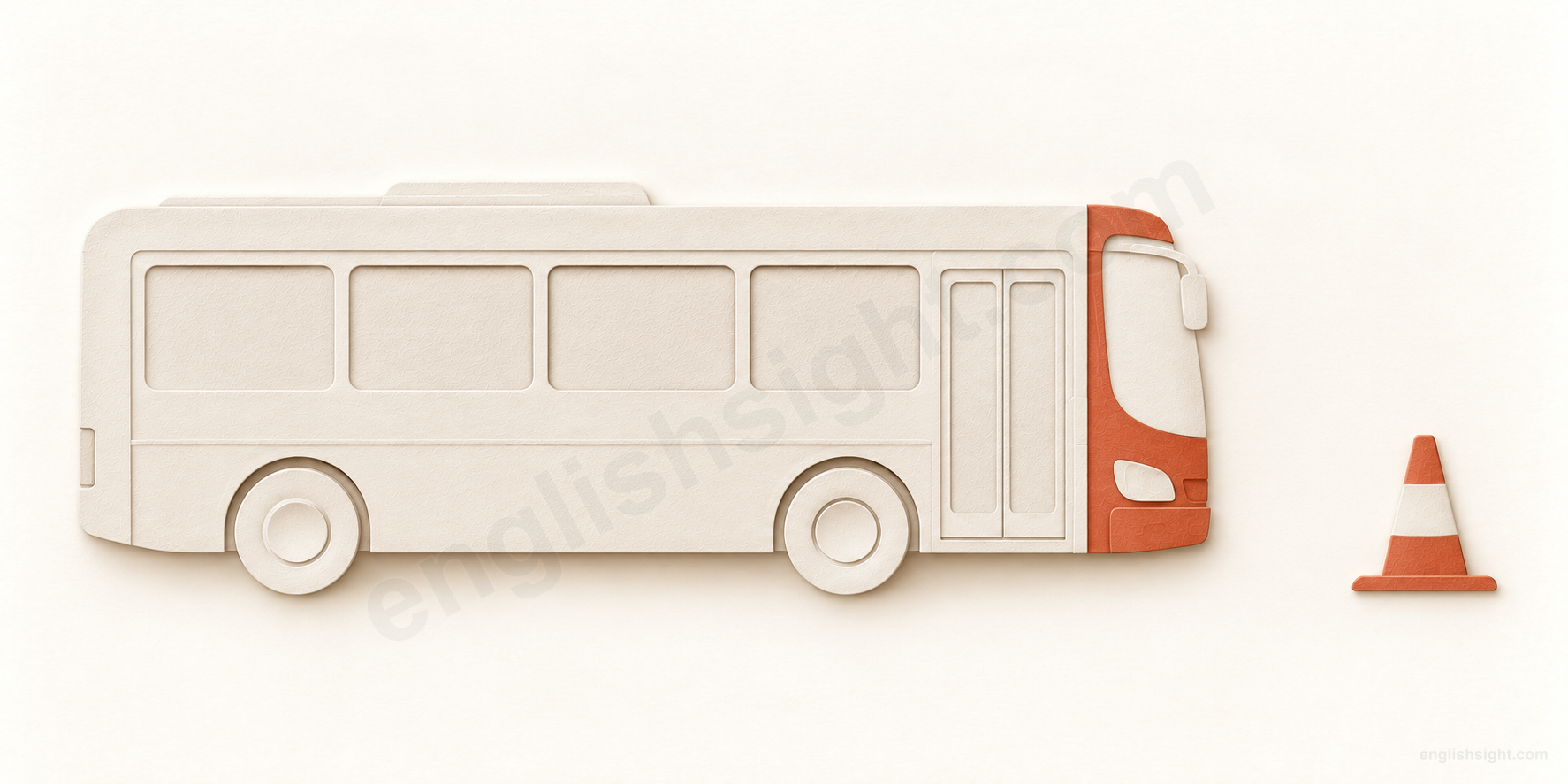
A parked bus has a forward end.
front
A separate cone stands ahead of that end.
The bus's own orientation establishes its front.
The orange end is the bus's front; the cone is in front of it.
Front identifies a thing’s forward or main-facing side; in front of locates something ahead of or facing a reference.
The bus’s own orientation establishes its front, even when it is parked. The cone is outside, ahead of that end. This spatial model supports the basic uses; it does not predict every idiom or technical meaning.
A bus has a forward end; a house has a main entrance side; a book has a front cover. Front helps us identify an oriented side or part. In front of then places something ahead of or facing a reference.
The same word also appears in established expressions about public appearances, leadership, attention, payment, and weather. Some links are useful to picture; others need to be learned with their full construction.
01
Find the forward side or part
Start with an object’s orientation. Then distinguish its surface, its forward part, and a separate position ahead of it.
01
the front of + noun; on the front (of something)
the front of something
the side that faces forward or is treated as the main face
Situation / reference
A bus, a house, or a book has an identifiable orientation.
Meaning / relation
You identify its forward or main face.
The reference object determines which side counts as its front.
The front of a bus is its forward end. The front of a house is usually the main entrance side, often facing the street. The front of a book is normally its front cover. These are parts or surfaces of the thing itself.
Use on the front for a mark or image on that surface: There is a small logo on the front of the box. The front can remain the front even when it points away from you; your own viewing position does not automatically rename an object’s sides.
Front and back form a useful pair. An object without a natural orientation may need context: the front of a tent is generally its entrance side, while a plain round ball has no obvious permanent front.
In a sentence
The front of the bus has a large windscreen.
Watch the difference A person’s face is a body part. The front of a building is not usually called its human face in a basic literal description.
02
lie on + possessive + front; spill something down + possessive + front
on your front / down your front
with reference to the forward-facing part of your body
Situation / reference
Your chest and stomach form the side opposite your back.
Meaning / relation
You describe body position or where something lands.
On your front describes a body position; down your front describes a path over the body or clothing.
If an adult lies on their front, their chest and stomach are towards the surface beneath them. Lie on your back describes the opposite position. Front is a noun with a possessive here: my front, her front, or your front.
I spilled tea down my front usually means it ran over the front of my clothes or body. The front of a shirt, jacket, or dress similarly identifies its forward-facing surface; buttons can run down the front.
Front does not mean only the face or only the chest. The exact area depends on the sentence.
In a sentence
I spilled soup down my front at lunch.
Watch the difference Use my front or the front of my shirt. My front is not a synonym for my face.
03
front + noun
front door / front seat / front row
located at or belonging to the front
Situation / reference
A whole object or space contains several parts or positions.
Meaning / relation
Front selects the forward one.
As an ordinary positional adjective, front comes before a noun.
The front door is at the front of a building; the front wheels are at the forward end of a vehicle. Front teeth are the teeth at the front of the mouth. The noun supplies the thing being located.
A front seat is in the forward part of a vehicle or seating area. The front row is the row nearest the stage, screen, or other main focus. That reference point, rather than north or the viewer’s left, establishes front.
A front cover belongs to the forward face of a book. A front garden is common British wording; front yard is usual American wording for the outdoor area in front of a home. These combinations do not all need separate meanings of front.
In a sentence
We found two seats in the front row.
Watch the difference Say The seats are at the front, not The seats are front. Do not confuse front with in front of.
04
at the front desk; on / make the front page; front-page + noun
the front desk / the front page
familiar names for reception and the first newspaper page
Situation / reference
You arrive at a hotel or open a newspaper.
Meaning / relation
You identify the main point of contact or the first page.
The nouns desk and page give these combinations their particular everyday functions.
The front desk is the reception point inside a hotel, office, or similar building. Ask at the front desk means ask the staff working there; it does not mean ask at any desk that happens to be nearest you.
A newspaper’s front page is its first page, usually used for major stories. The rescue made the front page means it received prominent coverage there. Front-page news appears on the first page, often because it is especially important or striking.
Both combinations connect with what visitors or readers meet first. They are established names, so knowing the physical sense alone is not a complete definition.
In a sentence
Ask at the front desk for a map of the town.
Watch the difference Use on the front page for printed news, but at the front desk when asking reception staff for help.
05
at / in / to the front (of something); up front
at / in the front of something
in the forward part or at the forward end
Situation / reference
A bus, room, book, or queue has an established front.
Meaning / relation
You locate someone or something in that part.
The front is a part of the whole under discussion.
At the front of the bus places someone in its forward section. In the front of the car usually places them inside, near or beside the driver. Context makes the relevant part clear. In the front of a book can mean its opening pages rather than a mark on its outer cover.
At the front of the queue, or the line in American English, identifies the person nearest the point of service. Move to the front means move towards that position. The prepositions at, in, and to contribute location, inclusion, and movement.
When the place is understood, say She sits at the front. Informal She sits up front also means in the forward part. In football, play up front means play in an attacking position; it is a sporting use, not a payment instruction.
In a sentence
The driver sits at the front of the bus.
Watch the difference The driver is at the front of the bus. Someone standing in front of the bus is normally ahead of it, outside it.
06
in front of + noun / object pronoun; in front (reference understood)
in front of something / someone
in a position ahead of or facing the reference
Situation / reference
You choose a person, object, or building as the reference.
Meaning / relation
You locate another thing on its forward or facing side.
In front of links two things; it does not name the front part inside one thing.
A cone in front of a bus is ahead of the bus’s forward end. A person in front of you in a queue is nearer the head of that queue. In these uses, in front of is a prepositional expression followed by the reference noun or pronoun.
Stand in front of a mirror means stand facing it, where you can see your reflection. Sit in front of a computer often suggests using it. Context can establish a viewing direction even when an object has no obvious natural front.
A bench in front of a house is near its front side. A bench opposite the house may be across the road. In front of does not by itself mean on the other side of the street.
When the reference is understood, in front can stand alone: The car in front turned left. The phrase can also describe written order: Put a title in front of your name means place it before the name in the written sequence.
In a sentence
A traffic cone stands in front of the parked bus.
Watch the difference Use in front of me, not in front me. In the front of the bus describes its forward part; it is a different construction.
07
face the front; look to the front; from front to back; front and back
face the front / from front to back
orient towards the front or describe an order through the whole
Situation / reference
A classroom or object has a front and a back.
Meaning / relation
You specify the direction people face or the order of inspection.
Direction and sequence come from the surrounding words.
Face the front asks people to turn towards the established front, for example towards the board in a classroom. Look to the front similarly directs attention forwards. Here front remains a noun after the or a preposition.
From front to back describes a path or order beginning at the front and continuing to the back: We checked the bus from front to back. Front and back can also name both surfaces together, as in Clean the front and back of the card.
A fixed orientation need not change just because someone turns around. In a classroom, the front normally stays near the board even when a pupil looks behind them.
In a sentence
Please face the front so that everyone can see the board.
Watch the difference Front is not a general replacement for forward: walk forward is neutral; walk front is not the ordinary instruction.
08
put / have something on back to front; something is back to front
back to front
with the back where the front should be
Situation / reference
A garment or object has its usual front-back orientation.
Meaning / relation
Its front and back are reversed.
This British expression describes the wrong orientation.
If you put a T-shirt on back to front, the part meant to cover your back is at your chest. The garment need not be inside out: that different expression means its inner surface faces outwards.
Backwards is the usual American alternative for this clothing mistake: You have your T-shirt on backwards. Neither expression says you are walking in a particular direction in this context.
In a sentence
You’ve put your T-shirt on back to front.
Watch the difference Back to front reverses front and back. Inside out reverses the inner and outer surfaces.
02
Ahead, facing, and in someone’s presence
A front position can be relative to another person, a viewer, a competition, or the time still ahead. The whole phrase tells you which relation matters.
09
speak / perform / appear in front of + audience / camera
in front of an audience / a camera
facing people who watch or an instrument that records
Situation / reference
Other people or a camera are ready to observe you.
Meaning / relation
You perform, speak, or act where you can be observed.
The phrase establishes an observer-performer relationship.
Speak in front of an audience means speak where the audience can watch and listen. The idea extends the facing relation; it need not describe who is geographically farther north or nearer a door.
In front of the camera can describe being filmed or photographed. Behind the camera often describes making the film or photograph instead. The activity and the noun camera give the contrast its practical meaning.
In a sentence
Maya feels relaxed in front of a camera.
Watch the difference In front of the camera does not by itself mean operating it; the person may be the one recorded.
10
do something in front of + person; before / in front of someone’s (very) eyes
in front of someone / before your eyes
while someone is present or able to witness it
Situation / reference
Someone is there when an event or conversation happens.
Meaning / relation
They may hear, see, or experience it directly.
Presence matters even when the physical arrangement is irrelevant.
Don’t argue in front of the children asks you not to argue while they are there. It does not require the children to stand in a particular row or directly face you. The concern is their witnessing the argument.
In front of my eyes or before my very eyes emphasizes direct witnessing: The ice melted before my very eyes. Very strengthens the expression here; it does not describe how good the eyes are.
In a sentence
Please don’t discuss my mistake in front of everyone.
Watch the difference The phrase does not mean before everyone arrives. For that time relation, use before they arrive.
11
have + time / life + in front of + person
your whole life in front of you
time and possibilities that still lie ahead
Situation / reference
Part of a person’s life or a period is still to come.
Meaning / relation
You present that future as lying ahead of them.
This is an established time metaphor, not a literal location.
You have your whole life in front of you encourages someone by emphasizing the years and opportunities still to come. Ahead of you is another natural choice in this time sense.
The metaphor uses a forward direction for future experience. It does not make in front of a general replacement for before: before lunch means earlier than lunch, while a life in front of you is still in the future.
In a sentence
You still have many happy years in front of you.
Watch the difference Do not use in front of Monday to mean before Monday. Ordinary calendar deadlines use before or by.
12
be / move in front; in front of + competitor
be / move in front
be ahead in a race, score, or competition
Situation / reference
Competitors have positions or scores that can be compared.
Meaning / relation
One competitor is leading.
In front can stand alone when the comparison is understood.
A runner in front is ahead of the other runners. In a match, a team can be in front because its score is higher, even though the players do not all occupy a forward physical position.
Move in front describes taking the lead. In front of can name the other competitor, while ahead of is also common. Bare front is not the usual adjective for the leader.
In a sentence
Our team is in front by two points.
Watch the difference In front here means leading. At the front of the stadium simply gives a location.
13
wait / stand out front; work / sit out front
out front
near the entrance or in the public-facing area
Situation / reference
A building separates its entrance or customer area from other space.
Meaning / relation
You locate someone in that front area.
The setting decides whether this is outdoors or a public area indoors.
I’ll wait out front commonly means outside, near the front entrance. Informal British English also uses out the front. The building is understood, so you need not add of it.
In a theatre or restaurant, out front can refer to the part used by the audience or customers. She works out front, while he cooks describes their different work areas; she may be indoors.
These meanings rely on the entrance or public-facing side. They do not mean that every place called front is outside.
In a sentence
The taxi is waiting out front.
Watch the difference Out front does not always mean outdoors: in a theatre it can mean in the audience area.
03
What faces the world
Front can name an outward appearance, a shared public position, or a field where activity takes place. These are established uses, not rules for inventing new meanings.
14
put on / put up / keep up + a brave / cheerful / calm front
put on / keep up a brave front
show confidence or calm while hiding different feelings
Situation / reference
A person feels worried, hurt, or unhappy.
Meaning / relation
Other people see an outward show of confidence.
Front names the appearance presented to the world.
A brave front is a display of courage that may hide fear or sadness. Put on emphasizes adopting that outward manner; keep up emphasizes maintaining it over time.
The adjective specifies the appearance: a cheerful front or a calm front can hide a different private feeling. Calling it just a front says the appearance does not reveal what is really going on.
The connection with a visible front is a useful teaching comparison. It does not mean front always implies dishonesty: the front door has no such implication.
In a sentence
He kept up a cheerful front, although he missed his family.
Watch the difference A brave front does not prove that the person feels fearless. The expression highlights the outward appearance.
15
be a front for + activity / group; front for + person / organization
a front for something / front for someone
a public cover that hides another activity or controlling group
Situation / reference
A real activity or controller remains concealed.
Meaning / relation
People see a different person, business, or organization instead.
For identifies what or whom the visible cover conceals.
The business was a front for an illegal operation means its visible work concealed that operation. This noun use suggests secrecy or deception; it is stronger than simply saying that a business represents someone.
Front for is also a verb expression: The company fronted for a criminal network. Here fronted names the act of serving as a cover. It is not the payment expression pay up front.
Keep for with its complement: It fronted for them. This is not a separable particle pattern; do not move them between fronted and for. By contrast, front a campaign can describe ordinary public representation without implying a hidden crime.
In a sentence
The shop was a front for an illegal betting operation.
Watch the difference Front for them means act as their cover. Front them some money means advance money to them; the patterns differ.
16
present / form + a united front (against something)
present a united front
show a shared position to people outside the group
Situation / reference
Several people need to respond to an issue.
Meaning / relation
They publicly show agreement and support for one position.
The shared front is the position others encounter.
Present or form a united front means appear together in support of the same stance. The members may have debated privately; the phrase concerns their public unity, not proof that they agree about everything.
Against introduces what they oppose: a united front against the cuts. A common front is a related combination. In some political organization names, capitalized Front names a movement or coalition; it does not name the front of a building.
In a sentence
The neighbours presented a united front against the road closure.
Watch the difference United describes the group’s stance. It does not mean that everyone must stand in a straight row.
17
on the + area + front; on several / all fronts
on the work front / on all fronts
in a particular area of activity or concern
Situation / reference
There are several areas of life, work, or public affairs to discuss.
Meaning / relation
You specify the area in which something is happening.
A front is a field of effort or concern here.
On the work front introduces news about work. On the economic front introduces economic matters. The modifier names the field; front does not mean a physical place at the front of an office.
Progress on several fronts means progress in several areas. On all fronts widens that to every relevant area. This can echo the idea of facing challenges in different directions, but it is an established abstract use.
In a sentence
Things are improving on the work front.
Watch the difference Use on the work front for work matters. At the front of the office locates something inside the office.
18
at the front; on / in the front line (of something); frontline + noun
at the front / on the front line
where opposing forces meet, or where people deal directly with a task
Situation / reference
A conflict or demanding activity has a point of direct engagement.
Meaning / relation
You identify the people or area most directly involved.
The literal war meaning and the work metaphor must be distinguished.
In war reports, the front is the area of fighting between opposing forces. The front line is the line or area where they directly face one another. At the front, on the front line, and in the front line occur in these contexts.
On the front line also describes people directly dealing with a problem or the public: Our support staff are on the front line, answering customers’ calls. This does not say they are soldiers.
The noun is often written front line as two words; frontline workers is a common adjective combination. The meaning concerns direct involvement, not simply the oldest or most senior members of staff.
In a sentence
Nurses were on the front line during the emergency.
Watch the difference The context decides whether a real military front or a work-related metaphor is intended.
19
on the home front; the home front (wartime noun)
on the home front
in domestic life or affairs within your own country
Situation / reference
A conversation has focused on work, travel, or events elsewhere.
Meaning / relation
You turn to home, family, or domestic affairs.
Home specifies the field of concern, rather than the front wall of a house.
In an everyday update, On the home front, we’re getting ready to move introduces family or home matters. In news, the same phrase can concern events within a country rather than abroad.
The historical war expression the home front refers to civilians and their work at home while others fight. The modern everyday expression does not require a war; context selects the intended sense.
In a sentence
On the home front, we’re busy preparing for the move.
Watch the difference On the home front concerns domestic matters. At the front of the house concerns a physical part of the building.
20
a cold / warm front; a front moves / passes
a cold front / a warm front
a boundary between different air masses
Situation / reference
Two large masses of air have different temperatures or characteristics.
Meaning / relation
Weather reports describe their meeting boundary.
This is a specific meteorological meaning, not a synonym for cold weather.
A front in a forecast is the boundary between different air masses. A cold front and a warm front name particular kinds of that boundary. A front may bring a change in weather as it passes.
The word names a meeting edge rather than a vehicle’s forward face. You cannot infer the exact rain, wind, or temperature from the noun alone; those details belong to the forecast.
In a sentence
A cold front will reach the coast tonight.
Watch the difference A cold day is not itself a cold front. Front names an air-mass boundary.
21
on / along the front; the seafront
walk along the front
walk along the seafront or waterfront area
Situation / reference
You are in a seaside town with a promenade by the water.
Meaning / relation
The local context identifies that waterfront as the front.
This noun use is particularly British.
In British seaside contexts, the front can mean the promenade, road, or area along the water. Let’s walk along the front suggests a walk beside the sea, not a trip across the front room of a house.
Seafront makes the reference clearer when the setting is not already known. This regional noun use should be recognized as a whole; it does not make every edge of every object its front.
In a sentence
We bought ice creams and walked along the front.
Watch the difference Without a seaside or waterfront context, the front can refer to many other things.
04
Payment, openness, and priority
Learn these familiar expressions as complete patterns. Their meanings are more specific than simply “towards the front”.
22
pay + amount + up front; an upfront fee / payment; cash up front
pay up front / an upfront fee
pay before the work, service, or later payments
Situation / reference
A service or job has not yet been completed.
Meaning / relation
Money is paid in advance.
The position is in the payment sequence, not in physical space.
Pay up front means pay in advance. You can pay the whole amount or only a part: They asked for a deposit up front. The expression itself does not decide whether later payments will follow.
An upfront fee is a fee charged at the beginning. This lesson uses the one-word adjective upfront; up-front is another dictionary spelling. After pay, the usual adverbial phrase is written up front.
Cash up front emphasizes immediate payment in cash. None of these expressions means pay at the front desk, although a hotel might happen to ask for advance payment there.
In a sentence
We paid half up front and the rest after the repairs.
Watch the difference Up front does not necessarily mean the full price. Check whether the sentence specifies all, half, or a deposit.
23
be upfront about + issue; be upfront with + person; state something up front
be upfront about something
be open and direct about information or intentions
Situation / reference
Someone could conceal an intention, difficulty, or cost.
Meaning / relation
They state it openly.
This adjective concerns openness, not an advance payment.
Be upfront about the cost means explain the cost openly. Be upfront with someone identifies the person you are being direct with. Both complements can occur together: Be upfront with us about the delay.
This is a familiar informal way to praise or request straightforward communication. It connects usefully with bringing information into public view, but the honesty meaning belongs to the established adjective upfront.
You can also state something up front, meaning openly or at the outset: I told them up front that I could not work weekends. Read the sentence to distinguish open disclosure from advance payment.
In a sentence
Please be upfront with me about any extra costs.
Watch the difference We paid up front describes timing. We were upfront about the payment describes openness.
24
be / move front and centre; keep / put / move + something + front and centre
front and centre / front and center
in the most prominent or important position
Situation / reference
An issue competes with other issues for attention.
Meaning / relation
It becomes especially noticeable or important.
The phrase is often about attention rather than a literal seat.
Keep safety front and centre means give safety a prominent place in decisions. The image of a central position at the front helps explain the emphasis, but the expression can apply to an abstract concern.
Centre is the British spelling; center is American. The phrase also has a literal use for a position at the front and in the middle, so read the noun and situation.
In a sentence
The new plan puts safety front and centre.
Watch the difference Something can be front and centre in a discussion without being a physical object in the room.
25
be on the front burner; put / keep + something + on the front burner
on the front burner
receiving active attention as a priority
Situation / reference
Several tasks could receive attention.
Meaning / relation
One task is treated as important now.
This informal expression is especially North American.
Put a project on the front burner means make it an active priority. Keep it on the front burner means continue giving it attention. The expression compares attention to a cooking task kept readily in view.
On the back burner is the contrasting expression for something postponed or given less immediate attention. Being on the front burner does not guarantee that the work is already finished.
In a sentence
We need to keep the repairs on the front burner.
Watch the difference This is an idiom about attention. It need not involve a stove or anything literally hot.
26
be / get / stay on the front foot
on the front foot
in an advantageous position or taking positive action
Situation / reference
A person or team could merely react to events.
Meaning / relation
They gain an advantage or act with initiative.
This especially British expression is common in sporting and competitive contexts.
A team on the front foot has the advantage and can put pressure on its opponents. The expression can also describe a person or organization taking positive steps rather than waiting to react.
Get on the front foot emphasizes gaining that position. It does not necessarily mean moving a particular foot. On the back foot is a contrasting expression for being under pressure or at a disadvantage.
In a sentence
The early goal put our team on the front foot.
Watch the difference Read this as a complete expression. It is not an instruction about which foot to move first.
27
lead from the front
lead from the front
set an example by taking an active part yourself
Situation / reference
A leader asks others to carry out a task.
Meaning / relation
The leader joins the task and demonstrates what to do.
The idiom describes active example-setting, not merely senior rank.
A manager who leads from the front takes part in the work they ask others to do. The leader is metaphorically in the exposed or active position rather than only giving instructions from a distance.
The exact action depends on the situation. It might involve helping customers, trying a new process, or sharing difficult work. The phrase does not require the manager to stand physically ahead of everyone.
In a sentence
Our manager led from the front and helped serve the waiting customers.
Watch the difference Being the first person in a queue is not enough to mean leading from the front.
05
Front as a verb
The verb is less basic than the spatial noun. Its object and context distinguish facing a place, representing people, advancing money, and informal pretence.
28
building + front + place; front on / onto + place; material + -fronted + noun
front a street / front onto something
have the main face directed towards a place
Situation / reference
A building has a main side and a neighbouring street or open space.
Meaning / relation
You describe what that side faces.
The building is the subject; the place is what it faces.
The hotel fronts the square means its front faces the square. Front onto the square and front on the square also occur. These are building descriptions, often found in property or travel writing.
The verb does not require movement: the building stays where it is. Plain face is often an easier everyday alternative.
In a glass-fronted cupboard, -fronted describes what the front is made of or covered with. It does not mean that the cupboard has moved in front of some glass.
In a sentence
The small hotel fronts onto a quiet square.
Watch the difference Front onto describes orientation, not entering the square. A glass-fronted cupboard has a glass front.
29
person + front + band / organization / campaign / show; be fronted by + person
front a band / campaign / show
be the leading performer, public representative, or presenter
Situation / reference
A group, campaign, or programme needs a visible public figure.
Meaning / relation
A person takes that public role.
The object tells you what kind of public role front describes.
Front a band normally means be its lead singer or leading performer. It does not mean simply stand somewhere ahead of the instruments.
Front a campaign or an organization can mean lead it or act as its public representative. Front a television show, especially in British usage, means present it. A person fronting a programme need not own or produce it.
The passive is natural: The band is fronted by a local singer. These public-role meanings do not themselves imply deception. Front for a secret organization is a separate, concealment-related pattern.
In a sentence
The band is fronted by a singer from our town.
Watch the difference Read the object: front a show means present it; front a street describes facing it.
30
front + person + money / amount; front + money / costs
front someone the money
provide money in advance so someone can do something
Situation / reference
A person needs money to start or complete a task.
Meaning / relation
Another person advances the necessary money.
The recipient and the money are objects of the verb.
Front someone the money means provide the money before they can pay it themselves or before the activity earns money. This conversational use is about supplying resources in advance, not acting as a secret cover.
Front the money is possible when the recipient is understood. Whether it is a loan, an investment, or another arrangement depends on the agreement; the verb alone does not settle ownership or repayment terms.
Compare We paid the builder up front: there the builder receives advance payment for work. We fronted Ava the money focuses instead on supplying Ava with funds she needs.
In a sentence
My brother fronted me the money for the train tickets.
Watch the difference Front me the money has no for. Front for me means act as a cover for me in a different pattern.
31
front (no object); stop fronting; don’t front
stop fronting
stop presenting a false image of yourself
Situation / reference
Someone acts as if they have a quality or identity they do not really have.
Meaning / relation
Another person challenges the pretence.
This is informal American usage, not the neutral meaning of every use of front.
Front can be an intransitive verb meaning put on a false public personality. Stop fronting challenges that behaviour; it can sound accusing or confrontational.
This use connects with the noun a front for a false appearance. It does not mean stop walking forwards. In neutral or formal conversation, stop pretending is easier to understand across varieties of English.
In a sentence
You don’t have to act fearless with me—stop fronting.
Watch the difference This direct challenge may sound rude. It is a register-specific use, not a polite general request.
32
front up (at / to + place / event)
front up
arrive or appear at a place
Situation / reference
People expect someone to attend an event or go to a place.
Meaning / relation
The person turns up.
This is an Australian and New Zealand expression.
Front up means arrive or appear in Australian and New Zealand English. A place or event can follow in a prepositional phrase: front up at the office or front up to the meeting.
Turn up is a more widely understood alternative. The meaning is conventional; adding up to front does not let you predict it from the picture of a vehicle’s forward end.
The verb takes regular forms: fronted up, fronting up. With a place, keep its preposition: They fronted up at the office. There is no direct object to move between front and up in this arrival use.
In a sentence
Sam fronted up at the office just before nine.
Watch the difference Front up means arrive; up front can describe advance payment or a forward position. The word order matters.
Keep the reference and the construction clear
Front depends on orientation
The front of an object is not always the side nearest you. A vehicle’s forward end, a building’s main side, and the viewing direction in front of a mirror provide different references. Front and back can stay fixed while the observer moves.
Part versus relative position
At/in the front of usually locates something in a forward part; in front of relates two things. A front garden may be outside, so the distinction is not simply “inside versus outside”. Opposite can mean across from something, while in front of need not.
Forms and grammatical jobs
Front is pronounced /frʌnt/. The noun plural is fronts. The positional adjective normally comes before a noun. Verb forms are front, fronts, fronted, fronting; the -ed ending in fronted adds a syllable. An action can be in progress, as in She is fronting a campaign. Transitive public-role uses allow a passive: The band is fronted by Lee.
Not every combination is a phrasal verb
In front of is a prepositional expression, pay up front contains an adverbial phrase, and upfront is an adjective. Front for and the regional arrival expression front up are established verb combinations. There is no everyday get-like family of particle verbs or general front + person + to-infinitive causative to learn here.
Scope and teaching model
This lesson covers everyday spatial uses and established public, idiomatic, and media uses, with labelled weather and regional recognition notes. Technical vowel descriptions, grammatical fronting, specialist architecture, golf terms, historical forehead senses, and rare confront meanings are not expanded. The diagram is a teaching aid, not a claim that every native speaker pictures front in the same way.
Choose the relation
Read the reference, the preposition, and the whole expression.
1. A person is outside a parked bus, just beyond its windscreen end. Which sentence fits?
2. Where is the driver while driving the bus?
3. “Don’t discuss this in front of the children.” What matters here?
4. Your T-shirt has its back over your chest, but its inner surface is still inside. Which description fits?
5. “We paid half up front.” What does this tell you?
6. “Her confidence was just a front.” Which interpretation fits?
7. “Rae fronts a television show.” What role does Rae have in this especially British use?
8. In Australian or New Zealand English, “Sam fronted up at the office” means…
Sources and teaching notes
The dictionary pages below support the meanings, constructions, and usage labels. Explanations and examples are original. The orientation model is a teaching interpretation, not evidence that all uses share one mental picture.
This diagram explains an oriented relationship; it does not represent a mental picture shared by every native speaker.