From fruit as food to the fruits of your work: learn the noun, its counting patterns, and familiar expressions.
From growth to a product
A product develops from its source
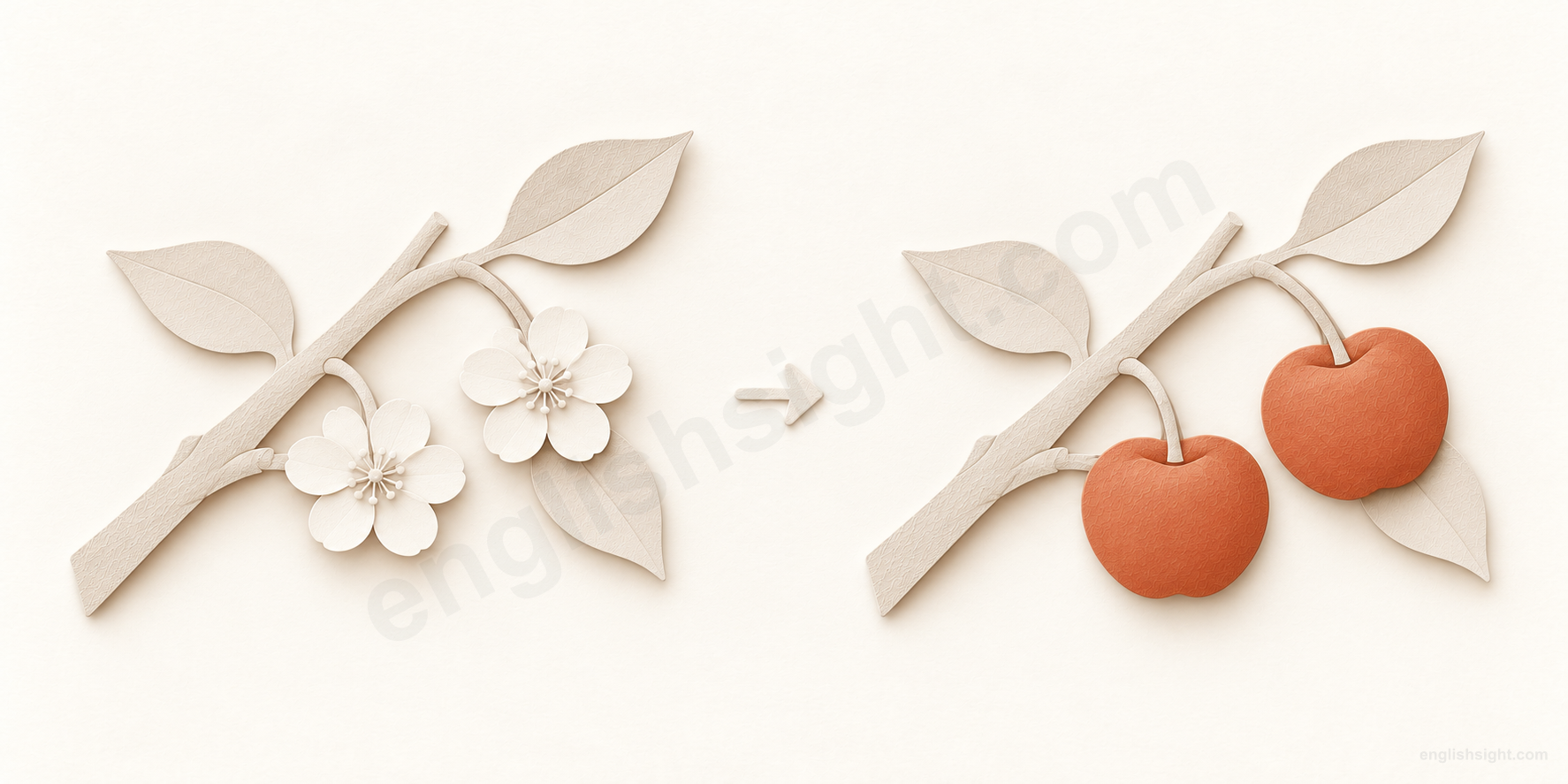
An apple branch carries two blossoms.
fruit
The same branch now carries two apples.
Over time, fruit develops at the flowering sites.
Fruit develops from the plant; “fruits of work” extends this source-to-product link.
Fruit names a plant’s seed-bearing product and, by extension, the results an activity produces.
Everyday fruit as food is a culinary category; botanical fruit is broader. The growth-to-result connection helps with fruits of your work and bear fruit, but does not mechanically explain every compound or idiom.
An apple is fruit, but English also speaks of the fruits of research. The connection is a product that develops from something: a plant produces fruit, and an activity produces results.
That connection helps with some uses, while grammar and established phrases supply other meanings. The sketch is a teaching aid, not a claim that every English speaker has the same mental picture.
01
Food, quantities, and everyday choices
Start with fruit as food. Choose a general amount, a named item, or a variety, then describe its condition or preparation.
01
some / any / much / a little + fruit; fruit + singular verb
some fruit
the food category that includes apples, oranges, and similar foods
Situation / source
You are choosing something to eat after lunch.
Meaning / outcome
You ask about fruit without choosing an individual item.
Fruit can name a category or amount of food without counting separate items.
For food in general, fruit is normally uncountable: some fruit, a little fruit, lots of fruit. In Some fruit is on the table, the verb is singular even when the bowl contains several apples and pears.
Eat fruit, buy fruit, and have fruit for dessert use this general food sense. Apples and bananas are fruit classifies them as members of that category. Fruit and vegetables is the familiar pairing in shopping and meals.
The branch sketch connects the food to plant growth. It does not suggest that all fruit grows on trees, that every fruit is sweet, or that every plant product is called fruit in everyday cooking.
In a sentence
Is there any fruit left for breakfast?
Watch the difference For a general offer, say Would you like some fruit? rather than treating fruit as an ordinary count noun in Would you like a fruit?
02
a piece of fruit; two pieces of fruit; a portion of fruit
a piece of fruit
one item of fruit, or a smaller piece in a cutting context
Situation / source
You need to pack two individual snacks.
Meaning / outcome
You count the items with pieces.
The word piece supplies a countable unit; fruit can remain uncountable.
A piece of fruit often means one whole item, such as an apple or a banana. Pack two pieces of fruit is an easy general instruction when the exact kinds do not matter.
If you know the kind, a banana or two apples is usually more natural than a fruit or two fruits. A portion of fruit is a serving amount; it need not be one whole item.
Context also allows piece to mean a cut part. There are small pieces of fruit in the yogurt refers to smaller bits, not whole apples or bananas. A slice of melon specifies the shape more clearly; piece does not itself guarantee a whole fruit.
In a sentence
Put two pieces of fruit in your bag: an apple and a banana.
Watch the difference Make piece plural after two: two pieces of fruit, not two piece of fruit. Pieces of fruit is not restricted to chopped fruit.
03
a + adjective + fruit; types / kinds of fruit; plural fruit / fruits
a tropical fruit / different fruits
a kind of fruit, or several kinds or individual fruits in suitable contexts
Situation / source
You are describing what a market sells.
Meaning / outcome
You distinguish varieties instead of giving only an amount.
Countable fruit often identifies kinds; it can also refer to individual fruits.
A mango is a tropical fruit classifies the mango as a kind. Tropical fruits and citrus fruits group varieties: oranges and lemons are citrus fruits. Different kinds of fruit is another clear way to express variety.
Fruit and fruits are both recorded plural forms. Do not turn the useful beginner rule “fruit is usually uncountable as food” into “fruits is always wrong.” Countable individual uses occur too, especially in descriptive or more formal writing: Examine each fruit for damage.
Choose the form for your purpose. We bought some fruit reports a general purchase; the stall sells tropical fruits stresses kinds. For three individual apples, we bought three apples is the clearest everyday choice.
In a sentence
The shop sells tropical fruits, including mangoes and pineapples.
Watch the difference Fruits is useful for varieties and some individual uses; it is not the required form every time several apples are present.
04
ripe / unripe / overripe / rotten / fresh + fruit; fruit ripens; grow / pick / harvest fruit
ripe fruit / pick fruit
describe readiness to eat and the act of collecting fruit
Situation / source
The fruit is still on the plant and is not ready to eat.
Meaning / outcome
It ripens, and someone collects it.
Ripe describes condition; ripen describes change; pick describes removal from the plant.
Fruit ripens as it develops toward the stage suitable for eating. Ripe fruit is ready; unripe fruit is not yet ready. Overripe means it has passed the best stage. Rotten describes decay, which is different from simply being very ripe.
Grow fruit can describe a person cultivating a crop. Pick fruit means remove it from the plant; harvest fruit presents collecting the crop more broadly. The fruit ripens has the fruit as subject, while We pick the fruit has the collectors as subject.
Fresh fruit commonly contrasts with dried, canned, or otherwise preserved fruit. Fresh and ripe answer different questions: fruit can be freshly picked but still unripe. These modifiers describe the fruit; they do not create new senses of fruit.
In a sentence
We pick the fruit when it is ripe, before it becomes overripe.
Watch the difference Use ripe for the condition and ripen for the process: The fruit is ripe; the fruit is ripening. Fresh does not automatically mean ripe.
05
dried fruit; some dried fruit; dried + fruit name
dried fruit
fruit preserved by removing moisture
Situation / source
Grapes or other fruits contain their usual moisture.
Meaning / outcome
Drying produces food such as raisins or dried apricots.
Drying changes the preparation; the food is still fruit.
Dried fruit includes foods such as raisins and dried apricots. Dried tells you that a drying process has taken place; it is not a separate plant category.
Use some dried fruit for a general amount, or name the items: a handful of raisins, three dried apricots. Dried fruits can refer to different types. In a recipe, dried fruit does not mean rotten fruit or a fruit that is merely not juicy.
Compare fresh fruit and canned fruit. These expressions tell you about condition or preservation. They need no new underlying meaning of fruit, but knowing them helps with recipes and shopping.
In a sentence
I added a handful of dried fruit to the bowl of oats.
Watch the difference Use dried fruit for the established food category. Dry fruit is not the usual substitute when you mean raisins and dried apricots.
06
fruit + noun: fruit juice, fruit salad; a glass of fruit juice; a bowl of fruit salad
fruit juice / fruit salad
use fruit to specify the ingredient or contents of another food
Situation / source
You know the product is a juice or a salad.
Meaning / outcome
Fruit tells you what it is made from or contains.
In these compounds, the last noun names the thing; fruit describes its relation to fruit.
Fruit juice is a drink obtained from fruit; fruit salad is a dish of mixed pieces of fruit. Fruit stays singular before these nouns even when several kinds are involved. The head noun supplies the main category: a juice is a drink, and a salad is a dish.
A glass of fruit juice counts a serving of liquid. Some fruit salad names an amount, while a fruit salad can mean a prepared dish or serving. Do not transfer the food noun’s usual uncountability mechanically to every compound.
Whole fruit and fruit juice are different forms of food. A bowl of fruit usually contains whole items; a bowl of fruit salad contains prepared pieces. These distinctions come from whole, juice, bowl, and salad, rather than an extra hidden meaning in fruit.
In a sentence
We served fruit salad with small glasses of fruit juice.
Watch the difference Use fruit juice and fruit salad as the usual compounds, not fruits juice or fruits salad. A fruit salad is not necessarily a salad with vegetables.
02
What a plant produces
The botanical noun and gardening verb concern a plant’s development. Their meanings are broader than the sweet food category used in a kitchen.
07
the fruit of + plant; a fruit tree; a tree bears fruit / is in fruit
the fruit of a plant
the structure that develops from a flower and contains the seeds
Situation / source
A flowering plant has blossoms.
Meaning / outcome
Fruit develops as part of its reproductive cycle.
Botanical classification concerns plant structure, rather than sweetness or a food’s place in a meal.
In a botanical description, fruit is the seed-bearing structure that develops from a flower. A tomato is a fruit in this sense, although cooks generally treat it as a vegetable. The two labels classify it for different purposes.
Not every botanical fruit is sweet or edible. The everyday food sense is narrower and follows culinary convention; the branch with apples illustrates a familiar case, not a complete botanical definition.
A fruit tree is a tree grown for its fruit. A tree bears fruit means it produces fruit; a tree in fruit has fruit on it. Here bear and in describe production or the present state. Compare the figurative bear fruit in the results section.
In a sentence
In botanical terms, the tomato is a fruit, although it is usually treated as a vegetable in cooking.
Watch the difference Fruit does not mean every part of a plant that people eat. Leaves and roots are not fruits just because they are edible.
08
plant / tree + fruit(s) / fruited / is fruiting / has fruited
the tree is fruiting
a plant is producing fruit
Situation / source
A young tree has not produced a crop yet.
Meaning / outcome
It begins producing fruit.
As a verb, fruit names the plant’s production of fruit, not a person’s eating or harvesting.
The gardening verb fruit has the forms fruit, fruits, fruited, fruiting. The tree fruits every summer describes a regular pattern; the tree is fruiting describes a process now. Oxford marks this verb as specialist, so produce fruit is a useful everyday alternative.
The plant is the subject in the ordinary intransitive pattern: These plants have not fruited yet. No object is required. Someone picking the crop is not fruiting in this sense.
Keep fruiting and ripening apart. Fruiting concerns producing the fruit; ripening concerns its development toward maturity. A plant can have fruit that is not yet ripe. Wider dictionaries also record a transitive gardening use meaning cause a plant to produce fruit, but this lesson teaches the more useful intransitive pattern.
In a sentence
Our young lemon tree has started fruiting this year.
Watch the difference Do not use fruit as an everyday verb meaning eat fruit or pick fruit. Say eat fruit, pick fruit, or go fruit picking.
03
What work and effort produce
English also calls the outcome of an activity its fruit. The surrounding construction tells us whether we mean a result, successful progress, or the earliest benefits.
09
the fruit / fruits of + activity; enjoy / reap the fruits of your labour / labor
the fruit / fruits of your work
the results or rewards produced by an activity
Situation / source
People put time and effort into a project.
Meaning / outcome
They have results they can see or enjoy.
The plant’s product becomes a metaphor for an activity’s outcome.
The fruit of years of work can name one outcome; the fruits of your work often presents several benefits or rewards. Of introduces the source of the outcome. The fruit itself is the result, not the work that produced it.
Enjoy the fruits of your labour means benefit from your effort. Reap the fruits of your labour adds a harvest metaphor: you receive what the work has produced. Labour is the British spelling; labor is the American spelling.
This result sense often presents something worthwhile, especially with enjoy. It can sound more reflective or formal than results. Broader uses can describe consequences without praising them; the exact evaluation comes from context. The growth connection is a teaching comparison, not a rule that all effort must succeed.
In a sentence
With the exhibition finally open, the artists could enjoy the fruits of their work.
Watch the difference The fruits of their work means its outcomes or rewards. It does not normally mean the tasks they still have to do.
10
effort / plan + bear fruit; bore fruit; has borne fruit; is bearing fruit
bear fruit
produce successful results
Situation / source
A group has tried a new approach for several weeks.
Meaning / outcome
The approach begins to produce the hoped-for improvement.
The subject is the effort, plan, or process; fruit stands for a successful outcome.
Our efforts are bearing fruit means the work is starting to pay off. The subject is what produces the result, such as talks, a plan, research, or an investment of effort. A tree can literally bear fruit, but a plan bears fruit figuratively.
Learn the complete expression bear fruit. Its usual pattern has no article before fruit. The verb changes: bear, bears, bore, borne, bearing. The talks bore fruit yesterday places success in the past; the talks have borne fruit connects it to the present.
Failed to bear fruit means no successful result followed. It does not necessarily mean that nothing at all happened. Fruit alone is a noun here; bear supplies the verb. This is an established verb–noun expression, not a phrasal verb.
In a sentence
The extra reading practice has borne fruit: Mina now understands the stories more easily.
Watch the difference Use borne, not born, in has borne fruit. The normal idiom is bear fruit, not bear a fruit or bear fruits.
11
the first fruit / fruits of + project / activity
the first fruits of a project
the earliest results or benefits of an activity
Situation / source
A longer project is still continuing.
Meaning / outcome
Its first visible achievements appear.
First selects the earliest outcomes, not necessarily the whole final achievement.
The first fruits of something are its early results or profits. The phrase often occurs when a project has begun to produce something useful but more is expected. Oxford lists first fruit as a noun, usually plural; Collins gives the first fruits and also allows the first fruit.
These first recordings are the first fruits of our collaboration describes early creative work. It does not mean the collaboration is finished. The fruit metaphor is still a product of growth or work; first adds the timing.
For a simple everyday report, early results is a direct alternative. First fruits is useful to recognize in articles, project reports, and more expressive descriptions of achievement.
In a sentence
The short film is one of the first fruits of the new partnership.
Watch the difference First fruits does not promise that these are the best results, or that all the expected results have arrived.
04
Expressions to learn as a whole
These established expressions add ideas that fruit alone does not supply: easy opportunities, the attraction of a prohibition, or a British name for a machine.
12
low-hanging fruit; go for / tackle the low-hanging fruit
low-hanging fruit
the easiest opportunities or goals to achieve
Situation / source
Several changes are possible, with different levels of difficulty.
Meaning / outcome
A team chooses the easiest useful ones first.
The comparison is to fruit within easy reach; the expression concerns ease of achievement.
Low-hanging fruit means the tasks or opportunities that can be dealt with most easily. It is informal and often appears in work discussions: Fixing the obvious errors is low-hanging fruit.
The physical picture is fruit you can reach without climbing. In the established expression, low describes how accessible the opportunity is, not how low its value is. An easy improvement can still be worthwhile.
Go for the low-hanging fruit means choose those easy opportunities. Low-hanging fruit can be a useful first step, but the phrase does not say that harder tasks are unnecessary or that every easy task is important.
In a sentence
For this week, let’s tackle the low-hanging fruit, such as correcting the broken links.
Watch the difference The idiom is about ease, not necessarily low quality or low price. Keep low-hanging together as the modifier.
13
forbidden fruit; forbidden fruit tastes sweetest
forbidden fruit
something made tempting by the fact that it is not allowed
Situation / source
A rule places something off limits.
Meaning / outcome
The restriction makes it seem especially attractive.
The prohibition contributes to the attraction; fruit supplies the familiar image of something desirable.
Forbidden fruit is something attractive partly because it is prohibited. In a story, a child might find an off-limits game especially tempting. The phrase can also refer to relationships, experiences, or other things people are told not to pursue.
Forbidden supplies the rule against it. The expression does not simply mean any food someone dislikes, and it need not involve literal fruit. Forbidden fruit tastes sweetest is a familiar saying about the attraction of what is off limits.
The phrase describes a temptation or an attitude. It does not establish that the prohibited thing is good, safe, or worth pursuing. The general plant-growth model does not predict this whole idiom; learn its established meaning.
In a sentence
Once the game was banned at home, it became forbidden fruit for the children.
Watch the difference A thing is not forbidden fruit merely because it is unavailable. The expression connects attraction with a prohibition.
14
a fruit machine; fruit machines; slot machine
a fruit machine
a British term for a slot machine
Situation / source
Someone describes a machine in a British pub.
Meaning / outcome
You recognize a gambling device rather than a food dispenser.
This is a fixed compound whose meaning must be learned separately.
In British English, a fruit machine is a gambling machine in which particular combinations of pictures can lead to a payout. Slot machine is also used in Britain and is the usual North American term. The name can also refer to an online version of the game.
Here machine is the head noun, so the plural is fruit machines. The expression is not a machine for squeezing juice, growing fruit, or selling apples. The plant-growth connection does not explain this conventional name.
In a sentence
There was a fruit machine beside the door of the old pub.
Watch the difference Treat fruit machine as a regional vocabulary item. Do not use it as a general name for equipment that handles fruit.
Keep the category, grammar, and whole expression distinct
Fruit is not always uncountable
Use some fruit for food generally, a piece of fruit for one unspecified item, and a named fruit such as an apple when possible. A fruit and fruits are valid for kinds and in suitable individual uses. There is no rule that fruits is always wrong.
Food and botany use different classifications
A botanical fruit need not be sweet or edible. A tomato can be a fruit botanically and a vegetable in cooking. The apple branch is one familiar illustration, not a complete definition of every plant structure.
Noun, verb, and expression
Fruit is pronounced /fruːt/. The noun’s plural can be fruit or fruits. The gardening verb has fruits, fruited, fruiting; it is not an everyday verb for eating fruit. Bear fruit uses the separate verb bear, with bore and borne. Fruit has no everyday phrasal-verb family to learn.
Scope and register
The course includes the main food and result senses, a limited botanical contrast, the gardening verb, and selected established expressions. It is not a frequency ranking. Literary uses for the earth’s produce, archaic offspring senses, technical wine and legal meanings, and rare transitive gardening uses are not expanded. Fruit used as a label for a gay person is offensive; do not use it to address or describe people.
Choose the meaning that fits
Use the situation and the complete expression to decide.
1. You are offering an unspecified amount of fruit after lunch. Which is the natural general offer?
2. A parent says Pack two pieces of fruit: an apple and a banana. What should you pack?
3. A biology teacher calls a tomato a fruit. What classification is being used?
4. Extra practice has produced a clear improvement. Complete: The practice has ___ fruit.
5. A team calls correcting obvious typing errors low-hanging fruit. What do they mean?
6. A gardening note says The young tree is fruiting. What is happening?
7. A game became more tempting to children after it was banned. Which expression fits?
Sources and teaching notes
Dictionary entries support the meanings, constructions, and register notes. The explanations, examples, and branch sketch were created for this lesson; the visual connection is a teaching interpretation.
The sketch connects growth with a product; it is not a picture shared by every native speaker.