Connect capacity with completeness, then learn the descriptive branches and fixed expressions.
A relevant capacity or whole
A relevant capacity or whole
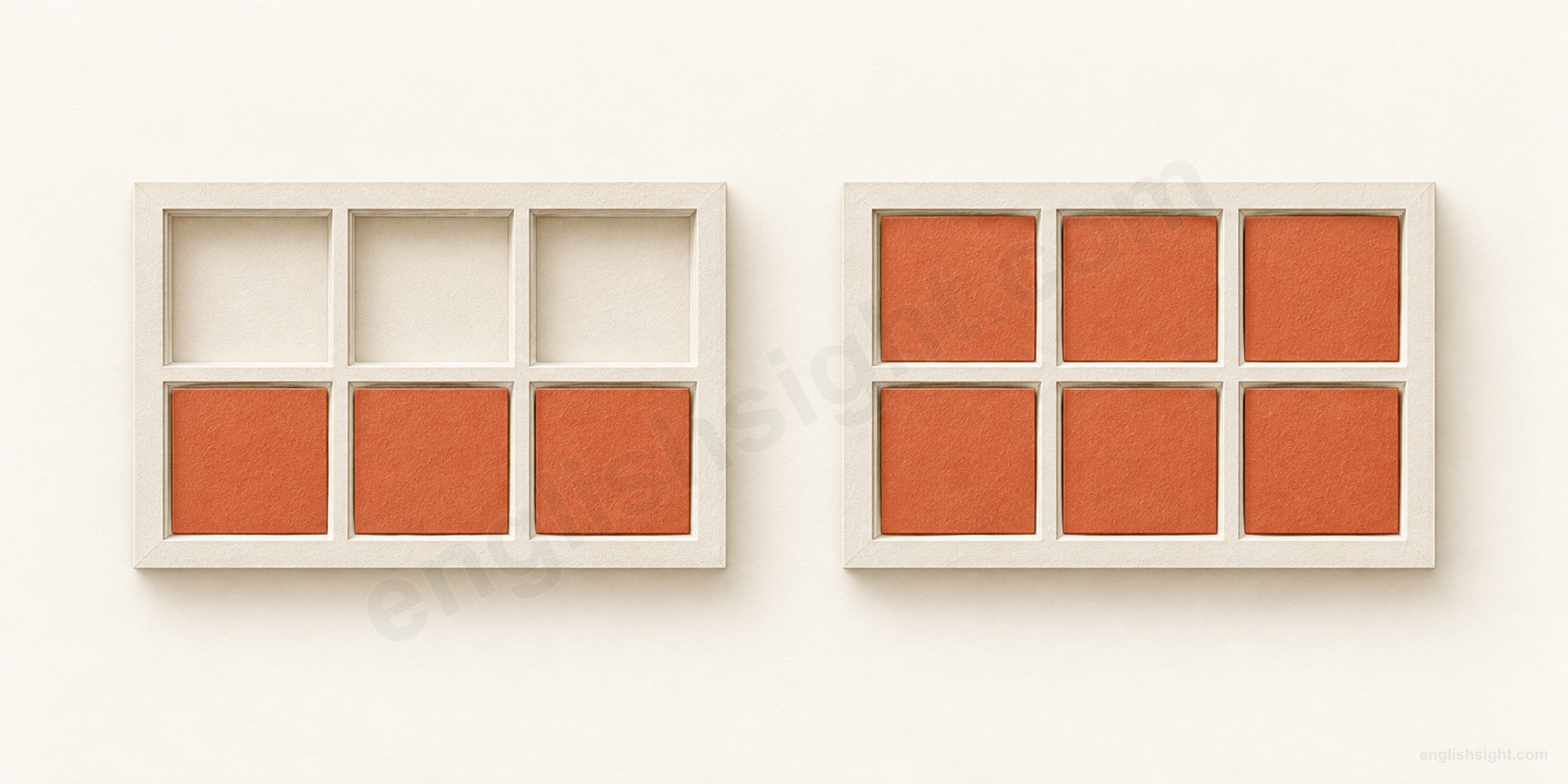
Three of the six places are occupied; three remain empty.
full
All six places are occupied; no place remains available.
Compare occupied places with the same six-place capacity.
The left tray has room; the right is full. Full describes a state. This capacity model does not explain every full of use or fixed idiom.
Something is full when it holds all it can take, or when the relevant whole is present without a missing part.
The sketch illustrates capacity with two equal six-place trays. Completeness and maximum degree extend the comparison beyond space; rich qualities and fixed idioms have additional conventions.
Full often compares what is present with a relevant capacity or whole: no room is available, no relevant part is missing, or a level is at its maximum. Full of can also simply mean that a lot of something is present.
This is a teaching connection, not a claim that every English speaker sees one shared mental picture. Rich sound, rounded shape, and idioms need their own explanations; the sketch cannot predict every combination.
01
Capacity, contents, and satisfaction
A container, place, person, or mind can have as much as it can hold, a large amount of something, or enough food. The context sets the relevant limit.
01
a full + container + of + contents; container + be + (almost / half / completely) full
a full bottle; half full
contain as much as the container can hold
Situation / starting point
There is space above the liquid.
State / intended meaning
The liquid reaches the usable capacity of the bottle.
Full describes the resulting state; it does not describe pouring.
The adjective describes the bottle or its contents relative to its capacity. A full bottle of water means a bottle containing its normal full amount of water; it need not be filled beyond a safe filling line.
The bottle is full describes a state. Fill the bottle describes an action, and The bottle is filling describes a process. Full itself is not the ordinary verb for putting more liquid in.
Almost full, half full, and completely full locate the amount relative to capacity. A fuller bottle contains more than another one; the comparative is natural when degrees are relevant.
In a sentence
The bottle is only half full, so we can add more water.
Watch the difference Use fill for the action: Fill the bottle, not Full the bottle.
02
place / vehicle / device + be + full; be full up
The bus is full.
have no available room for more people or things
Situation / starting point
You want to board a bus.
State / intended meaning
Its available passenger space is already taken.
Capacity can mean usable places rather than every cubic centimetre.
A bus, hotel, car park, or storage device can be full when it cannot take more passengers, guests, vehicles, or data. A hotel may be full even while some guests are out: its rooms are already booked.
Full up is also used for this state, especially in British English: The car park is full up. Up belongs to this adjective expression; it is not a separable verb particle. Compare fill up, which describes becoming or making something full.
At a performance, a full house means that all the seats are occupied: The young musicians played to a full house on Saturday. House here refers to the audience space, not a residential building. The poker term full house has its own card-game definition and is outside this lesson.
In a sentence
The bus is full; we will have to wait for the next one.
Watch the difference A full bus is about available capacity. A busy bus route can have many services without each bus being full.
03
be full of + noun; noun + full of + noun
full of people / useful ideas
contain many people or much of something
Situation / starting point
You open a small guidebook.
State / intended meaning
You find useful suggestions throughout it.
Of introduces the contents, whether physical or informational.
The park is full of people emphasizes the large number present. The book is full of ideas treats ideas as contents. Neither statement requires proof that another person or idea could not fit.
Compare a room full of boxes with a room filled with boxes. Full is an adjective followed by of; filled is a participle that commonly takes with. A room of full boxes instead describes boxes that are themselves full.
In a sentence
This little guide is full of useful ideas for rainy days.
Watch the difference Say full of ideas, not full with ideas. Filled with ideas has a different grammatical form.
04
person / expression / thing + be + full of + feeling or quality
full of hope / energy
have a great deal of a feeling or quality
Situation / starting point
The team has received encouraging news.
State / intended meaning
The players feel strong confidence about the next match.
A quality is plentiful; nobody is physically filled with it.
Full of hope, confidence, energy, or enthusiasm describes a strong presence of that feeling or quality. Eyes full of tears may be literal; eyes full of sadness describes an emotion conveyed by the expression.
The preposition of names what is abundant. The phrase can be positive or negative: a plan full of promise suggests possibilities, whereas a report full of errors contains many mistakes. Full alone does not make the contents good.
In a sentence
After the first rehearsal, the singers were full of confidence.
Watch the difference Full of confidence describes a strong feeling, not a guarantee of success.
05
person + be full of + topic
full of the new job
think or talk a lot about a subject
Situation / starting point
A friend has just started a new job.
State / intended meaning
Almost everything she says concerns the job.
The subject occupies attention rather than physical space.
Someone who is full of a subject is preoccupied with it or eager to talk about it. Full of her new job can describe repeated stories about colleagues, tasks, and plans.
This is an established use of full of, distinct from the new job being full of problems. Check the subject: the person is absorbed in a topic; the job or report contains things.
In a sentence
At dinner, Maya was full of her new job and the people she had met.
Watch the difference This does not mean the person has many jobs or has already finished the work.
06
person + be / feel + full; be full up; on a full stomach
I’m full.
have eaten enough and want no more
Situation / starting point
Someone offers you another serving.
State / intended meaning
You decline because you have had enough food.
The relevant endpoint is satisfaction after eating.
I’m full and I feel full describe a person’s state after eating enough. This need not mean discomfort or a stomach literally filled to its physical limit. A full stomach refers to having eaten, often when discussing how an activity feels afterwards.
No thanks, I’m full is a natural polite refusal. I’m full up is another informal form, especially in British English. A meal that makes you feel full is filling; the meal itself is not full in this sense.
In a sentence
The pie looks lovely, but I’m full after that lunch.
Watch the difference I’m full is about food in this context. I’m busy expresses lack of time.
02
The whole amount, account, or schedule
Full often means that no relevant part is missing. With days and lives, it can instead emphasize many activities and experiences.
07
full + name / details / story / report / range / extent; in full view of + person
full details / the full story
include every relevant part or detail
Situation / starting point
You have heard only a short summary.
State / intended meaning
You ask for the complete account.
Nothing relevant is left out.
Full usually comes before the noun in this meaning: your full name, the full story, a full report, or a full range of products. Full details include what is needed rather than only selected highlights. A full report may also be very detailed, so context decides how strictly complete is intended.
Full extent stresses the entire scale of something: We do not yet know the full extent of the damage. In full view of the neighbours means plainly visible to them; it concerns visibility, not their opinions.
Use complete when a sentence needs that adjective naturally after be: The account is complete. The account is full would normally need further context or full of something and is not the ordinary way to say nothing has been omitted.
In a sentence
Please send the full report, including the tables at the end.
Watch the difference Your full name means the whole name requested by the context, not your name written in large letters.
give or accept the whole relevant amount, right, or obligation
Situation / starting point
Only part of a payment might be returned.
State / intended meaning
The seller offers to return the entire payment.
Full excludes a partial or restricted version.
A full refund returns all of the relevant payment; full pay gives the complete normal pay. Full membership gives the rights of a regular member rather than a limited category. Full responsibility means accepting the whole responsibility, not merely a share.
A full recovery describes returning completely to health or a previous good condition. These combinations share completeness, but the noun decides what is restored, paid, granted, or accepted. Full does not itself specify a legal entitlement or promise.
In schoolwork, full marks means all the possible points, especially in British English: Sam got full marks on the quiz. Full marks for organizing the event can also give someone strong credit or praise without a literal score; tone can make such praise ironic. The marks, not the student, constitute the complete set.
In a sentence
The shop offered a full refund for the broken lamp.
Watch the difference A full refund is complete repayment; a large refund may still be only part of the payment.
09
a full + singular measure; a full + number + plural measure
a full hour / a full five years
emphasize a whole measured amount
Situation / starting point
The repair takes longer than expected.
State / intended meaning
You stress that sixty minutes pass.
Full makes the whole quantity noticeable.
A full hour stresses an entire hour, often suggesting that it is a substantial amount in context. A full five years similarly emphasizes the whole five-year period, not just part of it.
The number or measure still names the quantity; full adds emphasis. Compare half an hour and almost an hour. They do not describe the same amount. A full hour does not mean the hour was necessarily busy.
In a sentence
We waited a full hour before anyone answered.
Watch the difference Keep the noun after the number plural: a full three days, not a full three day.
10
have a full day / life; a very full schedule
a full day / a full life
contain many activities or experiences
Situation / starting point
Your diary lists meetings, errands, and a class.
State / intended meaning
There is little spare time in the day.
Time is occupied by activities, not physically filled.
A full day is a busy day with a lot happening. A full life often suggests many worthwhile experiences and can express approval. It does not necessarily mean that the person lived to a particular age.
Compare We spent a full day there, which can emphasize the whole duration, with We had a very full day, which emphasizes a packed schedule. The surrounding verb and modifiers help you choose the reading.
In a sentence
With three meetings and a concert, we had a very full day.
Watch the difference Do not assume full always means enjoyable: a full schedule can be exhausting.
03
Maximum degree and richness
Speed and effort have a possible maximum. A voice or flavour can be full because it is rich and substantial, without being the loudest or strongest possible.
11
at full + speed / power / volume; in full daylight
at full speed / full volume
operate at the highest relevant level
Situation / starting point
The fan has several speed settings.
State / intended meaning
Someone chooses the highest setting.
Full relates the level to the available maximum.
At full speed describes the highest relevant speed; at full power or full volume describes a maximum operating level. In full daylight means in the strong light of day, rather than twilight or darkness.
The relevant scale depends on the noun and situation. Full speed for a small fan is not the same numerical speed as for an aircraft. Full does not mean fast independently of the thing being measured.
In a sentence
The fan was running at full speed, but the room was still hot.
Watch the difference Use at full speed, not at a full speed, for this ordinary fixed expression.
12
make full use of + resource; take full advantage of + opportunity; reach full potential
make full use of; take full advantage of
use what is available as much as possible
Situation / starting point
A library offers books, rooms, and classes.
State / intended meaning
You use the available resources extensively.
The complete available opportunity is put to use.
Make full use of the library encourages using its resources thoroughly. Take full advantage of the facilities has a similar positive meaning here. To reach your full potential is to develop your abilities as far as possible.
Of introduces the resource after use or advantage; the verbs make and take belong to these established combinations. They do not describe physically taking an object. Full adds extent, not a guarantee that every single resource will actually be used.
In a sentence
Students can make full use of the recording studio during the course.
Watch the difference Say make full use of it, not make full use it.
13
a full + voice / sound / tone; sound fuller
a full voice / a full sound
sound rich, deep, and substantial
Situation / starting point
A recording sounds thin and weak.
State / intended meaning
A different recording has more depth and resonance.
Richness of sound is different from sheer loudness.
A full voice or a full sound has depth and richness. A full sound can still be quiet; turning the volume up does not automatically make a thin recording sound full.
This is an established descriptive branch. The capacity picture suggests substance rather than emptiness, but it cannot tell you precisely which acoustic qualities a musician is describing. The context supplies that detail.
In a sentence
The smaller speaker produces a surprisingly full sound at low volume.
Watch the difference Full volume describes the level setting; a full sound describes sound quality.
14
a full + flavour; have a full flavour
a full flavour
have a rich and substantial taste
Situation / starting point
You taste a weak, watery soup.
State / intended meaning
You compare it with a richer version.
Full describes richness of taste, not the amount in the bowl.
A full flavour is rich and developed. Coffee, soup, or wine can be described this way. It does not necessarily mean spicy, salty, or the strongest imaginable taste.
Compare a cup full of coffee, which describes the cup’s contents, with coffee with a full flavour, which describes how it tastes. The same word participates in different constructions.
In a sentence
The roasted tomatoes give this soup a full flavour.
Watch the difference A full bowl is about quantity; a full flavour is about taste.
04
A complete circle or generous shape
These established descriptive uses concern the moon, rounded features, and clothing with plenty of fabric. They are related teaching branches, not literal containers.
15
a full moon; the moon + be + full
a full moon
appear as a complete bright circle
Situation / starting point
Only part of the moon’s visible face appears lit.
State / intended meaning
Its visible face appears as a bright whole disc.
Completeness concerns the appearance of the visible disc.
A full moon is the phase in which the moon looks like a complete illuminated circle from Earth. The moon is full uses the same adjective after be.
The moon does not physically fill up or change into a larger ball. The connection with completeness is visual: the bright disc appears whole, unlike a crescent.
In a sentence
A full moon rose above the dark hills.
Watch the difference Full moon names a phase, not simply any moon that looks bright.
16
full + lips / face; a fuller figure
full lips / a fuller figure
have a rounded, substantial shape
Situation / starting point
You compare two drawn faces.
State / intended meaning
One has more rounded, substantial lips.
The description concerns shape rather than contents.
Full lips are relatively rounded and substantial rather than thin. A fuller figure is an established description of a larger, rounder body shape. Fuller and fullest are the regular comparison forms.
This is an appearance description, not a statement that the body part contains its maximum possible amount. Comments on someone’s body can be sensitive; describe appearance only when it is relevant and welcome.
In a sentence
The portrait shows a small nose and full lips.
Watch the difference Full lips does not mean the person has food in their mouth.
17
a full + skirt; full sleeves
a full skirt
be wide and made with plenty of fabric
Situation / starting point
Two skirts have the same waist size.
State / intended meaning
One spreads into many loose folds.
The fabric gives the garment width and volume.
A full skirt has ample fabric and a wide, loose shape. Full sleeves similarly contain extra fabric rather than fitting tightly around the arms.
The wearer need not have a larger body: fullness describes the garment’s cut. The capacity sketch is only a loose memory link here, not a literal explanation of a container.
In a sentence
She chose a dress with a fitted waist and a full skirt.
Watch the difference Full does not mean the skirt is full of objects; use full of to name contents.
05
Expressions to learn as a whole
Some expressions preserve a clear connection with capacity or completeness; others have conventional meanings and tones that the picture alone cannot predict.
18
verb + in full; be paid in full
pay / print / explain in full
include the complete amount or complete content
Situation / starting point
An invoice has been paid only in part.
State / intended meaning
The remaining balance is paid too.
In full means without leaving an amount or part out.
Pay in full settles the entire relevant sum. Print in full reproduces the whole text; explain in full supplies the complete explanation. The verb tells you whether money, wording, or information is involved.
The preposition in is part of this fixed phrase. Compare a full payment, where full is an adjective before a noun. In full cannot be freely substituted for full before any noun.
In a sentence
The invoice must be paid in full by Friday.
Watch the difference To pay in full is not to pay to the full; the latter phrase normally expresses maximum extent.
19
verb + to the full / to the fullest
enjoy life to the full / fullest
experience or use something to the greatest degree
Situation / starting point
You have an opportunity to travel and learn.
State / intended meaning
You decide to make as much of the experience as possible.
To the full emphasizes maximum extent of experience.
Enjoy something to the full means enjoy it as much as possible. Live life to the fullest is especially usual in North American English; to the full is also an established form.
The expression is about extent, not a physical filling action. It often has an encouraging tone, but it does not prescribe a particular kind of exciting or expensive life.
In a sentence
We had only one day by the sea, so we enjoyed it to the full.
Watch the difference Keep the article: to the full, not to full.
20
have + possessive + hands full; have … full with + noun; have … full + -ing clause
have your hands full
be very busy with demanding responsibilities
Situation / starting point
You are already looking after two young children.
State / intended meaning
You cannot take on another task easily.
The idiom treats responsibilities as occupying your available capacity.
My hands are full can literally mean I am carrying things. I have my hands full with the children is idiomatic: looking after them already requires much of my attention and effort.
Have your hands full doing something also names the demanding activity. The possessive changes with the subject: she has her hands full. No literal holding is required.
In a sentence
I have my hands full looking after the twins this afternoon.
Watch the difference This idiom expresses demands on time and attention, not necessarily enjoyment or physical tiredness.
21
be full of + reflexive pronoun
be full of yourself
be excessively pleased with your own importance
Situation / starting point
A colleague talks only about his own achievements.
State / intended meaning
Other people find his self-importance irritating.
The expression is a criticism, not ordinary encouragement.
She is full of herself suggests that she thinks too highly of herself or talks too much about her own importance. The reflexive changes with the subject: himself, herself, themselves, and so on.
Compare full of confidence, which can be positive. The critical meaning of full of yourself belongs to the established whole expression; it cannot be predicted just by counting how much confidence someone has.
In a sentence
After winning one prize, he became rather full of himself.
Watch the difference You’re full of yourself can offend; it is not a friendly synonym for You believe in yourself.
22
person / animal + be full of beans / life
be full of beans / life
be lively and energetic
Situation / starting point
The puppy rests after a walk.
State / intended meaning
Later it races around, eager to play again.
The established idiom describes energy, not food.
Full of beans describes someone lively and enthusiastic. Full of life also describes great energy and liveliness. A literal sentence about a bowl full of beans instead names the food it contains.
Context and the subject identify the reading. The idiom is informal and often cheerful; it does not imply that eating beans caused the energy.
In a sentence
After a short nap, the puppy was full of beans again.
Watch the difference Do not translate beans literally when this idiom describes someone’s energy.
23
person + be full of it
be full of it
talk nonsense or make dishonest or exaggerated claims
Situation / starting point
Someone keeps inventing impressive stories about himself.
State / intended meaning
A listener bluntly rejects what he says.
It is a fixed critical expression, not a request to identify contents.
You’re full of it is an informal, disapproving accusation that someone is talking nonsense, exaggerating, or not telling the truth. It is blunt and can be insulting.
Compare The box is full of it, said while pointing to sand: there, it can literally refer to known contents. In the critical idiom about a person, the phrase has a conventional meaning and does not need a named substance.
In a sentence
He says he can finish a month’s work in ten minutes; I think he’s full of it.
Watch the difference Avoid this blunt accusation in a situation that calls for a polite disagreement.
24
event / activity + be + in full swing
in full swing
be well under way at a high level of activity
Situation / starting point
You arrive after a festival has started.
State / intended meaning
Music, stalls, and performances are all active.
The event has moved beyond its early stage.
A party, festival, or season is in full swing when it is thoroughly under way and very active. Nothing needs to move like a playground swing.
The preposition in belongs to the phrase, and swing stays singular without an article. The phrase describes the event’s active stage; it does not say that the event is finished.
In a sentence
By the time we arrived, the street festival was in full swing.
Watch the difference Say in full swing, not in a full swing, for this idiomatic event description.
25
be on full blast; run / operate + at full blast
on / at full blast
produce the maximum level of sound or power
Situation / starting point
The heater is on a low setting.
State / intended meaning
Someone switches it to its strongest setting.
Blast adds an emphatic sense of powerful output.
A radio can be on full blast, and a heater can run at full blast. Both describe very high or maximum output. There need not be an explosion.
The device and surrounding verb help select the preposition: The music was on full blast; The fan was running at full blast. Learn these familiar combinations rather than treating full blast as a general phrase for completion.
In a sentence
The heater was running at full blast when we came in.
Watch the difference Full blast concerns output or intensity; in full concerns the whole amount or content.
26
come / turn full circle
come full circle
return to an earlier situation after a series of changes
Situation / starting point
You begin your career working in a village school.
State / intended meaning
After many different jobs, you return to teaching there.
A completed cycle leads back to a starting situation.
Come full circle describes a return to the original position, idea, or situation after intervening developments. It need not involve a literal circular journey.
The circle is complete, but this is a separate cycle metaphor from the container sketch. The return may be satisfying or disappointing; the idiom itself does not decide.
In a sentence
After years in other jobs, I came full circle and taught at my old school again.
Watch the difference Simply finishing a project is not necessarily coming full circle; the return to an earlier situation matters.
06
Adverbs and familiar compounds
Full is mainly an adjective. A few established adverb patterns and compounds need their own grammar; they do not make full a general replacement for fully.
27
know + full well + (that) + clause
know full well
be clearly and definitely aware of something
Situation / starting point
Someone acts as if a rule were a surprise.
State / intended meaning
You point out that they already knew it.
Full strengthens well in this established adverb pattern.
You know full well that… strongly emphasizes awareness, often when criticizing someone for ignoring what they know. Full here is an adverb modifying well, not an adjective describing a container.
This is a fixed use. The ordinary adverb fully works in many other patterns, such as fully understand. Do not generalize full well into full understand or full agree.
In a sentence
You knew full well that the last train left at nine.
Watch the difference The expression can sound accusing; it is stronger than simply saying You knew.
28
verb + full + in / on + body-part phrase
full in the face / full on the shoulder
directly or squarely at a point
Situation / starting point
A ball flies toward a player.
State / intended meaning
It strikes the player directly on the shoulder.
Adverb full emphasizes a direct line of contact or attention.
The ball hit him full on the shoulder means it struck him directly there. Look someone full in the face similarly describes a direct look rather than avoiding their face.
This established adverb use occurs before in or on phrases. It is more typical of vivid description than a neutral statement of where something happened. It does not mean the person’s shoulder was filled.
In a sentence
The ball hit him full on the shoulder.
Watch the difference This restricted pattern does not make full a general adverb: say fully prepared, not full prepared.
29
a full-time + job / student; work / study full-time; at full time (sport)
a full-time job; work full-time
work or study for the usual complete set of hours
Situation / starting point
A worker has a part-time contract.
State / intended meaning
A new job requires the usual full working week.
Full-time concerns the normal work or study schedule, not every hour of the day.
A full-time job or a full-time student involves the normal full set of working or study hours rather than only part of them. Work full-time uses the compound adverbially; full-time is not a promise of constant work without rest.
British sports reporting also uses the separate noun full time for the end of a match: The score was 2–1 at full time. That is a different established expression, not a description of employment.
In a sentence
Nora works full-time at the museum.
Watch the difference Full-time does not by itself mean permanent employment; a temporary job can be full-time.
30
a full stop; come to a full stop; statement + full stop!
a full stop; Full stop!
name punctuation, complete stopping, or a firm end to discussion
Situation / starting point
A sentence or movement is still continuing.
State / intended meaning
A stopping point is reached.
The complete-stop connection supports several distinct conventional uses.
In British English, a full stop is the punctuation mark . at the end of a sentence; North American English normally calls it a period. Come to a full stop means stop completely: The bus came to a full stop before the crossing.
Full stop! after a statement firmly signals that the speaker considers the discussion closed. This is informal and can sound uncompromising; North American English commonly uses Period! in that role.
In a sentence
I’m not lending you the car, full stop!
Watch the difference Punctuation is a countable noun: a full stop. The emphatic sentence-ending phrase normally has no article.
Choose the scale and the construction
Full is usually a state; fill is an action
The bag is full describes it. Fill the bag tells someone to put things in. A bag full of books and a bag filled with books are both natural, but their grammar differs: adjective + of versus participle + with. Full up is an adjective expression; fill up is a verb combination.
Full, complete, and fully
Use a full report or a complete report for the whole account, but The report is complete is the usual direct statement of completeness. Fully is the general adverb in fully understand or fully booked. Bare full has limited adverb uses such as full well and full in the face.
Degrees depend on the meaning
Full is pronounced /fʊl/; comparison forms are fuller and fullest. Half full, almost full, completely full, very full, and fuller can all be natural in suitable contexts. A full refund normally means the entire amount, so making it fuller would not normally make sense.
Scope of this lesson
The lesson covers modern everyday adjective uses, selected adverb patterns, and familiar expressions and compounds. It does not treat every compound as a separate sense. Specialist textile verbs meaning to thicken cloth or gather fabric, technical sailing and baseball senses, and uncommon noun uses are outside the practical core.
Find the right kind of fullness
Check the subject, the noun, and the complete expression.
1. You want someone to add water to a bottle. Which is the instruction?
2. Which sentence naturally names what a guide contains?
3. After meetings, errands, and a lesson, someone says, “I’ve had a very full day.” What do they mean?
4. A speaker has a full sound even at low volume. Which interpretation fits?
5. “I have my hands full looking after the twins.” What does the speaker mean?
6. An invoice has no unpaid balance. Which phrase describes how it was paid?
7. A friend says, “You’re full of yourself.” What tone does this expression normally have?
Sources and teaching notes
The sources below support the usage inventory. Explanations and example sentences are original; the capacity picture is a teaching model with stated limits.
The picture illustrates a relation; it is not a mental image shared by every speaker.