Talk about gardens, garden work, and expressions that reach beyond the plants.
Plants grown in a chosen space
Plants grown in a chosen space
A space is set aside for growing plants.
garden
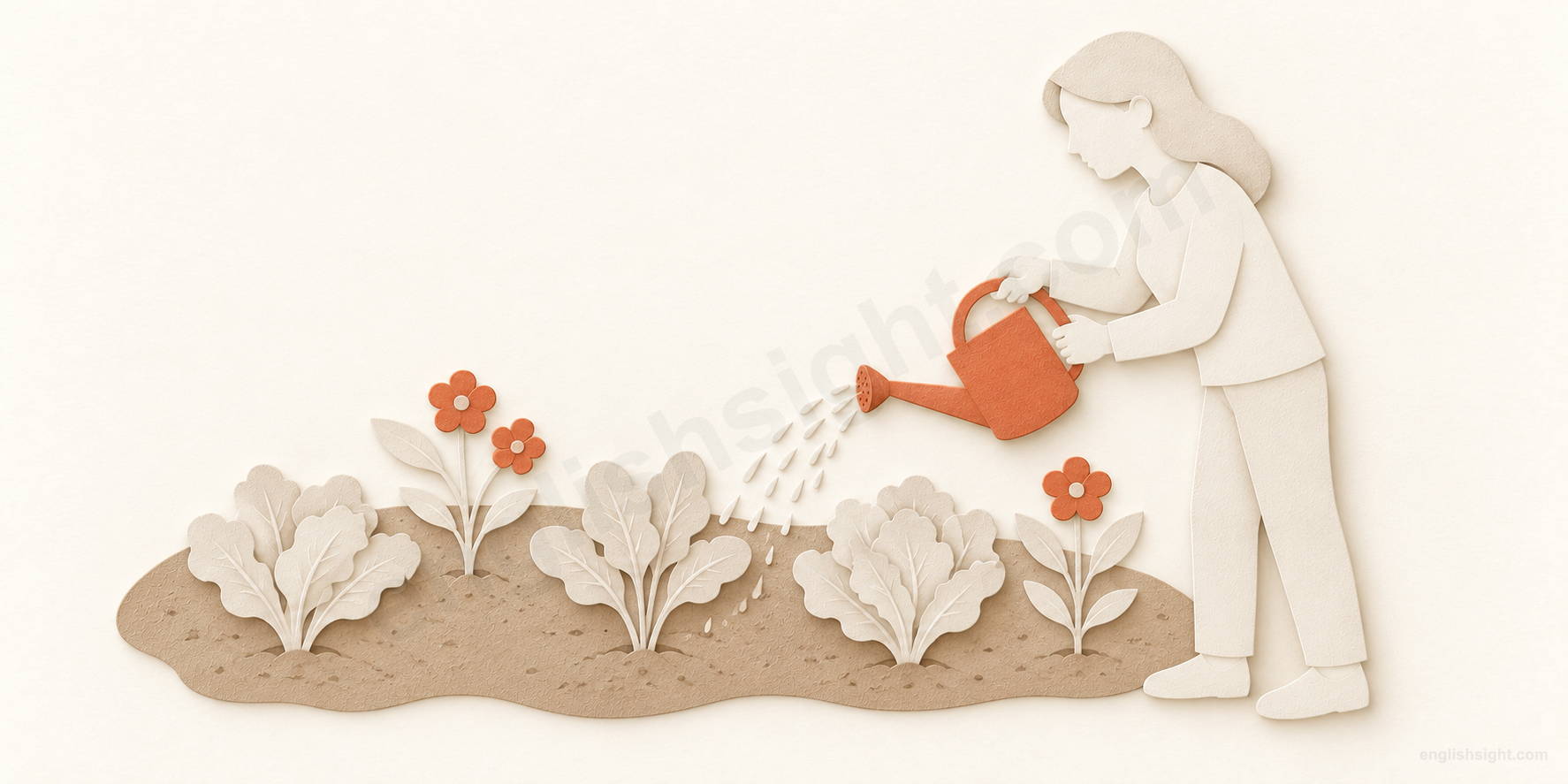
Leafy plants and flowers grow in the cared-for space.
A gardener waters plants rooted in the prepared soil.
Plants are deliberately grown and cared for in a garden. This small bed is one example; gardens need not be fenced.
A garden is a space where plants are deliberately grown, for food, beauty, or enjoyment.
The planted bed shows the core relationship between a place and its growing plants. A garden may also contain grass, paths, or seating. Its name alone does not guarantee a fence, a private owner, or public access.
Garden most often names a space where plants are deliberately grown. It can also name the work done there, describe related objects, or form part of a fixed expression.
Start with the planted space, then read the region and the whole construction. The picture is a teaching model, not a claim about a single image shared by all English speakers.
01
A place for plants and people
Start with the space. Region, purpose, and surrounding words tell you whether it is a home garden, a growing plot, or a place to visit.
01
a / the / possessive + (front / back / rear) garden
a front / back garden
the outdoor area belonging to a home, especially in British English
Starting situation
You describe the space behind your house.
Meaning in context
Your listener understands which outdoor area you mean.
British garden can include a lawn, paths, and places to sit.
In British English, a garden often means the whole outdoor area beside a home. A front garden is in front of the house; a back garden is behind it. Flowers are not required in every part of it.
In North American English, yard usually names this whole area. Garden more often picks out the part used for growing plants: a vegetable garden in the backyard. These are regional tendencies, not rules forbidding either word.
Garden is countable: a garden, our garden, two gardens. Gardens in an address such as 12 Cedar Gardens can instead be part of a street name; the name does not tell you whether the property has a garden.
In a sentence
Our back garden has a small lawn and two apple trees.
Watch the difference A lawn is the grassy part; it is not a synonym for the whole garden.
02
a + plant / purpose word + garden; grow + plants + in a garden
a vegetable / flower / kitchen garden
a space used to grow particular plants
Starting situation
You set aside a patch of ground for food plants.
Meaning in context
You grow vegetables there for meals.
The first word identifies what is grown or what the garden supplies.
A vegetable garden is for growing vegetables; a flower garden is for flowers. The plants may be decorative or useful for food. Garden does not mean only a display of flowers.
A kitchen garden, especially in British English, supplies fruit, vegetables, or herbs for use in the kitchen. It is not a garden inside the kitchen. In a rose garden, rose identifies the kind of plant.
Plant a garden means establish a planted area. Grow tomatoes in the garden names the plants as the object of grow and the garden as their location.
In a sentence
We grow beans and carrots in our vegetable garden.
Watch the difference Use vegetable garden, with vegetable as a noun modifier, rather than vegetables garden.
03
visit + the gardens; a botanical garden / botanical gardens
visit the gardens
visit a planted public space or park
Starting situation
You want a place to walk and look at plants.
Meaning in context
You visit a garden open to the public.
Gardens can name one public attraction with several planted areas.
A public garden is a place people can visit and enjoy. The plural gardens is often used for one large site, not necessarily several separately owned gardens.
A botanical garden, also botanic garden, grows collections of plants for scientific study. Many such places welcome visitors, but the scientific purpose helps distinguish this term from any attractive park.
Use plural agreement with a plural description: The gardens are open. Follow the actual name of an attraction rather than adding or removing an s yourself.
In a sentence
The botanical gardens are open until six today.
Watch the difference A garden is not automatically public, and a public garden is not necessarily a botanical collection.
04
a community garden; a plot in a community garden
a community garden
a garden shared by people in a local community
Starting situation
Local residents need a place to grow plants or spend time outdoors.
Meaning in context
They share a garden in their neighborhood.
Community identifies the people the garden serves.
A community garden can provide plots where residents grow flowers or food. It can also be a shared garden made for local people to use and enjoy, without assigning each person a private plot.
The phrase describes a community connection, not a guarantee that anyone may enter at any time. In our example, sharing the growing work explains why community is useful.
In a sentence
Our neighbors share the planting and watering in the community garden.
Watch the difference Do not assume every community garden is simply a public park with no growing work.
05
in + garden noun phrase; into + garden noun phrase; at the end / bottom of the garden
in / into the garden
locate someone there or describe entering it
Starting situation
A child is indoors and then goes outside.
Meaning in context
The child is inside the garden area.
In gives a location; into makes entry explicit.
She is in the garden says where she is. She walked into the garden describes movement from outside that area to inside it. Garden names the space; the preposition supplies the relationship.
The gate is at the end of the garden gives a position relative to the garden. In British usage, the bottom of the garden often means its far end away from the house, not a lower underground layer.
Use an ordinary noun determiner when needed: in a garden, in the garden, in our garden. Unlike home in go home, garden is not normally used bare in go garden to mean go to that place.
In a sentence
Mia carried her chair into the garden and sat beside the roses.
Watch the difference Walk in the garden can mean walk around within it; walk into the garden specifically describes entry.
02
Working in the garden
Garden can name an activity as well as a place. Other verbs specify the work; garden before a noun describes a connection with that space.
06
person + garden(s); be + gardening; enjoy / go + gardening
garden / go gardening
do the work of growing and caring for garden plants
Starting situation
There are plants and soil that need attention.
Meaning in context
Someone spends time doing garden work.
The verb names an activity, not simply being outdoors.
I garden at weekends means I do garden work, such as planting or weeding. In this everyday use garden is intransitive: it does not need an object. You can add where, when, or how: garden in pots, garden in the evening, garden organically.
The forms are garden, gardens, gardened, and gardening. She is gardening now describes an activity in progress. Gardening is also an uncountable activity noun: Gardening helps me relax; I enjoy gardening.
Go gardening is another way to describe doing the activity. Compare garden with work in the garden: the latter can also describe a different job done there, such as answering email outside.
In a sentence
I garden for an hour before breakfast when the weather is cool.
Watch the difference Do not use a gardening to name the general hobby; say gardening or a gardening session.
07
tend / water / weed / do + the garden; keep + the garden + adjective
tend / water / do the garden
care for a garden or carry out its maintenance
Starting situation
The growing area needs water and attention.
Meaning in context
You carry out the necessary garden work.
The verb specifies the action; the garden is what receives care.
Tend a garden means care for it over time. Water the garden names one task. Weed the garden means remove unwanted plants; plant the garden with herbs describes what you put there.
Do the garden is a familiar British way to talk about garden work generally. It does not specify whether you planted, weeded, or cut the grass. I did the garden yesterday reports the work; I was in the garden yesterday only gives a location.
Keep the garden tidy uses an adjective to describe the condition you maintain. These are ordinary verb-and-noun combinations, not phrasal verbs made from garden plus a particle.
In a sentence
Could you water the garden while we are away?
Watch the difference Garden does not mean water. Someone can garden without watering, for example by removing weeds.
08
garden + noun; gardening + noun
garden tools / furniture / plants
things connected with, used in, or grown in a garden
Starting situation
You need to distinguish outdoor equipment from indoor items.
Meaning in context
Garden identifies the relevant use or setting.
Garden before another noun describes a connection rather than a new growing plot.
Garden tools are tools used for garden work. Garden furniture is furniture for that outdoor space; a garden shed is a small building there for storage. Garden plants are plants grown in gardens.
The exact connection depends on the second noun. A garden chair is for sitting, not for growing. In garden tools, tools carries the plural ending; garden normally stays singular.
Dictionaries may label this use a noun modifier or an adjective. The practical point is its position before the thing being described. Gardening tools and gardening gloves likewise connect the object with the activity.
In a sentence
We keep the garden tools in a shed beside the fence.
Watch the difference Furniture is uncountable in this use: garden furniture, not garden furnitures.
03
Shops, social spaces, and work language
Read the whole compound. Some combinations remain close to a physical garden, while garden leave is an established workplace expression.
09
at / go to + a garden centre; US garden center
a garden centre / garden center
a place that sells plants and gardening supplies
Starting situation
You need seeds, plants, or equipment for growing them.
Meaning in context
You go to a shop that specializes in those supplies.
The compound names a business rather than the middle of a garden.
A garden centre sells plants and related supplies such as seeds and equipment. British spelling uses centre; American spelling uses center.
The centre of the garden instead means the garden’s central part. In this phrase, centre is the main noun, and of the garden identifies the space whose middle is meant. Compare We met at the garden centre with We stood in the centre of the garden.
In a sentence
We bought seeds and two large pots at the garden centre.
Watch the difference A garden centre can be a shopping destination even when you do not have a garden at home.
10
in + the beer garden; a pub with a beer garden
a beer garden
an outdoor seating area at a pub or bar
Starting situation
You want to sit outside with your drinks.
Meaning in context
You sit at tables in the pub’s outdoor area.
Beer identifies a kind of social space, not a crop.
A beer garden is an outdoor area with seats and tables at a pub or bar. It is a place for customers to sit, rather than a garden where beer is grown.
The compound identifies the venue’s outdoor seating area. A garden at home where you happen to drink beer does not automatically become a beer garden in this business sense.
In a sentence
It was warm, so we found a table in the beer garden.
Watch the difference The phrase names a setting; it does not require everyone at the table to order beer.
11
hold / attend + a garden party
a garden party
a social event held in a garden
Starting situation
Guests are invited to an outdoor gathering.
Meaning in context
They meet and socialize in a garden.
Party names the event; garden identifies its setting.
A garden party is a gathering held in a garden, characteristically an afternoon event and often a formal one. It does not mean a group of people employed to do garden work.
You can hold or attend a garden party. Compare garden party with gardening: at the party, the garden provides the setting for socializing rather than naming the guests’ activity.
In a sentence
The museum is holding a garden party for its volunteers on Sunday afternoon.
Watch the difference Do not replace garden with gardening here: a gardening party would suggest people gathering to do garden work.
12
be on + garden / gardening leave; put someone on + garden leave
on garden / gardening leave
away from work while still employed and paid before leaving a company
Starting situation
An employee is due to leave the company.
Meaning in context
They stop working for a period but continue to receive pay.
This British workplace expression has a fixed meaning.
Garden leave, also gardening leave, describes a period when a departing employee does not do their normal work but remains employed and paid. It can keep the person away from confidential information before they move to another employer.
The expression belongs especially to British business English. Leave is the uncountable noun for time away from work: on garden leave; put someone on gardening leave.
No actual gardening is required. Learn the compound as workplace vocabulary rather than trying to infer employment arrangements from the garden picture.
In a sentence
After resigning, Alex was put on garden leave for a month.
Watch the difference It does not mean ordinary holiday taken to look after plants.
04
Expressions that go beyond the plants
These expressions describe deception, ordinary things, or how well life is going. Learn their conventional meanings as complete expressions.
13
lead + person + up / down the garden path
lead someone up / down the garden path
mislead someone into believing something untrue
Starting situation
Someone makes promises that sound convincing.
Meaning in context
Another person believes a false account.
The whole idiom describes misleading a person.
Lead someone up the garden path means cause them to believe something that is not true. Lead someone down the garden path is also used. The expression is informal; up is especially associated with British usage.
The person after lead is the one being misled: They led us up the garden path. A passive is possible: We were led up the garden path. The misleading claim comes from the context, not from the noun garden alone.
A real sentence about leading a visitor along a garden path can also be literal. False promises, unreliable information, or similar context signal the idiom.
In a sentence
The seller led us up the garden path by promising repairs that never happened.
Watch the difference This is a fixed idiom built around lead, not a phrasal verb whose main verb is garden.
14
garden-variety + noun; common-or-garden + noun
garden-variety / common-or-garden
ordinary rather than unusual or special
Starting situation
Someone wonders whether an item has special features.
Meaning in context
You describe it as a normal everyday example.
These informal modifiers classify something as unexceptional.
Garden-variety is especially American English; common-or-garden, also written common or garden, is especially British English. They normally come before a noun and mean ordinary or without special features.
A garden-variety error is an everyday sort of error, not an error in growing plants. A common-or-garden bicycle is an ordinary bicycle. The phrases can sound dismissive if someone hoped the thing was special.
Learn each whole expression. Simply replacing ordinary with garden in any sentence will not reliably produce natural English.
In a sentence
It was a garden-variety spelling error, easy to find and fix.
Watch the difference A garden variety of rose can literally be a kind of rose; the compound adjective garden-variety has the broader ordinary meaning.
15
everything in the garden + is / is not + rosy
everything in the garden is rosy
everything is going well
Starting situation
Someone asks whether the situation has problems.
Meaning in context
You present the situation as satisfactory.
This British saying evaluates life or circumstances, not just plants.
Everything in the garden is rosy is a British saying meaning that everything is fine. It may concern work, relationships, or another situation with no physical garden.
The literal idea of a flourishing garden is a memory aid. The conventional meaning belongs to the full saying. In our example, adding not denies that all is well; it does not mean that every part of the situation is bad.
In a sentence
We have enough orders, but not everything in the garden is rosy: costs are still rising.
Watch the difference Do not interpret rosy as requiring roses, or assume the saying describes a real garden.
Keep the place, activity, and whole expression distinct
Garden, yard, and lawn
British garden often covers the outdoor area of a home; North American yard commonly does that job, with garden for a planted part. A lawn is an area of grass. These useful distinctions allow regional variation.
Noun and verb grammar
The place is countable: a garden, two gardens. The activity gardening is uncountable. The ordinary verb needs no object, as in She gardens, and can be progressive. Transitive garden meaning cultivate land exists in larger dictionaries, but tend the garden or turn the land into a garden is clearer for beginners.
Compounds are not one grammar family
Garden tools describes an association; a vegetable garden names a growing purpose; garden leave has an established workplace meaning. Garden has no everyday productive family of particle verbs to memorize here.
Scope of this lesson
This lesson covers common place and activity uses plus selected compounds and sayings. Literary descriptions of fertile regions, entertainment-hall names, religious names, and specialist horticultural or technical vocabulary are not expanded.
Choose the meaning in context
Check whether garden names a place, an activity, or part of a complete expression.
1. A North American speaker describes a vegetable garden in the backyard. What is the garden here?
2. Nora is gardening now. What does this tell us?
3. You need to buy seeds. Which destination names the relevant shop?
4. A company led its customers up the garden path about delivery dates. What happened?
5. A reviewer calls a fault a garden-variety problem. What is the reviewer saying?
6. Sam is on garden leave after resigning. Which reading fits the workplace expression?
Sources and teaching notes
The linked dictionary entries support the meanings and usage distinctions. Explanations, examples, and the diagram are original teaching material; the visual model is an interpretation.
The diagram offers a memory aid, not an image shared by every English speaker.