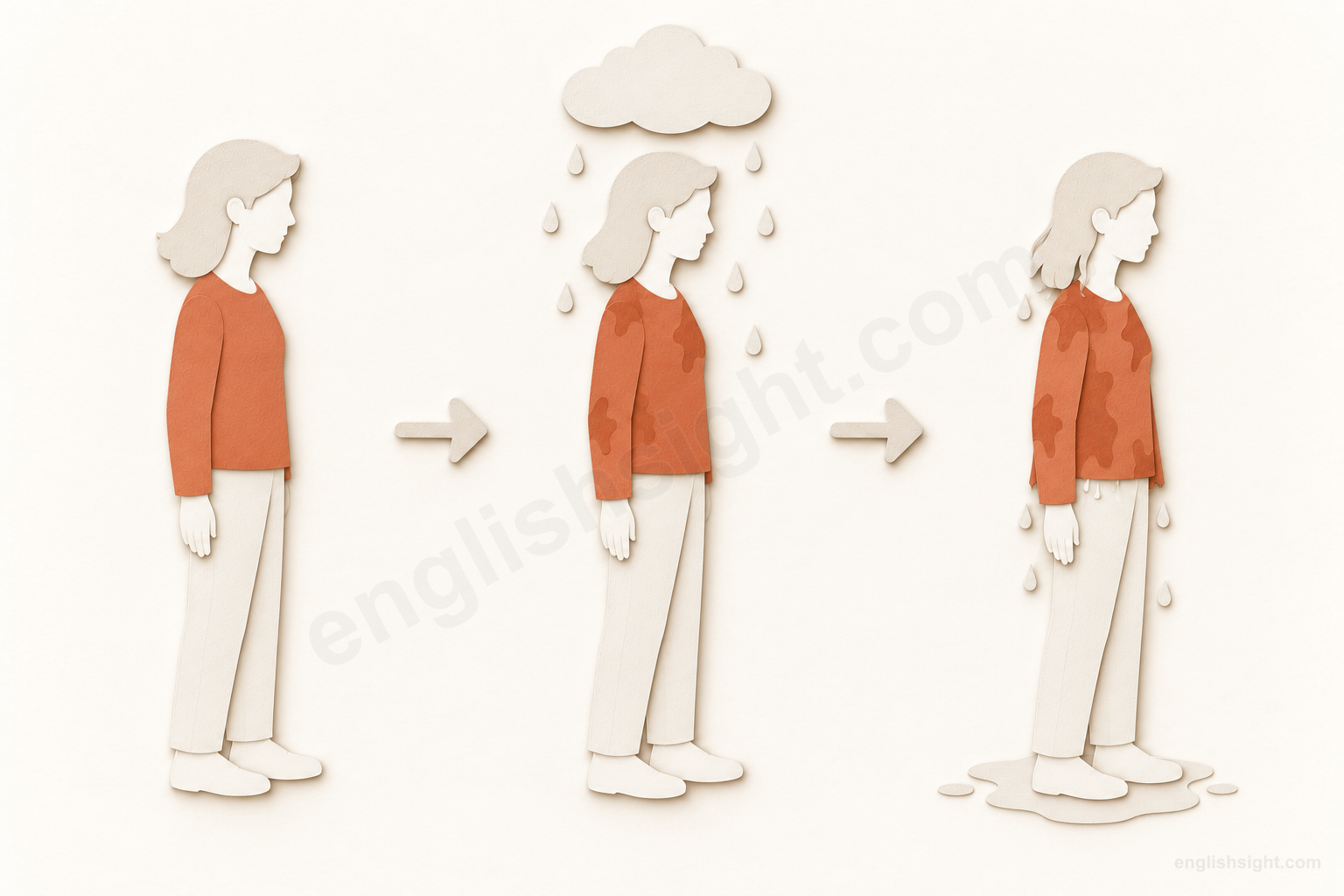
Understand get through a change and the result it reaches.
One change, a new result
Look for the new result
The woman is dry; her shirt has no wet patches.
get
The rain has stopped. Her shirt has more wet patches, her hair is damp, and water drips into a small puddle.
Rain falls on the same woman, and wet patches begin to appear on her shirt.
The arrows mark change over time, not travel: dry, becoming wet, then wet. This example shows get + adjective as becoming, rather than simply being in a state. Many other uses of get involve a new situation in possession or location; those uses are not pictured here. This teaching connection does not predict every fixed expression or represent a picture shared by all native speakers.
Not having → having. Not there → there. Not cold → cold. Many everyday uses of get draw attention to reaching a new situation.
This is a useful connection between these examples, not a definition that predicts every use of get. Learn each meaning with its sentence pattern.
A familiar word can belong to several related scenes. With get, ask what changes: who now has something, where someone arrives, or what someone becomes. The words around get help us choose the scene.
This model is a learning aid. It shows a connection you can remember, not a picture that every native speaker sees. A fluent reader usually understands the whole expression from its familiar wording and the situation.
01
Receive, buy, fetch, and obtain
A noun often names what comes into your possession or experience. Context tells us whether you receive, buy, fetch, earn, or catch it.
01
get + noun phrase
get a key
receive or obtain a key
Before
You do not have the key.
After
The key is now yours to use.
Possession or access changes.
Picture an owner handing you a key. Get focuses on your receiving it. The owner might give it to you, or you might collect it at a desk; the verb alone does not specify the method.
A following noun can name what you obtain: get a job, get information, get some sleep, or get results. These are not all physical possessions. Get a joke instead means understand it. The object and the situation help select the meaning.
In a sentence
I got a key from the owner.
Watch the difference Get a key describes obtaining it. Have a key describes already possessing it.
02
get + item; get something for someone
get a coffee
buy or order a coffee
Before
You have not bought your drink.
After
You obtain a coffee by ordering it.
The shop setting supplies the buying meaning.
At a café, get a coffee normally means buy or order one. The noun alone does not tell you whether money changes hands; the café and the conversation provide that information.
The same wording at home could mean fetch or prepare a coffee. A useful result image connects these situations, but it cannot choose the precise action without context.
In a sentence
Let’s get a coffee before the train leaves.
Watch the difference Can I get a coffee? is a common informal request. In a formal purchase description, buy may be more precise.
03
get + person / thing; get someone from + place
get my coat
go and bring my coat
Before
Your coat is elsewhere.
After
You have brought it to the place it is needed.
An object is collected, rather than bought.
If your coat is upstairs, I’ll get my coat means you will go there and bring it. You already own it; obtaining ownership cannot explain this use.
Get the children from school similarly means collect them. Notice the destination or starting place in the conversation, rather than translating every get as receive.
In a sentence
Wait here while I get my coat.
Watch the difference Get a doctor can mean summon or fetch medical help. It does not mean acquire a person.
04
get + amount + for work / per hour
get £20 an hour
earn or receive that amount
Before
The work has not yet brought that payment.
After
The work brings an hourly amount.
Income is the thing received.
With wages, get often means earn or receive payment. The hourly rate is the object: a person gets an amount for doing work.
Get £50 for an old bike refers to the amount received when selling it. Get paid describes the payment event and uses a different sentence pattern.
In a sentence
She gets £20 an hour at the bookshop.
Watch the difference The present tense can describe a regular wage. It does not say that the money arrived at this exact moment.
05
get + message / email / call / reply
get a message
receive a message or communication
Before
The message has not reached you.
After
The message has arrived.
Information reaches a recipient.
A phone notification makes the receiving use clear. Get an email, get a call, and get a reply all focus on the recipient receiving a communication.
Receiving and understanding are separate. I got your message, but I didn’t understand it is possible. In another context, I get the message can mean that the intended point is understood.
In a sentence
Did you get my email about Friday?
Watch the difference Get a message does not guarantee that you have read or understood it.
06
get + a bus / train / taxi / flight
get a bus
take a bus for a journey
Before
You have not yet arranged or taken that transport.
After
You travel using that service.
The vehicle names a means of transport.
Get a bus or get a taxi commonly means take that form of transport. It does not normally mean buying the vehicle. The journey makes the intended reading clear.
Get on the bus describes boarding; get the bus describes using or catching the service. These are related situations with different grammatical patterns.
In a sentence
We can get a bus from outside the museum.
Watch the difference Get the bus is especially familiar in British usage. Take the bus is also widely used.
07
get + illness / health problem
get a cold
develop a cold
Before
You do not have this illness.
After
The illness begins to affect you.
A health problem is experienced.
In get a cold, the article a introduces a noun: the illness. Compare get a headache or get the flu. No object is physically handed to you.
This belongs with get meaning develop or experience an illness. A broad change model can connect the before and after, but it is not a medical explanation of how infection happens.
In a sentence
I often get a cold in winter.
Watch the difference Get cold uses an adjective and means become cold. Get a cold uses a noun and means become ill.
08
get the phone / get the door
get the phone / door
answer a ringing phone or someone at the door
Before
Someone is calling or knocking.
After
You respond to the call or visitor.
A call for attention is answered.
When a phone rings, Can you get the phone? asks you to answer it. When a visitor knocks, I’ll get the door means you will answer the door.
These informal expressions depend on familiar household situations. They are not instructions to buy or carry a telephone or a door, although another context could give get a literal fetching meaning.
In a sentence
The doorbell is ringing. Can you get the door?
Watch the difference The definite article the points to the familiar phone or door. Learn these as ordinary conversational expressions.
09
get + object + back; get it back
get something back
recover something you previously had
Before
Your item is no longer with you.
After
It is returned or recovered.
Earlier possession is restored.
Get your money back can mean receive a refund. Get your bag back means recover the bag. Back adds the idea of returning to an earlier possession.
With a full noun, get the bag back is normal; with a pronoun, say get it back. Compare get back home, where the person, rather than an object, returns.
In a sentence
I returned the broken lamp and got my money back.
Watch the difference Say get it back, not get back it. Word order is part of learning a separable particle construction.
02
Read the whole sentence pattern
A destination, an adjective, two objects, or a following verb changes the job of get. These patterns also explain who causes a result and who experiences it.
10
get home / get to + place
get home
arrive home
Before
You are still on the way.
After
You have reached home.
Your location changes.
Picture the end of a journey: you reach your front door. Here get points to arrival. It does not mean obtaining a house. Walking, cycling, and taking a bus can all end with getting home.
Compare go home, which directs attention to going there, with get home, which directs attention to reaching it. This difference helps explain why a destination changes the reading of get.
In a sentence
I got home before dark.
Watch the difference Say get home, without to. With an ordinary place noun, say get to the station.
Picture someone standing in a cold wind and beginning to shiver. Nothing is being handed over, and no destination is reached. An adjective names the new condition instead.
Get tired, get hungry, get angry, and get ready name new conditions. Get better and get worse describe a change in degree. Be describes the existing state. Get married and get dressed are also familiar result expressions; their grammar should not automatically be treated as identical to every event passive.
In a sentence
You will get cold in that wind.
Watch the difference Get cold means become cold. Get a cold means develop the illness. The little word a changes the structure.
12
get + idea / joke / message / it
get it
understand it, in this conversation
Before
The explanation is unclear to you.
After
You understand what it means.
Your understanding changes.
After someone explains a puzzle, Now I get it means that you understand. You might use the image of an idea falling into place, but no physical object has to move into your hand.
Get can mean understand in informal conversation. The pronoun it refers to what is being discussed. With a parcel on a shelf, I will get it can instead mean fetching the parcel. The grammar alone cannot decide between them.
In a sentence
Thanks for explaining. Now I get it.
Watch the difference Get it is not one meaning in every situation. Ask what it refers to, and read the surrounding conversation.
13
get + person + thing; get + thing + for + person
get someone something
obtain or bring something for someone
Before
The other person does not have the item they need.
After
You provide it for that person.
The recipient and the item are both named.
In get Maya a drink, Maya is the recipient and a drink is the item. You might buy, fetch, or prepare it; the surrounding situation tells us which.
The alternative order is get a drink for Maya. Compare give Maya a drink: give focuses on handing it over, while get can include obtaining it first.
In a sentence
Can I get you some water?
Watch the difference Get you some water does not mean persuade you. Compare get you to drink water, which has a to-infinitive.
14
get + object + adjective
get something ready
make something reach a condition
Before
Dinner is not ready.
After
Dinner is ready after your preparations.
The object changes state because of an action.
Get dinner ready means do what is needed so dinner is ready. Get the room clean and get everyone comfortable similarly name the desired result after the object.
Compare get ready, where the subject becomes ready, with get the children ready, where someone helps cause the children to become ready. The extra noun changes who experiences the result.
In a sentence
Let’s get the room ready before the guests arrive.
Watch the difference You can get something wet or dirty accidentally. This pattern does not always describe an intended result.
15
get + object + past participle
get something repaired
arrange for a repair, or achieve its completion
Before
The object needs work.
After
The repair is carried out.
An object receives a completed action.
Get my bike repaired often means arrange for somebody to repair it. The subject organizes the result, rather than necessarily doing the repair personally.
Get the report finished can also stress successfully finishing it, possibly yourself. This construction can express arranging a service or achieving a result; context decides who does the work.
In a sentence
I’m getting my bike repaired tomorrow.
Watch the difference Compare My bike got damaged: the bike experiences an event. I got my bike repaired names an organizer and a separate object.
16
get + person / thing + to + verb
get someone to help
persuade or arrange for someone to do something
Before
The other person is not doing the action.
After
You manage to make the action happen.
Another person becomes the doer.
Get someone to help means persuade, ask successfully, or arrange for that person to help. The to-infinitive names the action you bring about.
With a machine, I can’t get it to start means I cannot make it start. No persuasion is involved; the shared grammatical pattern concerns causing an action.
In a sentence
I got my brother to help carry the boxes.
Watch the difference Keep to: get him to help. Make uses a different pattern: make him help.
17
get + person / thing + -ing
get something working / someone talking
cause a continuing activity to start
Before
The machine is not working, or the person is silent.
After
The machine is working, or the person is talking.
An object or another person enters an ongoing activity.
Get the machine working means manage to make it work. Get everyone talking means cause everyone to start a conversation. The noun after get names who or what begins the activity.
Compare get going, where the subject begins, with get the engine going, where the subject causes an engine to begin running. Get someone to talk uses a to-infinitive and may emphasize successfully persuading them.
In a sentence
A question about music got everyone talking.
Watch the difference Get the machine working describes causing or restoring activity. Get the machine repaired describes a completed repair, often arranged as a service.
18
get + past participle; subject receives the action
get paid / hurt / fired
experience an event expressed by a passive
Before
The event has not happened to the subject.
After
The subject is affected by it.
The subject receives the action.
She got paid means somebody paid her; he got hurt means he suffered an injury; they got fired means an employer dismissed them. Get-passives are common in informal speech.
The subject is not necessarily responsible for the event. Get married and get dressed are familiar changes of condition too, but their interpretation is not automatically identical to every event passive.
In a sentence
Luckily, nobody got hurt when the shelf fell.
Watch the difference Not every be-passive naturally allows get. For stable states, The answer is known is natural; The answer gets known is not an automatic replacement.
03
Beginnings, opportunities, and everyday grammar
Some constructions describe beginning an activity or gradually becoming familiar. Others express an opportunity, possession, or necessity. Learn the complete pattern.
19
get + to-infinitive; opportunity
get to do something
have the opportunity to do something
Before
The opportunity is not yet yours.
After
You are allowed or able to have that experience.
An opportunity becomes available.
I get to work from home expresses an opportunity or privilege. The verb after to names the activity you have a chance to do.
Compare I get to work at nine: work is a destination there, so the phrase describes arrival. The same written sequence needs its full sentence to reveal the structure.
In a sentence
Next week, I get to meet the author.
Watch the difference Get to do does not normally mean must do. Obligation uses have got to do or have to do.
20
get + -ing; get + object + -ing
get going
start an activity or leave
Before
The activity or journey has not started.
After
It begins.
A person or process moves into activity.
Let’s get going can mean let’s start, or let’s leave, depending on the situation. Get moving and get working also urge somebody to begin an activity.
Get someone talking instead includes another person as the object: you cause that person to start talking. A new noun changes who starts the action.
In a sentence
It’s getting late. Let’s get going.
Watch the difference Do not assume every -ing form works equally well after get. Learn familiar combinations such as going, moving, and talking.
21
get to know + person / place / subject
get to know someone
gradually become familiar with someone
Before
The person is unfamiliar.
After
You learn about them through contact.
Familiarity develops over time.
Get to know a neighbour describes becoming familiar with that person. It usually involves interaction over time, rather than just learning their name once.
Know describes the existing familiarity. Get to know describes its development. Get to understand and get to realize can also describe gradually reaching a state of understanding.
In a sentence
We got to know our neighbours over the summer.
Watch the difference Meet someone can describe a first encounter. Getting to know them usually goes beyond that first meeting.
22
get used to + noun / -ing
get used to doing something
become accustomed to something
Before
The situation still feels unfamiliar.
After
The situation becomes familiar or manageable.
Your response to a situation changes.
Get used to names becoming accustomed to a new situation. Be used to describes already being accustomed to it. The change may take time.
Here to is a preposition, so it is followed by a noun or an -ing form: get used to the noise, get used to driving. It is not the to of an infinitive.
In a sentence
I’m getting used to working from home.
Watch the difference I used to work from home describes a former habit. I’m getting used to working from home describes becoming accustomed now.
23
have / has got + noun; Have you got…?
have got
have or possess, in the present
Before
This pattern does not necessarily describe an earlier change.
After
A present possession or situation is stated.
The construction expresses an existing state.
I’ve got a ticket normally means I have a ticket. Have got is a familiar present-tense construction, especially in conversation; it can also describe relationships or a health problem.
It does not always mean I have just obtained one. This is a clear limit of the change image: a conventional grammatical construction can describe possession without focusing on a new transition.
In a sentence
Have you got a pen I can borrow?
Watch the difference For past possession, use I had a bike. I had got a bike normally describes an earlier obtaining event, not simply past possession.
24
have / has got to + verb
have got to do something
have to do something; express necessity
Before
A task is required.
After
The speaker states the need to do it.
The construction expresses obligation.
I’ve got to leave means I have to leave. The to-infinitive is essential: it names what is necessary. In everyday speech, have is often contracted.
Compare I get to leave early, which expresses an opportunity, and I’ve got a ticket, which expresses possession. Similar-looking words belong to different complete patterns.
In a sentence
I’ve got to leave before six.
Watch the difference Haven’t got to means do not have to, not must not. Informal gotta represents reduced speech; learn the standard written form first.
04
Movement and resulting positions
Direction words can make physical uses easy to picture. Keep the usual prepositions and transport combinations; a simple diagram cannot generate them automatically.
25
get in / get in the car / get into the car
get in
enter an enclosed place or vehicle
Before
You are outside the car.
After
You are inside the car.
You cross a boundary towards the inside.
Treat the car as a space with an outside and an inside. In gives the resulting location. Get in tells us that the person enters it, without specifying each movement of the body.
If the car is already clear, Get in! can be enough. Get in the car and get into the car are both normal ways to name it. Learn the complete combination and its usual objects.
In a sentence
Open the door and get in the car.
Watch the difference For boarding a bus or train, the usual expression is get on. A useful picture does not replace transport collocations.
26
get out / get out of + place
get out
leave an enclosed place or vehicle
Before
You are inside the car.
After
You are outside the car.
You cross the same boundary in the other direction.
Keep the same car, but reverse the journey. Out gives the outside as the result. This is why changing one small word can change the action while get stays the same.
Say get out when the place is understood. Add of when naming the space you leave: get out of the car. The extra word belongs to the construction, rather than being an optional translation detail.
In a sentence
We got out of the car near the lake.
Watch the difference Get out of the car and get off the bus are the usual pairings. Get out the car is not the standard form taught here.
27
get up
get up
rise, or leave your bed
Before
You are lying or sitting down.
After
You are upright or out of bed.
Your body's position changes.
Picture a person rising from a chair or leaving their bed. Up helps you remember the move towards an upright position. In a morning routine, the whole expression commonly refers to getting out of bed.
Wake up focuses on the end of sleep. Get up focuses on rising or leaving bed. You can wake up and stay lying there for a while. The two events often happen together, but they are not identical.
In a sentence
I wake up at seven, but I get up at half past seven.
Watch the difference Up does not always mean physical rising. Other expressions with up need their own examples and meanings.
28
get on + bus / train / plane / bike
get on
board a bus or train; mount a bicycle
Before
You are not aboard or on it.
After
You are aboard or riding it.
The resulting position is on the transport.
Get on the bus, get on a train, and get on a bike are ordinary combinations. On helps organize the boarding or mounting scene, but vehicle wording is also conventional.
With a car or taxi, get in is normally used instead. The distinction is not a universal rule based only on vehicle size or the ability to stand inside it.
In a sentence
We got on the train at the first stop.
Watch the difference Get on with a person means have a relationship. The extra with and its object change the expression.
29
get off + bus / train / bike; get off work
get off
leave a bus or train; dismount
Before
You are aboard or riding it.
After
You have left that position.
The boarding or riding situation ends.
Get off the train or get off a bike reverses the corresponding get on scene. Get points to reaching the position after leaving the vehicle.
Get off work means finish your working period: I get off work at six. Get the lid off instead means remove a lid. These are distinct familiar patterns; neither is an instruction to leave a bus.
In a sentence
We get off the bus near the library.
Watch the difference Use get out of the car for leaving a car. For a pronoun after get off the bus, say get off it, not get it off.
30
get down; get down from + higher place
get down
move to a lower position
Before
You are above the needed or safe position.
After
You reach a lower position.
Height decreases.
A child on a wall can be told to get down. From names the starting point: get down from the ladder. Get does not specify exactly how the person climbs or moves.
Something gets me down is a different construction meaning it makes me unhappy. The object me and the emotional context replace the physical movement reading.
In a sentence
Get down from the wall before you fall.
Watch the difference Get down to work does not mean climb down to a physical workplace. Learn that established task expression separately.
31
get back; get back to + place; get back from + trip
get back
return to an earlier place
Before
You are away from that place.
After
You have returned.
An earlier location is restored.
What time did you get back? asks about returning, often home. Get back to the office names the destination; get back from a trip names where the return follows from.
Back contributes the return idea. A different object changes the construction: get your bag back means recover the bag, not return physically to a place.
In a sentence
We got back from the beach at eight.
Watch the difference Get back to someone usually means reply later. It need not describe travelling back to that person.
32
get away; get away from + place / person
get away
leave, escape, or take a short break
Before
You are still in a place or situation.
After
You manage to leave it.
Distance or separation becomes possible.
A frightened animal may get away from a pursuer. An office worker may hope to get away for the weekend. Both involve leaving, while the reason and emotional tone differ.
Away from names what you leave or escape. A holiday use does not imply danger, and an escape use does not imply a relaxing break.
In a sentence
We hope to get away for a few days in May.
Watch the difference Get away with cheating adds with and has an established punishment-related meaning; it is not simply leaving a place.
33
get around + place; get around by + transport
get around
travel between places or move about
Before
You need to reach different places.
After
You are able to move between them.
Mobility, rather than one arrival, is in focus.
How do you get around the city? asks how you travel locally. Get around by bus names the method, while get around on foot describes walking.
Get around can also describe news spreading or finding a way around a problem. Those established uses need their own context; the travel meaning alone cannot predict them all.
In a sentence
It’s easy to get around the city by tram.
Watch the difference Get around to doing something means finally find time for a task. Keep the final to and its -ing complement.
34
get through + opening; get + object + through + opening
get through a narrow gap
pass from one side to the other
Before
The gap is still between you and the other side.
After
You have passed through it.
A route through an opening is completed.
Through directs attention to passing within an opening or passage and reaching the other side. The obstacle may make the movement difficult.
Get the sofa through the door adds an object: someone makes the sofa pass through. Compare get through the work, where work is completed rather than physically crossed.
In a sentence
Can we get the sofa through this doorway?
Watch the difference Through differs from over: passing through an opening is not the same route as passing over a wall.
05
Obstacles, progress, and getting through
Some expressions extend a journey to work, difficulties, or success. A physical comparison can help memory, but each established meaning still needs its own context.
35
get over + physical obstacle
get over a wall
reach the other side by crossing the wall
Before
The wall is between you and the other side.
After
You have passed over the wall.
A physical obstacle is crossed.
Picture a low wall and someone climbing over it. Over keeps its spatial meaning here. Get points to successfully reaching the other side; it does not tell us the exact climbing technique.
This visible obstacle gives us a helpful comparison for the next expression. It is a learning bridge between two uses, not proof that speakers silently imagine a wall whenever they hear get over.
In a sentence
She got over the low wall.
Watch the difference The following noun matters. A wall can be crossed physically; an illness cannot.
36
get over + illness or difficult experience
get over a cold
recover from a cold
Before
The illness is still affecting you.
After
You have recovered from it.
An unpleasant condition stops affecting you.
Here a cold is an illness, not a wall. You can remember recovery as coming through a difficulty and reaching the other side. This connection is a metaphorical comparison, not a literal description.
English has an established recovery meaning for get over an illness. Learn that whole use. The image can support memory after the meaning is known; it cannot guarantee the meaning of every new get over sentence.
In a sentence
It took me a week to get over a cold.
Watch the difference Say get over a cold, or recover from a cold. Do not combine the two patterns as get over from a cold.
37
get through + task / quantity of work / difficult period
get through the work
finish work or endure a difficult period
Before
The work or difficulty is still ahead of you.
After
You complete it or reach the end of the period.
An activity is treated as something to pass through.
Get through the emails means deal with them all. Get through a hard week instead means manage to endure it. The object tells us whether completion or coping is in focus.
The path comparison helps organize both uses, but finishing work does not necessarily mean suffering. Get through a book can simply mean finish reading it.
In a sentence
I got through all the emails before lunch.
Watch the difference Get through to a person is a different construction concerning contact or successful communication.
38
get through; get through to + person
get through to someone
reach someone by phone
Before
Your call has not connected.
After
You make contact with the person.
A communication connection is achieved.
If a line is busy, you may try several times before you get through. The phone context makes contact, rather than travel through a space, the relevant result.
Get through to someone can also mean make them understand, especially when communication has been difficult. I can’t get through to him needs context to distinguish a failed call from failed understanding.
In a sentence
I finally got through to the clinic after three calls.
Watch the difference Get to the clinic describes arrival at a place. Get through to the clinic here describes successful telephone contact.
39
get by on + income; get by in + language; get by with + resource
get by
manage with limited money, skill, or resources
Before
Your resources are limited.
After
You manage well enough for the situation.
Adequacy, rather than abundance, is achieved.
Get by often describes coping rather than thriving. Someone can get by on a small income or get by with basic language skills.
On commonly introduces money available; in can introduce a language; with introduces another limited resource. These prepositions are useful patterns, not interchangeable translations.
In a sentence
I can get by in Spanish when I travel.
Watch the difference Getting by does not mean speaking fluently or doing exceptionally well. It usually suggests managing sufficiently.
40
get somewhere / nowhere / anywhere; get there
get somewhere / nowhere
make progress or fail to make progress
Before
A problem remains unresolved.
After
Progress is made, or the effort still achieves nothing.
A journey becomes a comparison for progress.
We’re getting somewhere can mean a repair or discussion is making progress, even if nobody is changing location. We’re getting nowhere means the effort is not advancing.
Get there can similarly mean eventually succeed. These phrases use familiar destination words to discuss results, but the context must establish a task rather than a literal journey.
In a sentence
Now the numbers agree. We’re getting somewhere.
Watch the difference After a negative verb, not getting anywhere commonly means getting nowhere: no progress is being made.
41
get ahead in + field; get ahead of + person
get ahead
make progress, especially in work or competition
Before
You have not reached the stronger position you want.
After
You make progress or move ahead of others.
Advancement is treated as forward movement.
Get ahead in your career means make progress professionally. Get ahead of the other runners can be a more literal competitive movement.
Ahead can organize both physical position and social advancement. Learn the surrounding prepositions: in names the field; of names the people or standard you surpass.
In a sentence
She is learning new skills to get ahead at work.
Watch the difference Get ahead does not necessarily mean someone else fails. It can simply describe your own advancement.
06
People, messages, and staying connected
Who or what follows the phrase matters. Getting on with a person concerns a relationship; getting on with work concerns continuing an activity.
42
get along with + person; get on with + person
get along / on with someone
have a good or workable relationship
Before
Two people are interacting.
After
Their relationship works well or badly.
The expression evaluates a relationship.
I get along with my sister means we have a friendly relationship. A negative or adverb changes the evaluation: don’t get along, get along well.
Get on with someone is particularly familiar in British English; get along with someone is common in both British and American English. Neither means physically boarding a person.
In a sentence
Do you get along with your new colleagues?
Watch the difference Get on with the report has a thing as its object and means continue working on it, rather than have a friendship.
43
get on with + task / -ing; get on with it
get on with the work
continue or start doing a task
Before
Work is waiting, or something has interrupted it.
After
You turn your attention back to doing it.
Activity continues or resumes.
Let’s get on with the work moves attention from discussion or interruption to action. The object after with names the activity or task.
Get on with it can sound impatient: stop delaying and do it. Tone matters. With a person as its object, get on with can instead concern a friendly relationship.
In a sentence
We’ve discussed the plan. Let’s get on with the work.
Watch the difference Get on the train concerns boarding. Get on with the work is an established task expression, with with included.
44
get in touch with + person; get in touch about + topic
get in touch
contact someone
Before
You are not currently communicating.
After
You make contact.
A communication link begins.
Get in touch with someone means contact them, by phone, email, or another method. Touch is part of an established expression; physical touching is unnecessary.
Keep or stay in touch means maintain contact afterwards. The difference between get and stay helps distinguish beginning contact from continuing it.
In a sentence
Please get in touch with me when you arrive.
Watch the difference Say get in touch with me, not get in touch to me. Contact me is a shorter alternative without with.
45
get hold of + person / thing
get hold of someone / something
manage to contact someone or obtain something
Before
The person or item is not accessible.
After
You manage to reach or obtain them.
Access is successfully achieved.
Get hold of the manager can mean manage to contact the manager. Get hold of some tickets means obtain them. The object decides whether the issue is contact or acquisition.
A literal use can mean take hold of something physically. The contact use need not involve touching, so the complete phrase must be recognized in context.
In a sentence
I couldn’t get hold of the plumber this morning.
Watch the difference Get a hold of is also used, especially in American English. Keep of before the person or thing.
46
get + idea + across; get + idea + across to + person
get a point across
make someone understand an idea
Before
Your intended meaning is not clear to the listener.
After
The listener understands your point.
An idea successfully reaches another person.
Get your point across focuses on making an idea understood. A message is treated as crossing the distance between speaker and listener; this is a useful teaching comparison.
You can say get the point across or get across the point. With a pronoun, place it between get and across: get it across.
In a sentence
A simple example helped me get the idea across.
Watch the difference Get it means understand it yourself. Get it across means communicate it so someone else understands.
47
get back to + person; get back to + task
get back to someone
reply or contact someone again later
Before
A question or message needs a response.
After
You respond after checking or waiting.
The conversation is resumed.
I’ll get back to you is a common promise to reply later, often after finding information. It does not promise a physical return to the listener.
Get back to the report instead means return to that activity. A person usually signals communication; a task usually signals resuming work.
In a sentence
I’ll check the dates and get back to you tomorrow.
Watch the difference Get back at someone means retaliate against them. Changing to to at changes the established expression.
48
get together; get together with + people
get together
meet socially or come together
Before
People are apart or have not arranged a meeting.
After
They meet and spend time together.
People assemble or meet.
Let’s get together suggests meeting, often socially. The phrase does not itself specify the place, exact activity, or size of the group.
Get together with friends names the people. Get back together adds back and can describe a couple resuming a romantic relationship, which is a different conventional use.
In a sentence
Let’s get together for lunch next week.
Watch the difference The verb has two words: get together. The noun for an informal meeting is often written get-together.
07
Tasks, habits, and established expressions
These familiar combinations should be learned as units. Their small words do not have one fixed meaning that predicts every expression.
49
get down to + noun / -ing
get down to work
begin giving serious attention to work
Before
You have been delaying, preparing, or talking.
After
You begin focused work.
Attention settles on the task.
Get down to work often marks the point when preliminary talk stops and serious activity begins. Down does not require any physical movement towards the floor.
After to, use a noun or an -ing form: get down to business, get down to writing. This to is a preposition, unlike the to in get someone to write.
In a sentence
After a short break, we got down to planning the trip.
Watch the difference Compare get on with work, which emphasizes carrying on. Get down to work emphasizes starting serious attention.
50
get around / round to + noun / -ing
get around to doing something
finally find time to do something
Before
An intended task has been postponed.
After
You eventually make time for it.
A delayed intention becomes an action.
I finally got around to calling describes doing something you had intended but delayed. The expression often suggests that other things kept taking priority.
Get round to is also common in British English. Both patterns take a noun or an -ing form after to, because to is a preposition here.
In a sentence
I finally got around to replying to her email.
Watch the difference Say got around to replying, not got around to reply. Get to reply without around can instead express an opportunity.
51
get away with + noun / -ing
get away with something
avoid punishment or an expected bad consequence
Before
Someone has done something wrong or risky.
After
They avoid the expected consequence.
A negative consequence is escaped.
Get away with cheating means cheat without being caught or punished. The phrase is an established expression; with introduces the act or thing involved.
A milder use concerns doing less than might be expected: get away with a quick tidy means that little cleaning proves sufficient. The situation determines how serious the consequence is.
In a sentence
He copied the answer, but he didn’t get away with it.
Watch the difference Get away from a place describes leaving it. Get away with an act describes avoiding consequences.
52
get out of + noun / -ing
get out of doing something
avoid an unwanted duty or responsibility
Before
A duty or arrangement is expected of you.
After
You avoid having to carry it out.
A responsibility, rather than a physical space, is escaped.
Get out of washing up means avoid doing the dishes, often by finding an excuse. This is an established expression about avoiding something expected of you.
Compare get out of the car, which describes physically leaving. After of, an activity takes an -ing form: get out of attending a meeting. The small words alone cannot decide between these scenes.
In a sentence
He tried to get out of doing the washing-up.
Watch the difference Get out of doing concerns avoiding the duty. Get away with not doing concerns avoiding the consequences afterwards.
53
get rid of + unwanted thing
get rid of something
remove something unwanted
Before
Something unwanted is present.
After
It is removed or no longer kept.
An unwanted thing stops being part of the situation.
Get rid of old boxes may mean throw them away, recycle them, or give them away. The expression names removal, not the exact method.
Get rid of a smell or a bad habit is also common. The unwanted thing may be physical or abstract, so one literal picture cannot determine the action.
In a sentence
We need to get rid of these empty boxes.
Watch the difference Keep the complete expression get rid of. Rid is not an ordinary object like a key or a drink.
54
get the hang of + noun / -ing
get the hang of something
learn how to do something through practice
Before
The activity still feels unfamiliar or awkward.
After
You begin to understand how to do it.
Practical skill starts to develop.
Get the hang of a tool or activity means begin to understand how to use or do it. The phrase often fits learning by trying, not just reading a definition.
Hang does not tell us a literal direction or body position here. Treat the whole expression as a familiar unit, then connect it with examples of developing a skill.
In a sentence
I’m getting the hang of using this camera.
Watch the difference Getting the hang of something does not necessarily mean mastering it completely. It often describes early practical understanding.
55
get into + interest / activity; get into trouble / a habit
get into music
become interested or involved in something
Before
The activity is not yet part of your interests.
After
You start enjoying or becoming involved in it.
Interest or involvement develops.
Get into jazz can mean become interested in that music. There is no literal room to enter: the object is a subject or activity rather than a physical container.
Get into trouble means enter a difficult situation, and get into a habit means develop a repeated behaviour. These are related-looking but established combinations that need their own objects and contexts.
In a sentence
I got into jazz after hearing her records.
Watch the difference Get in the car is physical entry. Get into music is an interest expression; changing the object changes the scene.
56
get on + possessive + nerves
get on someone’s nerves
annoy someone
Before
A person is coping with a situation.
After
The repeated or irritating thing annoys them.
The expression describes an emotional effect.
A repeated sound may get on your nerves. This is an established idiom about irritation, not a statement that something physically climbs onto your nerves.
The possessive names the affected person: my nerves, her nerves, or the neighbours’ nerves. The phrase is informal and often fits repeated irritation.
In a sentence
That repeated beep is getting on my nerves.
Watch the difference Get nervous means become anxious. Get on someone’s nerves means annoy that person; the two expressions describe different feelings.
57
what + be + subject + getting at?
What are you getting at?
ask what someone is implying
Before
The point behind someone’s words is unclear.
After
You ask them to make the intended point explicit.
An implied meaning is questioned.
What are you getting at? asks what someone is trying to suggest. It can sound defensive or annoyed, especially when their words seem like criticism.
Get at the files can instead mean reach or access them. The question about a person’s remarks uses an established implying sense, not a physical movement towards an object.
In a sentence
You keep mentioning the cost. What are you getting at?
Watch the difference Tone matters: What do you mean? can be a more neutral question when you simply need clarification.
08
Got, gotten, and regional usage
Verb forms are not extra dictionary meanings. British and American English differ, especially in the past participle and in have got.
58
get → got → got / gotten; getting
got and gotten
recognize past forms and regional differences
Before
The verb needs a past or participle form.
After
The chosen form fits the variety and construction.
This is a verb-form distinction, not another scene.
The simple past is got in both British and American English. British English normally uses got as the past participle; American English often uses gotten for obtaining or becoming.
Compare British She has got better and American She has gotten better. Present possession I’ve got a car and obligation I’ve got to go remain familiar in American English too; do not replace their got mechanically with gotten.
In a sentence
US: She has gotten better. UK: She has got better.
Watch the difference Gotten is not the simple past: say Yesterday I got a message. Avoid claiming that every American participle must be gotten.
Use the picture, then check the expression
Related meanings are not one universal definition
Possession, arrival, change of state, and understanding are distinct uses. Their connections help memory, but forcing every sentence into obtain will produce mistakes.
Meaning comes from more than the small word
Look at the object, adjective, sentence pattern, and situation together. Some combinations are fairly transparent; others have meanings established through shared usage.
An illustrated lesson is a selection
The catalogue covers common modern senses, constructions, expressions, and a verb-form note. These entries are not separate dictionary meanings or a frequency-ranked list. It is not exhaustive, an official Ogden lesson, or a course limited to the original 850 words.
Which change does the sentence describe?
Choose a meaning, then read why it fits. Look at the whole situation.
1. Your eyes are open, but you are still lying in bed. Which action has definitely happened?
2. A friend has no coat and begins to shiver in the wind. What is happening?
3. I was ill last week, but I have got over the cold. What does over tell us in this established expression?
4. You arrange for a mechanic to repair your bike. Which sentence fits?
5. An employer paid the workers yesterday. Which sentence describes what happened to the workers?
6. Your new early routine feels less strange each week. Which sentence describes becoming accustomed to it?
7. Your manager requires you to leave by six. You are explaining the requirement. Which sentence fits?
Sources and teaching notes
Definitions and usage were checked against the sources below. Explanations, example sentences, and the diagram were written for this lesson; the visual connection is a teaching interpretation.
This diagram helps explain a connection; it is not a picture shared by every native speaker.