Use girl with attention to age, relationship, and the whole expression.
A child category, with contextual extensions
A child category, with contextual extensions
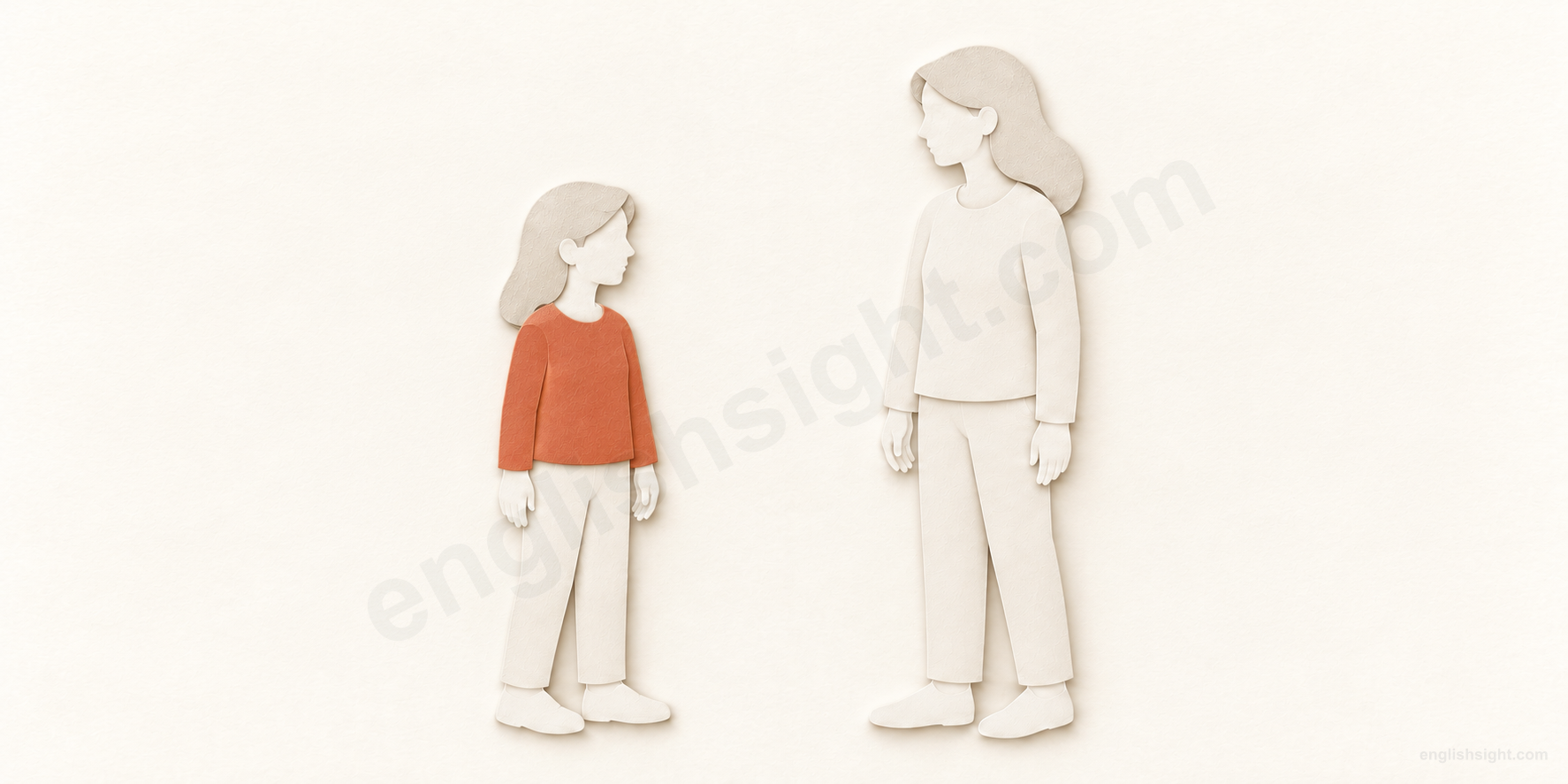
A girl is highlighted on the left.
girl
An adult woman stands on the right.
Compare a child with an adult, not a change over time.
Girl normally names a female child; the adult provides an age comparison. Height is only an age cue here, and appearance does not determine gender.
Girl normally identifies a female child; family relationships and familiar speech can extend the label beyond childhood.
The sketch compares a child with an adult. It shows a category contrast, not an action or a compulsory life path. It cannot explain every fixed compound.
Girl normally names a female child. Other familiar uses keep a family connection, an informal group identity, or a social label in view. These uses need context; they do not all describe someone below the same age.
Start with who is being talked about, then ask what the surrounding words add. This lesson offers a teaching connection, not a picture shared by every English speaker.
01
A person, an age, a family relationship
Start with the child meaning, then distinguish grammar, family membership, and references to adults.
01
a / the + (age or description) + girl; a girl of + age
a girl / a little girl
a female child
Context / speaker
A child joins a science club.
What is understood
You identify her and give her age.
Girl names a person; it does not describe what she can do.
Girl is a countable noun. A girl, the girl, and this girl can refer to one child; girls refers to more than one. A child can be a girl or a boy; child itself does not specify either.
Baby girl, little girl, and teenage girl add a stage of life. In a ten-year-old girl, the age phrase goes before the noun and year stays singular. A girl of ten gives the age after the noun. A schoolgirl is a girl who attends school; it is a separate compound, not a different plural of girl.
When I was a girl places the speaker in her childhood. The noun does not require a particular hairstyle, clothing, personality, or interest.
In a sentence
A ten-year-old girl built the tallest tower in our club.
Watch the difference Say She is a girl, with a determiner. She is girl is not a complete ordinary singular noun phrase.
02
girl → girls; the girl’s + noun; the girls’ + noun
girls / girl’s / girls’
distinguish number from possession
Context / speaker
Two girls arrive carrying bags.
What is understood
You say whose bag or bags you mean.
An apostrophe marks a relationship, not an ordinary plural.
Two girls are waiting uses plural girls and plural are. The girl’s bag belongs to one girl; the girls’ bags belong to more than one girl. The number of bags is a separate choice: two girls can share one bag.
In The girl’s waiting outside, ’s means is. In The girl’s bag is outside, ’s marks possession. Read what follows rather than treating every ’s as the same grammatical form.
In a sentence
The girls’ bags are beside the door.
Watch the difference Write two girls without an apostrophe. Do not write girls’s for the regular plural possessive.
03
my / our / their + girl; have + number + girls
our girl / two girls and a boy
a daughter in a family
Context / speaker
A parent describes the family.
What is understood
Girls is understood as daughters.
Family context supplies the parent–daughter relationship.
Our youngest girl means our youngest daughter in a family conversation. It need not mean she is still a child. Compare our youngest daughter, which makes the relationship explicit. It’s a girl! is also a familiar birth announcement.
Our girl is starting a new job this week can therefore refer to an adult daughter. Outside a family context, a possessive such as my does not by itself tell you whether the relationship is parental or romantic.
In a sentence
Our eldest girl has just moved into her own flat.
Watch the difference Girl does not mean daughter in every sentence; a girl at the bus stop may be unrelated to the speaker.
04
a young woman; the woman / colleague + identifying phrase
girl or woman?
girl can refer to a young woman, with social limits
Context / speaker
An adult customer asks for help.
What is understood
You choose a respectful description.
Woman is the neutral adult label; girl can make adulthood less visible.
You will hear girl used about a young adult. This may sound casual, affectionate, or patronizing, depending on the relationship and setting. It is not an exact legal age category.
For an adult in a formal introduction or workplace, use her name, woman, colleague, or an accurate job title. The woman at reception has my ticket avoids the possible belittling tone of the girl at reception.
In a sentence
The woman at reception helped me find the room.
Watch the difference Being unmarried does not make an adult a girl. Older dictionary wording is not a rule for choosing a respectful modern label.
02
Familiar speech and personal connections
Relationships and tone can change what girl communicates. Read the speaker, listener, and setting together.
05
meet / go out with + the girls; a girls’ night out
the girls / a girls’ night out
a familiar group of women friends
Context / speaker
A woman makes plans with close friends.
What is understood
The girls identifies the familiar group.
The group may consist entirely of adults.
The girls can refer informally to women who know one another. In I’m meeting the girls, the listener is expected to understand which group. It does not mean all girls everywhere.
A girls’ night out is an evening spent socializing with that female friendship group. This friendly in-group wording is different from an outsider calling adult colleagues the girls; their preferences and the context matter.
Hello, girls! is also a group address. With children it can be straightforward; with adult women it assumes familiarity that the speaker may not have.
In a sentence
I’m meeting the girls for dinner on Friday.
Watch the difference A night with the girls does not imply romantic partners. Use friends if the familiar label would be unwelcome.
06
someone’s girl; someone’s girlfriend
his girl / girlfriend
a romantic partner in a familiar expression
Context / speaker
Someone speaks about a romantic relationship.
What is understood
His girl may mean his girlfriend.
The relationship comes from context and established usage.
In some informal speech, his girl or my girl means a girlfriend. Oxford marks this use of girl as old-fashioned; Collins labels it informal. Learn to recognize it without assuming it is everyone’s preferred term.
Girlfriend is the clearer word for a female romantic partner: Maya brought her girlfriend to dinner. A girl I know does not itself imply romance. Girlfriend can also mean a female friend in some contexts, so even the longer word needs context.
In a sentence
Maya introduced us to her girlfriend after the concert.
Watch the difference My girl could mean my daughter in a family story. Do not infer romance from my alone.
07
Good girl!; request + there’s a good girl
Good girl! / There’s a good girl.
praise or encouragement directed at a child
Context / speaker
A small child finishes a helpful task.
What is understood
An adult praises or encourages her.
The whole utterance performs encouragement.
Good girl! can praise a child. There’s a good girl can encourage her to do something. In this formula, there’s does not simply announce that a girl exists somewhere.
Calling an adult good girl can sound as though you are treating her like a child. In ordinary adult interaction, Thank you or Well done is often a better fit. The phrase is also used to praise a female pet; that animal use is separate from the human child meaning.
In a sentence
Put your coat on, there’s a good girl.
Watch the difference The formula can praise or coax; it does not guarantee that the child has already done the requested action.
08
a + place / background + girl
a local girl / a city girl
a person described through where she comes from
Context / speaker
A woman talks about the place where she grew up.
What is understood
A place label expresses her background or identity.
The place description adds affiliation, not another childhood stage.
A local girl or a London girl can identify where someone is from. An adult may use such a label about herself affectionately: I’m a city girl at heart.
City girl and country girl can suggest familiarity with urban or rural life in context. These are descriptions, not facts about what every person from that background likes or can do. A woman from London is a neutral alternative.
In a sentence
Although I live by the sea now, I’m a city girl at heart.
Watch the difference Use this familiar style with care about other adults; birthplace and current home need not be the same.
03
Learn the complete combination
The other words identify a social image, a role, a music category, or an idea. These are not new meanings that girl predicts by itself.
09
the girl next door; a girl-next-door + image / role
the girl next door
a neighbor, or a familiar and unshowy social image
Context / speaker
A review describes a film character.
What is understood
The phrase describes a type rather than her address.
Distinguish actual location from an established character label.
Literally, the girl next door lives in the neighboring home: The girl next door lent me a bicycle. Next door supplies the location.
As a fixed description, the girl next door suggests a pleasant, respectable, ordinary type. Collins also notes a possible implication of dullness. A girl-next-door image can describe a performer’s public image without saying where she lives.
This is a cultural description someone applies, not a standard that girls or women should meet. The child-and-adult sketch does not predict this idiom.
In a sentence
In this film she plays the girl next door, not a glamorous celebrity.
Watch the difference Ask whether the context concerns a home or a public image; the same words can serve either purpose.
10
a flower girl; act as / be + the flower girl
a flower girl
a child with a flower-carrying role at a wedding
Context / speaker
A family plans a wedding ceremony.
What is understood
A young girl is given a particular role.
Flower identifies the role; she is not simply any girl holding a flower.
A flower girl carries flowers as part of a wedding. The expression names a ceremony role, not a family relationship: a niece, cousin, or family friend might have it.
Older stories also use flower girl for a young woman selling flowers in the street. A wedding scene and a street-selling scene therefore point to different meanings of the same compound.
In a sentence
My niece will be the flower girl at our wedding.
Watch the difference Do not assume a flower girl is the bride or that the expression always means a flower seller.
11
be chosen as head girl; the head girl
head girl
a senior pupil chosen to represent her school
Context / speaker
A British school chooses a pupil representative.
What is understood
The selected pupil has a school title.
Head signals a representative role, not a body part.
In some British schools, the head girl is a girl selected to represent the school for the year. This title is tied to a school system; not every school has the role.
She was chosen as head girl uses the role after as. The head girl welcomed the visitors uses the title to identify the pupil. Neither sentence makes her the adult in charge of the school.
In a sentence
The head girl welcomed the new pupils on their first day.
Watch the difference The head girl is a pupil; the head teacher or principal runs the school.
12
a girl band / girl group; two girl bands
a girl band / girl group
a pop group of young women
Context / speaker
A music program introduces a group.
What is understood
Girl modifies the kind of band.
The compound names a music category, even when members are adults.
Girl band and girl group are established names for a pop group of young women who sing and often dance. The word band does not require every member to play an instrument.
In two girl bands, bands carries the plural ending; girl remains the modifier. Compare the girls’ band, which describes a band associated with particular girls and is a different grammatical construction.
In a sentence
A new girl group will perform before the main act.
Watch the difference An established compound can contain girl without claiming that every member is a child.
13
girl power; celebrate / promote + girl power
girl power
confidence and independence for girls and women
Context / speaker
A speaker encourages young people to shape their own futures.
What is understood
Girl power expresses an idea of female independence.
Power here concerns agency and confidence, not physical force.
Girl power names the idea that girls and women can be confident, independent, and in control of their lives. It can appear as a slogan in music, media, or a discussion of opportunity.
Unlike a girl or two girls, girl power is an uncountable expression: The campaign celebrates girl power. Learn it as a whole; girl by itself does not mean independence.
In a sentence
The club’s poster celebrates girl power and encourages members to lead projects.
Watch the difference Do not add a to girl power when naming the general idea, or interpret it only as bodily strength.
Keep age, relationship, and register separate
Use a name or role when it is clearer
A person’s name or an accurate role often communicates more than a gender label. Girl is ordinary for a child; familiarity with adult friends does not make it suitable for every adult stranger or colleague.
Pronunciation and grammar
Girl is one syllable: /ɡɜːl/ in standard British pronunciation and /ɡɜːrl/ in standard American pronunciation. The plural is girls. This noun has no tense, passive, causative, or particle-verb family to memorize.
Older and specialist labels
Older texts may use girl for a female servant or worker, including racially derogatory uses. Recognize the historical context and use an accurate modern job title. Insults such as a big girl’s blouse use gender as a put-down; they are outside this lesson’s productive expressions.
Choose the meaning that fits
Use the situation and the whole phrase, rather than assuming every girl is a child.
1. You are writing a formal introduction for an adult researcher. Which wording is the safer neutral choice?
2. A parent says, “Our eldest girl is forty.” What does girl mean here?
3. Several girls own the bags. Which phrase expresses that relationship?
4. A reviewer describes a performer’s “girl-next-door image.” Must the performer live next to the reviewer?
Sources and teaching notes
Dictionary meanings and register labels were checked against the publisher pages below. Grammar notes also use British Council guidance. Explanations and examples are original; the visual comparison is a teaching aid.
The diagram supports a teaching comparison; it is not a shared mental picture or a way to determine gender.