Learn when glass names a substance, a drinking vessel, eyewear, or an established image.
Follow what the word refers to
Follow what the word refers to
Glass names a material.
glass
A glass of juice names a serving.
A glass names a drinking vessel.
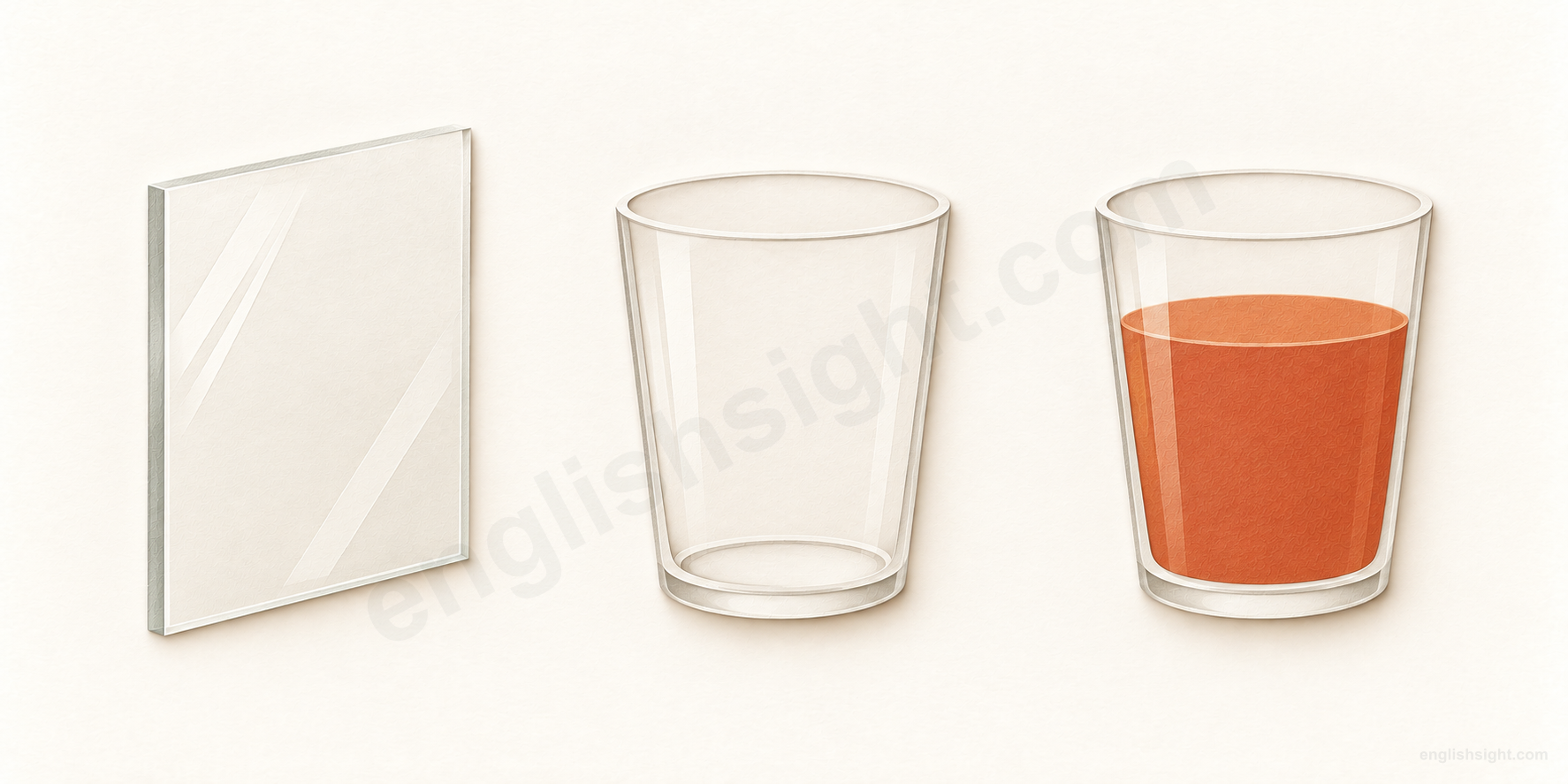
From material to vessel to serving: the reference changes, not the material’s physical form.
Glass can name a material; a glass can name a drinking vessel made from it; a glass of juice can name the serving it holds.
This connection explains a useful noun family. Eyewear and optical tools have conventional names, and the figurative expressions have established meanings. The model is not a manufacturing process or a rule for predicting every phrase.
Start with the hard material used in windows and vessels. English can use the material’s name for familiar objects made with it, and then use a drinking vessel’s name for what it holds.
Grammar does much of the work: glass, a glass, two glasses of water, and a pair of glasses point to different things. Fixed expressions add meanings that need their own context.
01
Material, pieces, and protective surfaces
Decide whether glass names a substance, an individual piece, a material used in an object, or a collection of objects.
01
be made of glass; some / broken / recycled glass
made of glass
name a hard material, often transparent
Situation
You are describing what a bowl is made of.
What glass refers to
The word identifies its material.
Material glass is uncountable.
In The bowl is made of glass, glass names a substance. Use glass without a or a plural ending in this meaning: some glass, recycled glass, or too much glass.
Clear windows are a useful starting point, but glass need not be colourless or easy to see through. Frosted, coloured, and opaque glass are still glass. Transparency alone does not define every object in the lesson.
The diagram links a material to a familiar object and then to a serving. That is a teaching connection between uses, not a rule that every use of glass means a transparent barrier.
In a sentence
This bowl is made of glass, so please handle it carefully.
Watch the difference A glass usually means a drinking vessel; it does not mean an unspecified amount of material.
02
a pane / sheet / piece / shard of glass; plural unit + of glass
a pane / piece of glass
count a sheet or fragment of the material
Situation
A window needs one new sheet, or a broken bottle has left fragments.
What glass refers to
A countable unit tells us how much or what shape.
The unit word is counted; material glass stays uncountable.
A pane of glass is a flat piece used in a window or door. A sheet of glass describes a flat piece more generally. A piece of glass can be a fragment of any shape; a shard is a sharp broken piece.
Say two panes of glass or several pieces of broken glass. Two glasses ordinarily suggests drinking vessels or servings, not two fragments. Broken glass can refer to the scattered material without counting it.
In a sentence
We need two panes of glass for the damaged window.
Watch the difference Do not count window pieces as two glasses.
03
glass + object noun
a glass bottle
identify the material before another noun
Situation
You choose between a glass bottle and a metal one.
What glass refers to
The noun bottle names the object; glass specifies its material.
Glass before a noun does not make the whole phrase mean a drinking glass.
In a glass bottle, glass is a material modifier and bottle is the main noun. The same pattern gives glass doors, a glass bowl, and a glass table. The plural ending belongs to the object noun: glass bottles.
Compare a glass, a glass bottle, and a bottle of water. They identify a drinking vessel, a bottle made of a particular material, and a bottle containing water. The words around glass determine which reference you intend.
In a sentence
She put the flowers in a glass jar.
Watch the difference Glass jars, not glasses jars; a glass jar is not a jar full of drinking glasses.
04
behind glass; see / look through the glass; the glass on + object
behind glass / through the glass
describe a glass barrier and what it lets you see
Situation
A museum object is enclosed, or you look out of a window.
What glass refers to
Glass is the material separating the spaces.
Behind gives position; through describes the line of sight.
The ring is behind glass locates it on the far side of a protective surface. We could see it through the glass says that our view passes through that surface. These are ordinary prepositional combinations, not phrasal verbs.
The glass can name the relevant pane or protective cover once the context identifies it. Break the glass on an alarm refers to its cover, not necessarily a drinking vessel. The definite article identifies a particular surface; it does not make glass a serving.
In a sentence
We could see the old map through the glass of the display case.
Watch the difference Behind glass does not mean invisible: a transparent barrier can prevent touching while allowing sight.
05
grow + plants + under glass; be grown under glass
grow plants under glass
grow plants in a glass-covered structure
Situation
Plants need a sheltered growing space.
What glass refers to
A greenhouse or similar enclosure provides it.
Under glass is an established growing expression.
In gardening, grow tomatoes under glass normally means grow them in a greenhouse or another glass-covered structure. It does not mean place loose glass directly on the plants.
Outside that gardening context, under glass may be literal, as when a drawing is displayed under a glass cover. Read the activity and object before choosing the interpretation.
In a sentence
We grow the early tomatoes under glass.
Watch the difference The gardening expression names a kind of growing environment, not the material of the plant.
06
collect glass; a collection of glass; stained glass; a stained-glass window
a collection of glass / stained glass
refer collectively to glass objects or to decorative glass
Situation
You describe a collection or a church window.
What glass refers to
Glass names objects collectively or a kind of material.
Collective glass is uncountable; individual drinking vessels are glasses.
In a collection of antique glass, glass collectively names objects made of the material. Glassware is another useful word for such objects. To count particular objects, name them: three bowls or four glasses.
Stained glass is coloured glass arranged into pictures or designs, especially in windows. A stained-glass window is one window made with that material. The fixed expression does not simply mean a dirty window.
Compare We collect old glass with We washed the glasses. The first describes a category of objects; the second picks out countable drinking vessels in an ordinary kitchen context.
In a sentence
The small museum has a collection of coloured glass.
Watch the difference Use a stained-glass window to count a window, rather than a stained glass for an ordinary individual window.
02
The vessel, the serving, and the toast
A glass is countable as a drinking vessel. With of, the same word can measure a serving; in a toast, the whole expression carries a social meaning.
07
a / the / my glass; number + glasses; fill a glass with + liquid
a glass / two glasses
name a drinking vessel
Situation
People need containers for their drinks.
What glass refers to
You count the vessels on the table.
A glass is a countable object, normally without a handle.
A glass is a drinking vessel; its shape can vary. One glass becomes two glasses. Ask Could I have a clean glass? when you need the container, even before any drink is poured.
A cup or mug has a different familiar shape, often with a handle, and may itself be made of glass. Compare a glass cup, where glass names the material, with a glass, where the word names the vessel.
Glasses is also the word for eyewear. The surrounding action usually resolves the ambiguity: wash the drinking glasses, but put on your glasses to read.
In a sentence
Please put three clean glasses on the table.
Watch the difference Do not choose glass solely because a container is transparent; a glass bottle is still a bottle.
08
a glass of + drink; number + glasses of + drink
a glass of water
name or count an amount held in a drinking glass
Situation
You order a drink or describe how much you drank.
What glass refers to
The container word measures a serving.
Of introduces the drink; glass supplies the serving unit.
A glass of water can mean the filled vessel or its contents, depending on the action. Carry a glass of water refers to the vessel with the drink; drink a glass of water refers to consuming the water.
The number counts servings: two glasses of juice. The liquid normally stays uncountable in this pattern. A glass is not a fixed scientific volume; different glass sizes hold different amounts.
Compare a water glass, a kind of vessel, with a glass of water, a vessel or serving containing water. A glass of wine identifies its contents, while a wine glass identifies a vessel designed for wine.
In a sentence
After the walk, Leo drank two glasses of water.
Watch the difference Drank two glasses does not mean he swallowed the containers.
A type name does not tell you what is currently inside.
Wine glass, beer glass, champagne glass, and shot glass are countable compound nouns. The first part tells us the intended drink or serving type. A wine glass is often stemmed; a shot glass is small.
The head noun carries the plural: two wine glasses. The vessel can be empty or contain something else, so She drank water from a wine glass is entirely possible. A pint glass names a size/type, not a guarantee that it is full.
In a sentence
The children drank juice from small glasses, and I used a wine glass for my water.
Watch the difference A wine glass is not automatically a glass of wine.
10
raise your glass / a glass to + person or occasion
raise your glass to someone
invite a toast or express good wishes
Situation
A group celebrates someone’s achievement.
What glass refers to
People lift their drinks to honour the person.
The whole expression gives the gesture its social purpose.
Raise your glass to someone means lift your drink as part of a toast: you express good wishes or honour the person. To introduces the person or thing being celebrated, not a physical destination for the glass.
Raise a glass to the new team is a similar invitation. Compare raise the glass to your lips, which describes ordinary physical movement for drinking. Raising the vessel does not by itself always mean a toast.
In a sentence
Let’s raise a glass to the volunteers who made today possible.
Watch the difference To the volunteers names the people being honoured; you do not have to hand them your glass.
03
Things you look through
Learn glasses as a plural object name and magnifying glass as a separate countable compound. These are conventional names, not promises about the material of every modern lens.
11
wear / put on / take off glasses; a pair of glasses; glasses are
wear glasses / a pair of glasses
name the framed lenses worn over the eyes
Situation
Small print is difficult to read.
What glass refers to
Someone puts on reading glasses.
Eyewear glasses is grammatically plural even for one wearable item.
Glasses names the framed lenses used to improve sight or protect the eyes. Say My glasses are on the desk and I wear glasses for reading. Eyeglasses is an alternative, especially in North American English; spectacles is more formal or old-fashioned. Specs is an informal alternative, especially in British English: I can’t find my specs.
Use a pair of glasses to count one complete item: This pair is new, but These glasses are new. Two pairs of glasses counts two complete items. A glass normally means a drinking vessel, not one complete pair of eyewear.
Put on describes starting to wear them; take off describes removing them; wear describes having them on. Reading glasses and sunglasses are familiar types. Modern glasses can have plastic lenses: the object name does not certify its material.
In a sentence
My reading glasses are beside the lamp.
Watch the difference Use Where are my glasses?, not Where is my glasses? A pair of glasses takes singular agreement when pair is the subject.
12
a magnifying glass; look through / examine under a magnifying glass
a magnifying glass
name a handheld lens that makes details look larger
Situation
Tiny lettering is hard to examine.
What glass refers to
You look through a magnifier to see enlarged detail.
This compound names one instrument and is countable.
A magnifying glass is a lens, usually with a handle, used to make things appear larger. Look through a magnifying glass or examine something under one are natural patterns.
Unlike glasses for eyesight, a magnifying glass is singular with a and pluralizes as magnifying glasses. Magnifying tells us its function; it is not a drinking glass that becomes larger.
This belongs to the optical-object branch of glass. It shares a historical material connection with other glass objects, but the complete name identifies a particular instrument.
In a sentence
Nora used a magnifying glass to examine the tiny numbers on the coin.
Watch the difference Do not replace the compound with a glass in an ordinary modern request; listeners may bring a drinking vessel.
04
Established images in conversation
A partly filled glass, a transparent ceiling, fragile houses, and coloured lenses support different familiar expressions. Learn each meaning with its complete wording.
13
the glass is half-full / half-empty; a glass-half-full person
the glass is half-full / half-empty
describe a positive or negative outlook
Situation
The same situation contains gains and losses.
What glass refers to
One person stresses what remains; another stresses what is missing.
The amount can stay the same while the viewpoint changes.
The glass is half-full describes an outlook that emphasizes the good side of a situation. The glass is half-empty emphasizes the bad side. Literally, both can describe the same amount of liquid.
In the figurative expression, the glass stands for the situation and the chosen description stands for an attitude. A glass-half-full person is an optimist in this comparison. This is an established metaphor, not a new material meaning of glass.
Compare literal measurement: The glass is half full; add more water. Context about attitudes or opportunities signals the figurative use.
In a sentence
We lost one client, but Sam still sees the glass as half-full because two others have joined.
Watch the difference The phrase describes an outlook, not proof that the situation is objectively good or bad.
14
hit / break / shatter the glass ceiling
hit / break the glass ceiling
describe an unofficial barrier to advancement
Situation
A capable group faces unfair obstacles to senior positions.
What glass refers to
Their progress is blocked, or someone overcomes the barrier.
The ceiling limits advancement despite the absence of a formal ban.
A glass ceiling is a barrier caused by unfair attitudes or practices that stops women or other groups reaching senior roles. The image suggests a barrier that is less obvious than an official rule.
Hit the glass ceiling means encounter that limit; break or shatter the glass ceiling means overcome it. In workplace discussion, this normally concerns unequal access to advancement, not simply any personal difficulty.
The glass barrier is a teaching image. It does not mean an actual ceiling must be transparent, and the expression’s social meaning must be learned as a whole.
In a sentence
The report asks why qualified women still hit a glass ceiling in senior management.
Watch the difference A literal glass ceiling in a building is possible; career context establishes the metaphor.
15
people (who live) in glass houses shouldn’t throw stones
people in glass houses shouldn’t throw stones
warn against criticism that invites similar criticism
Situation
Someone attacks another person for a fault they also have.
What glass refers to
You point out that their criticism exposes their own weakness.
The proverb warns the critic to consider their own vulnerability.
The saying People who live in glass houses shouldn’t throw stones warns against criticizing others when you are open to criticism yourself. Fragile glass houses provide the image; the usual conversational point is about behaviour and judgment.
People in glass houses shouldn’t throw stones is a shorter familiar form. You may also hear the opening People in glass houses… as an allusion, but the full proverb is the safest form to learn.
The meaning belongs to the complete saying. It is not a general instruction about throwing objects, nor a claim that criticism is never justified.
In a sentence
“You were late too,” Mina said. “People in glass houses shouldn’t throw stones.”
Watch the difference Use the proverb when the speaker’s own vulnerability is relevant; it does not mean every disagreement is hypocrisy.
16
see / view / look at + something + through rose-tinted glasses
see things through rose-tinted glasses
view something as better than it really is
Situation
Someone remembers only the pleasant parts of a difficult period.
What glass refers to
Their picture of the past becomes unrealistically positive.
Imaginary coloured lenses represent a biased viewpoint.
Look at or see something through rose-tinted glasses means view it too positively. Rose-coloured glasses and rose-coloured spectacles are related forms; American spelling has colored.
The lenses are a metaphor for the observer’s interpretation. No actual eyewear is required. The phrase often challenges idealized memories, but can also describe an overly positive view of the present.
Compare glass-half-full: that expression emphasizes a positive outlook. Rose-tinted glasses more specifically suggests that the outlook makes things seem better than they really are.
In a sentence
We may be remembering our first office through rose-tinted glasses; it was noisy and cramped.
Watch the difference The phrase usually implies distortion, not simply good eyesight or a cheerful mood.
05
Enclosing an area with glass
Glass can also be a verb. This building-related use is narrower than the ordinary noun and often appears in passive descriptions.
17
glass + area + in / over; be glassed in / over; a glassed-in + area
glass something in / over
fit glass around or over an area
Situation
An outdoor or open area needs an enclosure.
What glass refers to
Glass walls or a glass roof enclose or cover it.
Here glass is a verb; in and over describe enclosure or covering.
Glass something in or over means enclose it with glass walls or cover it with a glass roof. The construction is often passive: The pool was glassed in. A glassed-in porch describes the resulting enclosed space.
The forms are glass, glasses, glassed, and glassing. With an active pronoun object, place it before the particle: They glassed it in. The object is the area being enclosed, not the glass material being moved.
This is a building-related extension from the material noun. Do not infer that every glass verb is harmless construction work: in informal British reports, glass someone has a separate violent meaning, attacking someone with a glass or bottle. That use is a recognition note, not the building pattern.
In a sentence
The old courtyard was glassed over to create an indoor café.
Watch the difference Read the object and particle: glass someone and glass a courtyard over have different meanings.
Read the whole expression
Count the right thing
Material glass and collective glass are uncountable. Drinking vessels and servings are countable. Eyewear glasses is plural, while a pair of glasses has singular pair as its head.
Pronunciation and forms
Common pronunciations are /ɡlɑːs/ in British English and /ɡlæs/ in American English, with regional variation. Plural glasses adds a syllable: /ˈɡlɑːsɪz/ or /ˈɡlæsɪz/. The verb has glassed and glassing.
The object name can outlive the material
Glasses can have plastic lenses. A glass cup is a cup made of glass, whereas a glass is normally a drinking vessel of the conventional glass shape. Do not treat the diagram as a test of every object’s physical composition.
Scope and older uses
Older writing may use a glass for a mirror or the glass for a barometer; these are recognition notes here. Specialist optical, geological, sporting, and slang senses are not expanded. The violent British verb is noted separately from glass in/over. The normal expression for an unfocused, bored look is eyes glaze over; keep glaze distinct from this lesson’s construction verb.
Choose what glass means
Use countability, neighbouring words, and the situation to identify the reference.
1. You need to describe a bowl’s material. Which sentence fits?
2. A window needs two new flat pieces. Which request is clear?
3. “She drank two glasses of juice.” What did she consume?
4. You are looking for the one pair you wear to read. Which question is standard?
5. Does “a wine glass” tell you that wine is currently inside?
6. Someone idealizes an old job and forgets its serious problems. Which expression suggests this distortion?
Sources and teaching notes
Dictionary entries and usage notes support the uses below. Explanations and examples are original; the diagram is a teaching connection between related noun uses.
The diagram links a material, a vessel, and its contents. It is a teaching aid, not a picture shared by every native speaker.