From everyday hand coverings to close fit, careful treatment, and stronger conflict.
A hand and its covering
A hand and its fitted covering
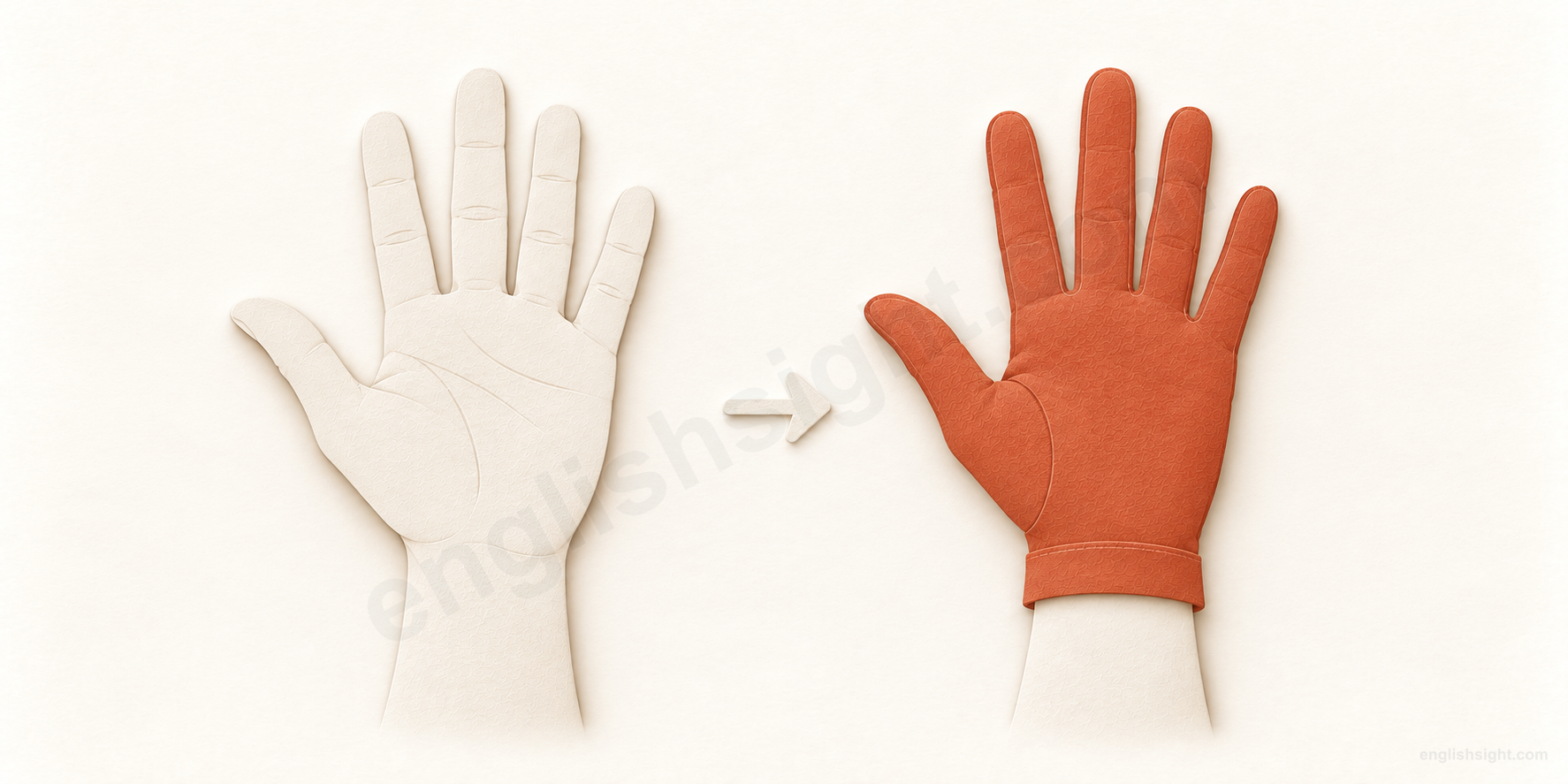
The hand is bare.
glove
The same hand wears a glove with separate finger sections and a wrist cuff.
A fitted covering is added around the hand.
The glove fits around the hand, covering its fingers, thumb, and wrist.
A glove is a covering worn over a hand, usually shaped around its separate fingers, for warmth, protection, or a particular task.
The picture shows an ordinary fingered glove. Sports and oven gloves can have different shapes; figurative expressions select fit, gentleness, or restraint rather than all sharing one meaning.
Glove /ɡlʌv/ is chiefly a countable noun: one glove, two gloves. Begin with a covering worn over a hand, then notice how a modifier, an action verb, or a fixed expression changes what the speaker communicates.
The hand-and-covering relationship helps connect some uses. The idioms still need to be learned as expressions; this teaching model is not a claim about a picture shared by all native speakers.
01
Covering, counting, and wearing
Start with the hand covering. Then use number, action verbs, and material or purpose words to say exactly what you need.
01
a glove; gloves; adjective / material + glove(s)
a glove / gloves
a covering worn over a hand
Situation / starting point
Your hands feel cold outside.
Meaning / result
You choose something to cover them.
The glove fits around the hand; it is a separate object from the hand.
A glove is a hand covering. An ordinary glove has individual spaces for the fingers and thumb, so the covered fingers can still move separately. Winter gloves and leather gloves are examples, not separate meanings of the noun.
A mitten keeps the four fingers together with a separate space for the thumb. Glove can also be a wider category: some special gloves do not have the ordinary five-part shape. Fingerless gloves leave part of the fingers exposed.
In a sentence
I left one woollen glove on the bus.
Watch the difference A glove covers a hand; a sleeve covers an arm. Do not assume every item called a glove has separate covered fingertips.
02
a glove; two gloves; a pair of gloves; two pairs of gloves
a pair of gloves
two gloves forming a matching set
Situation / starting point
You are buying coverings for both hands.
Meaning / result
You ask for one pair, containing two gloves.
Glove is countable; pair counts the set.
One glove covers one hand. Two gloves can form a pair. Unlike trousers, glove is not a plural-only noun: I lost a glove is ordinary English.
Use a pair of gloves for one set and two pairs of gloves for two sets. In standard agreement, This pair is mine counts one pair; These gloves are mine counts the individual items.
In a sentence
This pair of gloves is too small for me.
Watch the difference Use gloves after a pair of, not a pair of glove. A single lost item is a glove, not a gloves.
03
put on / wear / take off + gloves; put them on; take them off
put on / wear / take off gloves
distinguish getting dressed, being dressed, and removing clothing
Situation / starting point
Your gloves are beside you.
Meaning / result
You put them on, wear them outside, and take them off indoors.
The action verb supplies the stage; glove still names the clothing.
Put on your gloves describes moving them onto your hands. Wear gloves describes having them on. Take off your gloves describes removing them. Pull on and pull off emphasize the physical pulling; peel off suggests drawing a close-fitting glove away.
With pronouns, say put them on and take them off. With a noun, both put your gloves on and put on your gloves work. These are constructions with put and take, not phrasal verbs formed from glove.
In a sentence
I put my gloves on before I went out, and I wore them all morning.
Watch the difference Wear describes the state; put on describes the change. Say Take them off, not Take off them.
04
material + glove(s); gardening / protective + gloves
rubber / gardening / protective gloves
specify a material or a job for the covering
Situation / starting point
You are choosing equipment for a task.
Meaning / result
You name the type of glove needed.
A modifier tells us what the gloves are made of or what they are for.
Rubber, latex, leather, and cotton name materials. Gardening gloves and protective gloves identify purpose. A material word does not itself specify every use: latex gloves and thick gardening gloves need not do the same job.
The noun after a material modifier remains countable: a rubber glove, rubber gloves. In a purpose compound such as gardening gloves, the first part classifies the gloves; it is not a verb saying that the gloves themselves garden.
In a sentence
I bought gardening gloves for working among the rose bushes.
Watch the difference Use gardening gloves for the type, not gardens gloves. A named material and a named purpose convey different information.
05
an oven glove / mitt; oven gloves / mitts
an oven glove / an oven mitt
a thick hand covering for handling hot oven dishes
Situation / starting point
A baking dish has just come out of the oven.
Meaning / result
You use a thick covering to hold it.
The compound names a heat-protective kitchen item.
An oven glove is a thick covering used when holding hot dishes. Oven mitt is another name. Its shape may keep the fingers together, so the compound does not promise five separate finger sections.
You can ask Where is the oven glove? for one item or Where are the oven gloves? for several. The word oven identifies the use; it does not mean a glove kept permanently inside the oven.
In a sentence
She used an oven glove to lift the hot dish.
Watch the difference An ordinary winter glove is not what the expression oven glove names. Do not infer equipment suitability from glove alone.
06
a gloved hand; glove + object; gloved / gloving
a gloved hand
a hand with a glove on it
Situation / starting point
A hand is covered before handling an object.
Meaning / result
You describe the hand as gloved.
Gloved describes the covered state, rather than naming another kind of hand.
In a gloved hand, gloved is a participial adjective meaning that a glove is being worn. Compare a leather glove, which describes the covering itself, with a gloved hand, which describes the hand.
The transitive verb glove also means to cover or provide with gloves: to glove one’s hands. This is more specialized wording than the everyday put on gloves. Forms are glove, gloves, gloved, gloving; the final e drops before -ing.
In a sentence
He picked up the small tool with a gloved hand.
Watch the difference Gloved means wearing or covered by a glove. A glove hand is not the normal replacement for a gloved hand.
02
Gloves in sport
Sports give the covering a particular shape and job. In baseball, glove can also name a catching action or describe fielding ability.
07
a baseball / boxing glove; baseball / boxing gloves; a good glove
a baseball glove / boxing gloves
special hand equipment for catching or boxing
Situation / starting point
Players prepare different equipment for different sports.
Meaning / result
The modifier identifies the glove’s role.
Sports gloves are shaped for their task, rather than all looking like winter gloves.
A baseball glove is worn on a hand to catch a ball. Boxing gloves are padded hand coverings used in boxing. The surrounding sport may make the modifier unnecessary: Bring your glove can mean a baseball glove at practice.
In baseball commentary, a good glove can also refer to a player’s fielding ability. A coach praising someone’s glove may be praising defensive skill, not the quality of the equipment. This is a sports use, not a general meaning of skill in every activity.
In an informal boxing context, put on the gloves can mean engage in boxing: The two friends put on the gloves for a practice bout. Here the equipment stands for taking part in the sport; ordinary put on your winter gloves only describes getting dressed.
In a sentence
Maya brought her baseball glove to practice.
Watch the difference Do not assume the same design or purpose for boxing and baseball gloves. In sports reports, check whether glove names equipment or fielding ability.
08
glove + ball; gloved; gloving
glove the ball
catch a ball with a gloved hand
Situation / starting point
A baseball comes toward a fielder.
Meaning / result
The fielder catches it in the glove.
Here glove is the verb, and the ball is its object.
The verb glove can describe catching something, especially a baseball, with a gloved hand. The noun becomes a verb connected with using that piece of equipment.
The fielder gloved the ball reports a catching action. The fielder wore a glove only describes what the fielder had on. Outside sports writing or commentary, caught the ball is often the simpler way to report the action.
In a sentence
The fielder gloved the ball near the fence.
Watch the difference In this sentence the ball is caught, not dressed in a glove. Context separates the catching verb from the covering verb.
03
Fit, care, cooperation, and conflict
These established expressions select different aspects of gloves. Learn the whole phrase: the hand-covering picture alone cannot predict its meaning.
09
something + fits + (someone) + like a glove
fit like a glove
fit exactly or be especially well suited
Situation / starting point
You try on a jacket in your size.
Meaning / result
It fits you exceptionally well.
The expression compares the fit, even when the item is not a glove.
A jacket that fits like a glove has just the right size and shape. The close relationship between a hand and its fitted covering makes a useful comparison.
The expression can also describe suitability: The new role fits her like a glove says the role suits her very well. The subject is the thing that fits; the person may be an object after fit or may be understood. Like introduces the comparison.
In a sentence
This jacket fits me like a glove.
Watch the difference Like a glove is the fixed singular comparison, even with a plural subject: These boots fit like a glove. It does not say that the clothes are literally gloves.
10
handle / treat + someone or something + with kid gloves
handle / treat someone with kid gloves
deal with someone or something very gently or tactfully
Situation / starting point
You need to discuss a sensitive mistake.
Meaning / result
You choose your words with exceptional care.
The whole phrase describes careful treatment, not putting clothing on somebody.
Handle someone with kid gloves means treat them with great tact or gentleness, often to avoid upsetting them. A delicate subject or situation can also receive this treatment. Kid here refers to soft leather from a young goat, not gloves for children.
Keep the plural gloves in with kid gloves. The related noun phrase the kid-glove treatment names the same careful approach. Taking off the kid gloves can express abandoning that gentleness; read it in context rather than as an instruction about clothes.
In a sentence
We need to handle this disagreement with kid gloves.
Watch the difference The phrase can imply unusually delicate treatment; it is stronger than simply being polite. Do not interpret kid as child in this expression.
11
the gloves are off; the gloves come off; with the gloves off
the gloves are off
a dispute is becoming openly aggressive
Situation / starting point
Two rivals have avoided direct personal attacks.
Meaning / result
They begin attacking each other without that restraint.
Removing the metaphorical gloves signals a tougher confrontation.
The gloves are off means that someone is ready for a serious fight or argument. The gloves came off marks a change; with the gloves off describes the aggressive manner of a dispute.
This is a figurative conflict expression. It does not require an actual boxing match, actual gloves, or physical violence. Compare He took his gloves off to answer the phone, where the gloves are ordinary clothing and the action need not signal hostility.
In a sentence
After the accusation, the gloves came off in the debate.
Watch the difference Taking gloves off can be literal. Only context establishes the aggressive figurative meaning.
12
work / be + hand in glove + with someone
work hand in glove with someone
work in very close association
Situation / starting point
Two people coordinate their actions.
Meaning / result
Their cooperation is described as exceptionally close.
The hand and its covering suggest a close working relationship.
Work hand in glove with someone describes close cooperation. Be hand in glove with someone describes the association as a state. With introduces the partner, not an object physically inside a glove.
Oxford emphasizes the frequent suggestion of secret or illegal cooperation, while Collins also gives a broader close-cooperation definition. Do not assume illegality in every context, but notice that the expression can sound suspicious. Work closely with is a plainer neutral alternative.
In a sentence
The report claimed that the officials worked hand in glove with the smugglers.
Watch the difference This is not the same phrase as hand in hand. Keep hand and glove singular in hand in glove.
13
an iron fist / hand + in a velvet glove
an iron fist in a velvet glove
strict control presented in a gentle manner
Situation / starting point
A leader speaks pleasantly.
Meaning / result
The underlying decisions remain severe and uncompromising.
The soft outer appearance contrasts with the hard control inside.
An iron fist in a velvet glove describes firm or harsh control beneath a gentle appearance. Hand can replace fist in the expression. The contrast between hard iron and soft velvet matters more than any particular pair of gloves.
Calling an approach a velvet glove alone may emphasize its gentle presentation, but the full expression keeps both layers in view. A pleasant tone does not necessarily mean the authority behind it is weak.
In a sentence
Behind her gentle words was an iron fist in a velvet glove.
Watch the difference This describes a contrast between manner and power; it does not simply mean kindness or careful treatment.
14
hang up + possessive + (boxing) gloves
hang up your gloves
retire from boxing or, by extension, an activity
Situation / starting point
A boxer decides that this season will be the last.
Meaning / result
The boxer ends their competing career.
Putting the equipment aside stands for leaving the activity.
To hang up your gloves can mean to stop boxing. In the retirement pattern hang up one’s equipment, the equipment stands for the activity it belongs to; similar expressions use boots or a musical instrument.
It can be extended playfully to other work, but the context must identify that work. Hanging gloves on a hook after today’s training is only a literal action and does not by itself mean retirement. This is an expression with hang up, not a phrasal verb headed by glove.
In a sentence
After her final match, the champion decided to hang up her gloves.
Watch the difference Do not confuse ending a career with merely removing gloves or putting them away after one session.
04
Related objects and services
In compound expressions, identify the final noun or the complete adjective. Not everything containing glove is an item of clothing.
15
in the glove compartment / glovebox; glove compartments
the glove compartment / glovebox
a small storage space at the front of a car
Situation / starting point
You need the car’s small storage compartment.
Meaning / result
You name it without saying what it contains.
The whole compound names part of a car, not a kind of glove.
A glove compartment, also called a glovebox or glove box, is a small storage space facing the front seats of a car. It may hold maps, glasses, or other small things; it does not have to contain gloves.
Compartment is the head noun: one glove compartment, two glove compartments. Keep glove singular as the modifier. In the glove compartment describes the location of something inside that space.
In a sentence
The parking card is in the glove compartment.
Watch the difference Gloves compartment is not the standard compound. Its contents do not have to match the word glove.
16
a glove puppet / hand puppet; glove puppets
a glove puppet
a puppet worn over and moved by a hand
Situation / starting point
You put your hand inside a small puppet.
Meaning / result
Your fingers move the puppet.
The puppet covers the hand and uses its movements.
Glove puppet is a British English term for a puppet that fits over the hand and is moved with the fingers. Hand puppet is especially used in North American English.
The connection with a glove is the hand-inside-covering arrangement. Puppet is the head noun, so the plural is glove puppets. This is a toy or performance object, not another material for making gloves.
In a sentence
The teacher used a glove puppet to tell the story.
Watch the difference A glove puppet is moved from inside by the hand; the term does not simply mean a puppet wearing gloves.
17
white-glove + service / delivery
white-glove service
service marked by unusually careful attention
Situation / starting point
A company describes how carefully it handles customers’ needs.
Meaning / result
It advertises special attention to details.
White-glove is a compound adjective about the standard of care.
White-glove describes especially careful, attentive service. In white-glove delivery, for example, the phrase presents the handling as unusually meticulous. It does not guarantee a universal checklist of services.
Compare white gloves, which names gloves that are white, with white-glove service, which describes service. The hyphen connects the words as a compound adjective before the noun; glove remains singular.
In a sentence
The shop offers white-glove delivery for its furniture.
Watch the difference The staff need not literally wear white gloves. Read the provider’s description to know what the service includes.
Keep the covering, the action, and the expression apart
Number and pronunciation
Glove /ɡlʌv/ rhymes with love, not with move. It is countable; gloves ends in /vz/. A pair of gloves is one set containing two gloves.
The diagram has limits
The sketch illustrates an ordinary fitted hand covering. It does not mean all gloves have identical shapes or uses, and it cannot predict every idiom containing glove.
Grammar belongs to the whole construction
Put on gloves uses the verb put; hand in glove and with kid gloves are fixed expressions. The less general verb glove can take an object for covering or catching. Its passive is possible, especially when hands are described as gloved; there is no need to invent a family of glove-plus-particle verbs.
Scope of this lesson
The lesson includes everyday clothing, familiar compounds and idioms, and marked sports uses for recognition. Historical challenge expressions such as throw down the glove, detailed technical compounds, and specialist slang are not developed here.
Choose what the whole expression means
Use the situation, grammar, and surrounding words to decide.
1. You need a matching covering for each hand. Which request clearly asks for one set?
2. The gloves stayed on your hands for the entire walk. Which sentence describes that state?
3. A colleague is upset, so you must discuss the problem very tactfully. Which expression fits?
4. A new role suits Ana exceptionally well. Which sentence expresses that suitability?
5. A report says, “The fielder gloved the ball.” What happened?
6. A parking card is in the glove compartment. What does that tell you?
Sources and teaching notes
Dictionary headwords and related entries below support the usage inventory. Explanations and examples are original; the diagram is a teaching interpretation of the hand-covering relationship.
The diagram explains a useful relationship; it does not represent an image shared by every native speaker.