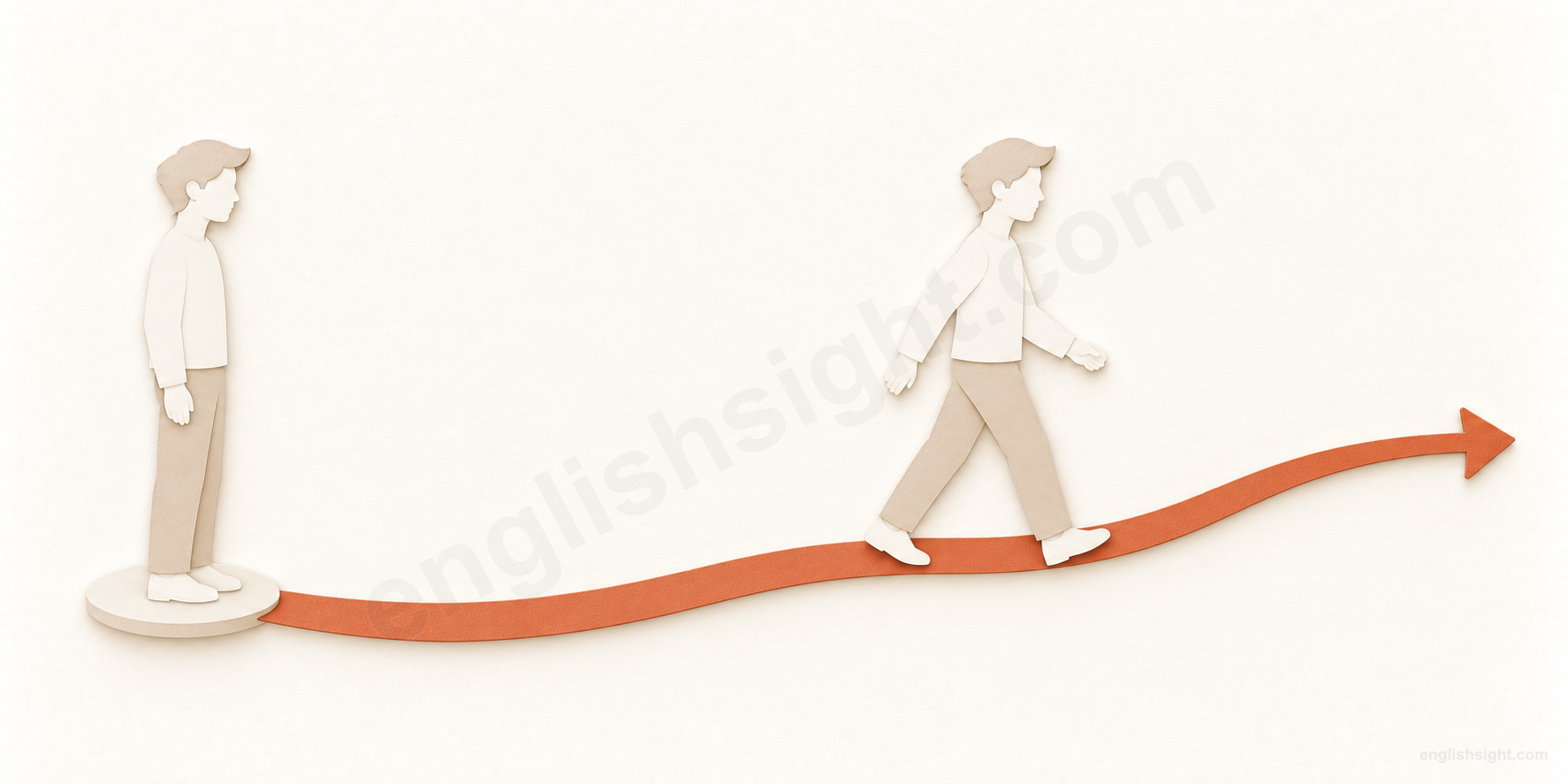
Use go for movement, unfolding events, and familiar changes of state.
Follow the course
Follow the course
At a reference point
go
Further along; the course continues
Leave the starting point and follow a course.
The same person is shown before and later. The path links movement with development; it does not promise arrival.
A starting point, a direction, and an unfolding course: useful connections between travel, progress, and changes.
Go need not imply arrival or successful completion. Some uses describe a continuing state, a relationship, or conventional wording rather than movement.
Go often presents movement away from a reference point or development along a course. Ask what moves or develops, and read the words that follow.
The path in this lesson is a memory aid, not a picture shared by every native speaker. Matching, quoting, and fixed expressions also have established meanings that a path cannot predict.
01
Journeys, purposes, and forms
Start with physical movement, then distinguish purpose, routine attendance, and completed visits.
01
go + to + place; go + home / there; go by + transport; go + distance / manner
go to London / go home
move or travel
Situation
We are at home.
Development / interpretation
We travel toward the station.
Go describes travel, not necessarily arrival.
Go by bus names transport; go on foot means walk. Go commonly points away from the speaker's reference place; come points toward it. Direction depends on the viewpoint.
Go faster describes how something moves; We went ten miles gives a distance. In The tray went flying, flying describes sudden movement, not a leisure outing.
In a sentence
We go to the station by bus.
Watch the difference Say go home, not go to home; get to emphasizes reaching.
02
go; be going; need to go
I must go.
leave a place
Situation
The visit is ending.
Development / interpretation
The speaker leaves.
No destination has to be stated.
I must be going is a polite departure signal. In informal family conversation, I need to go can also mean use the toilet; the situation supplies that reading.
In a sentence
It's late, so I must go.
Watch the difference Go does not itself mean leave something behind; that needs more words.
03
go to + verb; go and + verb
go to see / go and see
move in order to act
Situation
The door needs checking.
Development / interpretation
I go to check it.
The next verb supplies the purpose.
Go to check expresses purpose; go and check is common in speech. Go check is especially North American. Don't go telling everyone warns against an action; it need not involve travel.
Go and do can also express annoyance rather than purpose: Why did you go and tell everyone? criticizes the decision to tell them; it need not mean going somewhere first.
In a sentence
I'll go and check the door.
Watch the difference For past purpose use went to check or went and checked, not went check.
04
go to + institution / event; go on + website
go to school / work
attend or visit
Situation
Maya is a pupil.
Development / interpretation
School is part of her routine.
Attendance is more than a single trip.
Go to school concerns education; go to the school can mean visit the building. Go to work, go to a party, and go on a website keep their own prepositions.
In a sentence
Maya goes to school near the river.
Watch the difference British go to hospital contrasts with usual American go to the hospital.
05
go + activity in -ing; go for + a + activity noun
go swimming / go for a walk
take part in a leisure activity
Situation
Lunch is over.
Development / interpretation
We take a swim.
The activity names the outing.
Go shopping and go swimming are established activity combinations. Go for a swim or a walk uses a noun instead. Go on a trip names a journey; on is not interchangeable with for.
In a sentence
We went swimming after lunch.
Watch the difference Not every activity permits go + -ing: normally do homework, not go homeworking.
06
go + direction / location
Where does this road go?
extend toward or belong in a place
Situation
You inspect a map.
Development / interpretation
You identify the road's endpoint.
The subject need not physically move.
The road goes to the harbour describes its route. These cups go here identifies their proper place. A message goes to all staff is sent to those recipients.
In a sentence
This road goes to the harbour.
Watch the difference Where does it go? can ask about a route or storage; check the subject.
07
go – goes – went – gone – going; have been to / have gone to
went / gone / been
distinguish a past journey from absence
Situation
Ana visited Rome.
Development / interpretation
She has returned.
Been to normally presents a completed visit.
Ana has gone to Rome normally places her there or on the way, not back home. Went gives a past event. Gone is the ordinary participle; been serves the visit-and-return pattern.
In a sentence
Ana has been to Rome, but she's home now.
Watch the difference Use did you go, not did you went; gone, not went, follows have.
02
States, operation, and the future
A complement can name a change, a continuing condition, or a future event without a physical journey.
08
go + adjective
go quiet / go bad
become a different condition
Situation
People are talking.
Development / interpretation
The room becomes quiet.
An adjective describes the subject's new state.
Go often combines with unwelcome changes: food goes bad, a firm goes bankrupt. Colours and quiet are possible too. It is not a universal substitute for become; learn the pairing.
In a sentence
The room went quiet when Sam entered.
Watch the difference Say go quiet, not go quietly for this change; go wrong means develop a problem.
09
go to / into / on / out of + state expression
go to sleep / go on strike
enter or leave an established state
Situation
The baby is awake.
Development / interpretation
The baby starts sleeping.
The preposition belongs to the full expression.
Go to bed concerns bed; go to sleep concerns sleeping. Go into effect means become operative; go on strike means start a strike; go out of business means cease trading.
In a sentence
The baby went to sleep in my arms.
Watch the difference These state expressions cannot freely exchange to, on, and into.
10
go + adjective / negative participle
go hungry / go unnoticed
remain in a condition; not receive an action
Situation
I send a message.
Development / interpretation
Nobody answers it.
Go does not always introduce a new state.
Go hungry or barefoot describes living or moving in that condition. Go unnoticed and go unanswered mean nobody notices or answers the subject; these are conventional negative-participle patterns, not a general passive rule.
In a sentence
My first email went unanswered.
Watch the difference Not an ordinary causative: make someone go, not go someone.
11
be gone; go; be going
be gone / the brakes went
disappear or lose function
Situation
A headache hurts.
Development / interpretation
It is no longer present.
Loss has several context-dependent readings.
The headache has gone means disappeared. My brakes went means failed; my hearing is going means deteriorating. He's gone can gently mean died. That sofa has to go means be removed.
In a sentence
The headache has gone, but the tiredness remains.
Watch the difference A person being gone may simply be absent; do not assume death.
12
go; go + sound
won't go / go bang / Go!
function, sound, or start
Situation
You try the engine.
Development / interpretation
It fails to operate.
The subject and setting select the use.
An engine that won't go does not work. A balloon goes pop; a bell goes as a signal. Ready, set, go! starts a race. These established uses are separate from a destination.
In a sentence
The engine won't go, although the lights work.
Watch the difference Go bang reports a sound; go off can report an explosion or alarm.
13
be going to + base verb
be going to do
express a plan or evidence-based prediction
Situation
Dark clouds gather.
Development / interpretation
Rain appears likely.
The construction marks the future.
We're going to leave states an intention; it's going to rain predicts from present evidence. Compare I'm going to the shop: to introduces a place, so that sentence describes travel.
In a sentence
Look at those clouds. It's going to rain.
Watch the difference Keep be: she is going to call, not she going to call; gonna is informal speech.
03
How things develop and fit
Events, money, words, and combinations use different established patterns.
14
go + adverb; How did it go?; How is it going?
go well / How's it going?
develop in a particular way
Situation
An interview takes place.
Development / interpretation
It seems successful.
An adverb evaluates the event's course.
How did it go? asks about an event's outcome. How's it going? asks informally about life or progress. Went well does not guarantee a job offer; it evaluates the experience.
In a sentence
The interview went well, but I haven't heard back.
Watch the difference Use went well, not went good in standard English; compare go quiet, a state change.
15
time + go / go by / go on
time goes by
pass, as time
Situation
We wait for a bus.
Development / interpretation
Two hours pass.
Time is presented as an unfolding course.
Time goes quickly evaluates its felt speed. As the evening goes on means as it continues. Two hours to go instead names time still remaining, not time already passed.
In a sentence
Two hours went by before the bus arrived.
Watch the difference Do not confuse went by with the travel method by bus.
16
go on / to / for + noun or amount
go on rent / go to a winner / go for $20
be spent, awarded, or sold
Situation
I receive my pay.
Development / interpretation
Rent uses most of it.
Different prepositions mark different transactions.
The prize goes to Jo names a recipient. The chair went for twenty dollars gives its sale price. Most pay goes on rent names expenditure, especially in British usage.
In a sentence
Most of my pay goes on rent.
Watch the difference The chair went for $20 does not mean it went to fetch $20.
17
go in / into + space; go with + item; go together
go in / go with
fit a space or combine suitably
Situation
You compare clothes.
Development / interpretation
Their colours work together.
Fit and compatibility are different relations.
The box won't go in the drawer means it will not fit. Blue goes with grey means they match. Four goes into twelve three times expresses division. None requires a real journey.
In a sentence
This blue shirt goes with your jacket.
Watch the difference Go with someone can mean accompany them; colour matching needs the right context.
18
go + like this / that-clause / quotation / sound
How does the song go? / she goes…
give words, a tune, or quoted speech
Situation
You retell a conversation.
Development / interpretation
You quote the reply.
This is a conventional reporting use.
How does the song go? asks for its words or tune. The story goes that… introduces an account. In informal storytelling, she goes can introduce speech; it is unsuitable for formal reporting.
In a sentence
I asked for tea, and she goes, “We only have coffee.”
Watch the difference Historical present goes can tell a past story; it does not change the event's time.
19
go + extent; go to show + clause
go too far / go to show
exceed a limit or support a conclusion
Situation
A discussion becomes personal.
Development / interpretation
A comment crosses an acceptable limit.
The path is an analogy, not physical travel.
Go too far means exceed a reasonable limit; go so far as to accuse someone marks an extreme step. It goes to show that… means it helps demonstrate a conclusion, not that someone travels to a show.
In a sentence
That comment went too far and upset Lee.
Watch the difference Too far may concern conduct, distance, or degree; read the context.
04
Read go with its following words
Particles and prepositions can add direction or form conventional meanings; the following object often decides which.
20
go away; go back to + place / topic
go away / go back
leave, disappear, or return
Situation
A discussion has moved on.
Development / interpretation
We return to an earlier question.
Back points toward an earlier place or topic.
We went away for a weekend means left home temporarily. The pain went away means disappeared. Go back to the question returns to a topic; we go back ten years means we have known each other that long.
In a sentence
Let's go back to your first question.
Watch the difference Go back to a topic differs from go back on a promise, which means break it.
21
go in / out; go out with + person
go in / go out / go out with
enter, leave socially, stop shining, or date
Situation
We plan the evening.
Development / interpretation
We eat away from home.
The following words distinguish separate uses.
Go in enters a place. Go out often means socialize; the candle went out means stopped burning. They're going out together means dating. Invitations went out means were sent; context prevents a literal travel reading.
In a sentence
We're going out for dinner tonight.
Watch the difference Go out with a colleague once can simply describe an outing; dating needs context.
22
go up / down; go down well with + audience
go up / go down
rise, fall, fail, or be received
Situation
We compare rent bills.
Development / interpretation
The new amount is higher.
Up and down can describe a scale.
Prices go up or down. The sun goes down means sets; the server went down means stopped operating. The joke went down well means people liked it; American English also uses went over well.
Go up can also mean be built: New flats are going up near the station. This refers to construction, not rising rent.
In a sentence
Our rent has gone up again.
Watch the difference Raise the rent has an object; the rent goes up does not.
23
go on + -ing; go on to + verb; go on with + noun
go on doing / go on to do
continue or move to a subsequent action
Situation
She is reading.
Development / interpretation
The same activity continues.
The form after on changes the sequence.
She went on reading continues reading. She finished reading and went on to cook starts the next activity. Go on with the work resumes or continues it; the work follows with.
In a sentence
She went on reading while I cooked.
Watch the difference Go on doing and go on to do are not interchangeable.
24
be going on; go on; go on about + topic; go on + evidence
What's going on? / Go on!
happen, encourage, or talk at length
Situation
You hear kitchen noises.
Development / interpretation
You ask what is happening.
A continuous form commonly asks about events.
Go on! can encourage action or invite more speech. He goes on about prices means talks too long about them, often annoyingly. The lights went on means started shining; that is another subject-dependent use.
In questions and negatives, go on + evidence means use it as a basis for judgement: We have very little to go on means we have few clues. This is different from events going on.
In a sentence
What's going on in the kitchen?
Watch the difference Go on about is not the same as go about a task.
25
alarm / bomb / light / food + go off; go off + noun; go off on + person
go off
sound, explode, stop operating, or spoil
Situation
The alarm is silent.
Development / interpretation
It suddenly sounds.
Off does not always mean stopping.
A bomb goes off when it explodes; lights go off when they stop shining. British food goes off means spoils; I've gone off coffee means stopped liking it. She went off to work means departed.
The loss-of-liking use is British and informal. In North American informal speech, go off on someone means suddenly get angry with them: He went off on me for being late. Keep the preposition on before the person.
In a sentence
The alarm went off, but the lights stayed on.
Watch the difference An alarm going off starts its noise; a light going off stops its light.
26
go through + experience / material / supply; deal + go through
go through
examine, experience, use up, or be approved
Situation
Instructions need checking.
Development / interpretation
We examine them carefully.
The object identifies the kind of process.
Go through a hard time means experience it. Go through all the ink means use it up. The sale went through means completed successfully. Go through the steps means perform a procedure, not merely read about it.
In a sentence
We went through the instructions before we started.
Watch the difference Say go through it, not go it through for these meanings.
27
go over + material; go into + topic / career; work / ingredients + go into + result
go over / go into
review, investigate, enter a career, or contribute
Situation
Figures may contain errors.
Development / interpretation
We check them again.
Over reviews; into can explore or enter.
Go over figures checks them. Go into costs examines them in detail; go into teaching enters that profession. Much work went into it describes input; flour goes into bread names an ingredient.
In a sentence
Let's go over the figures once more.
Watch the difference Go into detail is conventional; a car going into a wall instead crashes into it.
28
go about + noun / -ing; go after + person / goal
go about / go after
approach a task or pursue someone or something
Situation
I need a place to live.
Development / interpretation
I ask for a practical method.
About concerns method; after concerns pursuit.
Go about finding a flat asks how to tackle it. People go about their business when they continue normal work. Go after a runner follows them; go after a job tries to obtain it.
In a sentence
How should I go about finding a flat?
Watch the difference After about use finding, not to find; go after does not guarantee success.
29
go ahead; go ahead with + plan
go ahead
proceed, take place, or give permission
Situation
Permission is granted.
Development / interpretation
Repairs can begin.
The way forward is open.
The event will go ahead means it will take place. Go ahead! commonly grants permission: “May I sit here?” “Go ahead.” Go ahead with a plan proceeds with it after preparation or approval.
In a sentence
We can go ahead with the repairs now.
Watch the difference The noun the go-ahead means permission; do not confuse its hyphenated form with the verb.
30
go for + choice / target / person / item to fetch; the same goes for
go for / Go for it!
choose, pursue, like, attack, or apply equally
Situation
You read the menu.
Development / interpretation
You choose a soup.
The object and situation select the meaning.
Go for a job means apply; go for it encourages an attempt. I don't go for horror films means dislike that type. The dog went for me means attacked. The same goes for you means the statement also applies to you.
She's gone for some milk means she has gone to fetch or buy it and bring it back. Here for names what she went to obtain, not what she prefers.
In a sentence
I'll go for the vegetable soup.
Watch the difference Go for a walk names an outing; it does not mean choose a walk in every context.
31
go against + rule; go along with + plan; go with + choice
go against / go along with / go with
oppose, agree, or be associated
Situation
A plan is proposed.
Development / interpretation
I refuse to support it.
These are relations, not literal travel.
Go against a rule conflicts with it. Go along with a plan agrees to it; go with that option accepts it. A car goes with the job is included; stress goes with the role is associated with it.
In a sentence
I can't go along with that plan.
Watch the difference Go with a friend can simply mean accompany them; it need not mean agree.
32
go around; go by + guide / name
go around / go by
circulate, suffice, follow a guide, or use a name
Situation
Several people need food.
Development / interpretation
Everyone can receive some soup.
A physical path cannot predict every meaning.
A rumour going around is spreading; go round is also British. Go by the instructions means use them as a guide. She goes by Jo means uses that name. Go around to a friend's house means visit.
In a sentence
There's enough soup to go around.
Watch the difference Go by a name is not travel by transport; read the noun after by.
33
go without + noun / -ing; go without
go without
manage despite lacking something
Situation
There is no breakfast.
Development / interpretation
We continue without eating it.
Without names what is missing.
Go without can stand alone when the missing thing is understood. Go without eating uses an -ing form. This often concerns something normally wanted or needed; it does not necessarily describe deliberate fasting.
In a sentence
We had to go without breakfast.
Watch the difference Go without food differs from go off food, which concerns appetite or liking.
34
go back on + promise; go through with + plan
go back on / go through with
break a commitment or carry out a difficult plan
Situation
A move is planned.
Development / interpretation
They decide to carry it out.
The whole multiword expression matters.
Go through with a move carries out the decision despite doubts. Go back on a promise fails to keep it. Compare go through a move: experience the process, without the same focus on commitment.
In a sentence
They decided to go through with the move.
Watch the difference Keep the object after with or on: go through with it; go back on it.
05
Attempts and everyday expressions
Noun uses and fixed expressions deserve their own grammar, rather than a forced travel explanation.
35
have a go at + noun / -ing; give + object + a go
have a go / give it a go
make an attempt
Situation
The radio is broken.
Development / interpretation
I ask to try repairing it.
Go is a countable noun here.
Give it a go also means try. In British informal usage, have a go at someone can mean criticize them: The boss had a go at me. A person object can therefore change the interpretation.
In a sentence
Can I have a go at fixing the radio?
Watch the difference After at use fixing, not to fix; the plural noun is goes.
36
it's + person's + go; be on the go
your go / on the go
a turn; busy activity
Situation
One player has finished.
Development / interpretation
Another player takes a turn.
The noun belongs to game and activity expressions.
Your go is especially British; your turn works widely. At one go means in a single attempt. On the go means busy or active: I've been on the go all morning. It need not mean travelling.
In a sentence
It's your go; roll the dice.
Watch the difference On the go and going on have different grammar and meanings.
37
let go of + object; let + object + go
let go
release a hold or stop clinging to something
Situation
You hold a rope.
Development / interpretation
You must keep holding it.
Let introduces release or permission.
Let the rope go also means release it. Let go of anger means stop holding on to that feeling. Let someone go may allow departure or, in employment, dismiss them; context distinguishes these readings.
In a sentence
Don't let go of the rope.
Watch the difference Say let her go, not let her to go; let supplies the causative pattern.
38
amount + to go; food / drink + to go
two days to go / coffee to go
remaining; for takeaway
Situation
You order a coffee.
Development / interpretation
You will drink it elsewhere.
The noun before to go selects the use.
Two days to go means two days remain. Coffee to go, especially North American, means takeaway coffee. The wording is fixed; it does not make the coffee a person planning a journey.
In a sentence
One coffee to go, please.
Watch the difference To go after an amount does not by itself mean takeaway.
39
anything goes; here goes; where do we go from here?
anything goes / here goes / where do we go from here?
allow freedom, announce an attempt, or ask the next step
Situation
The first problem is solved.
Development / interpretation
We ask what to do next.
Learn these conversational expressions as units.
Anything goes means anything is accepted or allowed. Here goes announces that you are about to try something. Where do we go from here? asks for the next action, often in a difficult situation. No go means impossible or not allowed.
In a sentence
We've solved the first problem. Where do we go from here?
Watch the difference Don't infer unlimited permission from anything goes outside its stated context.
40
go all out for + noun / to + verb; go out of your way to + verb
go all out / go out of your way
make a great or special effort
Situation
We want the visit to succeed.
Development / interpretation
We put in extra effort.
These idioms describe effort, not necessarily travel.
We went all out to welcome her means we made a very great effort. She went out of her way to help us means she made a special effort, perhaps beyond what was expected. The latter need not involve a detour.
In a sentence
We went all out to make her visit enjoyable.
Watch the difference Go all out for + noun; go all out to + verb; go out of your way to + verb.
41
it goes without saying + that-clause
go without saying
be so obvious that stating it seems unnecessary
Situation
We discuss a guest's welcome.
Development / interpretation
I present the welcome as obvious.
The whole idiom expresses assumed common ground.
It goes without saying that you're welcome stresses that your welcome is obvious. Saying it aloud is not a contradiction: the formula reinforces the point. Compare go without food, which means lack food, not that food is obvious.
In a sentence
It goes without saying that you are welcome here.
Watch the difference Use a that-clause or an understood subject: that goes without saying.
Follow the course, then check the construction
Grammar is part of the meaning
Go is usually intransitive or linking. Ordinary travel has no passive, but established prepositional uses can: the checks were gone through. Use make someone go or let someone go for causation; go someone is not the pattern.
A selected modern course
These are common uses, not a frequency ranking or every dictionary subentry. The diagram connects movement and development; noun uses, matching, quotations, and idioms need their own explanation. The lesson is not restricted to sentences made from the original 850 words.
Read the whole expression
Choose the form that fits the situation and compare the explanations.
1. Ana visited Rome and has returned home. Which sentence fits?
2. She is already reading and continues the same activity. Which pattern fits?
3. A silent alarm suddenly starts ringing. Which sentence fits?
4. You see dark clouds and predict rain. Which form is complete?
5. Someone fails to keep a promise. Which expression fits?
Sources and teaching notes
Usage was checked against the linked dictionaries. Explanations, examples, and the path analogy were created for this lesson. The analogy is a teaching interpretation.
The path is a memory aid, not a shared mental image of all native speakers.