Recognize goats, name their products, and separate fixed idioms from the praise word GOAT.
Recognize the animal kind
Recognize the animal kind
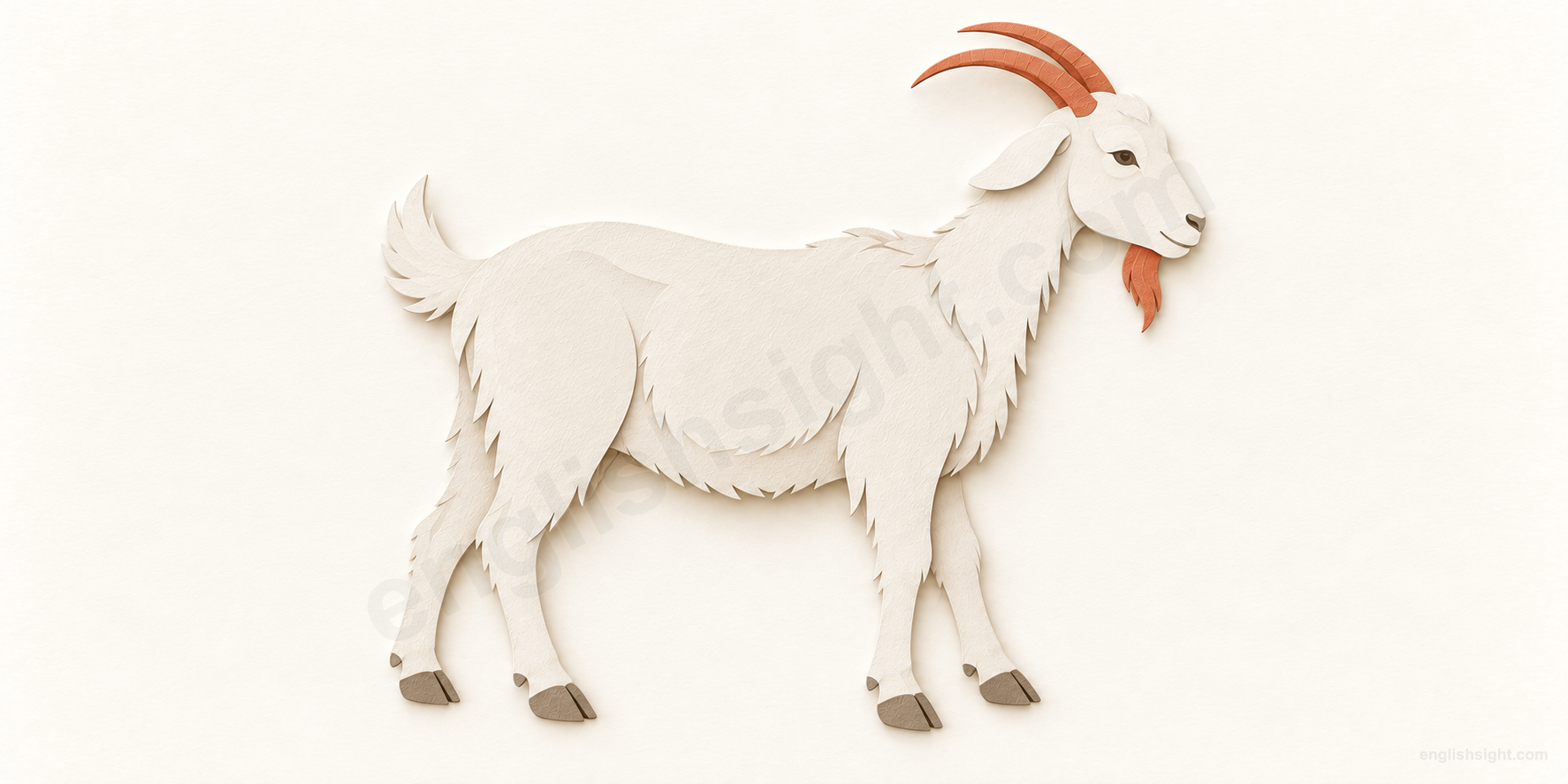
Notice the horns, beard, tail and hooves.
goat
Identify it as a goat.
Use the animal’s features to recognize its kind.
Recognize the animal kind: a goat.
A goat is a hoofed animal related to a sheep, often recognized by horns, a hairy coat, a short tail, and sometimes a beard.
This noun identifies a kind of animal; no before-and-after change is required. The drawing illustrates the literal meaning. Human labels, idioms, and the GOAT abbreviation need their own context.
Goat first names a kind of animal. Everyday combinations can specify a young or female goat, or name food made from goats’ milk. The surrounding words tell you whether you are talking about an animal, food, or a person.
Some expressions must be learned as a whole. Get someone’s goat means annoy them; GOAT meaning greatest of all time is an abbreviation with a separate explanation. The animal picture does not predict these meanings.
01
The animal and its products
Name the animal, distinguish its age or sex when needed, and identify what a food comes from.
01
a / the + goat; number + goats; feed / keep + goats
a goat / goats
a farm or wild animal related to a sheep
Situation / starting point
You see a small hoofed animal with a hairy coat.
What the expression conveys
You identify it as a goat.
Goat names an animal kind, not an action or a quality.
A goat is an animal kept on farms or living wild, including in mountainous areas. Horns, a short tail, and sometimes a beard help you recognize the familiar animal; the drawing is a typical example, not a test that every goat must match.
The ordinary countable pattern is a goat, one goat, two goats. Use the goat when your listener can identify which one. Feed the goats and keep goats describe ordinary farm activities; feed and keep supply the actions.
Wild goat and mountain goat describe animals in wildlife contexts. Do not assume that every animal called a mountain goat belongs to exactly the same biological group as a domestic goat.
In a sentence
Two goats are standing beside the fence.
Watch the difference For ordinary counting, say two goats, not two goat. A goat is not a sheep; the names identify different animals.
02
a billy goat; a nanny goat; a kid / baby goat
billy goat / nanny goat / kid
specify a goat’s sex or young age
Situation / starting point
You need to distinguish animals in a farm family.
What the expression conveys
You choose a male, female, or young-animal term.
Goat itself does not mean only a male animal.
A billy goat is a male goat; a nanny goat is a female goat. Male goat and female goat are clear alternatives when you do not want special animal vocabulary.
A young goat is a kid, so a nanny goat and her kids can describe an animal family. A baby goat is also clear everyday wording. The young animal remains a goat: kid adds age information.
Kid can also mean a human child, especially in informal conversation. The surrounding farm or family context determines which meaning is intended; a sentence containing kids alone is not automatically about goats.
In a sentence
The nanny goat stayed close to her two kids.
Watch the difference Do not use kid as the name for every small farm animal: a young sheep is a lamb.
The animal word specifies the source; the final noun names the food.
Goat’s milk is milk from a goat. In goat’s cheese, the cheese is made from that milk. These source relationships remain understandable even when the food comes from many animals rather than one particular goat.
Goat’s cheese is the British form listed by Oxford; goat cheese is its North American form. You may also see goats’ cheese, with a plural possessive, on menus. These spellings do not name different ingredients.
Milk and cheese are normally uncountable when referring to the food as a substance: some goat’s milk, a little goat cheese. A goat is an animal; some goat cheese is a quantity of food. Goat meat likewise identifies the animal source, without an apostrophe.
In a sentence
I added a little goat cheese to the salad.
Watch the difference The head noun controls the meaning: goat cheese is cheese, not an animal. Some cheese does not need a plural ending.
02
Fixed expressions about behavior and judgment
These phrases have established meanings. Learn the whole expression instead of trying to recover its meaning from a picture of the animal.
04
something / someone + get(s) + someone’s goat
get someone’s goat
annoy or irritate someone
Situation / starting point
A repeated noise bothers you.
What the expression conveys
You express how irritating you find it.
The possessive identifies the person who feels annoyed.
In This gets my goat, this names the irritating thing or behavior, and my identifies me as the annoyed person. Replace it with your, her, his, or a person’s name as needed.
The whole phrase is informal: it does not describe obtaining or stealing an animal. The pattern can change tense normally: That comment got her goat. What really gets my goat is… introduces a particular complaint.
Compare get my coat, which can literally mean fetch clothing. In the idiom, keep the fixed noun goat and the possessive together. Annoy me is a straightforward alternative when the idiom might be unclear.
In a sentence
People talking loudly during the film really get my goat.
Watch the difference Say It gets my goat, not It gets me goat. This is a fixed idiom, not a particle phrasal verb.
05
act / play the goat; act the giddy goat
act / play the goat
behave in a silly way
Situation / starting point
Someone makes silly faces when attention is needed.
What the expression conveys
You ask them to stop fooling around.
Act describes behavior, and the goat belongs to the fixed expression.
Act the goat is a British expression for behaving foolishly or playfully. Play the goat is another form, and act the giddy goat is a longer form. The expression can be used jokingly, or as a mild complaint when silly behavior gets in the way.
Stop acting the goat asks for a change of behavior. It does not normally ask an actor to stop playing an animal role. A literal performance needs context, such as playing a goat in a school show.
The article the stays in this idiom. You do not change it to my simply because I am the person acting. Fool around or be silly provides a more widely transparent alternative.
In a sentence
Stop acting the goat and help me pack these boxes.
Watch the difference Recognize the British idiom, but do not assume that calling someone a goat by itself means they are being silly.
06
separate / sort out + the sheep + from the goats
separate the sheep from the goats
distinguish stronger performers from weaker ones
Situation / starting point
People’s abilities are not yet clear.
What the expression conveys
A demanding task reveals differences in ability.
The comparison classifies performance; it is not a claim about animals.
Separate the sheep from the goats and sort out the sheep from the goats mean distinguish people who are capable, skilled, or otherwise judged suitable from those who are not. A test or challenge can be the subject.
This is a fixed metaphor. A sentence such as The final task will separate the sheep from the goats says the task will reveal a difference; it need not mean anybody will physically move into separate groups.
The expression makes a blunt division and can sound dismissive when applied to people. In practical feedback, a direct description such as show who has mastered the skill can be more precise.
In a sentence
The practical test will separate the sheep from the goats.
Watch the difference Do not reverse sheep and goats if you intend this established expression. Literal sorting of farm animals is a separate possibility in farm context.
03
Praise, blame, and an insulting label
Context matters when goat refers to a person. The praise word GOAT is an abbreviation, while other human uses can be critical or offensive.
07
be / call someone + the GOAT; the GOAT of + field
the GOAT
the greatest of all time in a field
Situation / starting point
Fans compare the strongest performers across generations.
What the expression conveys
They call one person the best ever.
The capital letters stand for greatest of all time.
GOAT is an informal abbreviation used as a noun, especially in sports, for the person considered the best ever in a particular field. It is pronounced like goat, not normally as four separate letter names.
In She is the GOAT, the signals a claim to the top position. To me, she’s the GOAT makes the speaker’s judgment explicit. This is praise, often part of a debate, rather than an official title.
Greatest of all time is stronger than best in today’s match. The abbreviation is not explained by horns, climbing, or a supposed personality trait of goats. Capitalization helps distinguish it in writing; in speech, listen to the context.
In a sentence
Her fans call her the GOAT of women’s tennis.
Watch the difference A lowercase goat in a blame context can mean something very different. Do not infer praise from the sound alone.
08
be the goat; make someone the goat
be the goat
be the person blamed for a failure
Situation / starting point
A team loses after one player’s mistake.
What the expression conveys
That player receives the blame.
This critical human use differs from the praise abbreviation GOAT.
Goat can refer to a scapegoat: someone who takes the blame, including blame that properly belongs to others. In American sports reporting, the goat can be the player blamed for a loss.
The missed kick made him the goat identifies the person singled out for failure; it does not prove he alone caused it. The expression often contrasts with hero.
This use is worth recognizing, but if you want your meaning to be immediately clear, say the player everyone blamed or a scapegoat. Capital letters and context usually help distinguish the GOAT meaning best ever from the goat meaning the blamed person.
In a sentence
After missing the penalty, the striker became the goat in the next day’s reports.
Watch the difference The blamed player need not actually deserve all the blame. This meaning is not the same as being the greatest of all time.
09
an / that + old goat
an old goat
an insulting label for an older man, especially one seen as sexually unpleasant
Situation / starting point
A speaker strongly disapproves of an older man’s behavior.
What the expression conveys
The speaker uses a disparaging label.
The human label carries a judgment beyond age.
An old goat can be an insulting way of referring to an older man, especially one whose sexual behavior or attention is considered unwelcome. It is not a neutral synonym for an elderly man.
In animal context, an old goat can simply be an animal that has lived a long time. The human reference and surrounding attitude create the insulting reading.
This is useful to recognize in dialogue, but it is not a polite form of address. Describe the behavior directly if that is what matters.
In a sentence
In the story, she calls the man who keeps making unwanted advances “an old goat.”
Watch the difference Do not use old goat as a friendly general translation of older man; it can sound offensive.
Keep the literal noun and the whole expression distinct
A noun, not a verb family
This lesson teaches the noun goat, its combinations and idioms, and the separate GOAT abbreviation. There is no ordinary everyday goat verb family requiring passive, causative, progressive, or particle-verb lessons. The verbs in feed goats, get someone’s goat, and act the goat provide the grammatical action.
Counting and spelling
Use goats as the ordinary animal plural. Dictionaries also record a zero plural goat in some uses, but beginners do not need it for ordinary counting. A goat’s coat belongs to one goat; the goats’ coats belong to several. Goat cheese uses the animal noun as a modifier.
What the image can explain
The animal outline supports recognition. It is a teaching aid, not a shared mental picture attributed to every native speaker. The words in a fixed expression and its context determine the intended meaning.
Choose the meaning from the context
Look at the full expression, the situation, and whether the speaker is naming, praising, or complaining.
1. There are three animals beside the barn. Which sentence uses the ordinary plural?
2. A farm guide points to a young goat. Which word fits?
3. “That constant tapping gets my goat.” What does the speaker mean?
4. Fans call a champion “the GOAT” while comparing the best players in history. What is their claim?
5. A menu lists goat cheese. What does goat tell you?
Sources and teaching notes
The sources below support the animal vocabulary, food combinations, idioms, and human labels. Explanations and example sentences are original. The animal outline is a teaching illustration.
The diagram supports the literal animal meaning; it is not a picture shared by every native speaker.