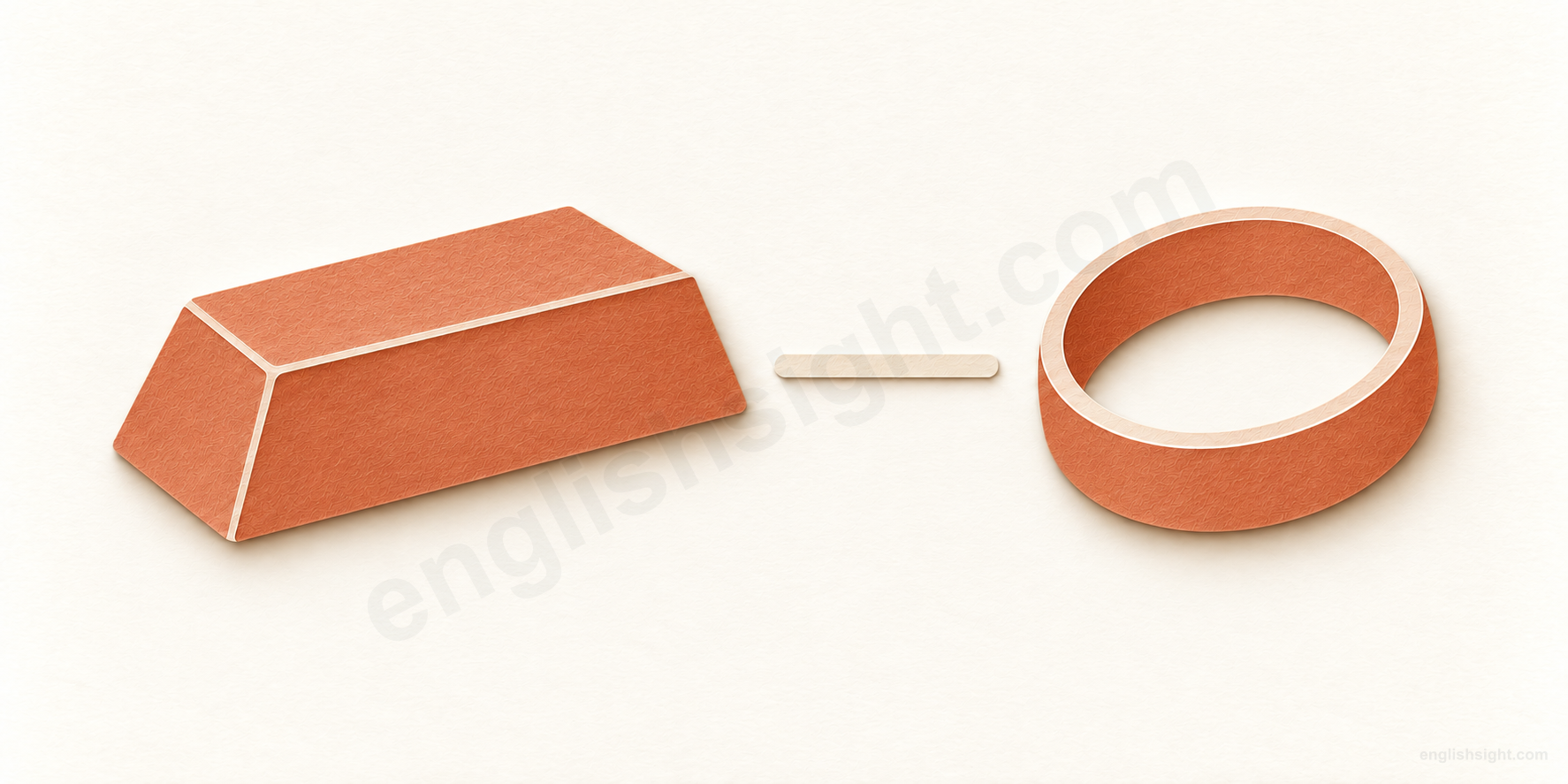
Connect gold as a material with its appearance, awards, and established expressions of value.
The material stays gold; the use changes
The material stays gold; the use changes
A bar is one object made of gold.
gold
A ring is a different object made of gold.
The short line links a shared material, not a manufacturing step.
Different objects, the same material: gold. The line shows a connection, not a transformation.
Gold names a valuable yellow metal. Its characteristic appearance and perceived value help connect colour descriptions, awards, and figurative praise.
The sketch shows a bar and a ring as different forms of the same material, without claiming that one has been made from the other. Colour resemblance and metaphorical value are further connections explained below.
Start with the metal. Then ask whether gold names what something is made from, how it looks, an award, or a kind of value. The same word can play different roles in different constructions.
The connection through colour and value is a teaching model. It helps organize the uses, but it cannot predict every idiom or tell us what every English speaker pictures.
01
The metal and things made from it
Name the material, describe jewellery, and distinguish gold throughout an object from a thin surface layer.
01
gold (uncountable); some gold; a bar / piece of gold
gold
the valuable yellow metal
Situation or object
You identify the material in a small bar.
What the expression conveys
You name the metal rather than count the objects.
Gold names a substance; a bar or coin names one object made from it.
Gold is the name of a metal. Use it without a or a plural ending when talking about the substance: some gold, a little gold, or the price of gold.
To count physical pieces, name the unit: a bar of gold, two gold coins, or a piece of gold. Gold is heavy describes the material; The gold is heavy refers to a particular amount already identified.
Mine gold means extract it from the ground. Pan for gold means search for it by washing material in a pan. For belongs to the searching expression, not to a special verb form of gold.
In a sentence
The museum displays a small bar of gold.
Watch the difference For an amount of the metal, say some gold or a piece of gold, rather than a gold.
02
a gold + object; object + be made of gold
a gold ring / made of gold
describe the material of an object
Situation or object
You ask what a ring is made from.
What the expression conveys
You identify gold as its material.
In a gold ring, gold describes the ring’s material; ring is the countable head noun.
A gold ring is an ordinary way to describe a ring made from gold. This ring is made of gold makes that material relationship explicit. A gold mine has a different relationship: it is a place containing gold, not a mine constructed from the metal.
Gold stays unchanged before a plural noun: two gold rings. The -s belongs to rings, not to the material word. Jewellery is the usual British spelling; jewelry is the American spelling.
For ordinary material descriptions, gold is the neutral choice. Golden can also mean made of gold, especially in literary descriptions such as a golden crown, but the two words do not replace each other in every expression.
In a sentence
My grandmother gave me a gold necklace.
Watch the difference Write gold necklaces, not golds necklaces. Use context to separate material from colour.
03
pure / solid gold; a solid gold + object; number-carat / number-karat gold
pure gold / solid gold
distinguish purity from material throughout
Situation or object
You compare descriptions of two bracelets.
What the expression conveys
You separate a purity claim from a claim about the material beneath the surface.
Pure concerns the metal’s purity; solid contrasts material throughout with a surface coating.
Pure gold emphasizes gold without other substances mixed into it. Solid gold says that the gold material is not merely a thin layer on another material.
These expressions answer different questions. Do not silently turn a description such as solid gold into a precise purity statement. Jewellery descriptions may specify the gold separately, as in 18-carat gold.
British English normally spells the purity unit carat; American English uses karat for gold. A carat can also name a gemstone weight, so read which material is being measured.
In a sentence
The bracelet is solid gold, not gold-plated.
Watch the difference Solid gold and pure gold are not interchangeable claims. Colour alone establishes neither.
04
gold-plated + object; be gold-plated; decorate / cover something with gold leaf
gold-plated / gold leaf
describe a gold surface or thin decorative sheet
Situation or object
A less expensive metal object receives a gold surface.
What the expression conveys
It has gold on the outside, rather than gold throughout.
A coating and the material underneath are distinct.
Gold-plated describes an object covered with a thin layer of gold. A gold-coloured object only has the appearance of gold; the description makes no claim that a real gold layer is present.
Gold leaf is gold formed into very thin sheets for decoration: The restorer applied gold leaf to the frame. Leaf here belongs to an established material name, not to a plant description.
Use the hyphen in gold-plated earrings. These are material and surface descriptions, not separate everyday senses of a verb gold.
In a sentence
The earrings are gold-plated, so the metal underneath is different.
Watch the difference Gold-coloured does not mean gold-plated; gold-plated does not mean solid gold.
05
possessive + gold; gold coins; gold reserves; pay in gold
gold coins / her gold
gold objects or wealth considered together
Situation or object
A family gathers its gold jewellery and coins.
What the expression conveys
They refer to the collection collectively as their gold.
The material name can stand for possessions made from that material.
In They sold their gold, gold may mean gold objects collectively. The noun remains uncountable in this use even when several necklaces or coins are involved.
Gold coins names individual coins, while gold reserves refers to gold held in reserve. In older or story-like language, gold can also stand more broadly for money or riches.
Gold is not the ordinary neutral word for money in every modern situation. I need money for the bus is natural; replacing money with gold would suggest literal gold or a deliberately unusual style.
In a sentence
They kept their gold in a locked box.
Watch the difference Their gold can include several objects, but that does not make it their golds in this collective use.
02
A colour that resembles the metal
Something can be gold in colour without containing any gold. The noun after gold and the wider situation guide the reading.
06
gold + noun; be gold; a pale / deep gold; shades of gold
gold paint / a pale gold
a colour resembling the metal
Situation or object
You choose a paint colour for a wooden frame.
What the expression conveys
The frame looks gold without becoming a gold object.
Gold can describe appearance independently of material.
Gold paint and gold lettering normally describe colour or visual effect. In The frame is gold, gold can be a colour description; say made of gold when you need to specify the material.
As a colour noun, gold appears in phrases such as a pale gold. Different shades can be called golds, as in The design combines reds and golds. That colour plural is different from counting amounts of metal.
Gold and golden overlap for colour. Golden is especially natural in descriptions such as golden light or golden hair. Keep established expressions intact: a golden opportunity means an excellent opportunity; a gold opportunity is not its ordinary equivalent.
In a sentence
We painted the wooden frame gold.
Watch the difference A gold frame can refer to colour or material. The phrase alone may leave that distinction open.
03
First place and recognized success
Sport and music use gold in established award expressions. Wanting an award, winning one, and reaching an award standard are different.
07
win / take gold; win a gold (medal); win two golds; gold in an event / for a team
win gold / a gold / two golds
win or count first-place medals
Situation or object
A swimmer finishes first in two events.
What the expression conveys
The report counts the first-place medals she won.
In sport, gold can name a first-place award rather than a quantity of metal.
Win gold refers to first-place success in a competition. Win a gold and win two golds count gold medals. The medal sense allows a and a plural even though the metal sense normally does not.
Take gold is another way of reporting first place: The team took gold in the final. In identifies the event; for can identify the team or country represented.
A gold medal is an award name. Do not use the name alone as proof that the whole medal consists of pure gold.
In a sentence
She won two golds at the swimming championships.
Watch the difference Two golds counts medals here. It does not mean two pieces of an unspecified amount of metal.
08
go for gold; be going for gold
go for gold
try to win first place
Situation or object
The final has not happened yet.
What the expression conveys
The runner aims for the highest award.
Going for gold states an aim; winning gold reports an achieved result.
Go for gold means try to win the gold medal. The expression describes intention and effort; it does not say the person has already won.
Outside sport, people may use it as encouragement to aim for the best result. That is an extension of the award expression, not a literal instruction to fetch some metal.
Keep for in this expression. Go gold has a separate established use in music; it is not simply a shortened version of go for gold.
In a sentence
After taking silver last year, he is going for gold.
Watch the difference He went for gold does not tell us whether he succeeded.
09
album / recording + go gold; went gold; has gone gold
an album goes gold
reach the sales level for a gold record award
Situation or object
A recording has sold enough to qualify for an award.
What the expression conveys
A report says that the album has gone gold.
Gold names an award level, not a change in the recording’s physical material.
In music reporting, go gold means reach the sales level needed for a gold record award. The album is the subject: Its first album went gold.
This is a specialized but useful entertainment expression. The award level belongs to a certification system; the phrase itself does not supply one universal sales number.
Went and gone are forms of go. Gold supplies the resulting status. Do not treat gold as a past-tense verb or confuse go gold with go for gold in sport.
In a sentence
Their second album went gold a year after its release.
Watch the difference The music expression is go gold, without for. It does not normally mean win a sporting gold medal.
04
Praise, usefulness, and successful discoveries
The value associated with the metal helps connect these expressions. Learn the whole wording: each expression selects a different kind of value.
10
something + be gold / pure gold
That advice is gold. / pure gold
praise something as exceptionally valuable or good
Situation or object
A short piece of advice solves a serious problem.
What the expression conveys
You praise its value rather than its appearance.
The metal’s value supports a metaphor for an excellent contribution.
That advice is gold is an informal, emphatic way to say the advice is extremely valuable. Gold is a noun after is, used metaphorically; the advice is not being described as yellow.
Pure gold can similarly praise outstanding material, a performance, or an idea: The final scene was pure gold. Pure strengthens the praise in this context.
This is an evaluation, not a measured financial value. What makes the advice valuable comes from the situation; the word gold does not tell us its specific content.
In a sentence
Your notes are pure gold for anyone starting this course.
Watch the difference Read the context: pure gold can literally describe a metal’s purity or figuratively praise something.
11
person + have a heart of gold; a person with a heart of gold
have a heart of gold
be a very kind person
Situation or object
A neighbour repeatedly helps people who need support.
What the expression conveys
You praise that person’s kindness.
A heart of gold describes character, not wealth or a physical heart.
Have a heart of gold praises someone’s kindness and generosity. Heart stands for character or feelings; gold adds the idea of something precious.
Use a heart of gold for one person, or hearts of gold for several: Those volunteers have hearts of gold. With a heart of gold can describe a person inside a longer noun phrase.
The expression does not mean rich. A person with little money can have a heart of gold, and an expensive gift alone does not establish the character judgment.
In a sentence
Our neighbour has a heart of gold and checks on everyone during storms.
Watch the difference Keep a in have a heart of gold. The usual idiom is not have a gold heart.
12
person + be (as) good as gold
(as) good as gold
behave very well
Situation or object
A child waits quietly through a long appointment.
What the expression conveys
You tell the parent that the child behaved very well.
This idiom praises behaviour; it does not compare prices or colours.
As good as gold is an informal expression for very good behaviour, especially when talking about children. The first as may be omitted: She was good as gold.
It normally focuses on how someone behaved in a situation. A heart of gold instead praises a kind nature. A child can be as good as gold while waiting without doing a generous act.
The comparison is a fixed expression. Replacing good with another adjective does not automatically create an idiom with a related meaning.
In a sentence
The children were as good as gold during the appointment.
Watch the difference For this everyday child-behaviour use, do not interpret good as gold as meaning wealthy or made of gold.
13
someone / something + be worth + possessive + weight in gold
worth your / its weight in gold
extremely useful or valuable
Situation or object
A repair kit helps you finish a journey.
What the expression conveys
You emphasize how much its help mattered.
The imagined gold value is an exaggeration expressing usefulness.
Worth its weight in gold strongly praises a thing’s usefulness. The same expression works for people: You are worth your weight in gold.
Match the possessive to the subject: she is worth her weight, they are worth their weight, and the tool is worth its weight in gold. Worth follows be directly here.
This is not a literal calculation based on the person’s or object’s weight. Unlike a heart of gold, it can praise a tool, information, or practical help rather than kindness.
In a sentence
That tiny repair kit was worth its weight in gold on our trip.
Watch the difference Say worth its weight in gold, not worth of its weight in gold or worth its weight of gold.
14
something + be like gold dust
like gold dust
very hard to find or obtain
Situation or object
Almost every ticket has already been sold.
What the expression conveys
You explain how difficult the remaining tickets are to obtain.
The idiom emphasizes scarcity, not how small or dusty the tickets are.
Like gold dust is a British English expression for something difficult to obtain. It commonly fits tickets or other things that many people want and few can get.
Gold dust by itself can literally mean gold in powder form. Like marks the comparison in the idiom: These tickets are like gold dust.
Compare worth its weight in gold, which stresses usefulness or value. A useful object can be easy to buy; an item that is like gold dust is hard to get.
In a sentence
Tickets for the small theatre’s final show are like gold dust.
Watch the difference Dust is uncountable here. Use like gold dust, not like a gold dust.
15
a gold mine; something + be a gold mine; a gold mine of + useful resource
a gold mine / a gold mine of information
a mine for gold, or a rich source of profit or useful things
Situation or object
An archive contains many letters that answer your research questions.
What the expression conveys
You describe it as a rich source of information.
A place yielding metal provides the comparison for a source yielding something valuable.
Literally, a gold mine is a place where gold is extracted from the ground. Figuratively, a business can be a gold mine because it produces large profits.
A gold mine of information extends the source idea to useful knowledge: of names what the source supplies. The archive does not need to contain any literal gold or make money.
Goldmine is also used as a single-word spelling, especially in figurative contexts. The plural belongs to the head noun: gold mines or goldmines.
In a sentence
The town archive is a gold mine of information about local families.
Watch the difference A gold mine supplies something valuable; a pot of gold is the reward hoped for. The two images have different roles.
16
the gold standard in / for + field or purpose; the gold standard (monetary system)
the gold standard
a leading standard of quality; also a gold-based monetary system
Situation or object
Other makers compare their equipment with one outstanding model.
What the expression conveys
You identify that model as a quality benchmark.
Gold standard can name a benchmark rather than an object’s material.
In a quality comparison, the gold standard is a leading example that others use as a benchmark. In or for can identify the field or purpose.
In economic history, the gold standard has a separate technical meaning: a monetary system that links money’s value to gold. This lesson identifies the meaning without explaining the system in detail.
Neither use means simply coloured gold. A speaker calling something the gold standard is making a quality claim; the phrase alone is not evidence that the claim is justified.
In a sentence
For this workshop, that model remains the gold standard for durability.
Watch the difference Read the subject area: a quality benchmark and a monetary system are distinct meanings of the full compound.
17
strike gold; strike gold with + successful discovery / product
strike gold
discover literal gold or find something that brings success
Situation or object
A small company launches a product that becomes very successful.
What the expression conveys
People say it has found a highly rewarding opportunity.
A successful discovery links the mining scene with the established success idiom.
Literally, miners strike gold when they discover it. Figuratively, strike gold means find, do, or produce something that brings substantial success or money.
With can name what brought success: She struck gold with her first novel. The past and past participle are struck in this expression: struck gold; has struck gold.
A casual exclamation such as We’ve struck gold! can celebrate a particularly good find. The context supplies what is valuable; no literal metal is required.
In a sentence
The small publisher struck gold with a series of local history books.
Watch the difference Strike gold is a fixed verb–noun expression, not a particle verb. Do not replace struck with striked.
05
Hopes of wealth and misleading appearances
These expressions describe people chasing rewards, expecting easy money, or discovering that an attractive prospect has little real value.
18
a gold rush; a gold rush town; a gold rush into + market; a gold rush for + resource
a gold rush
a rush to seek newly discovered gold, or a comparable chase for profit
Situation or object
News of a gold discovery spreads.
What the expression conveys
Many people hurry to the area hoping to gain wealth.
Gold supplies the hoped-for reward; rush supplies the sudden collective movement.
A gold rush literally involves many people going to a place after gold is discovered there. The plural is gold rushes. Gold rush town describes a town connected with such an event.
Writers also extend the expression to a rush into a promising business: The new market triggered a digital gold rush. This metaphor compares the pursuit of profit with the historical search for metal.
The expression describes an eager collective pursuit. It does not guarantee that everyone involved becomes rich.
In a sentence
The discovery started a gold rush, and the village quickly filled with newcomers.
Watch the difference A gold rush is the rush to seek a reward, not the reward itself or a description of the colour of the ground.
19
a pot of gold; the pot of gold at the end of the rainbow
a pot of gold
a large reward or wealth someone hopes to obtain
Situation or object
Someone dreams of making a fortune from a new project.
What the expression conveys
They imagine the project’s eventual reward.
The pot represents the hoped-for prize rather than a current source of earnings.
A pot of gold is a figurative reward or fortune someone hopes to get. It can suggest a dream that may be difficult or unrealistic to achieve.
The longer expression the pot of gold at the end of the rainbow emphasizes a hoped-for ultimate reward. A crock of gold is another version, mainly British.
Literal pots containing gold are possible, but in a discussion of ambitions the phrase usually points to a reward, not to a particular container. Compare a gold mine, which describes a source that yields value.
In a sentence
She saw the new contract as a pot of gold, but the profits never came.
Watch the difference The phrase expresses a hoped-for reward; it does not assert that the money is guaranteed.
20
the streets + be paved with gold; the streets are not paved with gold
the streets are paved with gold
a place seems to offer easy opportunities to become rich
Situation or object
A newcomer expects money to be easy to make in a city.
What the expression conveys
Someone challenges that unrealistic expectation.
An imagined gold-covered city stands for the promise of easy wealth.
The streets are paved with gold is a saying about the belief that making money in a place is easy. It is often used critically or in the negative.
The streets aren’t paved with gold reminds someone that life in the place still involves effort and difficulty. The expression need not describe the actual surface of any street.
Paved with supplies the imagined surface; the whole saying supplies the easy-money interpretation. It is not a general meaning of the preposition with.
In a sentence
He soon learned that the streets of the capital were not paved with gold.
Watch the difference In this saying, gold represents imagined wealth. Do not infer that the speaker saw real gold on a road.
21
All that glitters is not gold. (saying)
All that glitters is not gold.
attractive appearances do not always mean real value
Situation or object
A glossy offer looks excellent at first.
What the expression conveys
Closer checking reveals disadvantages.
Looking precious and actually being valuable can come apart.
This saying warns that appearances can mislead. Its conventional message is that not everything attractive is genuinely good or valuable.
Read the scope carefully: it does not mean that nothing attractive has value. Some appealing things are genuinely good; others merely look good.
Oxford also records glistens and glisters in this saying. Glitters is the form used here. The contrast recalls the metal’s attractive appearance, but the saying can concern offers, people, or opportunities.
In a sentence
The offer looked perfect, but all that glitters is not gold.
Watch the difference The message is not everything attractive is good, rather than everything attractive is bad.
22
fool’s gold (uncountable); something + turn out to be fool’s gold
fool’s gold
a mineral resembling gold, or an apparently valuable but worthless prospect
Situation or object
A business promises large profits from a new scheme.
What the expression conveys
The scheme fails to deliver the wealth people expected.
Resemblance to something valuable can produce a false expectation.
Fool’s gold literally names a yellow mineral, iron pyrites, whose appearance can be mistaken for gold. It is a different material, not another name for pure gold: The yellow mineral in the sample was fool’s gold, not real gold.
Figuratively, fool’s gold describes something that seems valuable or promising but will not deliver the hoped-for success. The expression names the disappointing prospect; the glitters proverb states a broader warning.
The established noun is uncountable. The apostrophe belongs in fool’s gold, even when no particular person is being called a fool.
In a sentence
The business scheme promised huge profits but turned out to be fool’s gold.
Watch the difference Gold-coloured simply describes appearance. Fool’s gold adds mistaken expectations about value.
Choose the meaning from the whole expression
Material, colour, and award are different
A gold ring can be a material description; gold paint describes colour; a gold in sport counts an award. Ask what the speaker is talking about before choosing a meaning.
Count the right thing
The metal is normally uncountable: some gold, a piece of gold. A medal can be a gold, and several medals can be golds. Shades of the colour can also be golds. These countable uses do not make every use countable.
Gold and golden overlap, but phrases select their own words
A gold necklace is a neutral material description. Golden light and golden hair describe appearance; golden opportunity is an established positive expression. Literary golden can also describe real gold. Do not replace one word mechanically with the other.
A metaphor helps connect uses; it does not define every phrase
A heart of gold praises kindness; as good as gold praises behaviour; like gold dust emphasizes difficulty obtaining something. Read the complete expression and its situation.
Scope of this lesson
This lesson covers the ordinary noun, material modifiers, colour uses, selected common compounds, and established expressions. It does not develop chemical properties, detailed purity calculations, monetary history, specialist certification rules, names, or rare verb uses. There is no everyday gold particle-verb family to learn here.
Choose the intended meaning
Use the situation and the complete expression, not only the idea of something yellow.
1. A wooden frame has been painted gold. What can you conclude?
2. A swimmer won first place in two events. Which sentence counts the awards?
3. A neighbour always helps people in difficulty. Which expression praises that kindness?
4. A necklace is described as gold-plated. Which interpretation fits?
5. Before the race, a runner says she is going for gold. What has she told you?
6. Tickets are almost impossible to obtain. Which expression highlights that scarcity?
7. What does All that glitters is not gold conventionally warn you about?
8. A report says an album has gone gold. Which interpretation fits the music expression?
Sources and teaching notes
The sources below were read for meanings, constructions, idioms, and usage labels. Explanations and examples are original. The visual connection is a teaching interpretation.
This diagram helps explain a connection; it is not a picture shared by every native speaker.