Quality, kindness, ability, benefit, and the expressions that connect them.
A standard supplied by context
Evaluate something against what matters here
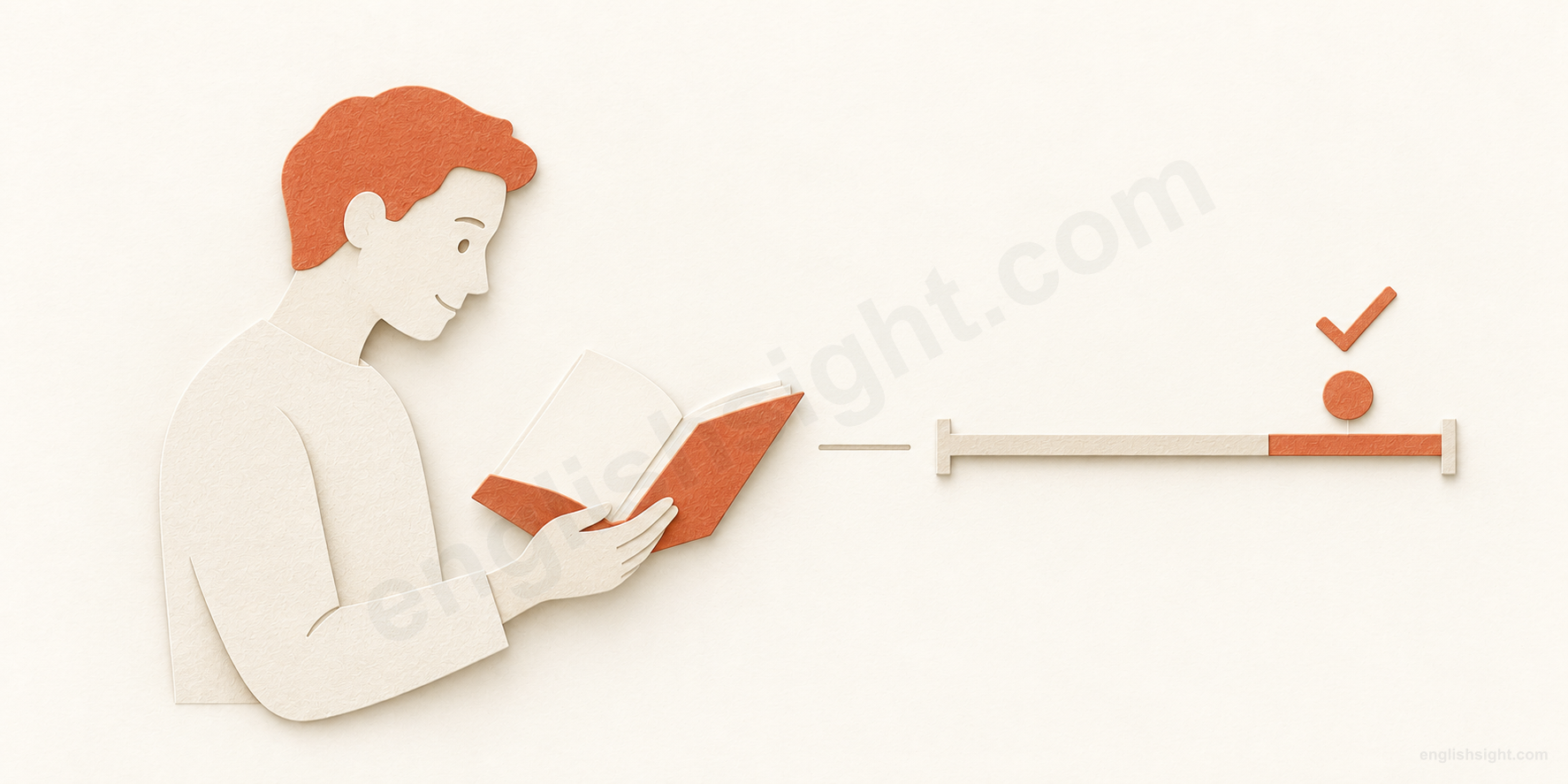
A book to assess
good
A favorable judgment
Judge it against the standard that matters here.
Good gives a favorable judgment; context supplies the standard.
Good gives a positive judgment against a standard supplied by the context: quality, suitability, benefit, or conduct.
The scale is a teaching metaphor for evaluation, not a universal scoring system. No change of state is required. Quantity expressions and idioms need their own explanations.
Good usually gives a favorable judgment. What makes something good depends on what matters in the situation: how well it works, how pleasant it is, how someone behaves, or whom it helps.
The same word does not promise the same kind of goodness in every sentence. A good actor can play a bad person brilliantly; a good reason can explain an unwelcome decision. Read the noun, the grammar, and the situation together.
The picture offers one teaching model for evaluation. It is not a claim that all English speakers share one mental image, and it cannot predict fixed expressions such as for good.
01
Quality, enjoyment, and judgment
Ask what is being evaluated. A good meal, reason, estimate, and review can be good in different ways.
01
good + noun; be / seem / look + good
a good book / good work
meet an acceptable or high standard
Situation / need
You need to judge the quality of a piece of work.
What is judged or expressed
You say that it meets or exceeds the relevant standard.
Good evaluates quality; it does not always mean outstanding.
Good works before a noun or after a linking verb: a good book; The book is good. The noun and situation supply the criterion: readable writing, reliable equipment, or careful work.
The same word can give strong praise or modest approval. Pretty good often means fairly or quite good, though tone can make the praise warmer. In good condition evaluates the state of something rather than how recently it was made.
Good value and a good price judge what you receive relative to what you pay; a good price can be low for a buyer or high for a seller. Good English judges language against an accepted standard of usage, not its moral character.
In a sentence
The recording is good, but the final page needs more work.
Watch the difference A good recording need not be the best recording. Good can mean satisfactory or excellent; context and tone determine the strength of praise.
02
have a good time; it is good to + verb
have a good time
enjoy an experience
Situation / need
You spend the afternoon with friends.
What is judged or expressed
You describe the experience as enjoyable.
Here the favorable judgment concerns pleasure, not moral behavior.
Have a good time means enjoy yourself. A good meal, a good day, and good weather may likewise describe what people enjoy or welcome in that context.
Good news reports something welcome or favorable; it does not say the report is well written. It is good to hear from you evaluates the experience of receiving contact. The infinitive supplies that experience.
With a joke, story, or witty remark, good can specifically mean funny or clever. After a joke, “That’s a good one!” can praise its humor. The same reply after an implausible excuse can be mocking: “You finished all that in five minutes? That’s a good one!” Context and tone distinguish amusement from disbelief.
In a sentence
We had a good time exploring the old town.
Watch the difference Say We had a good time, not We had good time, for one enjoyable occasion.
03
a good reason for + noun / -ing; good reason to + verb
a good reason / a good idea
judge reasoning or a proposal as sound
Situation / need
A route is unsafe after heavy rain.
What is judged or expressed
You judge postponing the walk to be sensible.
A reason can be good because it supports a decision.
Good reason concerns justification; a good idea concerns a sensible or useful proposal. There is good reason to wait does not describe a pleasant feeling. Good advice offers guidance judged reliable or useful.
Good point acknowledges something relevant that another person has raised. Good question can recognize an important question, sometimes one the speaker cannot answer immediately. The approving function comes from the conversational setting.
In a sentence
We have a good reason to postpone the walk: the river has flooded.
Watch the difference A good reason is a strong justification; a nice reason is not the usual equivalent.
04
a good estimate of + noun; have a good idea of + noun / wh-clause
a good estimate / a good idea of
have a reasonably accurate understanding
Situation / need
You compare your estimate with the actual total.
What is judged or expressed
The estimate turns out to be close.
Good can evaluate accuracy rather than desirability.
A good estimate or indication gives a reliable picture of reality. Have a good idea of the cost means understand it reasonably accurately; it does not mean possess a proposal you approve of.
Compare I have a good idea: without of and an object, this often announces a useful proposal. The surrounding construction separates understanding from suggesting.
In a sentence
The trial gives us a good idea of how long the task will take.
Watch the difference A good estimate can predict an unwelcome cost; good does not make the predicted outcome pleasant.
05
good reviews; a good reputation; a good name
good reviews / a good name
receive favorable judgments or public respect
Situation / need
Customers describe a repair service favorably.
What is judged or expressed
The service becomes known for reliable work.
Public approval is different from proof that every job is excellent.
Good reviews are favorable assessments. A good reputation or a good name means that people generally respect or trust someone or something.
Good modifies different sides of evaluation: a good review may be positive about the subject, while a well-written review concerns the reviewer’s writing. Those judgments can come apart.
In a sentence
The workshop has a good reputation for careful repairs.
Watch the difference Good reputation reports favorable standing; it does not guarantee a particular result.
02
Ability, suitability, and useful effects
At, with, for, and a following infinitive specify the activity, the people or things handled, the purpose, or the beneficiary.
06
be good at + noun / -ing
be good at something
perform an activity skillfully
Situation / need
Mina practices finding patterns in numbers.
What is judged or expressed
She can solve those problems skillfully.
At introduces the area of ability.
Use good at with a noun or an -ing form: good at chess; good at explaining things. The person has ability in the activity. A good teacher names someone who performs that role well.
Good for introduces a different relation: something can be good for your studies because it helps you. It does not mean that the thing is skilled at studying. Are you any good at it? is a natural question about ability.
In a sentence
Mina is good at spotting patterns in numbers.
Watch the difference Use good at solving problems, not good at solve problems.
07
be good with + person / thing
be good with people / things
handle people or use things effectively
Situation / need
A child becomes anxious during a lesson.
What is judged or expressed
The teacher knows how to respond calmly and effectively.
With names who or what someone handles well.
Good with children describes skill in dealing with children. Good with numbers or with your hands describes handling calculations or practical work effectively.
Compare good to children: that stresses kind treatment. Good with children stresses the ability to deal with them; good at teaching children names the activity. The preposition carries part of the meaning.
In a sentence
Our new instructor is good with nervous beginners.
Watch the difference Good with someone is not the same claim as good to someone.
08
be good for + person / purpose; a good + noun + to-infinitive
be good for a purpose / good to use
fit a practical need or occasion
Situation / need
You need a convenient meeting time.
What is judged or expressed
You find that Tuesday fits the schedule.
Good can mean suitable in the situation.
Is Tuesday good for you? asks whether Tuesday is convenient. A good place to study suits that activity. The person after for may be the person whose needs or schedule matter.
This chair is good for a small room evaluates suitability. It need not mean the room becomes healthier. Good to eat can concern pleasant taste or fitness for eating, depending on context; the infinitive identifies the relevant use.
In a sentence
Is Tuesday afternoon good for you?
Watch the difference Good for you in a scheduling question is not the same as Good for you! as praise.
09
be good for + noun; it is good for + person + to-infinitive
be good for someone / something
have a helpful effect
Situation / need
A team keeps missing important updates.
What is judged or expressed
A shared noticeboard helps everyone stay informed.
For can name the person or thing that benefits.
Good for the team evaluates a helpful effect on the team. It can concern health, work, relationships, or the environment; the context supplies the kind of benefit.
It is good for someone to do something includes the person who does the action: It is good for the team to meet regularly. Compare good at meeting deadlines, which describes ability. Neither for nor at can be swapped without changing the relation.
In a sentence
Clear instructions are good for everyone on the project.
Watch the difference Good for does not always mean healthy; ask what kind of benefit is intended.
10
ticket / pass / coupon + be good for + period / entitlement
be good for three months
remain valid for a stated use or period
Situation / need
You buy a pass with a limited validity period.
What is judged or expressed
You can use it within those three months.
The stated limit concerns acceptance, not general quality.
A pass good for three months remains valid for that period. A coupon good for one free drink can be exchanged for that drink. For introduces the period or entitlement.
Good on its own can also mean unspoiled or still usable: Is this milk still good? That question concerns its condition, not a ticket’s administrative validity. Read the object and context rather than assuming one meaning of good for.
In a sentence
This visitor pass is good for three months.
Watch the difference Good for three months does not by itself mean it may be used exactly three times.
11
be good for + duration / distance / expected contribution
be good for a distance / a laugh
have capacity to last or be relied on to provide something
Situation / need
You assess what a battery can still supply.
What is judged or expressed
You expect another two hours of operation.
Good for can describe available capacity or a predictable contribution.
The battery is good for another two hours says it can last that long. A walker good for another mile has enough strength to continue that far. This differs from a ticket being valid for a period.
With a person as subject, always good for a laugh means you can rely on the person to provide amusement. Always good for advice similarly concerns a contribution. These are established uses, not a rule that every for-phrase expresses benefit.
In a sentence
The battery should be good for another two hours.
Watch the difference A comedian good for a laugh provides amusement; a joke good for you would describe a beneficial effect.
03
Conduct, kindness, relationships, and condition
A good person, a person who is good to you, and a person who feels good make different claims.
12
a good person / deed; good practice
a good person / a good deed
judge conduct by moral standards
Situation / need
Someone finds a wallet that is not theirs.
What is judged or expressed
They return it rather than keep the money.
The relevant standard is conduct toward others.
A good person is judged morally decent; a good deed is an action regarded as morally right or helpful. A good driver instead evaluates driving ability. The noun tells you which standard is relevant.
Good practice describes a recommended way of doing something according to professional or practical standards. Good manners concerns polite social behavior. Moral approval, professional practice, and obedience can overlap, but they are not identical meanings.
In a sentence
Returning the lost wallet was a good thing to do.
Watch the difference Calling someone a good lawyer can praise their professional skill without judging all of their conduct.
13
be good; be (as) good as gold
be good / as good as gold
behave in an approved, cooperative way
Situation / need
A child waits through a long appointment.
What is judged or expressed
The child behaves patiently and causes no trouble.
In this setting good evaluates behavior.
Be good is often addressed to children or animals and asks them to behave properly. It does not ask them to become more talented. As good as gold is a familiar emphatic expression for very good behavior, especially by a child.
The idiom is not a price comparison with gold. Calling an adult a good boy or good girl can sound patronizing; use the expression with awareness of the relationship.
In a sentence
The children were as good as gold during the long appointment.
Watch the difference Be good here means behave well; it does not mean be skilled at an activity.
14
be good to + person; be good about + situation
be good to someone
treat someone kindly
Situation / need
A neighbor needs help while moving house.
What is judged or expressed
You describe how kindly another neighbor treats them.
To identifies the recipient of kind treatment.
Be good to someone concerns how the subject treats that person. She was good to us might refer to generous help, patience, or thoughtful care.
Be good about something describes a kind or understanding reaction to a situation: The manager was good about my late arrival. Compare good for me, which evaluates the effect on me, and good with me, which can describe skill in dealing with me.
In a sentence
Our neighbors were very good to us when we moved in.
Watch the difference Good to someone concerns treatment, not necessarily a beneficial long-term result.
15
it is good of + person + to-infinitive; be good enough to + verb
it is good of you to…
thank or praise someone for a kind action
Situation / need
A colleague offers practical help.
What is judged or expressed
You acknowledge their kindness.
Of identifies the person whose action is being appreciated.
It was good of you to help praises your kindness. The action after to is what you did. Compare It was good for you to help, which says helping benefited you.
Would you be good enough to send the file? is a polite, rather formal request. In that expression good enough appeals to willingness or kindness; it is not an assessment of the person’s skill. Tone can make it sound impatient.
In a sentence
It was good of you to bring the spare key.
Watch the difference Good of you to help and good for you to help make different claims.
16
be good friends; be in a good mood / in good spirits
good friends / in a good mood
describe closeness or a pleasant emotional state
Situation / need
Two friends have known and supported each other for years.
What is judged or expressed
You describe their close relationship.
The noun determines whether good evaluates a bond or a mood.
Good friends are close or trusted friends, rather than simply people who are morally admirable. A good friend can also be someone who is supportive; context determines the emphasis.
In a good mood and in good spirits describe a cheerful state. In good humor describes a pleasant, cheerful disposition at that time. These phrases do not mean that someone is telling high-quality jokes.
In a sentence
We became good friends while working in the same shop.
Watch the difference A good friend and a person in a good mood need not refer to the same kind of goodness.
17
feel / look / sound / taste + good; in good health / condition
feel good / look good
describe well-being, appearance, or promise
Situation / need
After a difficult week, you finally feel comfortable and cheerful.
What is judged or expressed
You report a positive personal state.
A linking verb connects good with the subject’s state or appearance.
I feel good can describe physical comfort or emotional well-being. I feel well focuses more specifically on health. Good in good health or your good ear refers to a healthy or functioning condition, sometimes contrasted with an injured part.
You look good can praise appearance or suggest health. The plan looks good means it seems promising. The soup tastes good and That sounds good similarly use adjectives after linking verbs; they do not describe how skillfully someone tastes or sounds.
In a sentence
I feel good now that the difficult week is over.
Watch the difference She sings well describes her singing; Her voice sounds good evaluates the voice.
04
Enough, better, and a substantial amount
Good can evaluate a standard, compare options, or emphasize size and completeness. These functions are related but not interchangeable.
18
good enough for + noun; good enough to + verb; too good for + noun
good enough / too good for
meet or exceed a context-dependent threshold
Situation / need
You test a microphone for a small meeting.
What is judged or expressed
It meets that meeting’s needs.
Enough follows the adjective and introduces the required standard.
Good enough for the meeting means adequate for that purpose, even if something better exists. Good enough to use adds the possible action. Not good enough says the standard has not been reached.
Too good for everyday use can mean better or more special than the occasion requires. Said about people, too good for someone can make a judgment about their relative worth. Too good to be true is a separate familiar expression explained later.
In a sentence
This microphone is good enough for our small meeting.
Watch the difference Say good enough, not enough good. Enough does not automatically mean excellent.
19
better than; the best + noun; as good as + comparison
good → better → best
compare the degree of a favorable quality
Situation / need
You compare two recordings and then choose from the whole set.
What is judged or expressed
You call one better and the strongest one the best.
The ordinary comparative and superlative have different forms.
Use better than for comparison and the best when identifying the top option in a relevant set: This take is better than the first; This is the best take. Gooder and goodest are not the ordinary standard forms.
As good as the original compares quality at an equal level. Not as good as denies that equality. This is distinct from as good as finished, where the whole expression means practically finished. Better and best also serve as the comparative and superlative of well.
As good as it gets means that no better situation or result is expected or available. “This connection is slow, but it’s as good as it gets here” accepts a local limit; it need not praise an excellent service. In an enthusiastic context, the same wording can praise something as unbeatable.
In a sentence
The second recording is better than the first, but the third is the best.
Watch the difference Do not combine ordinary comparison markers: use better, not more better.
20
a good deal of + uncountable noun; a good many / few + plural noun
a good deal / a good many / a good few
emphasize a substantial amount or number
Situation / need
More people attend than you expected.
What is judged or expressed
You describe their number as substantial.
Good strengthens quantity rather than praising the people.
A good deal of time means a substantial amount of time. A good many people means many people; a good few people means quite a few. The last expression does not mean only a tiny number.
A good chance that something will happen means a fairly strong possibility; it does not guarantee it. A good deal when buying something can instead mean a favorable bargain. In There is a good deal of noise, the of-phrase signals quantity.
In a sentence
A good many people stayed to ask questions.
Watch the difference Use a good deal of time but a good many questions; countability matters.
21
a good + number + unit; a good hour / mile
a good hour / a good ten minutes
emphasize a full, often slightly greater amount
Situation / need
You wait longer than the listener might expect.
What is judged or expressed
You stress that the wait lasted at least about an hour.
Good emphasizes extent; it need not mean the wait was pleasant.
A good hour presents the hour as a full amount, often a little more. A good ten minutes can similarly stress that ten minutes is no exaggeration. This is not an exact measurement guarantee.
The article can remain before a plural measure phrase: a good ten miles. The whole distance is treated as one amount. Compare a good time, which usually means an enjoyable experience.
In a sentence
We waited a good hour before anyone answered.
Watch the difference A good hour of waiting is not necessarily a pleasant hour.
22
have / take a good look at; have a good rest / sleep / laugh
a good look / a good rest
do or experience something thoroughly or sufficiently
Situation / need
You examine a damaged hinge before deciding what to do.
What is judged or expressed
You inspect it carefully rather than glance at it.
Good can strengthen the completeness or extent of an activity.
Have or take a good look means look carefully or thoroughly. Have a good rest or a good sleep presents the rest as substantial and satisfying. A good laugh can be a hearty laugh.
The noun and verb identify the activity; good adds a favorable assessment of its degree or completeness. This does not license replacing every adverb with good: examine it carefully is neutral standard English.
In a sentence
Take a good look at the hinge before you order a replacement.
Watch the difference A good look is a thorough inspection; good looks refers to attractive appearance.
23
good and + adjective, especially ready / tired
good and ready
be completely ready, with emphasis
Situation / need
Someone presses you to leave immediately.
What is judged or expressed
You insist that you will leave only when fully ready.
Good and can intensify the following adjective in informal speech.
Good and ready means completely ready. Good and tired similarly emphasizes being very tired; it does not mean both morally good and tired.
This informal intensifying pattern occurs in established combinations. Learn familiar combinations rather than putting good and before any adjective. It can add determination or irritation, depending on tone.
In a sentence
I will leave when I am good and ready.
Watch the difference Do not read and here as joining two separate descriptions of character and readiness.
05
Greetings, reactions, and everyday replies
Learn what the whole expression does in conversation: welcome someone, praise them, decline an offer, or report readiness.
24
Good!; Good job!; Keep up the good work!; Good old + name
Good! / Good job!
show approval, satisfaction, or encouragement
Situation / need
A colleague announces that the equipment is working.
What is judged or expressed
You welcome the news and move on.
A short approving response is an action in the conversation.
Good! can welcome news, signal satisfaction, or mark that a decision has been reached. Good job! praises something someone has done; Keep up the good work encourages them to continue.
Good old Sam! can affectionately praise a familiar person, not necessarily an elderly one. These expressions need suitable tone and relationship. Good used after bad news can sound sarcastic rather than approving.
In a sentence
“The sound system is working.” “Good! Let’s open the doors.”
Watch the difference Good job! praises performance; It’s a good job that… can instead mean fortunately.
25
Good for + person!; Good on you!
Good for you!
praise someone for an achievement or decision
Situation / need
A friend says they finally completed a difficult task.
What is judged or expressed
You congratulate them.
The whole exclamation praises the person.
Good for you! responds approvingly to what someone has done. The pronoun can change: Good for her! Especially in Australian English, Good on you! serves a similar purpose.
Compare This is good for you, which normally says something benefits you. In the exclamation, the achievement is usually supplied by the previous turn. Tone can make praise sound dismissive or sarcastic.
In a sentence
“I finally finished the course.” “Good for you!”
Watch the difference Do not interpret every Good for you! as a health recommendation.
26
Good morning / afternoon / evening!; Good night!; Good luck!
Good morning / Good evening / Good night
greet someone or say goodbye at the appropriate time
Situation / need
You meet a guest in the evening.
What is judged or expressed
You greet them, then later say goodbye for the night.
The conventional function matters more than a literal quality judgment.
Good morning, Good afternoon, and Good evening are polite greetings. Good night normally belongs to leaving late in the day or going to bed, rather than first greeting someone.
These expressions do not report that the weather or morning has been good. Good luck! wishes someone success, and Have a good day! expresses a friendly wish. In good luck, luck names favorable chance; the expression is not a promise that success will occur.
In a sentence
“Good evening, Rosa.” Later, as she leaves: “Good night!”
Watch the difference Use Good evening when greeting someone at night; Good night usually marks departure or bedtime.
27
I’m good; No thanks, I’m good; We’re good
I’m good / We’re good
say you are fine, need nothing more, or have no remaining problem
Situation / need
A host offers you another serving.
What is judged or expressed
You politely say you do not need more.
Context determines what is satisfactory or settled.
I’m good can answer How are you? or decline an offer: No thanks, I’m good. It is an informal way to say you are fine or have enough, not necessarily a claim about moral character.
We’re good can reassure someone that a disagreement is settled or that no problem remains between you. All good similarly reassures that things are acceptable. Explain the context if the listener might not know what is being settled.
In a sentence
“Would you like another slice?” “No thanks, I’m good.”
Watch the difference I’m good is natural informal English; it is not always an answer about health.
28
person / thing + be good to go
be good to go
be prepared and ready for use or action
Situation / need
You finish the equipment checks.
What is judged or expressed
The equipment is ready to use.
To go belongs to a familiar readiness expression.
The equipment is good to go means it is ready for use. We’re good to go can mean we are prepared to begin or leave; actual travel is not required.
Compare good to eat, where the infinitive identifies an activity or use. Good to go has a conventional broader readiness meaning and is especially natural in practical, informal exchanges.
In a sentence
The microphones are connected and tested, so we’re good to go.
Watch the difference Ready does not mean the task has already been completed.
29
it is a good thing / (British English) a good job + (that) + clause
it’s a good thing / a good job that…
say that a circumstance is fortunate
Situation / need
You bring a spare key without knowing it will be needed.
What is judged or expressed
The main key breaks, and you appreciate the spare.
Good thing evaluates a fortunate fact, not an object.
It’s a good thing that we brought a spare means we were fortunate to do so. British English also uses It’s a good job that… with this meaning. That is often omitted in conversation.
Compare You did a good job, which praises the quality of someone’s work. In the fortunate expression, job does not refer to employment or to a task that was performed skillfully.
In a sentence
It’s a good thing we brought a spare key.
Watch the difference It’s a good job you came early does not necessarily praise the work you did.
30
Good grief!; Good heavens!
Good grief! / Good heavens!
express surprise, shock, or annoyance
Situation / need
You discover that the missing parcel has been next door all week.
What is judged or expressed
You react with surprised frustration.
Good in these exclamations does not approve of the event.
Good grief! and Good heavens! are established reactions to surprise or annoyance. Their meaning belongs to the expression, not to a positive evaluation of grief or heaven.
Good God! and Good Lord! also occur, but references to religion can be sensitive and the expressions can sound stronger. Choose a reaction appropriate to your listener and the situation.
In a sentence
Good grief! The parcel has been next door all week.
Watch the difference The speaker is not saying that grief is a good thing.
06
Good as a noun: benefit and moral value
Here good can name helpful effects or moral value. Fixed expressions also use good in meanings that cannot be calculated word by word.
31
for + possessive + (own) good; for the good of; the common good
for your own good / the common good
name someone’s benefit or the welfare of a group
Situation / need
A rule is introduced to protect everyone using a workshop.
What is judged or expressed
The rule is explained in terms of shared benefit.
Good can be a noun naming benefit.
For your own good means for your benefit. For the good of the group and the common or public good concern the welfare of a larger group. Good here is not a countable object.
Saying I’m doing this for your own good presents the speaker’s view of what will help; it does not prove they are right. The phrase can sound paternalistic when used to justify an unwanted decision. Moral good, as in good and evil, is another abstract noun use.
In a sentence
The safety rule exists for the good of everyone in the workshop.
Watch the difference Use for your own good, not for your own a good.
32
do good; do + person + good; do some / any / much good
do good / do someone good
help, produce a benefit, or act for others’ welfare
Situation / need
A practical change removes a recurring problem.
What is judged or expressed
You ask whether the change has helped.
Good names a beneficial effect; it is not an adverb of performance.
Do good can mean act helpfully or morally, or produce a useful effect. Do someone good identifies a beneficiary. Do some good and do any good ask about the amount or existence of benefit.
Do you the world of good is an emphatic way to say something will help you greatly. Compare do well, which describes successful performance. Informal, especially North American, do good can also mean do well; that adverbial use should not replace well throughout formal writing.
Questions such as “What good would another argument do?” ask what benefit an action would produce. “What’s the good of arguing now?” uses of + an -ing form to question its usefulness. These often imply that the action will not help, rather than asking how skillfully it would be performed.
In a sentence
Did the new instructions do any good?
Watch the difference She does good in the community can describe helpful actions; She does well at work describes performance.
33
be no / not any / not much good; it is no good + -ing
be no good / it’s no good doing…
be ineffective, unsatisfactory, or not useful
Situation / need
You keep pressing a button that is disconnected.
What is judged or expressed
Someone tells you that repeating the action will not help.
No good can reject usefulness, quality, or ability according to context.
This cable is no good can say the cable is faulty or unsuitable. This cable is no good to me identifies a person who cannot use it. I’m no good at drawing evaluates ability; Are you any good at drawing? asks about it.
It’s no good pressing the button means that action will not help. Use an -ing form after this familiar expression. It is not good to press it might instead warn that the action is harmful or inappropriate.
In a sentence
It’s no good pressing that button; the power is off.
Watch the difference No good doing something stresses futility; not good for you stresses a harmful or unhelpful effect.
34
be up to no good
be up to no good
be doing or planning something wrong
Situation / need
Someone hides what they are doing and watches for witnesses.
What is judged or expressed
You suspect dishonest or mischievous activity.
The whole idiom describes suspicious activity.
Up to no good means engaged in, or planning, wrongdoing or mischief. It can be serious or light-hearted; the context tells you how strong the accusation is.
Compare I’m no good at this: that reports a lack of ability, not dishonest intentions. The phrase up to changes the relation and must be learned as part of this expression.
In a sentence
They shut the door and started whispering; I suspected they were up to no good.
Watch the difference Suspicion is the speaker’s judgment; the expression does not provide evidence by itself.
35
leave / close / stop + for good
for good
permanently
Situation / need
A shop closes after a series of temporary closures.
What is judged or expressed
This time it will not reopen.
For good is an established time expression.
Close for good means close permanently. Leave for good means leave without intending to return. The expression does not describe whether closing or leaving is morally right or beneficial.
Compare for your own good, which explicitly names a benefit, and for a good reason, which gives a justification. The fixed expression for good has no article or possessive in this meaning.
The same words can have a different structure: in “The project became a force for good,” good is the noun for helpful or morally positive effects. That sentence does not say how long the project lasted. Permanence is the reading of the fixed expression in examples such as closed for good; it is not a rule for every occurrence of for followed by good.
In a sentence
The little cinema closed for good last winter.
Watch the difference Closed for good means closed permanently. A force for good instead describes a beneficial influence.
07
Established expressions worth learning together
Keep the whole wording. These expressions concern practical equivalence, progress, promises, honesty, timing, and approval.
36
as good as + state / past participle; as good as + verb
as good as finished
be practically in a stated condition
Situation / need
Only a final check remains on a report.
What is judged or expressed
You treat the report as virtually complete.
As good as can mean practically, without praising the result.
As good as finished means virtually finished; as good as lost means practically lost. The following word can describe an unfavorable state. He as good as admitted it can mean that his words or behavior amounted to an admission.
Compare as good as the first report, which is an ordinary comparison of quality. In the idiomatic reading, as good as comments on how close the situation is to a state, rather than measuring how good two things are.
In a sentence
The report is as good as finished; only the title needs checking.
Watch the difference As good as lost does not describe a good result.
37
be (as) good as new; be as good as + possessive + word
as good as new / as good as one’s word
match a familiar standard of condition or reliability
Situation / need
A repaired lamp works just as it did before it was damaged.
What is judged or expressed
You describe it as restored to near-new condition.
The comparison has a conventional focus supplied by the following noun.
As good as new describes something in a condition like new, whether it has been repaired or simply kept in excellent condition. It can also describe a person recovering fully: “After a few days of rest, she was as good as new.” It does not mean an object has literally become new. As good as your word says you do what you promised.
For example, She was as good as her word and returned the key means she kept her promise. These established comparisons differ from the practically reading in as good as finished, and from as good as gold about behavior.
In a sentence
After the repair, the lamp was as good as new.
Watch the difference As good as her word praises reliability; it does not compare a person with the quality of a written word.
38
so far, so good
so far, so good
report satisfactory progress up to now
Situation / need
You are halfway through installing some equipment.
What is judged or expressed
Everything has worked up to this point.
So far limits the favorable judgment to the present stage.
So far, so good is a compact response about progress. It approves of what has happened up to now while leaving the later outcome open.
It does not mean the work is finished or guaranteed to succeed. The repeated so belongs to the established expression; do not replace good with well to make it supposedly more grammatical.
In a sentence
“How is the installation going?” “So far, so good.”
Watch the difference A successful beginning does not guarantee a successful ending.
39
make good + damage / loss; make good on + promise; make good
make good / make good on a promise
repair a loss, fulfill a promise, or become successful
Situation / need
A company has promised to replace a damaged item.
What is judged or expressed
It follows through and provides a replacement.
Objects and prepositions distinguish the established meanings.
Make good the damage means repair or compensate for it. Make good on a promise, especially associated with American usage, means do what was promised. Make good a promise is also possible. A threat can be fulfilled in the same construction, so the result need not be morally good.
Make good without an object can mean become successful: He moved to the city and made good. These are established expressions. They are not all instances of the ordinary make + object + adjective pattern in make the picture good.
In a sentence
The company made good on its promise to replace the broken lamp.
Watch the difference Make good on a promise means fulfill it, not improve the wording of the promise.
40
act / say / provide something + in good faith
in good faith
act honestly and with a sincere belief that the action is right
Situation / need
You pass on information you sincerely believe.
What is judged or expressed
Later it turns out to be mistaken.
Good faith concerns sincerity rather than guaranteed accuracy.
Act in good faith means act honestly, without intending to deceive, believing that what you do is right or legitimate. Information can be provided in good faith and still be wrong.
This expression has specialized legal uses too; this lesson explains its everyday meaning, not the requirements of a legal test. The complete phrase should be learned together.
In a sentence
I passed on the address in good faith, but it turned out to be out of date.
Watch the difference Good faith does not guarantee that a claim is true.
41
arrive / finish + in good time for + event
in good time
arrive with time to spare
Situation / need
You need to be at a station before departure.
What is judged or expressed
You arrive early enough to find the platform without rushing.
The expression concerns timing relative to an event.
Arrive in good time for a train means arrive sufficiently early, with time to spare. This differs from having a good time, which means enjoying yourself.
On time stresses meeting the scheduled time. In good time often stresses a comfortable margin before it. Other contexts can use in good time for something happening at the proper time; here the focus is the common arrival-and-deadline use.
In a sentence
We reached the station in good time for the first train.
Watch the difference In good time and have a good time express different ideas.
42
add / include / do something + for good measure
for good measure
add something extra beyond what is already included
Situation / need
You pack the tools needed for a small repair.
What is judged or expressed
You add an extra screwdriver as well.
Measure belongs to an idiom for an additional action or item.
For good measure marks an extra item or action beyond the main set. The extra may be a precaution, a bonus, or simply an addition.
It is not a claim that someone measured accurately. Compare good measurements, which evaluates the quality of the measurements themselves.
In a sentence
I packed the small tools and added a spare screwdriver for good measure.
Watch the difference For good measure means as an extra, not using an accurate ruler.
43
be / get back in + possessive + good books
in someone’s good books
have someone’s approval
Situation / need
You help a colleague with an urgent task.
What is judged or expressed
They are pleased with you afterward.
The books are figurative; the expression concerns personal approval.
Be in someone’s good books means they are pleased with you or approve of you. Be in their bad books means they are annoyed or displeased with you.
The phrase is informal and does not require any literal book or written record. It concerns someone’s current attitude toward you, rather than a permanent judgment of your moral worth.
In a sentence
I’m back in Jo’s good books after helping with the move.
Watch the difference The idiom is in someone’s good books, with plural books.
44
seem / sound / be + too good to be true
too good to be true
seem so favorable that you doubt it is genuine
Situation / need
An offer promises an unusually large benefit with no apparent drawback.
What is judged or expressed
You suspect a hidden problem.
The positive appearance is what prompts doubt.
Too good to be true expresses suspicion that something so attractive may not be genuine. It can also express delighted disbelief when an unexpected benefit is real.
Too introduces a degree that seems incompatible with truth. The expression does not logically prove the offer is false. Sound or seem can make the speaker’s uncertainty explicit.
In a sentence
That offer sounds too good to be true; I want to read the details.
Watch the difference Suspicion is not proof. The expression reports a reaction to an unusually favorable appearance.
Read the whole construction
Good and well
Good usually describes a person, thing, or state; well usually describes how an action is done: a good singer; she sings well. After linking verbs, good is normal: tastes good, looks good, feels good. Well can also be an adjective meaning healthy. Informal adverbial good, especially in North American speech, is real usage; use well for ordinary performance descriptions in formal writing.
The preposition changes the relation
Good at drawing concerns ability; good with children concerns dealing with them; good to a child concerns kind treatment; good for a child concerns benefit or suitability. It was good of you to help praises your kindness. These are adjective constructions, not phrasal verbs.
Comparison, negation, and noun use
The normal forms are good, better, best. Not good, no good, and not good enough differ in construction and emphasis. Abstract noun good names benefit or moral value; goods is a separate noun for merchandise or possessions. One good is possible in specialized economic classification, outside this everyday lesson.
No single picture predicts every expression
Good can express relative standards rather than an objective universal quality. A full hour need not be enjoyable, as good as lost need not be positive, and for good means permanently. Read these as established patterns. This lesson is a common-use selection, not an exhaustive idiom dictionary or a frequency ranking.
Choose the relation
Use the construction and situation to decide what good contributes.
1. You want to say that Ada treats the children kindly. Which sentence makes that claim directly?
2. A colleague kindly brings you a spare key. Which sentence thanks them for their kindness?
3. A shop has closed for good. What does that normally mean?
4. You waited a good forty minutes and were annoyed. What does good emphasize?
5. The match is as good as lost. What is the likely interpretation?
6. Which is the neutral standard way to describe skill at drawing?
7. A guest arrives at eight in the evening. Which is the ordinary greeting?
Sources and teaching notes
Usage was checked against the dictionary pages below. Explanations and examples are original; the evaluation scale is a teaching interpretation.
This picture illustrates evaluation; it does not represent a mental image shared by every speaker.