Use grain for cereal, tiny particles, material structure, and two familiar idioms.
A small unit within a larger amount
A small unit within a larger amount
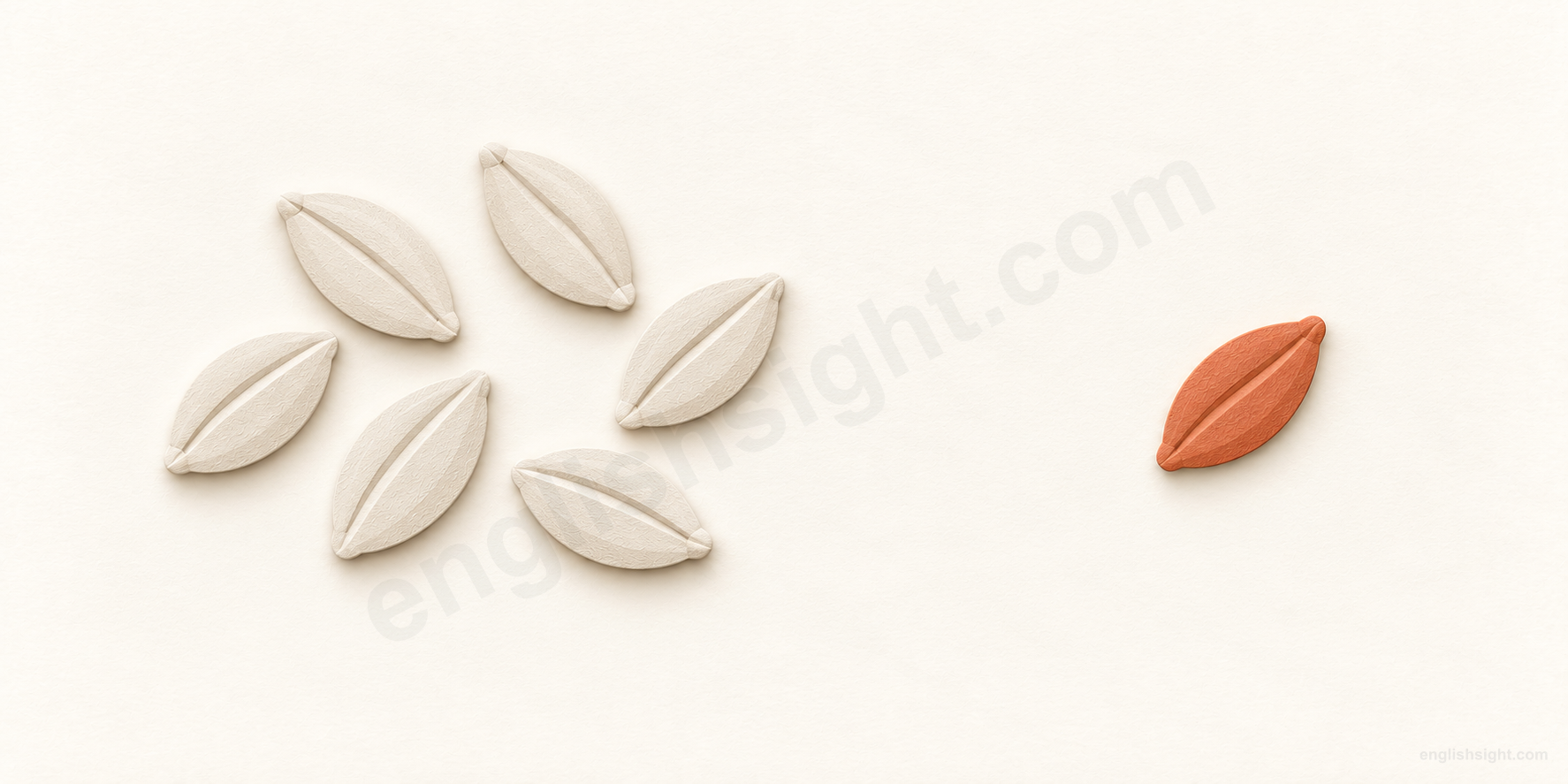
Several cereal kernels are considered together.
grain
One kernel is considered separately.
Focus shifts from the group to one small unit.
A grain is one small unit; grain can also name cereal seeds collectively.
A grain is a small hard unit that can be considered on its own or as part of a mass.
This model connects cereal seeds, hard particles, and figurative tiny amounts. Material texture and direction form a related but distinct branch; fixed idioms need their own explanations.
A grain can be one rice seed or one tiny piece of sand. Grain can also name cereal as a supply. Counting units and naming material require different grammar.
There is another important branch: the grain of wood is its fibre pattern or direction. Keep that branch visible rather than forcing every use into the meaning “seed.”
01
Seeds, crops, and food
Choose between an individual kernel, a supply of cereal, and a food-label expression.
01
a grain of + cereal name; number + grains of + cereal name
a grain of rice
one cereal seed
Situation
Some rice is scattered on the counter.
What you mean
You count the individual pieces.
Grain supplies a countable unit for rice or another cereal.
Rice is normally uncountable when it names the food. To count individual seeds, say one grain of rice or three grains of rice. Rice grains puts the material first as a noun modifier.
The same pattern works with wheat. Seed is broader: an apple seed is a seed, but we do not normally call it a grain. Kernel overlaps with grain for cereal seeds; it is not a replacement for every use in this lesson.
Food labels also use long-grain rice and short-grain rice to describe kernel shape. Long-grain rice has long, slender kernels; short-grain rice has shorter, rounder kernels. For example: This recipe calls for long-grain rice. Grain stays singular inside these modifiers; to count the individual seeds, return to grains of rice.
In a sentence
Three grains of rice were stuck to the spoon.
Watch the difference Say three grains of rice, not three rices, when counting individual pieces.
02
grow / harvest / store + grain; a bag of grain; different grains
grow and store grain
cereal crops or their seeds considered as a supply
Situation
A farm harvests wheat.
What you mean
The wheat is kept as a food supply.
Uncountable grain names the crop or supply; grains can name different kinds.
Grow grain, harvest grain, store grain, and a bag of grain treat it as a crop or material. The verb describes the action; grain names what is grown or handled. Grain production and grain exports use the noun before another noun.
Use much grain for quantity and several grains for several cereal types when that is the context: The farm grows several grains, including barley and oats. Out of context, several grains could instead mean several individual seeds.
In a sentence
The farmer stored the grain in a dry building.
Watch the difference A lot of grain can mean a large supply, not a large number of cereal varieties.
grain foods retaining all the main parts of the kernel
Situation
You compare two bread labels.
What you mean
One describes bread made with whole grain.
Whole refers to retained grain components, not simply an unbroken shape.
A whole grain retains the bran, germ, and endosperm, the main parts of the kernel. It may be ground into flour and still be whole grain. The expression does not require every seed to remain physically unbroken.
Whole grains is a noun phrase. Wholegrain bread and whole-grain bread use an adjective before bread; both spellings occur. These describe ingredients, whereas grains of bread is not the normal way to count pieces of bread.
In a sentence
We bought whole-grain bread for the sandwiches.
Watch the difference Do not interpret whole-grain as meaning that the bread contains only unbroken seeds.
02
Tiny particles and tiny amounts
The small-unit meaning can be physical or can describe a minimal amount of a quality.
04
a grain of + substance; grains of sand / salt / sugar
a grain of sand / salt
one tiny hard particle
Situation
Sand has fallen into a shoe.
What you mean
You notice a single tiny particle.
The small-unit idea extends beyond edible seeds.
A grain of sand or salt is a tiny hard piece of that substance. Grains of sugar is possible too. Of names the material, while the plural ending belongs to grains.
Grain does not count every kind of small thing. Say a drop of water for liquid, a crumb of bread for a small broken piece, and a speck of dust for a tiny dust particle. The material and form guide the choice.
In a sentence
A grain of sand had slipped inside my shoe.
Watch the difference A grain of salt can be literal; the full take … with a grain of salt expression has a separate idiomatic meaning.
05
a grain of + abstract noun; not a grain of truth
a grain of truth
a very small amount of an abstract quality
Situation
A story contains many invented details.
What you mean
One small part may still be accurate.
A tiny physical particle provides a useful comparison for a tiny amount.
There is a grain of truth in it concedes that something is partly true. Not a grain of truth denies even a small amount. This abstract use often appears in negatives, but it is not limited to them.
A grain of sense or a grain of sympathy similarly suggests a minimal amount, often with criticism or emphasis. The quality after of matters: a grain of truth is not a physical piece that can be picked up.
In a sentence
There is a grain of truth in her complaint about the noise.
Watch the difference A grain of truth does not mean the entire account is reliable.
03
Texture, direction, and detail
This branch concerns how material is structured or how finely something is described.
06
the grain of + material; wood grain; a wood-grain pattern
the grain of the wood
the pattern and arrangement of a material’s fibres
Situation
You look closely at a wooden shelf.
What you mean
You notice the natural lines in its surface.
Grain can name the structure visible in a material, rather than a separate seed.
The grain of the wood refers to its fibre arrangement or the visible pattern that arrangement produces. In this sense grain is usually uncountable or singular: This wood has an attractive grain.
This is a distinct material-structure branch. Do not force it to mean a pile of seeds. A wood-grain pattern on a printed surface can imitate real wood; grain can describe appearance even when the object is not solid wood.
In a sentence
The clear finish brings out the grain of the wood.
Watch the difference The grain here is a pattern or structure, not one small removable piece of wood.
07
along / with / across / against + the grain
along / across the grain
in relation to the direction of fibres or threads
Situation
The fibres in a board run lengthwise.
What you mean
You describe a cut by its relation to that direction.
Along follows the fibre direction; across crosses it.
Cut along the grain describes a cut following the direction of the fibres. Cut across the grain describes one crossing that direction. With the grain commonly means following the natural direction; against the grain opposes it.
The noun can also describe the direction of threads in cloth. These are ordinary prepositional phrases, not phrasal verbs. In literal instructions, the material and task determine which direction is useful; against is not a universal warning that an action is wrong.
In a sentence
The first cut runs along the grain, and the second runs across it.
Watch the difference Across and against are not automatic synonyms: crossing a line and opposing a direction describe different relations.
08
fine / coarse grain; fine-grained / coarse-grained + material
fine / coarse grain
the size or character of a material’s texture
Situation
You compare two stone surfaces.
What you mean
One has much smaller visible particles.
Fine and coarse describe the texture, not the amount of material.
A material of fine grain has a fine texture; coarse grain has larger or more noticeable constituent particles or features. Fine-grained and coarse-grained are useful adjectives for such descriptions.
The small-unit and material-structure branches meet in texture: the size and arrangement of components affect the surface. Fine here is about texture, not automatically praise, and coarse does not by itself mean dirty.
In a sentence
The two stones differ in texture: one has a much finer grain.
Watch the difference A fine grain describes texture; a grain of sand identifies an individual particle.
09
film grain; visible grain; a fine-grain image
film grain
the visible granular texture of a photographic image
Situation
You enlarge a photograph taken on film.
What you mean
Its small image-forming particles become noticeable.
Photographic grain concerns image texture, not cereal or wood fibres.
In film photography, grain can refer to the image-forming particles or their visible texture. A fine-grain image shows comparatively little coarseness when enlarged.
Grain is often uncountable when discussing the overall look: The grain is visible in this print. Grainy is a related adjective. Do not use grain as a general synonym for every kind of blur; a picture may be blurry without having conspicuous grain.
In a sentence
Enlarging the film photograph made the grain easier to see.
Watch the difference This is a photography use; it does not mean that bits of sand are stuck to the print.
10
fine-grained + analysis / description
a fine-grained analysis
an analysis that distinguishes small details
Situation
A report gives only a total for the year.
What you mean
A second report examines each week and location.
The adjective extends fine texture to detailed distinctions.
A fine-grained analysis works at a detailed level. This is a figurative use of the adjective fine-grained, not a separate everyday verb grain.
The texture comparison is useful: smaller units allow finer distinctions. However, an analysis can be detailed and still mistaken. Fine-grained describes the level of detail, not proof of quality or accuracy.
In a sentence
We need a fine-grained analysis of when the delays occur.
Watch the difference Do not replace this adjective with many grains: the full adjective carries the figurative meaning.
04
Natural resistance and cautious belief
Learn these full expressions with their meanings; the seed picture cannot predict them by itself.
11
go / be against the grain; it goes against the grain to + verb
go against the grain
conflict with a person’s nature or with normal practice
Situation
Someone values speaking openly.
What you mean
Keeping quiet about a problem feels unnatural to them.
The established expression compares resistance to an opposing natural direction.
It goes against the grain to do something can mean that doing it conflicts with your instincts or principles. The action is the uncomfortable thing; grain does not name a crop in this expression.
Go against the grain can also describe departing from what is customary or generally accepted. Context tells us whether the emphasis is personal reluctance or a departure from convention. It does not necessarily mean the person is morally wrong.
In a sentence
It goes against the grain for me to hide a mistake from the team.
Watch the difference Learn against the grain as an idiom. Go is not describing literal travel, and the phrase is not a separable phrasal verb.
12
take + information + with a grain / pinch of salt
take something with a grain of salt
treat information with some doubt
Situation
An advertisement makes a spectacular promise.
What you mean
You remain cautious about believing it.
The whole expression signals caution about a claim.
Take the claim with a grain of salt means do not accept it completely without question. Something names the information being judged. Nothing needs to be eaten or seasoned.
The grain version is especially associated with North American English. Take something with a pinch of salt is also standard, especially in British English. These expressions leave room for doubt or exaggeration; they do not assert that every part is false.
In a sentence
I would take that promise of instant success with a grain of salt.
Watch the difference Compare add a grain of salt, which can be literal. The skeptical meaning comes from the established with a grain of salt phrase, commonly used with take; it is not a meaning of grain alone.
Keep units, material, and idioms distinct
Countability follows the meaning
One grain and two grains count seeds or particles. Some grain names cereal as a supply. Different grains can name cereal types. A grain of truth measures a figurative amount.
Grain, seed, cereal, and flour
Seed is broader than cereal grain. Cereal can name the crop or a prepared breakfast food; grain does not by itself mean a bowl of breakfast cereal. Flour is the powder produced by grinding grain, not the name for an individual kernel.
Scope and forms
The noun is pronounced /ɡreɪn/ and has the regular plural grains. The specialist verb has forms grain, grains, grained, graining, for such processes as forming granules or imitating wood texture. This lesson concentrates on the noun and useful compounds, not specialist verb constructions.
Do not infer a precise weight from a seed
Grain is also a technical unit of mass. That fixed unit is distinct from the variable weight of an actual rice or wheat seed. Technical measurement systems, metallurgy, leather processing, dye history, and rocketry are outside this everyday lesson.
Choose the meaning that fits
Use the object and the whole expression to decide what grain means.
1. You want to count three individual pieces of rice. Which phrase fits?
2. A farm keeps a large cereal supply after harvest. Which sentence fits?
3. Wood fibres run lengthwise. A cut follows those fibres. Which description fits?
4. You are cautious about believing a remarkable online claim. What could you say?
5. Keeping a mistake secret conflicts with your principles. Which expression fits?
Sources and teaching notes
Dictionary sources support the uses and forms below. The explanations, example sentences, and visual teaching model were created for this lesson.
The diagram is a teaching aid, not a claim about a picture shared by every native speaker.