Use the noun, construction, and context to tell what makes something great.
Far beyond an ordinary level
Far beyond an ordinary level
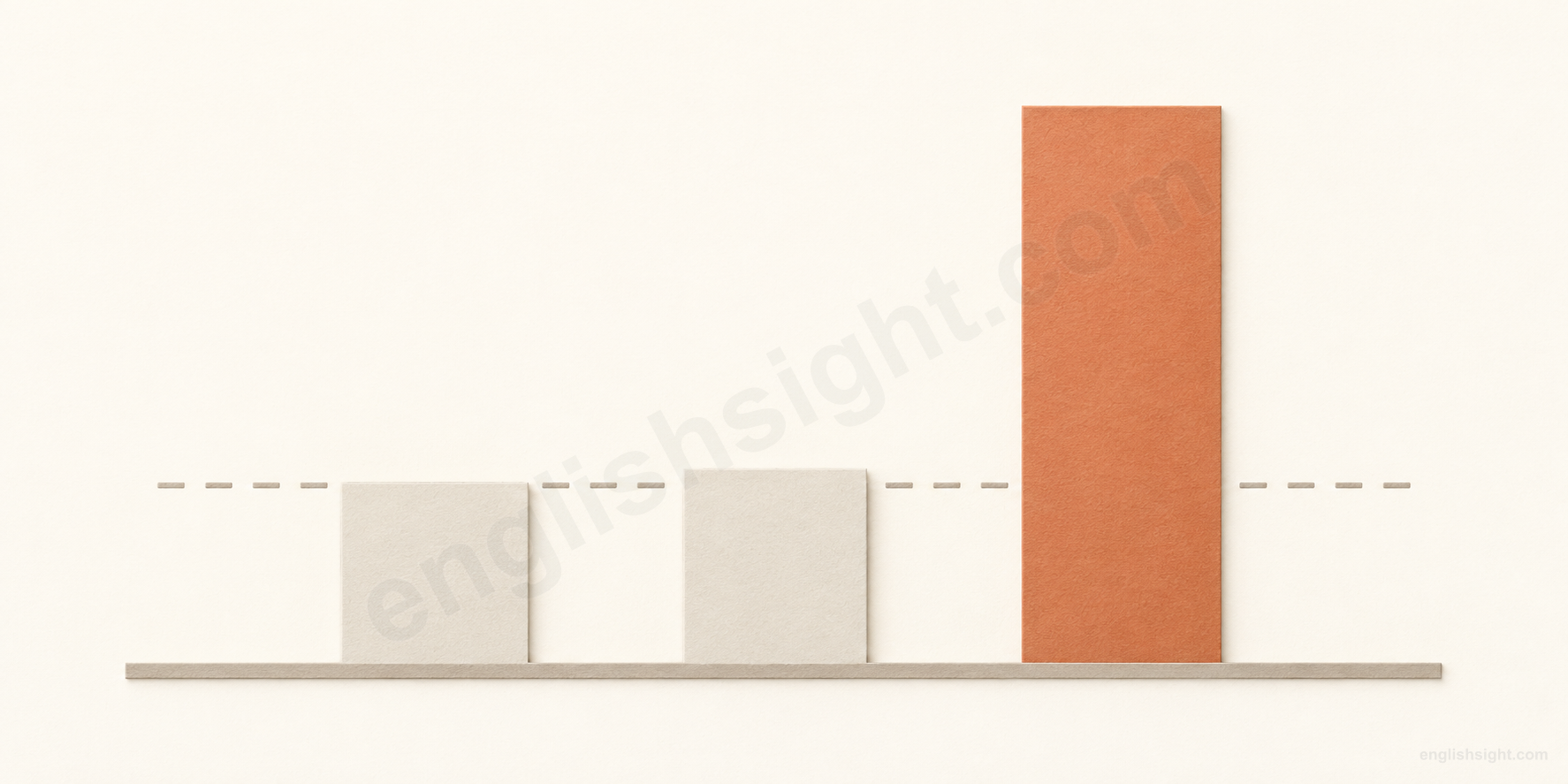
Two ivory bars mark an ordinary comparison range.
great
The terracotta bar rises far above the ordinary range.
Compare levels, rather than stages in time.
Great can mark a high degree; a high degree need not be good.
Great can mark something as far beyond an ordinary level in size, degree, importance, or quality.
The diagram compares levels; it does not show growth over time or guarantee a good outcome. Approval is a common branch, while irony, idioms, and family great- need their own explanations.
Great can emphasize size, amount, or degree, and it can express strong approval. A great danger is serious danger; a great idea is an idea you like very much. The same word does not make both things desirable.
This lesson connects the uses where comparison helps, then treats familiar idioms and the family prefix separately. The diagram is a teaching model for degree, not a picture that every English speaker must imagine.
01
Size, amount, and degree
Ask what is large: a physical object, a quantity, a feeling, a difference, or an effect. A high degree can be welcome or unwelcome.
01
great + concrete noun; a great big + noun
a great tree / a great big box
emphasize impressive physical size
Situation / comparison
An unusually large tree dominates the garden.
Meaning in context
You describe its striking size.
The object is large; this need not be a judgment of quality.
Before a concrete noun, great can emphasize imposing size: a great tree or a great hall. This use can sound descriptive or literary; big and large are more neutral choices for ordinary measurements.
In a great big box, great strengthens big. The box may be awkward or unwelcome. Great big is conversational, unlike the more literary impression that great alone can give with some physical objects.
An everyday sentence such as The box is great will usually sound like praise. Use The box is big when size alone is the intended message.
In a sentence
A great tree shaded almost the whole garden.
Watch the difference Do not use great as a general replacement for big in every size statement.
02
great + abstract noun; with great care; in great detail; to a great extent
great care / great difficulty
mark a high degree of a quality or condition
Situation / comparison
A fragile object needs careful handling.
Meaning in context
You emphasize how much care is needed.
The noun determines whether the high degree is positive or negative.
Great often increases an abstract noun: great care, great difficulty, great pleasure, great danger, great effort. It does not turn danger into something good; it says the danger is considerable.
With great care describes the manner of an action. In great detail means with extensive detail, and to a great extent means largely. These prepositions build different relationships around the same degree meaning.
No great difficulty means no major difficulty, rather than absolutely no difficulty. Contrast a great success with a great failure: the evaluation comes from success or failure.
A great help means someone or something is very helpful: Your notes were a great help. Help names the assistance here, rather than a physically large helper.
Great can also describe extent in time or age. We had not met for a great while means we had not met for a long time; a long time is the more neutral everyday choice. Someone who lives to a great age lives to an advanced age, rather than necessarily having an enjoyable life.
In a sentence
They moved the cracked vase with great care.
Watch the difference Great danger means serious danger, not excellent danger.
03
a great many + plural noun; a great number of + plural noun
a great many / a great number of
describe a large countable quantity
Situation / comparison
You receive far more applications than expected.
Meaning in context
You describe the large number of applicants.
Many and number select countable plural nouns.
A great many applications and a great number of applications both mean many applications. Great adds emphasis; the pattern does not state an exact number.
A great many takes a plural noun directly; a great number takes of before the plural noun. Both phrases normally take a plural verb: A great many people have applied.
Great numbers of people and the great majority of people are related quantity expressions. Majority emphasizes that most people are included, rather than merely a large number.
In a sentence
A great many families use the library after school.
Watch the difference Say a great many books, not a great many money. Use much money or a great deal of money.
04
a great deal of + uncountable noun; verb + a great deal
a great deal of time
describe much of an uncountable thing
Situation / comparison
Repairs require many hours.
Meaning in context
You emphasize the amount of time involved.
A great deal of introduces an amount, not necessarily a bargain.
A great deal of time, money, or information means a lot of it. The usual pattern takes an uncountable noun. A great deal of work remains uses singular agreement with work.
Without a following noun, a great deal can describe how much something happens: The job has changed a great deal. A good deal is a close alternative in this amount expression.
Compare We got a great deal on the desk. There, a great deal is an attractive agreement or price, with great expressing approval. It is a different use of deal from the quantity phrase.
In a sentence
The repair took a great deal of time.
Watch the difference For separate countable objects, use a great many chairs, not a great deal of chairs.
05
greater + noun; greater than; the greatest + noun; a great deal + comparative
greater than / the greatest / a great deal better
compare degrees, amounts, or achievement
Situation / comparison
Two plans have different costs and risks.
Meaning in context
You identify a larger risk or a much better result.
Greater compares the scale in question; better compares goodness.
Great has the comparative greater and superlative greatest. Greater risk is more risk; the greatest risk is the largest risk within the relevant set. Neither is praise.
For everyday approval, good, better, best is often the natural comparison: This is a better idea. The greatest novelist ranks outstanding achievement; a greater novelist suggests greater stature, not simply a more enjoyable book.
A great deal can strengthen a comparative: a great deal better, cheaper, or worse. In This is a great deal better, the comparative is better; great does not become an adverb by itself.
In a sentence
The second route is a great deal safer, although the distance is greater.
Watch the difference Avoid more greater and most greatest: the ending already marks comparison.
06
be of great + abstract noun; a great + event / opportunity
of great importance / a great occasion
emphasize importance or impact
Situation / comparison
A small document determines whether the trip can happen.
Meaning in context
You explain its importance despite its size.
Importance can be great even when the physical object is small.
Of great importance means very important. Of great value and of great concern use the same description pattern, though value and concern supply different kinds of significance.
A great occasion can be a major, memorable event. A great opportunity or a great advantage may combine importance with a positive evaluation; context determines the emphasis.
Great does not always identify something large enough to measure. A passport can be of great importance while fitting into a pocket.
In a sentence
That single page is of great importance to the application.
Watch the difference Use of great importance or very important, not of great important.
02
Praise, well-being, and usefulness
In everyday conversation great often expresses strong approval. The following preposition or complement tells us whether we mean skill, interaction, usefulness, or an experience.
07
great + noun; be / look / sound / taste / smell + great
a great idea / look great / sound great
express strong approval
Situation / comparison
A friend suggests a plan you like.
Meaning in context
You evaluate the plan very positively.
Great can mean very good without saying anything about size.
A great idea is a very good idea. A great cook is someone you think cooks very well. This approving use is ordinary in conversation and can appear before a noun or after be.
Look great, sound great, taste great, and smell great evaluate an impression through the relevant sense. In The soup tastes great, great describes the soup, rather than explaining how the soup performs an action.
Really great and absolutely great are natural enthusiastic forms. Very great is possible in degree expressions such as very great difficulty, but really great is a more natural everyday compliment than very great.
In a sentence
Your plan sounds great, especially the walk by the river.
Watch the difference A great room may be an excellent room; context must establish a physical-size reading.
08
have a great time; have a great + day / weekend; do a great job; great fun
have a great time / do a great job
praise an experience or someone’s work
Situation / comparison
A group enjoys a day together.
Meaning in context
You say the experience was very enjoyable.
Time names an experience here, not an unusually long duration.
Have a great time means enjoy yourself. Have a great weekend is a friendly wish. Neither expression promises that the period will be longer than normal.
Do a great job praises the quality of someone’s work. Great fun describes something very enjoyable; fun is normally uncountable in this pattern.
Compare a great time with a great deal of time: the first evaluates the experience, while the second describes an amount. The surrounding noun phrase changes the meaning.
In a sentence
We had a great time building the kite together.
Watch the difference Say It was great fun, not It was a great fun.
09
feel + great; not feel too great
feel great / not feel too great
describe a very good physical or emotional state
Situation / comparison
You rest after a tiring week.
Meaning in context
You report that you feel refreshed.
Feel great describes your condition, not your size or fame.
I feel great can describe energy, health, or mood. The surrounding conversation tells us whether the speaker mainly means physical well-being or happiness.
I don’t feel too great is a conversational way to say you feel unwell or low. It may soften the report rather than mean you are only a little below excellent.
You look great can compliment appearance without making a reliable claim about health. Looking well and feeling well can differ.
In great spirits describes a very cheerful mood. In great form can describe someone who is feeling and behaving very well. These are established phrases rather than references to ghosts or body shape.
In a sentence
After a quiet night, I feel great this morning.
Watch the difference Do not infer a medical condition from the compliment You look great.
10
be great at + noun / -ing
be great at explaining
praise skill in an activity
Situation / comparison
Maya makes difficult instructions easy to understand.
Meaning in context
You praise her ability to explain.
At introduces the activity in which someone performs well.
Be great at chess names a skill. With an action, use an -ing form: great at explaining, cooking, or solving problems. Great adds enthusiastic praise to the familiar good at pattern.
She is a great teacher praises her in the role. She is great at teaching highlights an activity. A person may be great at one part of a job and less good at another.
At is a preposition here, so great at to explain is not the pattern. Great to work with has a different structure and evaluates the experience of working with someone.
In a sentence
Maya is great at explaining difficult instructions.
Watch the difference Use at plus -ing: great at solving problems, not great at solve problems.
11
be great with + person / animal / thing
be great with children
handle or interact with someone or something very well
Situation / comparison
A volunteer helps nervous children settle in.
Meaning in context
You praise the volunteer’s manner with them.
With names the people or things someone handles well.
Great with children praises the way someone interacts with children. Great with animals works similarly; great with computers can praise an ability to handle or use them.
Compare great at teaching children, which names an activity, with great with children, which focuses on the people involved. The meanings may overlap but the complements differ.
Great for children evaluates suitability or benefit to children. A museum can be great for children without itself interacting with them as a person does.
In a sentence
Our new volunteer is great with nervous children.
Watch the difference Do not treat with and for as interchangeable: good interaction and suitability answer different questions.
12
be great for + noun / -ing
be great for opening jars
recommend suitability or usefulness
Situation / comparison
Someone needs a tool for tight lids.
Meaning in context
You recommend a tool for that purpose.
For introduces the use or beneficiary, not the performer’s skill.
A tool is great for opening jars means it works very well for that purpose. Great for travel similarly says that something suits traveling.
A park can be great for children because it offers suitable play space. That does not mean the park is skillful; for gives the purpose or people who benefit.
Compare Jo is great at opening jars with This tool is great for opening jars. The first praises Jo’s ability, and the second recommends a useful object.
In a sentence
This small tool is great for opening tight jars.
Watch the difference After the preposition for, use opening, not to open.
13
it is / would be great to + verb; person / thing + be great to + verb + preposition
It’s great to see you / great to work with
evaluate an action or experience
Situation / comparison
You meet an old friend again.
Meaning in context
You express pleasure at seeing the friend.
The infinitive supplies the experience being evaluated.
It’s great to see you uses it as a grammatical placeholder, with to see you naming the pleasant experience. It would be great to visit can express a wish or respond positively to a possible plan.
In This editor is great to work with, the editor is the person you work with. The preposition with belongs to work with; it is not the same structure as great with children.
Great to see you is a natural shortened greeting. It does not say the person has grown or become famous.
In a sentence
It would be great to see you when you are in town.
Watch the difference Keep the needed preposition: She is great to work with, not She is great to work.
14
do / go / work + great (informal)
do great / things are going great
informally say that performance or progress is very good
Situation / comparison
A learner worries about progress.
Meaning in context
You give casual encouragement.
Here great modifies performance rather than naming a property after a linking verb.
You’re doing great is a familiar conversational encouragement. Things are going great similarly reports very good progress. Here great functions as an adverb.
Usage labels differ: Oxford labels this adverb informal and non-standard; Collins labels it informal, while Merriam-Webster records the adverb without that label. Doing very well is a neutral alternative for formal work.
Greatly is a different adverb meaning to a high degree in combinations such as greatly improved. You’re doing greatly does not ordinarily replace You’re doing great.
In a sentence
You’re doing great; the instructions are much clearer now.
Watch the difference For formal prose choose very well when it fits; do not mechanically replace great with greatly.
03
Ability, importance, and personal habits
Distinguish outstanding achievement from power, enthusiasm, and closeness. The noun being described matters as much as great itself.
15
a great + person / achievement; one of the greatest + plural noun
a great scientist / a great achievement
describe outstanding ability or accomplishment
Situation / comparison
A scientist’s discoveries transform a field.
Meaning in context
You describe exceptional achievement.
Great can express enduring distinction beyond a casual compliment.
A great scientist or a great artist has exceptional ability or achievements. This can carry a stronger judgment of importance than saying someone is a great person to chat with.
The greatest scientist in a field compares standing within a group. One of the greatest scientists leaves room for other outstanding figures.
A great achievement emphasizes something remarkable that was accomplished. Admiration does not have to mean worldwide fame, and context determines how strong the praise is.
In a sentence
Her colleagues regard her as one of the great scientists of her generation.
Watch the difference After one of the greatest use a plural noun: scientists, not scientist.
16
a great power; the great powers; name + the Great; the great and the good
a great power / Alexander the Great
refer to major influence or a historical title
Situation / comparison
A country has strong international influence.
Meaning in context
You classify it among leading powers.
Great can identify power or historical stature without moral approval.
A great power is a country with major influence. In historical writing, the great powers refers to the leading countries in the situation being discussed.
Alexander the Great contains a conventional title after a name. The capitalized title is not a new claim by the speaker that every action of that ruler was admirable.
The great and the good is a group expression for prominent, respected people, often used with an ironic attitude toward their status. It does not name every good person.
In a sentence
The treaty changed the balance between the great powers.
Watch the difference Power, public distinction, and moral goodness are separate judgments.
17
a great + activity / attitude noun; be a great one for + noun / -ing; a great believer in + noun / -ing
a great reader / a great one for walking
describe strong interest or a frequent habit
Situation / comparison
Your uncle walks whenever he can.
Meaning in context
You describe walking as a favorite regular activity.
The activity noun may emphasize enthusiasm rather than exceptional skill.
A great reader often reads a lot; a great admirer strongly admires someone. A great pianist, by contrast, is usually praised for ability. The noun and context determine the kind of greatness.
Be a great one for doing something describes an enjoyment or habit: She’s a great one for making lists. It can be affectionate or mildly critical, depending on context.
I’m not a great one for parties means I do not particularly enjoy or often attend them. It does not normally mean I am a morally bad party guest.
A great believer in something strongly believes that it is good, important, or valuable: I’m a great believer in learning through play. In belongs to believer in; use a noun or an -ing form after it. This is not limited to religious belief.
In a sentence
My uncle is a great one for walking before breakfast.
Watch the difference A great reader need not be a brilliant reader; the phrase can focus on how much someone reads.
18
be great on + subject / interest (informal, especially British)
be great on local history
know a subject well or be enthusiastic about it
Situation / comparison
A friend needs information about old buildings.
Meaning in context
You suggest someone with knowledge of local history.
Great on can concern knowledge or enthusiasm; context selects the reading.
In informal British usage, be great on a subject can mean know a lot about it: Ask Ruth; she’s great on local history. This is not a physical position on top of a subject.
It can also express enthusiasm: Ruth is great on recycling; she talks about it whenever she can. That sentence stresses what she favors, rather than proving specialist expertise.
Great at is the clearer general pattern for skill in doing an activity. Great on is not a freely interchangeable substitute in every great at sentence.
In a sentence
Ask Ruth about the old station; she’s great on local history.
Watch the difference Do not assume that enthusiasm always proves expertise; read the surrounding information.
19
be great friends; become great friends
great friends
emphasize a close friendship
Situation / comparison
Two neighbors have shared their lives for years.
Meaning in context
You describe the strength of their friendship.
Great friends describes the relationship rather than physical size.
We are great friends can mean we are very close friends. Great strengthens the relationship expressed by friends.
Compare They are great friends with They are great people. The first can describe their closeness to one another; the second directly praises them as people.
Great friends can also mean friends you value highly. When the intended point is closeness alone, close friends makes that meaning explicit.
In a sentence
The two neighbors became great friends over the years.
Watch the difference The plural friends describes a relationship involving more than one person.
20
an all-time great; one of the greats; the greats of + field
one of the all-time greats
name an outstanding person in a field
Situation / comparison
A museum celebrates several influential musicians.
Meaning in context
You place one musician among the outstanding figures.
Great becomes a countable noun for a distinguished person.
An all-time great is an outstanding figure considered across the history of a field. The greats commonly refers to several such people, as in the greats of jazz.
One of the greats uses a plural noun after one of. A great singer has an adjective before singer; a great can itself stand for the distinguished person.
In music journalism, greats can also refer to enduringly popular recordings or songs. Context must tell you whether a program features famous performers or classic recordings.
In a sentence
The exhibition celebrates one of the all-time greats of jazz.
Watch the difference The noun greats takes a plural ending; the adjective in great musicians does not.
04
Responses and evaluations
Great can accept a proposal, express pleasure, or express annoyance through irony. Read the situation and tone rather than a positive word alone.
21
Great!; That sounds great.; That would be great, thanks.
Great! / That would be great.
show pleasure, agreement, or appreciation
Situation / comparison
A friend offers to collect your parcel.
Meaning in context
You warmly accept the offer.
The short response evaluates the offer without repeating it.
Great! can show that you are pleased with news or accept a suggestion. That sounds great evaluates a proposal; That would be great welcomes something offered or imagined.
You can add thanks when accepting help. The words do not by themselves specify a time, price, or other arrangement; those details still come from the conversation.
In this use, dictionaries may call Great! an exclamation or treat it as a shortened approving evaluation. Either analysis captures its positive conversational function.
In a sentence
“I can bring the parcel over tonight.” “That would be great, thanks.”
Watch the difference Would can respond politely to an offer; it need not signal doubt about the speaker’s gratitude.
22
Oh, great. (ironic); be not great; not too great
Oh, great. / not great
use context to reverse or soften an evaluation
Situation / comparison
Rain starts just after you hang the washing outside.
Meaning in context
You express annoyance rather than delight.
Tone and an unwelcome event can turn apparent praise into irony.
Oh, great can be sincere, but after bad news it often means the speaker is annoyed. The positive word remains the same; the ironic meaning comes from context and delivery.
Compare an excited Great! after an offer of help with a flat Great after a new problem. Written punctuation alone may not reveal the intended tone.
Not great often gives a restrained negative evaluation: The interview wasn’t great can mean it went rather badly. No great problem instead minimizes the size of a problem; it is not the same pattern.
In a sentence
Oh, great. It’s raining, and all the washing is outside.
Watch the difference Do not interpret every Great! as approval or every Oh, great as sarcasm.
23
the great thing about + noun + is…; the great thing is that…; What’s so great about…?
The great thing about… is…
highlight a particularly good feature
Situation / comparison
You explain why you like an online course.
Meaning in context
You identify the feature that matters to you.
The construction selects an advantage for special attention.
The great thing about this course is its flexibility draws attention to a major good feature. With a clause, say The great thing is that you can study anywhere.
What’s so great about it? asks what makes something special and can sound skeptical. The question may request a real reason rather than express enthusiasm.
The great thing is to finish can instead identify the most important objective. Read the complement: that-clause evaluations and to-infinitive priorities need not have exactly the same emphasis.
In a sentence
The great thing about this course is that you can study at your own pace.
Watch the difference Use about before the topic: the great thing about the course, not the great thing of the course.
05
Familiar expressions and idioms
Learn these expressions as whole units. Great contributes emphasis, but the surrounding words supply meanings that the comparison sketch cannot predict.
24
be no great shakes; be no great shakes at + noun / -ing
be no great shakes
say that ability or quality is unimpressive
Situation / comparison
You can play chess, but only at a basic level.
Meaning in context
You give a modest assessment of your ability.
The idiom gives a negative evaluation, not a description of shaking.
Be no great shakes means be unremarkable or not particularly good. It can describe a person’s skill or the quality of a thing.
You can specify an activity with at: I’m no great shakes at chess. The expression is informal and often sounds self-deprecating when used about yourself.
Do not assemble this meaning from separate literal meanings of no, great, and shakes. Learn no great shakes together.
In a sentence
I enjoy chess, but I’m no great shakes at it.
Watch the difference Keep the plural shakes in the fixed expression.
25
be going great guns
be going great guns
describe vigorous, successful progress
Situation / comparison
A new club quickly gains members.
Meaning in context
You describe its strong progress.
The whole idiom expresses momentum and success, without literal weapons.
Be going great guns says that an activity or enterprise is progressing energetically and successfully. It is an informal expression.
The subject can be a project, organization, or person engaged in an activity. The pattern often appears in the progressive because it evaluates how things are currently developing.
Compare Things are going great, which is a broad positive progress report. Going great guns adds a stronger sense of vigor and momentum.
In a sentence
The new chess club is going great guns and now meets twice a week.
Watch the difference Do not translate guns literally when the context is progress.
26
Great minds think alike.
Great minds think alike.
joke when two people have the same idea
Situation / comparison
You and a friend both bring the same game.
Meaning in context
You jokingly celebrate having thought alike.
The saying playfully praises shared thinking rather than proving exceptional intelligence.
Great minds think alike is a light response when you and someone else make the same choice or suggest the same thing. It jokingly includes both of you among clever people.
The expression works because the shared idea is already clear. It is usually friendly or humorous rather than a serious claim about how highly intelligent people reason.
Agreement is not evidence that the idea is correct. The saying is a social response, not a rule for evaluating an argument.
In a sentence
“You brought the same game!” “Great minds think alike.”
Watch the difference Use the established plural minds and the adverb alike.
27
go to great pains to + verb; take great pains with / over + noun
go to great pains to…
emphasize careful effort
Situation / comparison
A guide wants every visitor to understand the instructions.
Meaning in context
You describe the care put into explaining them.
Pains means effort in this expression, not necessarily physical suffering.
Go to great pains to explain something means make a substantial, careful effort to explain it. The to-infinitive names the goal.
Take great pains with or over something focuses on care given to the work: She takes great pains over each drawing. Take great pains to do something is also possible.
The care may be worthwhile or excessive, depending on context. The expression does not guarantee that the effort succeeds.
In a sentence
The guide went to great pains to explain the route clearly.
Watch the difference Keep pains plural in this idiom: go to great pains to explain, not go to great pain to explain.
28
go to great lengths to + verb; discuss / explain + at great length
go to great lengths / at great length
distinguish extreme efforts from a lengthy explanation
Situation / comparison
Organizers take elaborate steps to protect a surprise.
Meaning in context
You emphasize how far their efforts go.
Lengths in one idiom and length in another do different jobs.
Go to great lengths to do something means take substantial, sometimes unusually elaborate measures to achieve a goal. Go does not require a physical journey.
At great length describes speech or writing that continues extensively and in detail: She explained the schedule at great length. It evaluates the extent of the explanation rather than the measures taken to achieve a goal.
Compare go to great pains: that often foregrounds careful effort. Go to great lengths foregrounds how far someone is prepared to go. These can overlap without being identical.
In a sentence
They went to great lengths to keep the party a surprise.
Watch the difference Use plural lengths after go to, but singular length after at great.
29
be greater / more than the sum of its parts
greater than the sum of its parts
say a combination achieves more than its separate elements suggest
Situation / comparison
Several modest performers work exceptionally well together.
Meaning in context
You praise the combined result.
Greater evaluates the whole in relation to its components.
A team that is greater than the sum of its parts is more effective together than its members would lead you to expect when considered separately.
This is an established comparison applied to groups, artworks, or other combinations. It often suggests that the relationship among elements adds value.
It does not claim that ordinary arithmetic is false. The sum is a figurative estimate of individual contributions, and greater can often be replaced by more in this expression.
In a sentence
This little band is greater than the sum of its parts.
Watch the difference The expression praises the combined effect, not necessarily every component separately.
30
the great outdoors; enjoy / explore the great outdoors
the great outdoors
refer enthusiastically to natural open places
Situation / comparison
You want a break from buildings and busy streets.
Meaning in context
You talk about enjoying nature.
The phrase names the natural outdoor environment as an appealing whole.
The great outdoors refers to the natural world outside, especially countryside and open spaces where people walk, camp, or explore.
The noun phrase takes the: enjoy the great outdoors. By contrast, We ate outdoors uses outdoors as an adverb and has no the.
This is a familiar expression rather than a measurable claim that a particular outdoor area is larger than another.
In a sentence
We spent the weekend exploring the great outdoors.
Watch the difference Do not use the in the simple adverbial sentence We slept outdoors.
06
Family relationships and established names
The family prefix and words in names need their own conventions. They do not simply describe excellent relatives or objects.
31
great- + family term; great-great- + family term
great-grandmother / great-aunt
mark an additional generation in a family relationship
Situation / comparison
You trace relationships beyond your grandparents.
Meaning in context
You identify an older generation precisely.
The prefix great- changes a kinship relationship, not a person’s quality.
Your great-grandmother is the mother of one of your grandparents. A great-grandchild is the child of a grandchild. The added generation can be older or younger than you.
A great-aunt is an aunt of one of your parents, not necessarily an especially kind aunt. Repeating great- adds another generation: a great-great-grandparent is one generation beyond a great-grandparent.
Writing my great aunt without the hyphen may simply praise an aunt, although real-world spelling varies. Keep the hyphen in the kinship terms you learn here.
In a sentence
My great-grandmother taught my grandmother this song.
Watch the difference Great-grandmother and grandmother are different generations, not different levels of admiration.
32
Greater + city name; great + established animal / plant name
Greater London / the great white shark
recognize established names rather than new evaluations
Situation / comparison
You read an address in a wider city region.
Meaning in context
You recognize a place name rather than a compliment.
Names and classification terms follow established conventions.
Greater before a city name can designate the city together with a wider surrounding area, as in Greater London. It is not a comparison saying that London is morally or aesthetically better.
Great also appears in established animal and plant names, often distinguishing a larger kind from related kinds: the great white shark. The word alone does not identify a species or give its exact dimensions.
Learn geographical, historical, and biological names as complete terms, including their conventional capitalization. The comparison sketch helps with the idea of extent, but cannot predict official names or boundaries.
In a sentence
Her new office is in Greater London, beyond the central districts.
Watch the difference Do not create a supposed official place or species name merely by adding Great or Greater.
Read beyond the positive sound
Degree, praise, and comparison
Great is pronounced /ɡreɪt/, like grate. Forms are great, greater, greatest; noun greats is separate. In degree uses, greater means more, not necessarily better. For everyday praise, better and best are often the natural comparative choices.
The preposition carries a relationship
Great at describes skill in an activity; great with describes handling or interaction; great for describes usefulness or suitability. They overlap in some situations but are not a single interchangeable phrase.
Scope and grammar
This is primarily an adjective lesson, with the familiar noun, conversational adverb, exclamation, and family prefix included. Passive and causative verb families and separable particle verbs do not apply to great. In make something great, make supplies the causative construction; great is an adjective complement.
A useful model has limits
The scale sketch helps with size and degree and can support comparisons of quality. It does not predict the meaning of every idiom, establish an exact threshold, or describe a universal mental image. Historical, technical, and some less useful expressions are listed as outside the main scope in the coverage notes.
Choose what great contributes
Read the noun, preposition, and situation before choosing.
1. A report warns of great danger. What does great contribute?
2. You recommend a tool because it opens tight jars easily. Which pattern fits?
3. You mean that the repair needs many hours, rather than that you enjoy it. Which phrase fits?
4. Your bus leaves just before you reach the stop. You say Oh, great in an annoyed voice. What do you mean?
5. Who is your great-grandmother?
6. Plan B has greater risk than Plan A. What does that comparison say?
Sources and teaching notes
The sources below support the usage inventory. Explanations and examples are original; the comparison diagram is a teaching interpretation. Oxford, Collins, and Merriam-Webster group the senses differently and label the conversational adverb differently.
The diagram is a teaching aid, not a mental picture shared by every English speaker.