From leaf colour to growth and familiar expressions.
Recognize the colour, then let the situation and the whole phrase guide you.
Leaf colour, growing life, and context
Leaf colour, growing life, and context
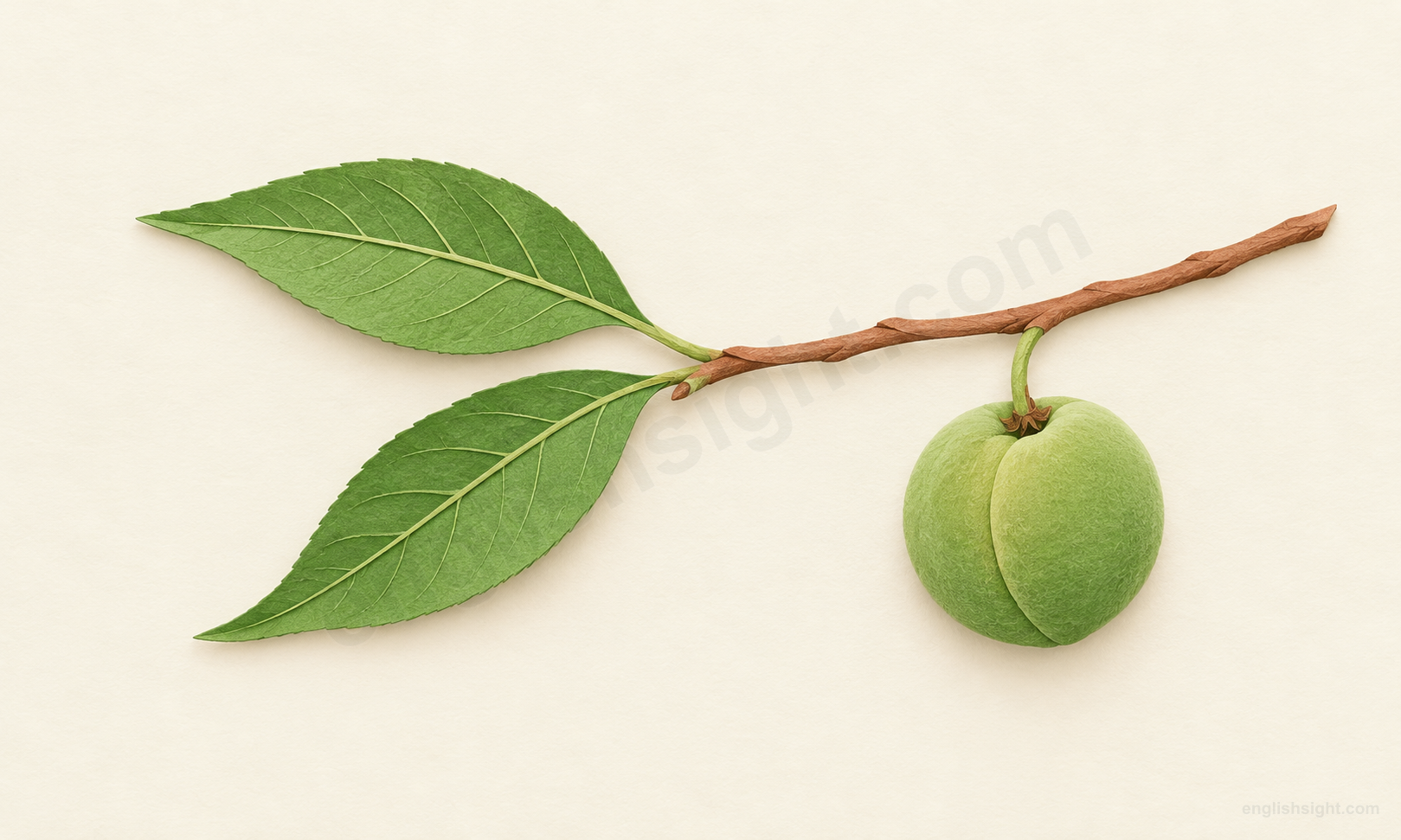
The leaves provide a familiar reference for the colour green.
green
The fruit is presented here as still developing, before ripeness.
Leaves and a developing fruit share the same branch and colour.
Leaf colour connects with an unripe growth stage here; green colour alone does not establish ripeness.
Green names a colour familiar in living leaves; plant-related uses also describe vegetation and a stage before maturity. Other meanings depend on the context or an established expression.
The branch shows the literal plant anchor and an unripe fruit together, not a universal change from one meaning into another. Inexperience, environmental concerns, sickness, and idioms need the explanations below.
Green first gives us a familiar colour reference: the leaves and grass around us. In other contexts it points to vegetation, fruit that has not ripened, a beginner’s lack of experience, or environmental concerns.
These links are useful for learning, but they do not make every green expression predictable. A green light, green fingers, and green with envy each need their own context. The diagram is a teaching aid, not a shared mental picture claimed for every English speaker.
01
A visible colour
Start with what you can see. Then distinguish an adjective describing an object from a noun naming its colour.
01
green + noun; be / look / turn + green
a green coat / turn green
have, or come to have, the colour of many leaves
Situation / starting point
You need to identify one coat among several.
Meaning in this context
Its colour distinguishes it.
Green describes a visible property; turn supplies a change.
Put the adjective before a noun, as in a green coat, or after a linking verb: The coat is green. A green coat need not have any connection with plants; the familiar leaf colour is the reference point.
Light green and dark green specify shades. In The light turned green, turn means became; green names the resulting colour. A traffic signal’s colour can carry a conventional instruction, but green itself is not a verb meaning go.
In a sentence
Mia chose a dark green coat.
Watch the difference An adjective has no plural ending: green coats, not greens coats.
02
green as a noun; in green; a shade of green; different greens
in green / a shade of green
name the colour itself
Situation / starting point
You are choosing paint rather than naming an object.
Meaning in this context
You discuss green as a colour.
A colour word can be a noun as well as an adjective.
In I like green, the word names a colour. In dressed in green, it names the colour of the clothing without naming the individual garments. This differs from a green dress, where green describes dress.
Green is usually uncountable when referring to the colour generally. A pale green means one shade, and several greens means several shades: The artist used three different greens. These are colour uses of countable nouns, not vegetables.
In a sentence
We painted the door a soft green.
Watch the difference Use context to distinguish different greens in a painting from greens on a plate.
02
Plants, food, and grassy places
Leaves provide a useful anchor, but green can describe vegetation, a stage of growth, food, or a particular area of grass.
03
green + place noun; green space; land turns green
green hills / green space
covered with grass, leaves, or other plants
Situation / starting point
You compare a planted area with nearby buildings.
Meaning in this context
You describe the area through its vegetation.
A green place contains growing plants, not merely green paint.
Green hills draws attention to grass or other vegetation. A town can have more green space when it gains parks or planted areas. Here the colour is closely connected with what covers the land.
The hills turned green after the rain describes a change in their appearance as vegetation grows. It does not say that every plant is healthy or that the whole town follows environmental policies. Compare a green wall painted that colour with a green hillside covered in plants.
In a sentence
We stopped beside a green field beyond the houses.
Watch the difference A green city can mean a city with many plants or one with environmental policies; the context must decide.
04
green + fruit / wood; fruit is still green
green fruit / still green
not yet ripe or fully ready
Situation / starting point
The fruit is still developing.
Meaning in this context
You decide to leave it longer before eating it.
The growth-stage meaning is related to plants, but colour and ripeness are different tests.
Green can describe fruit that has not ripened. In The peaches are still green, still emphasizes that they have not reached the expected stage. The picture of a leaf beside a developing fruit helps connect colour with growth, without making the two meanings identical.
Some fruit stays green when ripe, so green does not always mean unripe. A green apple may name its colour or type. In another established use, green wood is recently cut wood that has not dried or seasoned; it is not necessarily green in colour. Do not extend this to all fresh food.
In a sentence
These pears are still green; leave them for a few days.
Watch the difference Green is not a general replacement for raw: raw rice means uncooked rice, not green rice.
05
some greens; salad greens; greens + plural verb
greens / salad greens
leafy vegetables eaten as food
Situation / starting point
You plan the vegetable part of a meal.
Meaning in this context
You refer to leafy vegetables together.
Greens is a plural food noun, not every green-coloured food.
Greens commonly refers to edible leaves such as spinach or cabbage. Salad greens are leaves used in a salad; greens can also be cooked. Serve some greens is a natural way to discuss a portion without counting individual leaves.
Use plural agreement: These greens are fresh. A green salad is a salad based on green leaves. Peas and green apples are not automatically called greens just because of their colour.
In a sentence
We served the rice with steamed greens.
Watch the difference For this food meaning, say some greens or a bowl of greens, not a green.
06
a village / town green; on the green
the village green
an open grassy area in a village or town
Situation / starting point
People arrange to meet in a shared outdoor place.
Meaning in this context
They name the local area of grass.
Here green is a countable place noun.
A green is a grassy open area, especially a shared space in a town or village in British English. A village green may be used for games or gatherings. The noun names the place rather than just its colour.
Say on the green for an event taking place on that area. Compare The village is green, which describes the village, with The village has a green, which says it contains a particular grassy space.
In a sentence
The summer fair takes place on the village green.
Watch the difference Do not use a green as a general synonym for any park; it names a particular kind of grassy area.
07
the green; a putting green; on the green
on the green / putting green
the short-grass area around a golf hole
Situation / starting point
A golfer has brought the ball close to the hole.
Meaning in this context
The next shot is played on the closely cut area.
The sport gives green a specific place meaning.
In golf, the green is the area of closely cut grass around a hole, where players putt the ball. The eighteenth green is the green associated with the eighteenth hole, not the entire golf course.
The ball landed on the green locates it on that area. This is a conventional noun use related to grassy ground; it does not mean any green patch visible during the game.
In a sentence
Her ball stopped near the edge of the green.
Watch the difference A golf course contains several greens; a green is only part of the course.
08
some green tea; a cup of green tea
green tea
a named type of tea
Situation / starting point
You choose a drink from a menu.
Meaning in this context
You name a tea type rather than just its colour.
Some combinations name products and must be learned as units.
Green tea is a type of tea made from leaves processed differently from those used for black tea. The name does not simply mean any drink that looks green.
Use it as an uncountable drink name: some green tea or a cup of green tea. In a café, Two green teas, please can mean two servings. This serving use does not change the basic meaning.
In a sentence
Would you like a cup of green tea after lunch?
Watch the difference The name identifies the tea; it does not promise that the liquid will be a bright green colour.
03
Experience and appearance
With people, green can refer to limited experience or an unhealthy appearance. Read the situation before choosing the meaning.
09
be (still / very) green; a green + person noun
still green / a green recruit
inexperienced in a job or situation
Situation / starting point
A new team member has not learned the routines.
Meaning in this context
You explain why guidance is needed.
Green describes lack of experience, not lack of intelligence.
Informally, a green person is new to the relevant activity and has not developed much experience. The growth-stage connection is a useful teaching comparison: a beginner has not yet developed the experience expected in the role.
You can say He is still green or a green recruit. An older person can be green in a new role too. The description may sound dismissive, so new to the job or inexperienced is often kinder in a formal assessment.
Green can also suggest being naive or easily deceived because of limited experience: Don’t be so green—check who sent the message before you trust it. This informal criticism can sound unkind; it is not a neutral statement about someone’s intelligence.
In a sentence
I was very green when I joined the repair team.
Watch the difference Do not confuse a green employee, a beginner, with an employee who is green because they care about the environment.
10
look / turn green; be / look green around / about the gills
look green / green around the gills
look pale and as if about to be sick
Situation / starting point
A passenger feels ill during a rough journey.
Meaning in this context
Their face looks unusually pale and unhealthy.
Appearance and context distinguish this from inexperience.
When somebody looks green on a boat or after an unpleasant experience, the expression can describe a sickly appearance, especially nausea. Look is a linking verb here; it describes how the person appears.
The person need not have literally green skin. Compare The new sailor is green, which may describe inexperience, with The sailor looked green during the storm, which strongly suggests feeling sick. Neither reading follows from the colour word alone.
The informal expression green around the gills, also green about the gills, describes looking or feeling sick, especially nauseated: After the ride, I felt green around the gills. Gills are part of a fish’s body, but this expression describes people; it is not a literal anatomical claim. It can also describe nervous pallor.
In a sentence
By the end of the boat trip, Ben looked rather green.
Watch the difference Look green describes appearance; it is not a medical diagnosis or a general word for every illness.
04
Environmental choices and change
Green also belongs to discussions of nature, public policy, and environmental impact. These uses do not require anything to be visibly green.
11
green + noun; be green; go green; greener + noun
green energy / go green
concerned with protecting the environment
Situation / starting point
You compare ways of producing energy or using resources.
Meaning in this context
You describe an environmental aim or choice.
The plant connection leads to nature-related language, not a literal colour requirement.
Green energy, green policies, and a green lifestyle relate to environmental protection or reduced environmental harm. A green product does not have to be coloured green. Go green means adopt more environmentally friendly practices; go supplies the idea of changing.
Greener compares environmental impact or practices: a greener way to travel. The word alone does not specify how impact was measured or prove that a product causes no harm. Read the particular claim rather than treating green as an absolute guarantee.
In a sentence
The office is trying to go green by using less paper.
Watch the difference Going green is an environmental change; turning green may simply mean changing colour.
12
the Green Party; the Greens; a Green
the Green Party / the Greens
a political party or its members associated with environmental protection
Situation / starting point
You read a report about an election.
Meaning in this context
You identify a political group.
Capitalization and context distinguish a political name from a general description.
The Green Party names a political party associated with environmental aims. The Greens can name the party or its members collectively. It is a plural expression: The Greens have announced their candidate.
A green voter may simply be a voter concerned about the environment; that does not necessarily identify their party. This political use is related to environmental green, not to a party’s members being inexperienced.
In a sentence
The Greens have chosen a new local candidate.
Watch the difference Greens on a menu are vegetables; the Greens in an election report are a political group.
13
green + place; the greening of + place
green the city
add plants and green spaces to an urban area
Situation / starting point
A built-up neighbourhood has few trees or planted areas.
Meaning in this context
A project adds vegetation.
As a verb, green can mean making a place more planted.
In plans to green the city, green is a transitive verb: the city is the object being changed. The project might create parks or add trees. This is especially useful language in planning and environmental discussions.
The forms are green, greens, greened, and greening. The noun-like phrase the greening of the city names the process. In more general use, grass can green as it becomes green; the more explicit turn green is also available.
In a sentence
Volunteers are greening the neighbourhood by planting street trees.
Watch the difference Greening a city need not mean painting its buildings green.
14
green + business / policy; be greened
green the business
make practices more environmentally friendly, or present them that way
Situation / starting point
An organization reviews the environmental effects of its work.
Meaning in this context
It changes, or promotes changes to, its practices.
The verb can describe practical change or an environmental presentation.
Greening a business or its policies can mean changing operations to reduce environmental harm. The object is the organization or policy being changed, not an item being coloured.
Context matters: green can also concern making people more environmentally aware or making an organization appear environmentally friendly. The verb alone does not establish whether improvements are substantial. This use is more typical of policy and business discussion than casual descriptions of a colour.
In a sentence
The company hopes to green its operations by cutting energy waste.
Watch the difference Compare is green, a description, with is greening its operations, an ongoing action with an object.
15
the green belt; green belt land
the green belt
open land around a city where building is controlled
Situation / starting point
A planning discussion concerns land outside a city.
Meaning in this context
The speaker identifies an area with restrictions on development.
Green belt is a land-use term, not just a description of its colour.
Especially in British English, a green belt is open land around a city where building is strictly controlled. The belt image suggests an area around the city, rather than a belt someone wears.
The term is useful in local planning news: green belt land and building in the green belt. It does not mean that every place described as green has this planning status.
In a sentence
Residents want to protect the green belt outside the city.
Watch the difference Do not infer green belt status from a field’s appearance alone.
05
Learn the whole expression
Permission, gardening skill, envy, comparisons, and named documents depend on established combinations. The colour alone cannot predict them.
16
give someone / something the green light; get the green light to + verb
give / get the green light
give or receive permission to proceed
Situation / starting point
A team has a plan but is waiting for approval.
Meaning in this context
The person in charge authorizes the next step.
The traffic-signal association becomes permission in an established expression.
Give someone the green light to do something means authorize them to proceed. Get the green light means receive that approval. A green light is also possible. No physical signal is required in a discussion about a project.
The object can be the person receiving permission or the project being approved: They gave the project the green light. Permission is not the same as completion; getting approval does not say the work has already succeeded. Keep this whole noun phrase separate from literal The light is green.
In a sentence
We got the green light to start recording the lessons.
Watch the difference Green light is a noun phrase here, not a separable verb-plus-particle construction.
17
have green fingers (BrE); have a green thumb (NAmE)
have green fingers / a green thumb
be good at growing plants
Situation / starting point
A person repeatedly keeps plants growing well.
Meaning in this context
You describe their gardening ability.
This idiom refers to skill, not colour or inexperience.
Have green fingers is the usual British expression; have a green thumb is the North American counterpart. Both praise someone’s ability to grow plants. The plant connection makes the idiom memorable, but it must be learned as a whole.
Say My aunt has green fingers or My aunt has a green thumb. The singular thumb takes a; plural fingers does not. This is quite different from My aunt is green, which can mean she lacks experience.
In a sentence
Nora has a green thumb; even her kitchen herbs thrive.
Watch the difference Do not replace the idiom with has green hands or is a green thumb when you mean the usual have pattern.
18
be / go / turn green with envy
green with envy
very envious of what someone else has
Situation / starting point
Another person has something you wish you had.
Meaning in this context
You describe a strong envious reaction.
With envy supplies the emotion in this fixed expression.
Green with envy means intensely envious. It can be used playfully, without suggesting serious hostility: a friend’s wonderful holiday might make you green with envy.
The expression does not claim that the person’s skin changes colour. Nor does green alone reliably mean envious in any sentence. Read the whole phrase, and distinguish it from looking green because of nausea.
In a sentence
I was green with envy when I saw your seaside office.
Watch the difference With envy is part of the expression; inexperienced and envious are different meanings.
19
the grass is (always) greener on the other side (of the fence)
the grass is always greener on the other side
other people’s situations can seem better than your own
Situation / starting point
You are tempted to idealize a different job or way of life.
Meaning in this context
Someone reminds you that appearances may mislead.
The saying compares situations through an image of more attractive grass.
The grass is always greener on the other side, sometimes extended with of the fence, comments on the tendency to prefer what somebody else has. The actual topic might be a job, a relationship, or a place to live.
Greener is the comparative of green, and than can introduce an ordinary comparison: The lawn is greener than ours. In the saying, however, the whole image carries the lesson. It does not prove that every alternative is worse or that changing your situation is a mistake.
In a sentence
Before you leave a job you enjoy, remember: the grass is always greener on the other side.
Watch the difference Treat this as a comment on idealizing alternatives, not a factual rule for every decision.
20
have a green card; a green card holder
a green card
a US document associated with permission to live and work there
Situation / starting point
A conversation concerns someone’s immigration document.
Meaning in this context
Green card names the document rather than just its colour.
This is a conventional compound with a specific institutional meaning.
In the US context, a green card is the document that allows a person from another country to live and work there. The lesson teaches the vocabulary, not application rules or eligibility.
Say have a green card or a green card holder. This is not the same phrase as get the green light, which means receive approval more generally. In British motoring usage, green card can also refer to an international insurance document; the surrounding topic distinguishes the senses.
In a sentence
The form asks whether the applicant has a green card.
Watch the difference A card coloured green in a game is not automatically a green card in the immigration sense.
Read the noun and the situation
Forms and grammar
The adjective has the comparative greener and superlative greenest; these can compare colour, vegetation, or environmental qualities. The colour noun can be uncountable or name a shade. Greens for food is plural. The verb forms are green, greens, greened, greening; it can describe a process and take an object. Verb passives are possible, but be green is normally an adjective description.
No single translation covers every use
A green shirt has a colour; green fruit may be unripe; a green worker lacks experience; a green policy concerns the environment. Green tea, green belt, and green card are established names. Learn the whole expression rather than replacing green with one fixed meaning.
Scope of this lesson
These are common meanings and useful expressions, not a frequency ranking or a complete list of compounds. Specialist uses in pottery, concrete, meat curing, and wine, slang uses for money or drugs, surnames, and place names are not developed here. The ordinary adjective is not a phrasal verb family; words such as greenhouse and greenwashing need their own treatment.
Choose the meaning that fits
Use the context and the full expression, rather than the colour alone.
1. “Be patient with the new recruit; she is still green.” What does green mean here?
2. A recipe says, “Add the greens and stir.” What should you add?
3. “The team got the green light to begin.” What has happened?
4. A pear is described as “still green” because it needs more time to ripen. Which meaning fits?
5. Your neighbour grows healthy plants with ease. Which expression praises that skill?
Sources and teaching notes
The publisher pages below support the meanings and expressions. The explanations, examples, and visual teaching connection were written for this lesson.
The diagram is a teaching connection, not a picture shared by every native speaker.