Start with colour, then learn the separate uses for appearance, judgment, and familiar expressions.
A colour range, then context
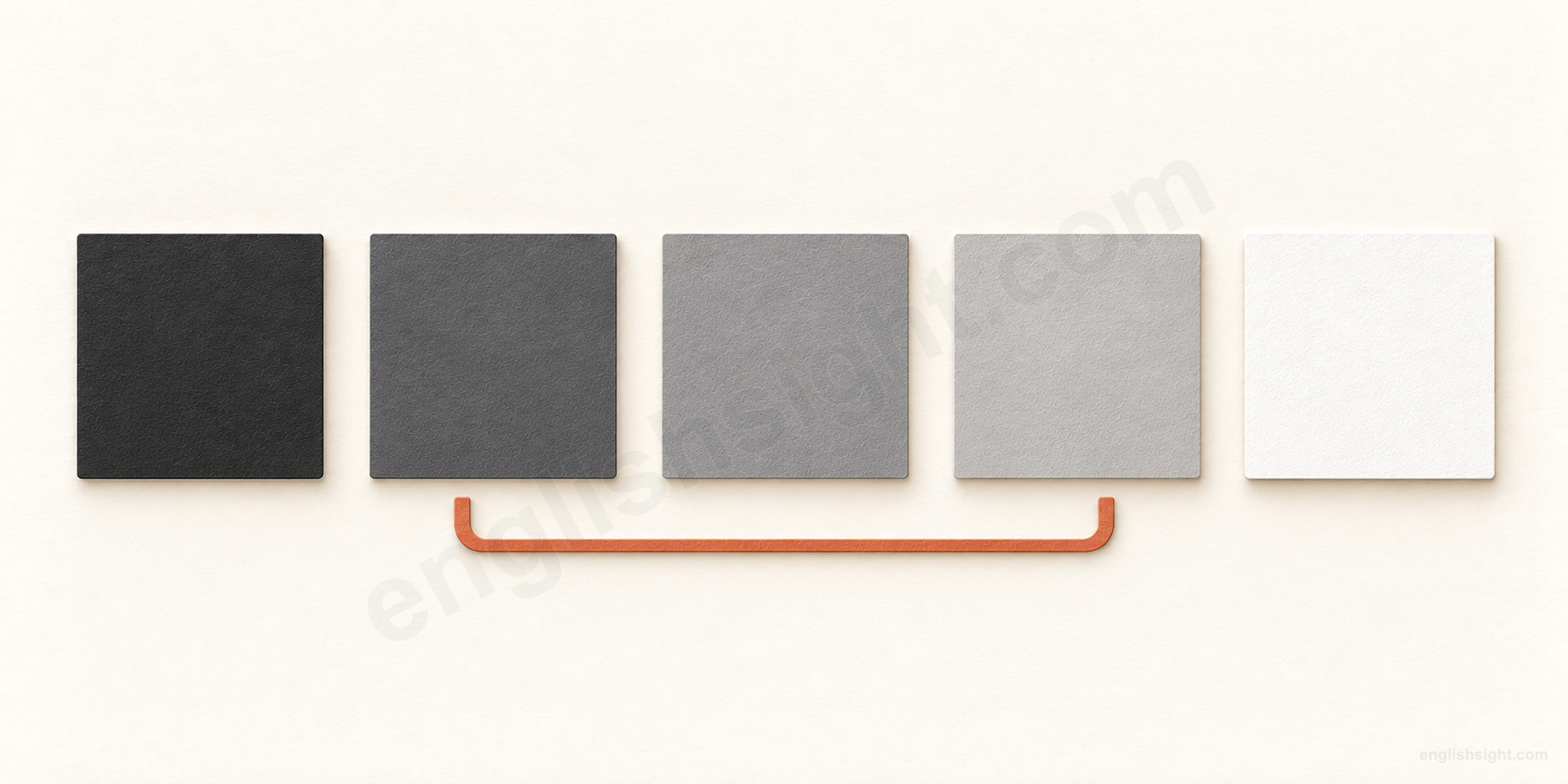
A neutral range between black and white
Black: the dark endpoint
grey
White: the light endpoint
Grey includes a range of tones between black and white.
The bracket highlights several grey tones, not movement or a change of state. Fixed expressions need their own context.
Grey names tones between black and white. A useful teaching connection leads from reduced brightness to dullness, and from an intermediate tone to an uncertain distinction.
This is a memory model, not a universal mental image or a rule that derives every expression. Grey hair is a physical appearance; grey matter and grey market need their own explanations.
Grey /ɡreɪ/ is usually spelled gray in American English. Both spellings describe the same colour; the spelling does not mark a lighter or darker shade. This lesson uses grey throughout.
A colour comparison gives us a starting point. Hair, weather, mood, age, and fixed expressions then need their own context; they are not all names for the same physical colour.
01
Colour, weather, and appearance
Start with things you can describe by sight. Read the subject and the linking verb to distinguish a colour, a condition, and a change.
01
grey + noun; be / look + grey; light / dark grey
a grey coat; light / dark grey
describe a colour between black and white
Situation / starting point
You compare coats in a shop.
Description / interpretation
You identify one by its colour.
Grey describes the coat; light or dark specifies the shade.
Grey can go before a noun or follow a linking verb: a grey coat; The coat is grey. Light grey and dark grey name different shades, so grey does not mean only the exact midpoint between black and white.
Use greyer and greyest when comparing how grey things look: This sample is greyer than that one. Greyish means somewhat grey. A blue-grey fabric combines a grey appearance with a blue tint.
A colour is not automatically an evaluation. A grey coat may be beautiful, and grey eyes do not imply sadness.
In a sentence
I chose a light grey coat to wear with my black trousers.
Watch the difference Say The coat is grey, without a, when grey is an adjective. A grey coat contains a noun.
02
grey as a noun; a + shade description + grey; in grey
in grey; a shade of grey
name the colour, clothing, or different grey shades
Situation / starting point
You are choosing paint or describing clothes.
Description / interpretation
You refer to the colour itself.
As a noun, grey can name a colour rather than modify an object.
I prefer grey uses the colour noun without an article. A soft grey refers to a particular shade; several greys refers to several shades. The plural is useful when comparing paint or fabrics.
Dressed in grey means wearing grey clothes. In tells us the colour of the clothing; it does not place the person inside a grey container. Compare a grey jacket, where grey is an adjective.
In a sentence
We tested three greys before choosing the paint for the hall.
Watch the difference Do not use greys for every colour reference: I like grey is the ordinary general statement.
03
a grey + day / morning / sky; the sky is / looks grey
grey skies; a grey day
describe dull, cloud-filled weather
Situation / starting point
Clouds cover the sky.
Description / interpretation
The day has little bright sunlight.
The weather meaning concerns cloud and dull light.
A grey sky or grey day suggests cloud cover and a lack of brightness. It may be wet, but grey does not itself say that rain is falling. A grey, dry morning is possible.
The day was grey describes the weather. The day felt grey can instead convey a gloomy experience, depending on context. Use cloudy when you simply want to report clouds.
In a sentence
The sky was grey, but we reached home before any rain fell.
Watch the difference Grey weather is not the same as cold weather; specify temperature separately.
04
hair / a person + be grey; go / turn grey; grey-haired + person
go / turn grey
describe hair becoming grey
Situation / starting point
A person’s hair used to have more of its original colour.
Description / interpretation
More of the hair now looks grey or white.
Go and turn express the change; grey describes the resulting appearance.
Her hair is grey describes a state. Her hair is going grey describes a change in progress. She has gone grey usually refers to her hair even though the subject is the person.
Before a noun naming a person, grey-haired is clear: a grey-haired teacher. A grey teacher could be understood differently. Hair colour does not establish someone’s exact age.
In a sentence
My brother started going grey in his twenties.
Watch the difference Going grey does not mean going bald: the first concerns colour, the second hair loss.
05
hair + grey / be greying; greying + hair
grey; greying hair
use grey as a verb meaning become grey
Situation / starting point
You notice changes at someone’s temples.
Description / interpretation
You describe an ongoing colour change.
Grey can be a verb; greying can also modify hair.
His hair is greying uses the verb in the progressive. His greying hair uses an -ing modifier. The forms are grey, greys, greyed, greying; American spellings use gray, grays, grayed, graying.
Collins and Merriam-Webster also record a transitive use meaning make grey. This is a broader dictionary possibility, not a reason to replace everyday paint it grey with grey it. The common hair pattern here has no object.
In a sentence
Her hair is greying at the temples.
Watch the difference In is going grey, going comes from go; in is greying, greying comes from the verb grey.
06
look grey; a face + be grey with + condition
look grey; grey with exhaustion
describe a pale, unwell-looking complexion
Situation / starting point
Someone arrives after an exhausting night.
Description / interpretation
You notice that their face looks unusually pale.
Grey can describe a loss of healthy-looking colour in a face.
With a face or complexion, grey may suggest an ill, exhausted, or distressed appearance. It does not normally mean the person’s skin is literally the same colour as grey paint.
Look grey reports an appearance, not a medical diagnosis. The phrase with exhaustion supplies the suggested reason; that reason is not contained in grey alone.
In a sentence
After the sleepless night, his face looked grey with exhaustion.
Watch the difference He is grey may suggest grey hair. His face looks grey makes the complexion meaning clearer.
02
Evaluation and older people
These uses go beyond colour. Some express a negative judgment; others are established language used in news and marketing.
07
grey + life / existence / routine; grey + person or institution
a grey existence; grey officials
express a lack of cheer, interest, or individuality
Situation / starting point
A routine or group seems lifeless to the speaker.
Description / interpretation
The speaker gives a negative evaluation.
Figurative grey can concern mood or character, not visible colour.
A grey existence suggests a cheerless, monotonous life. Describing officials as grey suggests that they are dull or lack individuality. The second is a judgment about people, not their clothes or hair.
These uses draw a teaching connection between a lack of visual brightness and a lack of emotional liveliness. They are established evaluations, not rules that all grey objects or people are boring.
In a sentence
She wanted more than a grey existence of work, meals, and sleep.
Watch the difference Calling people grey can be dismissive. Use specific descriptions when you want to avoid that judgment.
08
grey + vote / power / consumer; a greying + population / workforce
the grey vote; grey power; a greying population
refer to older people or an ageing population
Situation / starting point
A report discusses older voters or customers.
Description / interpretation
Age is used to identify the group.
Grey before a noun can identify older people; greying can describe an ageing group.
The grey vote means the votes or political influence of older people. Grey power similarly refers to their influence. This wording is found in journalism and public discussion, particularly in British English.
This is an established association with greying hair, not a claim that all older people have grey hair or share the same views. Older voters is often a more direct description.
In reports about demographics, a greying population means a population with a growing proportion of older people: The region has a greying population and needs more services for older residents. Here the verb grey concerns the age profile of a group, rather than every person’s hair changing colour.
In a sentence
The report examines how the grey vote could affect the election.
Watch the difference Do not call an individual a grey to mean an older person in ordinary conversation.
03
Unclear boundaries and established expressions
Learn each complete expression. Intermediate colour can help you remember uncertainty, but it cannot predict all the meanings below.
09
a grey area in + rule / policy; a grey area between + categories
a grey area
identify an unclear rule, category, or boundary
Situation / starting point
A policy covers clear cases but leaves one case uncertain.
Description / interpretation
You identify a point that is difficult to classify.
The uncertainty concerns how to draw or apply a distinction.
A grey area can be a point where a rule is unclear or where a situation fits no category neatly. It need not be halfway between two positions; the important feature is an uncertain boundary.
This is a countable expression: a grey area; several grey areas. A grey area in the policy locates the uncertainty. Calling something a grey area does not itself decide whether it is acceptable.
Grey can also describe an uncertain position directly: The story presents a morally grey choice. Here morally identifies the kind of uncertainty; the adjective does not need to be followed by area.
In a sentence
Personal use of the office printer is a grey area in our policy.
Watch the difference A grey area can involve ethics, but it is not limited to moral questions.
10
shades of grey; see / recognize shades of grey
shades of grey
recognize uncertainty about right and wrong
Situation / starting point
A story invites a simple judgment of good and bad.
Description / interpretation
You notice that motives and actions complicate that judgment.
Figurative shades of grey contrast with a strict black-and-white judgment.
Literally, shades of grey are different grey tones. In the idiom, the phrase refers to situations in which right and wrong are not clear. Different motives may make a judgment less simple.
Compare a grey area, which can identify one unclear rule. Shades of grey stresses complexity in judging a situation, often a moral one. It does not mean that every view is equally reasonable.
In a sentence
The novel explores shades of grey: its hero lies to protect a friend.
Watch the difference Do not use the idiom as a general substitute for many colours or many opinions.
11
grey matter as an uncountable noun; use + possessive + grey matter
use your grey matter
refer informally to intelligence or thinking
Situation / starting point
A puzzle requires thought.
Description / interpretation
Someone encourages mental effort.
The whole expression refers to brains or intellect.
Grey matter literally names a type of nerve tissue in the brain and spinal cord. Informally, your grey matter means your intelligence or mental ability. Use your grey matter invites someone to think.
This expression has to be learned as a unit. Matter supplies the idea of material, and the informal expression stands for thinking ability; grey alone does not mean intelligent. An instruction to use your grey matter may sound teasing or impatient.
In a sentence
We will have to use our grey matter to solve the final clue.
Watch the difference Use grey matter without a plural -s in this sense.
12
grey + object + out; grey out + noun; be greyed out; a control greys out
grey out; be greyed out
show an unavailable option in a computer interface
Situation / starting point
A form has an option you cannot currently select.
Description / interpretation
That control appears faint or grey.
Out belongs to a computing expression about an unavailable control.
The button is greyed out describes a control displayed as unavailable. The software greys out the button is transitive; The button greys out describes the change without an object. With a pronoun object, say grey it out.
Here the colour change signals an interface state. A grey button is not necessarily disabled; it might simply have a grey design. Grey out is also recorded for fading vision before unconsciousness, a separate sense not developed in this computing unit.
In a sentence
The Save button is greyed out until you enter a filename.
Watch the difference For the pronoun pattern, use grey it out, not grey out it.
13
the grey market; on / through the grey market; target the grey market
the grey market
recognize two context-dependent market meanings
Situation / starting point
You read a report about imported goods or older customers.
Description / interpretation
The context identifies which market is meant.
The expression has two established meanings; colour alone cannot select one.
In trade, the grey market can mean products imported and sold outside the manufacturer’s authorized distribution system. In British marketing language, the grey market can instead mean older people considered as customers.
In Our holidays target the grey market, customers are the focus. In The camera came through the grey market, distribution is the focus. Neither meaning follows just by combining a colour with market.
In a sentence
The retailer sells cameras imported through the grey market.
Watch the difference Grey market does not by itself mean counterfeit goods or settle their legal status.
Choose the meaning from the whole expression
Grey and gray are spelling variants
Use one spelling consistently in ordinary prose. Comparative forms are greyer / greyest or grayer / grayest. The colour noun can be uncountable, or countable for shades; the adjective does not take a plural ending.
Separate appearance from evaluation
Grey hair, grey clouds, and a grey jacket need not express a negative judgment. A grey existence and grey officials can be negative evaluations. The subject and surrounding words tell you which reading fits.
State, change, and grammar
Be grey gives a state; go or turn grey gives a change. Grey is also a verb, especially for hair. The computing expression grey out has transitive, intransitive, and passive patterns. There is no broad everyday family of grey plus many particles to invent.
Coverage boundary
This course covers everyday colour and appearance, common figurative uses, and selected expressions useful for reading or conversation. The countable noun a grey can also mean a grey or white horse. Specialized textile senses, the radiation unit gray, names such as Earl Grey, and technical accounts of fading vision are outside the main lesson.
Read the situation, then choose
Use the subject, grammar, and context to decide which meaning fits.
1. The sky is grey, but no rain has fallen. Which interpretation fits?
2. Which sentence describes a change in hair colour?
3. A policy does not clearly cover personal printing. Which expression identifies the uncertainty?
4. You cannot select Save until you name a file. How can you describe the unavailable button?
5. A travel company says its holidays target the grey market. In British marketing usage, who are the customers?
Sources and teaching notes
The sources below support the meanings, forms, and expressions. Explanations and examples are original; the colour comparison is a teaching model, not evidence that all uses share one mental image.
The diagram supports a teaching connection; it does not represent a picture shared by every English speaker.