Connect hands and surfaces with attention, influence, understanding, and control.
A firm hold
Contact becomes a secure hold
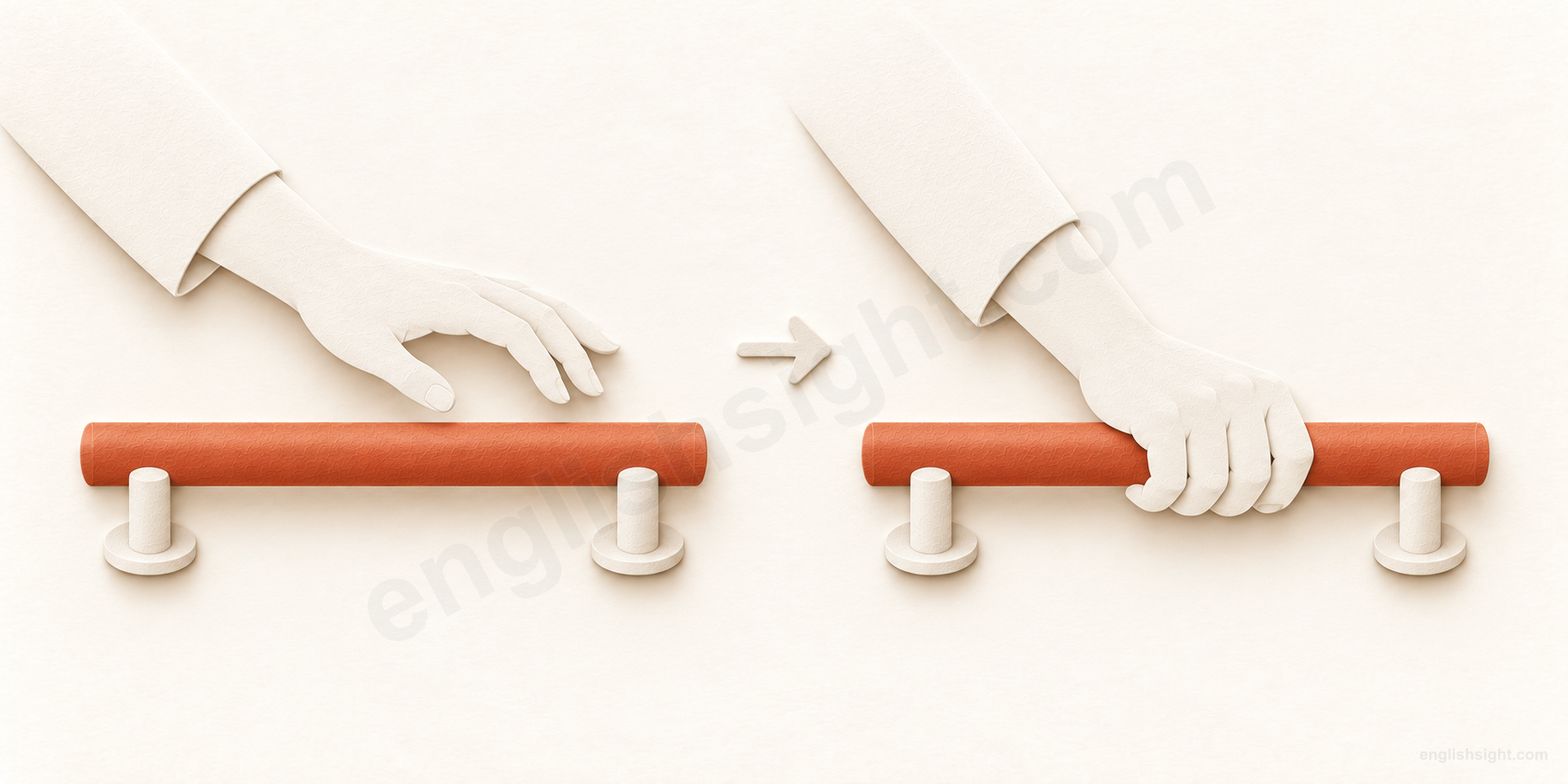
An open hand is above a fixed rail.
grip
The hand maintains a firm hold.
The fingers close around the rail.
Grip means holding firmly. The rail stays in place; a firm hold resists slipping without making it impossible.
Grip means taking or maintaining a firm hold; secure contact resists slipping or release.
The hand-and-rope model illustrates the physical relationship. Attention, strong effects, and control are established figurative uses; the model helps connect them but cannot generate every idiom or job name.
A hand grips a rope by holding it firmly. From that concrete relationship, a firm hold is a useful teaching comparison for a story that holds attention or a person’s control of a situation.
The full construction matters: have a grip on, get to grips with, and be in the grip of assign different roles. This lesson separates those roles instead of treating every phrase as one translation.
01
Hands, surfaces, and equipment
Start with firm contact. The verb describes holding; the noun can name the hold, its technique, the ability to resist slipping, or a physical handle.
01
grip + object; grip on to + object
grip the rail / grip on to it
hold something firmly
Starting situation
A passenger needs support as the boat rocks.
Result or relationship
Her hand holds the rail securely.
The hand maintains firm contact with its object.
Grip the rail puts the held object directly after the verb. Grip it uses the same pattern with a pronoun. Firmness is central; grip does not require lifting or moving the object.
You can also grip on to the rail: the extra words identify what you hold for support. Grip on to it keeps the pronoun after to. This is not a separable particle pattern such as pick it up.
Hold is the broader choice and can be gentle. Grab often highlights quickly taking hold; grip highlights a firm hold, which can continue: She was still gripping the rail.
In a sentence
When the boat rocked, Mina gripped the rail with both hands.
Watch the difference Do not add on when using the direct-object pattern: grip the rail or grip on to the rail.
02
have / keep / tighten / loosen / release / lose + a/your grip (on + object)
a firm grip on something
a strong hold or the strength of that hold
Starting situation
A wet handle may slip out of your hand.
Result or relationship
You adjust how firmly you hold it.
The noun names the hold; on introduces what is held.
Keep a firm grip on the handle describes maintaining a secure hold. Tighten your grip means hold more tightly; loosen or relax your grip reduces pressure. Release your grip means let go.
Lose your grip on a rope can be literal: your hand no longer holds securely. A strong grip can also describe hand strength, as in Her grip is strong. Grip strength names that physical capacity.
A tight grip is not automatically desirable: a delicate object may need a gentler hold. The noun describes the hold, not a guarantee that the object cannot slip.
In a sentence
I loosened my grip on the handle so I could change hands.
Watch the difference Use a determiner for a particular hold: a firm grip or my grip, not keep firm grip.
03
change / adjust + your grip (on + equipment)
change your grip
the way you position your hand when holding something
Starting situation
A player holds a racket awkwardly.
Result or relationship
The coach shows a different hand position.
Technique concerns how the object is held, not only how hard.
Your grip on a racket or club includes the position of your fingers and hand. Change or adjust your grip can mean alter that position rather than squeeze harder.
A backhand grip names a particular way of holding a racket. The same noun can describe strength or technique, so the sport and the instruction supply the distinction.
In a sentence
The coach asked me to change my grip before the next shot.
Watch the difference A better grip in a coaching instruction need not mean a tighter grip.
04
tyres / tires / soles + grip (a surface); have / give + good / better grip
tyres grip the road / have good grip
make secure contact with a surface instead of slipping
Starting situation
A bicycle reaches a wet bend.
Result or relationship
The tyres stay in contact without sliding.
The subject may be a tyre or a sole; no hand is required.
Tyres grip the road uses a surface as the verb’s object. Grip can also stand without an object when the surface is understood: These tyres grip well.
Good grip describes the ability to resist slipping. In product comparisons, better grip and less grip normally treat grip as uncountable. A good grip on ice is also possible; it presents one effective hold on a surface.
This connects to the hand model through secure contact, but tyres do not squeeze a road like fingers. British tyres and American tires name the same objects.
In a sentence
These tyres grip the wet road better than the old ones.
Watch the difference Grip here is traction, not the rubber handle called a grip.
05
a / the + grip; plural grips
a rubber grip
the part designed for your hand to hold
Starting situation
A bicycle’s handle covering is worn.
Result or relationship
You replace the part that your hand holds.
A countable grip can be a handle or its gripping surface.
A rubber grip is a physical part, often on a bicycle handlebar, tool, or sports club. Unlike your grip, it can remain on the equipment when nobody is holding it.
Two handlebar grips uses an ordinary plural because there are two parts. Compare The rubber grips give me better grip: the first names objects; the second names secure contact.
In a sentence
One of the rubber grips on my bicycle has split.
Watch the difference A grip on a tool is not the same thing as your grip on the tool.
02
Attention, feelings, control, and understanding
A physical hold provides a useful comparison for several abstract uses. Check who or what does the holding: a story holds attention, fear affects a person, and a person may control a situation.
06
story / event + grip + person; person + be gripped by + story; a gripping + noun
a story grips you / be gripped by it
hold someone’s attention strongly
Starting situation
A reader opens a mystery novel.
Result or relationship
The story keeps her absorbed.
The story is the subject in the active form; the interested person is the subject in the passive.
A story grips you when you want to keep reading or listening. The story acts on your attention; you are not physically holding it. The passive I was gripped by the story is a natural way to describe your response.
A gripping story uses gripping as an adjective meaning strongly absorbing. In The story is gripping me, gripping is part of a verb phrase. In ordinary recommendations, It’s gripping is a simple adjective description.
Compare I gripped the book: with a physical book as the object, that normally describes my hands. The book gripped me reverses the roles and normally concerns attention.
In a sentence
The mystery gripped me from the opening scene.
Watch the difference For interest, say I was gripped by it or It was gripping; I was gripping it normally describes holding it.
07
emotion / pain / situation + grip + person / place; be gripped by + emotion / situation
fear grips someone
affect someone powerfully
Starting situation
A speaker suddenly notices the enormous audience.
Result or relationship
Fear strongly affects her.
The emotion or situation does the figurative holding; the person or place is affected.
Fear gripped me and I was gripped by fear describe a powerful emotional effect. The passive changes the viewpoint, not who experiences the feeling.
Pain, panic, and a serious crisis can also be described with grip. The wording is vivid and strong; it is more forceful than I felt a little worried. A country can be gripped by a crisis without every resident having an identical experience.
In a sentence
Panic gripped me when I realized the child was missing.
Watch the difference Being gripped by fear is different from gripping someone’s arm in fear: the second still describes a physical hold.
08
have / keep / get / tighten / loosen + a/your grip on + situation / person
keep / get a grip on a situation
maintain or gain practical control
Starting situation
Small extra expenses are increasing.
Result or relationship
The manager brings spending under control.
A figurative grip can be power to direct or limit something.
Keep a tight grip on costs means control spending closely. Get a grip on the situation emphasizes gaining control; tighten or loosen a grip changes how much control is exercised.
An iron grip emphasizes severe, firm control, often over people or an organization. It is stronger than ordinary responsibility: The owner kept an iron grip on every decision suggests very little freedom for others.
Collins also records the direct verb grip a problem, meaning take firm control of it. For a neutral beginner sentence, get a grip on the problem makes the intended construction easier to recognize. It does not mean merely picking up a physical object.
In a sentence
We need to get a grip on spending before the costs rise again.
Watch the difference A grip on a problem may mean control or understanding; read what the person is trying to do.
09
have / get + a good / firm grip on + subject / what-clause
have a good grip on a subject
understand a subject or situation
Starting situation
A student studies how the system works.
Result or relationship
She can explain its main relationships.
A mental hold is a teaching comparison for understanding.
Have a good grip on a subject describes understanding it. Get a grip on what is happening emphasizes reaching that understanding; have describes the resulting position.
Context separates understanding from practical control. A student may have a good grip on the rules without controlling the organization that uses them.
A grip on reality concerns recognizing the actual situation. Losing your grip on reality is strong language about a person’s judgment; it is not a casual synonym for forgetting one small detail or a medical diagnosis.
In a sentence
After the workshop, I had a much better grip on how the system worked.
Watch the difference Use on here: a grip on the subject. With belongs to get to grips with, a different pattern.
03
Facing difficulties and regaining control
Learn these expressions as whole patterns. Articles, plural grips, and the prepositions on, with, and of belong to different constructions.
10
get / come to grips with + noun / -ing form
get / come to grips with something
start understanding and dealing with a difficulty
Starting situation
A new booking system seems confusing.
Result or relationship
You begin working through its demands.
The whole idiom means engaging with a difficult matter.
Get to grips with a new system describes starting to understand it well enough to work with it. Come to grips with a problem can emphasize facing it directly and dealing with it. The context determines whether learning or tackling is more prominent.
This does not promise a complete solution. We are still getting to grips with the new software describes continuing work, not failure to touch a physical object.
Keep plural grips and with: get to grips with it. Compare get a grip on it, with singular grip, an article, and on. Both may concern understanding or control, but their word patterns differ.
In a sentence
We are still getting to grips with the new booking system.
Watch the difference Do not mix the patterns into get a grips with or get to grip on.
11
get / take a grip (on yourself / myself / themselves)
get / take a grip on yourself
regain control of your feelings or behavior
Starting situation
You feel overwhelmed before speaking.
Result or relationship
You steady yourself enough to continue.
The person regains self-control rather than physically grabbing their body.
I need to get a grip on myself is self-directed language about managing emotions or behavior. Take a grip on yourself is also possible. Without an object, Get a grip! is an informal instruction to regain control.
Said to another distressed person, Get a grip! can sound impatient or dismissive. The softer Let’s take a moment is often more supportive. Tone and relationship matter; the idiom does not itself offer emotional help.
In a sentence
I took a breath and told myself to get a grip.
Watch the difference Do not interpret the bare command as an instruction to hold an object unless a physical context supplies one.
12
lose + your / my / their grip (on + situation)
lose your grip
become less able to understand or manage things
Starting situation
A manager used to handle everything confidently.
Result or relationship
She feels unable to manage the workload.
Without a physical object, losing a grip often concerns competence or control.
I’m losing my grip can express a feeling that you are no longer coping or thinking clearly. Lose your grip on a situation specifies the area of lost control or understanding.
Compare She lost her grip on the rope, which can be completely physical. Neither sentence is automatically about mental illness. Claims about someone else losing their grip can sound insulting, so describe the actual difficulty when precision matters.
In a sentence
With so many urgent tasks, I felt I was losing my grip.
Watch the difference The object and context determine whether the loss is physical, practical, or mental.
13
be in the grip of + condition; hold + person / place + in its grip
in the grip of something
strongly affected by a force or condition that is hard to escape
Starting situation
A region experiences a prolonged drought.
Result or relationship
The drought continues to dominate daily life.
The affected person or place is held by the condition, not in control of it.
A region in the grip of drought is strongly affected by it. The expression often introduces an unpleasant condition such as recession, fear, or extreme weather.
The storm held the coast in its grip uses a possessive version of the same image. Compare The council has a grip on the problem: here the council has control. In the grip of the problem reverses that relationship.
In a sentence
The region remained in the grip of drought throughout the summer.
Watch the difference Keep the in in this idiom: in the grip of fear, not on the grip of fear.
04
Two additional meanings to recognize
Context can identify a small hair accessory or a film worker. These uses deserve recognition without making them the main model for the word.
14
a grip / hairgrip; plural grips / hairgrips
a hairgrip / a grip
a small pin that holds hair in position
Starting situation
Loose hair falls across someone’s face.
Result or relationship
A small folded pin holds it back.
British English can use grip for a hair accessory.
In British English, a grip or hairgrip can mean the small folded pin used to secure hair. Bobby pin is the usual North American equivalent.
Two grips in a hair-styling conversation names two accessories. It does not mean two acts of squeezing. The longer word hairgrip makes this meaning clearer outside that context.
In a sentence
She fixed the loose strand with a hairgrip.
Watch the difference A grip in this sense is a small accessory, not an ordinary hand hold.
15
a grip; work as a grip
a grip on a film set
a crew member who works with production equipment
Starting situation
A camera setup needs equipment prepared and moved.
Result or relationship
A member of the crew handles the equipment.
In production credits, grip names a person’s job.
A grip is a member of a film or television crew who handles equipment used in production, such as equipment supporting camera movement. This is a job noun: one grip, several grips.
Exact duties depend on the production and working system. The dictionary job meaning does not tell you every responsibility, and it does not simply mean the person is holding a camera at that moment.
In a sentence
Her first job on a film set was as a grip.
Watch the difference Read the production context: a grip can be a person, while a camera grip can be a part you hold.
Keep the hold and the construction distinct
Forms and grammar
Both the noun and verb are pronounced /ɡrɪp/. Modern forms are grip, grips, gripped, gripping: double p before -ed and -ing. Physical action can be progressive, as in She is gripping the rail. Passive patterns are possible, especially be gripped by a story or fear. Grip has no productive everyday causative family such as grip someone to do something.
Countability follows the meaning
A grip or your grip can name a particular hold; grips can name handles, techniques, accessories, or workers. Good grip often names traction without an article. The plural in get to grips with is fixed and does not count several hands.
Scope of the lesson
The lesson covers modern practical senses and the main dictionary idioms, with two extra recognition meanings. The old-fashioned travel-bag meaning, specialist mechanical devices, drainage channels, secret handshakes, and historical disease or pain labels are not developed. This is a common-use selection, not a frequency ranking.
Find the right hold
Use the object, the roles, and the complete expression to choose an interpretation.
1. You could not stop watching a mystery. Which sentence describes its effect on your attention?
2. A shoe advertisement promises better grip on wet pavement. What is being improved?
3. You are learning a confusing new system. Complete: I am getting ___ the system.
4. A town is in the grip of a severe drought. Who or what has the powerful effect?
5. Someone says “Get a grip!” to an upset friend. Which interpretation includes the tone?
Sources and teaching notes
Dictionary entries support the uses and constructions. Explanations, examples, and the compatibility sketch were created for this lesson; the visual link is a teaching model.
The diagram offers a useful connection; it does not represent an identical mental picture shared by every English speaker.