Becoming larger, more numerous, or more developed.
Name a process of increase or development—and sometimes what that process produces.
More size, amount, or development over time
More size, amount, or development over time
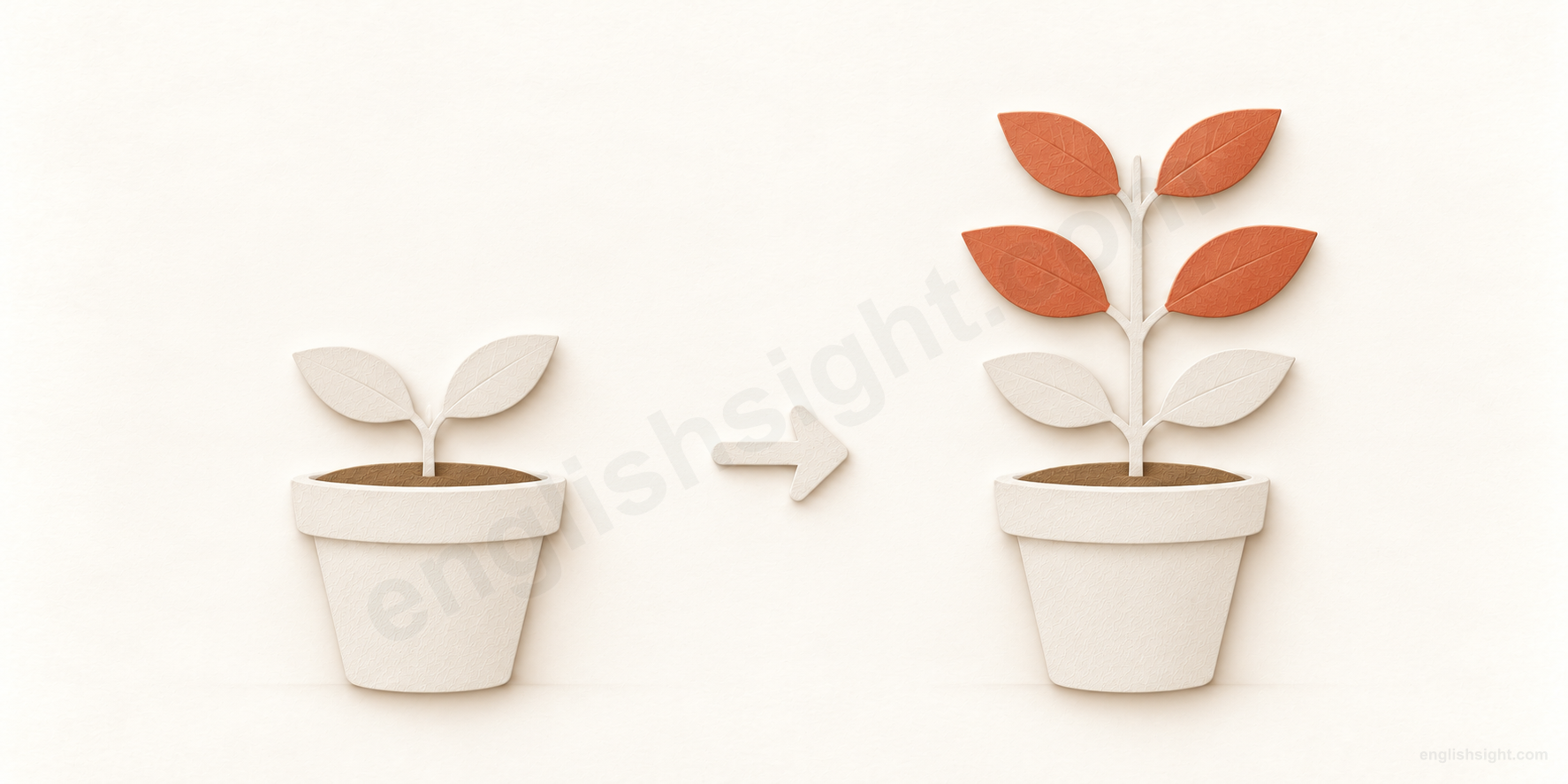
The plant has a short stem and two leaves.
growth
The same plant has a taller stem and six leaves.
Over time, the stem grows taller and new leaves form.
The plant grows taller and forms more leaves over time. Orange highlights newly formed leaves.
Growth is a process of becoming larger, more numerous, or more developed; the noun can also name something produced by growing.
The two plants show the same plant at earlier and later stages, not a plant moving sideways. New shoots illustrate a physical result; personal and economic uses require their own context.
Growth is the noun related to grow. Ask what changes over time: a plant’s size, a person’s understanding, a number, or the activity of a business.
The plant sketch illustrates development over time. It is a teaching model, not a claim about a picture shared by all English speakers; physical growth does not explain every established use by itself.
01
Living things and personal development
Talk about growing bodies and developing abilities, then name a burst of growth or a condition that affects it.
01
growth of + living thing; plant / child / hair growth
plant / child growth
the process of becoming physically bigger or more developed
Earlier state / situation
A seedling has a short stem and two leaves.
Later state / meaning
Later it has a taller stem and more leaves.
Growth names the change over time, rather than one size at one moment.
Compare The plant grows with The plant’s growth is slow. Grows is a verb; growth is a noun, so it can be described by slow and can be the subject of is.
Plant growth and the growth of a plant describe the process. A growth chart records changes in a child’s measurements; it is not a picture of one unusually large child.
Growth hormone is a familiar biological combination: hormone names the substance, and growth identifies its role. This lesson teaches the expression, not a treatment.
In a sentence
We measured the plant’s growth each week.
Watch the difference Say The plant grows quickly or Its growth is rapid, not The plant growths quickly.
02
personal / emotional / intellectual growth; growth as + role
personal / emotional growth
development in character, understanding, or emotional ability
Earlier state / situation
Someone avoids discussing difficult feelings.
Later state / meaning
Over time they become better able to understand and discuss them.
Personal growth concerns development, not extra height.
In a discussion of experience or education, growth can refer to changes in how a person thinks, relates to others, or handles feelings. Personal, emotional, and intellectual identify the aspect.
In I want room for growth at work, the context may point to skills and responsibility. Ask what kind of growth is meant; the word alone does not promise a promotion or a higher salary.
In a sentence
Learning to listen has been an important part of my growth as a manager.
Watch the difference Personal growth is normally uncountable: opportunities for personal growth, not opportunities for personal growths.
03
have / go through / experience + a growth spurt
a growth spurt
a short period of especially fast growth
Earlier state / situation
A child’s height changes little for a while.
Later state / meaning
Then the child becomes taller quite quickly.
Spurt adds the idea of a brief burst to growth.
A growth spurt is one episode, so say a growth spurt or several growth spurts. Growth itself does not always mean a sudden change; spurt supplies that feature.
Compare steady growth, which suggests a more regular pattern. A child may go through a growth spurt, while the child’s growth continues over a much longer period.
In a sentence
Leo went through a growth spurt and needed longer trousers.
Watch the difference The plural is growth spurts: spurt is the head noun.
The verb tells us whether a condition helps or restricts growth.
Encourage, promote, and stimulate growth describe helping the process; inhibit growth describes restraining it. Stunt growth means prevent normal development, often leaving something undersized.
These are verb–object combinations, not phrasal verbs. In The growth of the plants was stunted, the passive belongs to stunt. Growth remains a noun.
Choose the noun carefully: encouraging the growth of useful plants may be desirable; encouraging the growth of weeds may not be. Growth itself does not mean improvement.
In a sentence
Too little light can stunt the growth of these plants.
Watch the difference Stunt is stronger than merely saying growth is slow; it suggests restricted normal development.
02
What increases, and by how much?
Name the thing that expands, the measure that rises, and the speed of change. A higher amount and a faster growth rate are different claims.
05
growth in + quantity / measure
growth in demand
an increase in a named amount or measure
Earlier state / situation
The shop receives 40 orders a day.
Later state / meaning
Later it receives 60 orders a day.
In identifies the quantity or aspect that increases.
Growth in sales, demand, membership, or the number of visitors tells us what is rising. You can often rewrite the statement with increase: demand increased.
Compare growth in the city. Here in the city can simply name the location; ask whether the following phrase answers “what increased?” or “where?”. Context decides.
A growth in demand is possible when describing a particular increase. Uncountable wording is also natural: We expect growth in demand. An article does not automatically indicate the medical sense.
In a sentence
The bakery has seen growth in online orders.
Watch the difference Growth in demand concerns the amount wanted; it does not necessarily say the bakery itself has become physically larger.
06
the growth of + entity / activity / idea
the growth of a town / an idea
the expansion or development of an entity or phenomenon
Earlier state / situation
A small town has a few streets.
Later state / meaning
Over time it expands into a larger town.
Of can identify the thing whose development is being discussed.
The growth of the town treats the town as the developing entity. The growth of an organization may involve members, reach, or activity; it need not refer to a larger office.
The growth of an idea or movement concerns its spread or importance, not physical height. Growth in interest in the idea focuses more directly on the amount of interest.
Do not turn this into an absolute of-versus-in rule. Both can occur with abstract nouns, as in growth of interest and growth in interest. The framing and the following noun matter.
In a sentence
The growth of the town created a need for another school.
Watch the difference Growth of an organization and growth in its membership may describe related changes, but they do not specify exactly the same thing.
07
growth in + measure + of + amount; growth of + amount + over + period
growth of 10 per cent
the amount by which something increases
Earlier state / situation
There are 200 members at the start of the year.
Later state / meaning
There are 220 at the end.
A number after of can measure the increase rather than name the thing growing.
In annual membership growth of 10 per cent, membership identifies the measure, annual gives the period, and of 10 per cent states the relative increase. The final number is 220, not 20.
Compare Growth in membership was 10 per cent: in names what increased. The same preposition of has another job in the growth of the club, where it names the entity.
An increase from 200 to 220 is an increase of 20 members or 10 per cent of the starting number. State the period and starting basis when the comparison could be unclear.
In a sentence
Membership rose from 200 to 220, a growth of 10 per cent in one year.
Watch the difference Growth of 10 per cent is an increase by that proportion, not a final total of 10 per cent.
08
growth rate; rate of growth; growth slows / accelerates
growth rate / slowing growth
how fast something increases, and changes in that speed
Earlier state / situation
Output rises by 10 per cent in one year.
Later state / meaning
It rises by 5 per cent the next year.
Growth can slow while the total continues to rise.
A growth rate measures change relative to a time period, often as a percentage. A rate of growth expresses the same basic relationship; growth is not a second verb in growth rate.
Rapid, slow, steady, and strong describe different aspects of growth. Steady suggests a consistent pattern; it does not necessarily mean fast. Compare 2 per cent growth every year with 10 per cent one year and none the next.
If output goes from 100 to 110 to 115.5, the annual growth rate falls from 10 per cent to 5 per cent, while output rises both years. Negative growth, especially in economic reporting, means contraction; zero growth means no increase over the stated period.
In a sentence
Sales growth slowed, but total sales still increased.
Watch the difference Falling growth and falling sales are different: check whether the report describes the rate or the level.
The context identifies what economic activity or business measure is growing.
In economic news, growth often refers to an expanding economy. In a company report, sales growth, revenue growth, and profit growth name different measures. More sales do not by themselves prove more profit.
Achieve growth and experience growth report an outcome. Sustain growth means keep it going; promote or drive growth describes contributing to it. The verb supplies that relationship.
Growth potential and growth prospects concern possible future expansion, not an increase already measured. Without a clear measure, business growth can be a broad description.
In a sentence
The company reported sales growth but lower profits.
Watch the difference Growth does not tell you who benefits, whether prices rose, or whether every part of a business improved.
03
What has grown
Growth can name the process or its physical result. Articles and context help distinguish new shoots, a covering, and an abnormal mass.
10
new / fresh / young growth; growth ring(s)
new growth
newly formed shoots, leaves, or other growing material
Earlier state / situation
A branch has older leaves.
Later state / meaning
Fresh shoots appear on it.
The noun can refer to material produced, not only the process.
In Cut away the dead branches without damaging the new growth, growth names the fresh plant parts. You could point to them. In Warmth encourages growth, the emphasis is the process.
New growth is commonly treated as a mass. Horticultural descriptions may use growths for separate shoots or formations; that plural is different from ordinary personal growth.
A related concrete compound is growth ring: a layer formed during a regular period of growth, often visible in a cut tree trunk. Ring is the countable head: one growth ring, several growth rings.
In a sentence
Be careful not to break the new growth on the rose bush.
Watch the difference Do not assume every occurrence of new growth means new height; it may name actual fresh material.
11
a dense / thick growth of + plant material; a week’s / several days’ growth of + hair / beard
a thick growth of grass
a mass or covering of something that has grown
Earlier state / situation
A path was once clear.
Later state / meaning
Grass now covers it densely.
A growth of can name the resulting mass, rather than its increase.
A thick growth of grass describes the grass present as a mass. A week’s growth of beard similarly refers to facial hair produced during that time. It is not a claim that the process took only one instant.
Compare The growth of grass is slow, where growth is a process, with A thick growth of grass blocked the path, where it is material. The verb and surrounding description help select the meaning.
In a sentence
A thick growth of grass hid the edge of the path.
Watch the difference A growth of grass is not one individual blade. Use a blade of grass to count a single one.
12
a growth on / in + body part; a benign / malignant growth
a growth on / in the body
an abnormal mass of tissue
Earlier state / situation
A person notices a small lump.
Later state / meaning
A clinician describes it as a growth.
Here a growth is a countable physical thing.
The doctor found a growth describes one mass; two growths describes two. On and in locate it, as in on an arm or in the stomach.
The word alone does not identify the kind of mass. Benign and malignant provide additional information; a growth is not automatically a synonym for cancer.
This is a distinct established result sense. The seedling diagram helps recall something that develops, but it cannot show what kind of tissue is involved or establish a diagnosis.
In a sentence
The doctor removed a small growth from his arm.
Watch the difference The noun describes a mass here, not a general process of healthy development; the sentence alone does not say it was cancerous.
04
Familiar combinations
Learn the meaning of the whole combination. Growth can describe a business field or the kind of development someone believes is possible.
13
a growth area / industry / market
a growth area / growth industry
a field of business with expanding activity
Earlier state / situation
A business field attracts a limited amount of activity.
Later state / meaning
Demand and activity in that field expand.
Area means a field of activity here, not necessarily a physical place.
A growth area or growth industry is one whose activity is increasing. Growth modifies the following noun; the head noun carries the plural in growth areas and growth industries.
Compare a growing industry, which also describes expansion, with a growth strategy, a plan intended to produce growth. Growth before a noun does not always mean “currently growing”; learn what the whole combination means.
Collins labels the business modifier use an adjective, while noun-based descriptions also treat growth as a noun used before another noun. Both analyses point to the same practical word order here.
In a sentence
Home insulation has become a growth area for the company.
Watch the difference A growth area need not be a district on a map; in business it can be a service or type of work.
14
have / develop + a growth mindset
a growth mindset
a belief that abilities can develop through learning and effort
Earlier state / situation
A learner treats ability as something fixed.
Later state / meaning
They begin to see practice and feedback as ways to develop it.
Mindset names the belief; growth identifies its focus on development.
A growth mindset concerns how a person views the possibility of developing abilities. It does not describe body size or an economic forecast.
Say have or develop a growth mindset. A learner can hold this belief before making measurable progress, so the phrase is not proof that growth has already happened.
The contrast is a fixed mindset. Learn the full expression: knowing the separate words does not provide a theory about how much anyone will improve.
In a sentence
Our teacher encourages a growth mindset by asking us to learn from feedback.
Watch the difference The expression names a belief about learning; it does not guarantee success from effort alone.
Read the noun and the surrounding words
Growth, grow, growing, and grown
Growth is a noun, with plural growths in countable result uses. Grow is the verb: grow, grows, grew, grown, growing. Say Sales grew or There was growth in sales. Growing can modify a noun, as in growing demand; grown appears in has grown. Growth has no verb tense, passive, or phrasal-verb family of its own.
Process, amount, and result
Growth is often uncountable when it names a general process. A particular measured increase may be a growth in demand; a thick growth of grass is a mass; a growth on the skin is one physical formation. Do not use the presence of a alone to choose a meaning.
Increase is not always improvement
Growth in pollution can be undesirable. Personal growth often carries a positive evaluation, but neither physical size nor a rising number proves that a situation is better. Development is broader than increase in quantity; choose the aspect you mean.
Compounds have their own meanings
Growth spurt, growth rate, growth hormone, growth ring, growth industry, and growth mindset are combinations to learn in context. The main headword sources list no everyday idiom or phrasal-verb family for the noun; this course does not invent one.
Choose the meaning in context
Identify the process, the measure, or the thing produced.
1. Which sentence uses growth as a noun?
2. Membership rises from 200 to 220 over one year. Which description fits?
3. Sales rise by 10 per cent, then by 5 per cent the next year. What happened?
4. In “Don’t damage the new growth on the bush,” what should you protect?
5. “The doctor removed a growth.” What does this sentence establish?
6. Someone has a growth mindset. What does the phrase describe?
Sources and teaching notes
Headword meanings and combinations were checked against the dictionary pages below. The explanations, situations, examples, arithmetic comparisons, and diagram are original teaching material.
The diagram illustrates one connection; context determines the actual meaning.