Understand the object, then learn what each construction adds.
A device and its directed output
A device and its directed output
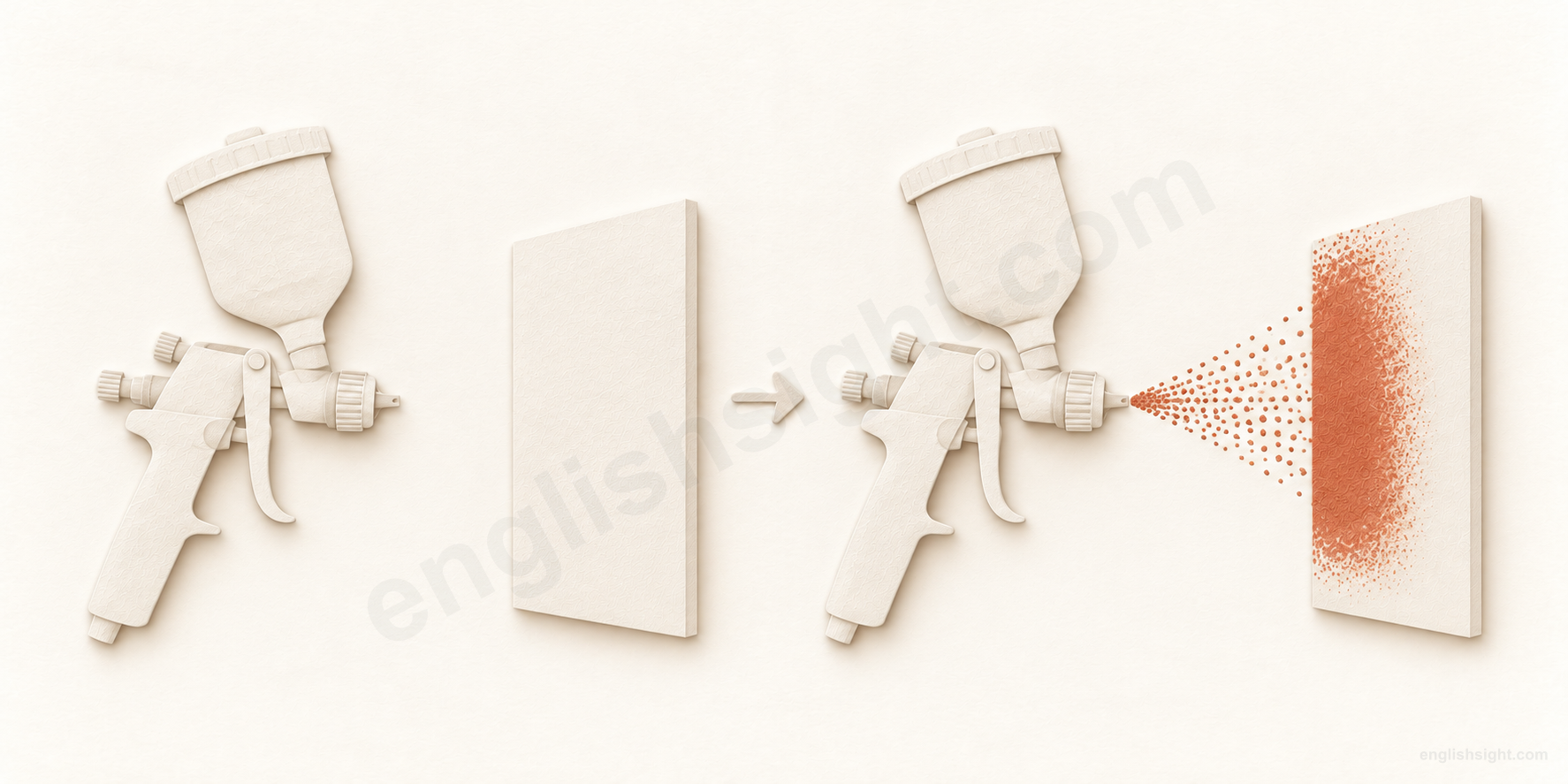
The spray gun is at rest beside an unpainted panel.
gun
The panel receives the paint while the tool remains in place.
Paint sprays from the nozzle toward the panel.
A spray gun directs paint outward; gun names the tool, not the paint.
A gun can send a projectile out through a barrel; related tools send out material or objects in a directed way.
The sketch illustrates the weapon’s firing function, not a definition of every compound or idiom. A gun need not be firing to be called a gun. Acceleration and fixed expressions are taught separately.
A gun is usually a weapon that fires a projectile through a barrel. Related tool names, such as spray gun and staple gun, preserve a directed-output function. The noun names the device whether or not it is being used.
Other uses belong to particular verbs and fixed expressions: an engine can be gunned, someone can jump the gun, and an investigation can uncover a smoking gun. The physical picture helps with some connections, but it does not mechanically explain every expression.
01
Weapons, tools, and signals
Identify the object first, then read the words that describe its kind or what happens with it.
01
a / the + gun; plural guns; gun + noun
a gun / guns
a weapon that fires bullets or shells
Context / before
A museum has a collection of weapons.
Meaning / result
One exhibit is identified as a gun.
Gun names the device, not its ammunition or a single shot.
Gun is a countable noun: a gun, the gun, two guns. It can refer to a small handgun or a much larger weapon; pistol and rifle are more specific names. A gun remains a gun when it is not being fired.
Carry a gun describes having it with you. Draw a gun means take it out ready for use; pull a gun on someone adds a threatening situation. These verbs supply the action; the noun itself does not.
In gun ownership, gun violence, and gun control, gun modifies the following noun. Gun control concerns restrictions on access to or use of guns; it does not mean physically holding a gun steady.
In a sentence
The museum displays a gun from an old sailing ship.
Watch the difference A bullet is fired from a gun; a shot is a firing event. Do not use these nouns interchangeably.
02
point / aim a gun at + target; fire a gun; gun + go off
point / fire a gun; a gun goes off
distinguish direction from discharge
Context / before
A report describes a gun pointing toward a door.
Meaning / result
Another sentence says whether it actually fired.
Pointing establishes direction; firing is a separate event.
Point or aim a gun at something describes its direction. Fire a gun describes causing it to discharge. The person is the subject in She fired the gun; the gun is the object.
The gun went off makes the gun the subject and reports a discharge. This wording can describe an accident, but it does not itself prove the discharge was accidental. The phrasal verb here is go off, not a phrasal verb built from gun.
In a sentence
In the film, a gun goes off behind the closed door.
Watch the difference Pointing a gun does not entail firing it. A gun went off does not mean someone switched it off.
03
spray / staple / grease / water + gun
a spray gun / staple gun
a tool that sends out material or objects
Context / before
A worker needs to apply paint to a panel.
Meaning / result
The tool sends paint out onto the surface.
The tool shares a directed-output function with the weapon.
In a spray gun, pressure sends liquid out as a spray. A staple gun drives staples into material. Grease gun is another established tool name. The first word tells you what kind of gun is meant.
A water gun sends out water rather than bullets. These compounds connect to the device’s shape or function; they do not make every tool a weapon. Keep the whole compound when its kind matters.
In a sentence
The decorator used a spray gun to paint the panel.
Watch the difference A spray gun is a tool name; it does not mean that the person is spraying a firearm.
04
a starting gun; wait for / at + the gun
the gun / a starting gun
a race-starting device or its signal
Context / before
The runners wait for the official signal.
Meaning / result
The signal sounds and the race begins.
The gun can stand for the signal rather than only the physical object.
A starting gun is a device used to give an audible start signal. In a race report, the gun can mean the signal itself: the runners wait for the gun.
The first word in starting gun explains its function. This timing association is useful for remembering jump the gun, but it does not predict unrelated gun idioms.
In a sentence
The runners set off at the gun.
Watch the difference The gun in this race context is not a general word for every loud sound.
02
Acceleration, attacks, and goals
The verb and its following words distinguish accelerating a vehicle, reporting a shooting, targeting a person, and pursuing a goal.
05
gun + engine / vehicle / it; engine + gun
gun the engine / gun it
make an engine or vehicle run faster
Context / before
A car is moving slowly in a film scene.
Meaning / result
The driver accelerates sharply.
Here gun is a verb about speed, not shooting.
Gun the engine means increase its speed, often suddenly. Gun the car or gun it can describe accelerating the vehicle. Collins labels this mainly US; Oxford marks its engine and vehicle senses North American.
An engine can also be the subject: the engine was gunning. The transitive pattern can take a direction phrase: she gunned the car up the hill. Forms are gun, guns, gunned, gunning; double the n before -ed and -ing.
The US slang expression give it the gun also means make something start or gain speed: The driver gave it the gun and pulled away. Here gun is a noun in a fixed phrase after give; compare the direct verb in The driver gunned it.
In a sentence
In the chase scene, the driver gunned the engine and sped away.
Watch the difference Gunned is not guned. Gun the engine does not mean shoot the engine.
06
gun + person + down; be gunned down
gun someone down
shoot someone, often fatally or with serious injury
Context / before
A news report describes an attack.
Meaning / result
It reports that someone was shot.
The person affected is the object, or the subject in the passive.
Gun down is a transitive phrasal verb for shooting a person, especially killing or seriously injuring them. It is strong wording used in reports of violence, not a neutral verb for every action involving a gun.
Both gun someone down and gun down someone are possible with a noun phrase. A personal pronoun goes between the verb and particle: gun him down. Reports often use the passive: someone was gunned down.
In a sentence
The news report said that a guard had been gunned down outside the building.
Watch the difference Do not place a pronoun after down: gunned him down, not gunned down him. The phrase does not mean merely knocking someone over.
07
be gunning for + person
be gunning for someone
seek a chance to attack, blame, or undermine a person
Context / before
A manager is angry about a mistake.
Meaning / result
A colleague expects to be targeted for blame.
The person after for is a target of hostility.
In this informal figurative use, someone is actively looking for a chance to criticize, blame, or damage another person. A real gun is not required.
The familiar form is be gunning for someone. For keeps the target after it, including pronouns: gunning for me. Unlike gun down, this phrase does not by itself report a shooting.
In a sentence
After that argument, I think the manager is gunning for me.
Watch the difference Do not confuse a hostile target with a desired prize. Read what follows for and the surrounding situation.
08
be gunning for + goal / prize / position
be gunning for a prize
try hard to obtain or win something
Context / before
A team is preparing for the final.
Meaning / result
Its effort is directed toward winning the cup.
The thing after for is a desired result.
Be gunning for a title, promotion, or other prize describes determined pursuit. Here the target is something wanted, rather than a person to be blamed.
For introduces the goal and stays before a pronoun: Both teams want the cup and are gunning for it. The expression suggests effort or ambition, not a promise of success.
In a sentence
Our team is gunning for its first national title.
Watch the difference Gunning for a title does not mean the team has already won it.
03
Timing, resolve, and pressure
These fixed expressions apply weapon and race associations to decisions and relationships. Learn each expression as a whole.
09
jump the gun; jump the gun by + -ing
jump the gun
act before the appropriate time
Context / before
A decision is still awaiting approval.
Meaning / result
Someone announces it prematurely.
The expression concerns timing, not jumping over an object.
Jump the gun means move too soon. Think of a runner starting before the signal; in ordinary conversation, the action may instead be publishing news, making plans, or drawing a conclusion.
Keep the in this idiom: jump the gun. The verb can change tense: jumped the gun. Jumping the gun criticizes premature action; it does not simply praise someone for being first.
In a sentence
We jumped the gun by announcing the date before the venue was confirmed.
Watch the difference It is jump the gun, not jump a gun, for this idiom.
10
stick to + my / your / his / her / our / their + guns
stick to your guns
maintain your position despite pressure to change it
Context / before
Other people challenge a decision.
Meaning / result
The decision-maker refuses to change position.
A maintained position is the key, not a physical weapon.
This informal idiom describes keeping an opinion, demand, or decision when others try to change it. It can suggest admirable resolve or stubbornness; context supplies that judgment.
Match the possessive to the person: I stuck to my guns; she stuck to her guns. Guns stays plural. To belongs to stick to, the pattern for maintaining a position.
In a sentence
Maya stuck to her guns and refused to lower the price.
Watch the difference Do not infer that the person must be right. Refusing to change a position is not proof that it is sound.
11
be / feel + under the gun
be under the gun
be under strong pressure
Context / before
A deadline is close and much remains unfinished.
Meaning / result
The team feels intense pressure to finish.
Under marks the situation of pressure in this fixed idiom.
Under the gun is informal and especially North American. It often describes demands, deadlines, or scrutiny that make someone feel they must perform quickly.
The phrase describes the pressured person or group: We are under the gun. A literal weapon is not normally involved in a workplace deadline context. Under pressure is a more neutral alternative.
In a sentence
The team is under the gun to finish the report by noon.
Watch the difference Keep the article the. Under the gun does not automatically mean someone has made a violent threat.
12
hold / put a gun to + possessive + head
hold / put a gun to someone’s head
force a choice through threats
Context / before
A person wants someone to accept an unwanted deal.
Meaning / result
They threaten severe consequences for refusal.
One party applies coercion to another.
Literally, this describes a weapon held against a person’s head. Figuratively, it means using serious threats to make someone do something unwillingly. Hold and put are both established variants.
The expression is stronger than ask firmly or remind someone about a deadline. Nobody is holding a gun to your head denies that someone is forcing you; in conversation that denial can sound dismissive.
In a sentence
They threatened to cancel all our contracts unless we signed; it felt like they were holding a gun to our heads.
Watch the difference Distinguish someone applying coercion from someone merely feeling under pressure. Context decides whether the weapon is literal.
04
Energy and progress
Separate forceful effort from rapid and successful progress. The two idioms do not make the same claim.
13
go great guns; be going great guns
go great guns
make rapid, vigorous, often successful progress
Context / before
A project has been slow to develop.
Meaning / result
It is now progressing quickly and effectively.
The whole idiom evaluates progress.
Go great guns is an informal expression for working or progressing with speed and energy. It often conveys success: a project, business, or person can be going great guns.
Learn the plural guns and the fixed wording together. Going great guns describes how things are progressing; it does not describe carrying large weapons or physically going somewhere.
In a sentence
The repair project is going great guns now that the parts have arrived.
Watch the difference Do not change this idiom to going a great gun.
14
come out (with) (all / both) guns blazing
come out with all guns blazing
begin or respond with forceful effort and determination
Context / before
A team has prepared for a difficult match.
Meaning / result
It starts with intense energy.
This expression emphasizes intensity rather than guaranteed success.
With guns blazing can describe literal continuous firing. Figuratively, come out with (all) guns blazing means start an effort or response very energetically, sometimes aggressively.
Oxford also lists with both guns blazing. Learn these as variants of an idiom, not a rule that any number can replace all. Unlike going great guns, the focus is the force of the effort, not how well progress is going.
In a sentence
The team came out with all guns blazing in the second half.
Watch the difference A forceful start does not mean the team eventually won. Blazing here need not mean anything caught fire.
05
People, proof, and informal language
Context can shift gun away from an object to an influential person, a paid specialist, apparent proof, or muscular arms.
15
a big gun; the big guns
a big gun / the big guns
an influential or powerful person
Context / before
A difficult negotiation needs senior decision-makers.
Meaning / result
The organization brings in its most influential people.
Gun figuratively names a person with considerable influence.
A big gun is an informal name for an important or powerful person. In an organization, the big guns may be senior leaders or people with substantial influence.
The noun remains countable: a big gun, several big guns. Big concerns influence in this figurative use, not the person’s size. In a military passage, big guns may instead be literal large weapons.
In a sentence
They brought in the big guns from head office for the final negotiation.
Watch the difference A big gun is a person in this idiom, not necessarily a gun owner.
16
a hired gun; hire / bring in + a hired gun
a hired gun
a paid armed person, or a specialist brought in for a difficult task
Context / before
A company cannot resolve a difficult dispute internally.
Meaning / result
It hires an outside expert for that assignment.
A paid specialist can be described through a weapon-related metaphor.
In a literal crime or military context, a hired gun can be a paid killer or someone paid to fight or provide armed protection. Gun names the person rather than the weapon they carry.
In American informal usage, a hired gun can also be an expert contracted for a difficult problem, such as a legal dispute. The label can suggest that the person serves whoever pays, so consultant or specialist is more neutral.
In a sentence
The firm brought in a hired gun to handle the contract dispute.
Watch the difference Do not assume every hired gun is literally armed. The professional label can carry a critical tone.
17
a / the + smoking gun; no smoking gun
a smoking gun
evidence that appears to establish wrongdoing
Context / before
Investigators have suspicions but need clear evidence.
Meaning / result
A document directly connects a person to the wrongdoing.
The expression points to proof, not just a clue.
A smoking gun is informal language for evidence presented as decisive proof of responsibility for something wrong or illegal. It might be a recording, document, or other discovery, with no real firearm involved.
The phrase draws on the image of a gun that has just been fired. That is a memory connection, not a guarantee that the evidence is valid: a report can call something a possible smoking gun, and the claim can still be disputed.
In a sentence
The altered invoice became the smoking gun in the fraud investigation.
Watch the difference A suspicious detail is not automatically a smoking gun. No smoking gun means no such decisive evidence has been identified.
18
possessive + guns; show off + possessive + guns
guns
muscular arms, in slang
Context / before
Friends are joking about someone’s gym training.
Meaning / result
They use a slang name for the person’s arms.
The plural names arms or their conspicuous muscles.
In casual slang, guns can mean someone’s arms, especially visibly muscular ones. In a gym conversation, showing off your guns may mean displaying your arm muscles.
This use is normally plural and depends heavily on context. It is not the ordinary neutral term used in a medical description, and it does not replace arm in every sentence.
In a sentence
After months at the gym, he joked about showing off his guns.
Watch the difference Use arms or arm muscles for neutral description. Guns has many other meanings outside a gym or joking context.
Read the whole expression
A noun, a verb, or part of an idiom?
In a gun, the word names an object. In gun the engine it is a verb. In jump the gun or stick to your guns, the complete phrase carries an established meaning; replacing the article, possessive, or number can lose the idiom.
Forms and grammar
The noun plural is guns. Verb forms are gun, guns, gunned, gunning. Gun down has a personal object and is often passive; be gunning for keeps its target after for. Progressive forms are natural in engines gunning and people gunning for a goal. This word has no general get-style complement or causative system to extend to every use.
An association is a teaching aid
Directed output links the weapon with some tools. Force, targeting, and a race-start signal help remember particular figurative uses, but these are learning connections, not evidence that all meanings derive from one mental picture or that every speaker visualizes the same thing.
Scope and register
Begin with the object and ordinary collocations; recognize the marked informal expressions in context. This course also includes news and workplace uses. Historical weapon classifications, specialist electronics, and regional or uncommon expressions are outside its main teaching scope.
Choose the intended meaning
Use the situation and the complete expression, not gun alone.
1. A decorator asks for a spray gun to paint a panel. What does gun name here?
2. You announced a plan before it was approved. Which expression fits?
3. The team is gunning for the cup. What is the cup?
4. Which pronoun position fits the phrasal verb gun down?
5. A recording is called the smoking gun in a fraud investigation. What does that suggest?
6. A report only says that someone pointed a gun at a door. What does that establish?
Sources and teaching notes
Definitions and usage were checked against the sources below. Explanations, example sentences, and the diagram were written for this lesson; the visual connection is a teaching interpretation.
The sketch shows the device’s firing function. It is a teaching illustration, not a shared mental image for all speakers.