See hair as a whole, count a hair, and learn what the familiar expressions add.
One covering, many strands
One covering, many strands
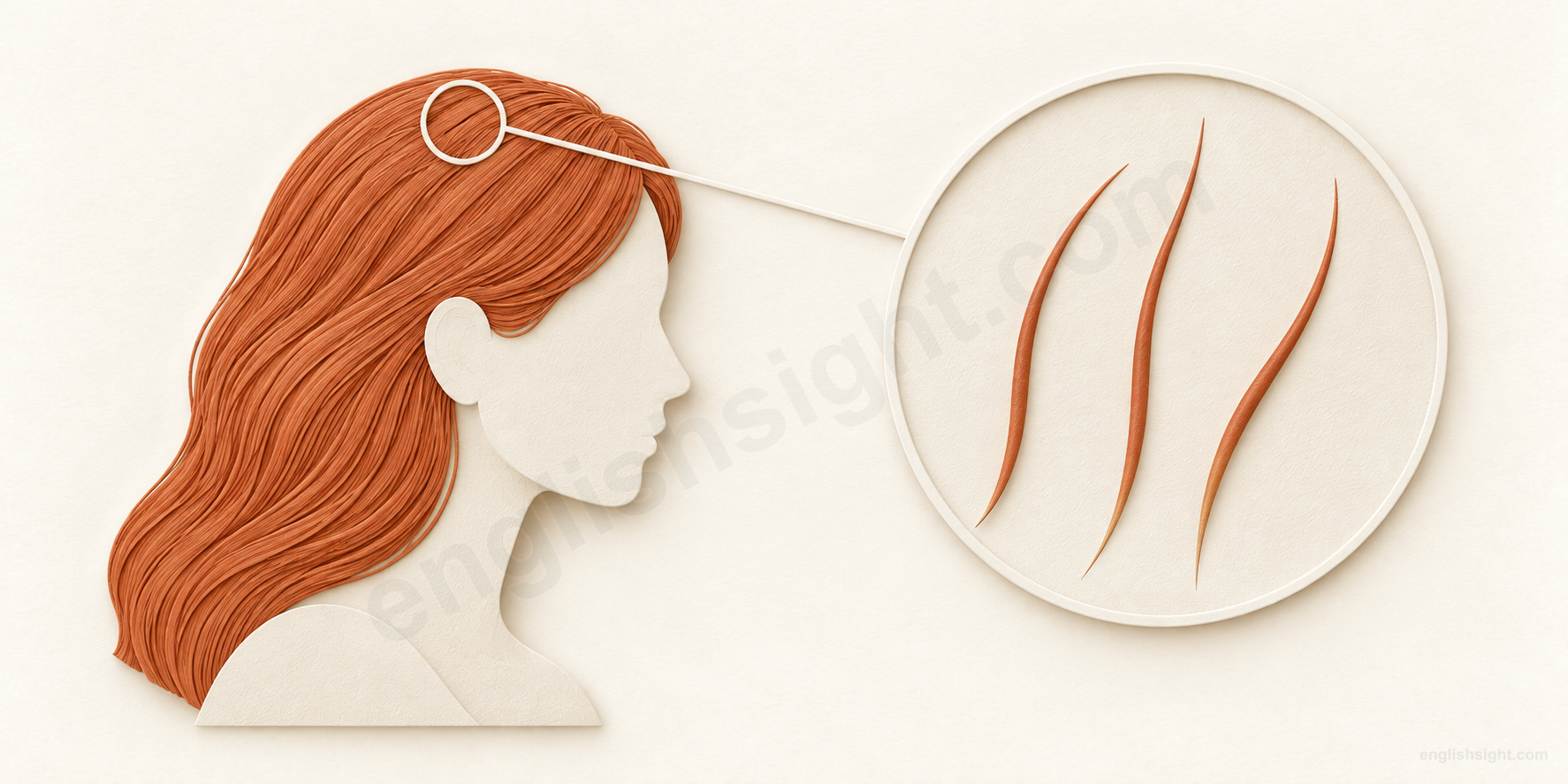
Hair viewed as a whole covering.
hair
Three individual hairs in the enlarged detail.
Look more closely at the individual strands.
The covering is hair; each strand is a hair. The inset changes scale, not the substance.
Hair names fine strands growing from skin, either considered together as a covering or singled out as one hair or several hairs.
The connecting line changes the viewing scale; it does not show hair being removed or becoming a different material. Similar-looking plant growths and fixed expressions need their own explanations.
Hair can name a whole covering or one of the fine strands that make it up. That change of focus explains why both Your hair is wet and There are two hairs on your sleeve are natural.
Begin with the physical noun, then notice the verbs and fixed expressions around it. A single picture cannot predict every idiom, and it is not a claim about what every English speaker imagines.
01
A covering, individual strands, and similar growths
First decide whether you mean hair as a whole or countable hairs. The distinction works beyond the hair on a person’s head.
01
possessive + hair + singular verb; a full head of hair
hair / a head of hair
the strands considered together, especially on the head
Situation / starting focus
You describe someone’s appearance.
Meaning / resulting focus
You refer to the whole covering rather than count strands.
Hair as a whole is an uncountable noun.
In Her hair is wet, hair names the covering collectively and takes a singular verb. Use some hair or a lot of hair, not a hair, when the whole amount is intended.
A full head of hair means plenty of hair growing on someone’s head. Here head is the countable noun: a head of hair. The drawing’s whole-head view represents this collective way of looking.
In a sentence
Your hair is still wet at the back.
Watch the difference For an ordinary hairstyle, say She has short hair, not She has short hairs.
02
a / one + hair; number / a few + hairs; a strand of hair
a hair / hairs / a strand of hair
one or more separate threads
Situation / starting focus
You notice separate strands on a dark jacket.
Meaning / resulting focus
You count the individual pieces.
A hair is one strand; hairs is its plural.
The same material can be viewed as individual units: one hair, two hairs, a few grey hairs. This is a change of focus, not a different substance. The enlarged strands in the diagram represent this view.
A strand of hair is another way to identify one long thin piece. Compare There is some hair on the brush with There are three hairs on the brush: the first gives an amount, the second counts pieces.
In a sentence
There are two white hairs on your jacket.
Watch the difference Use a singular verb with one hair and a plural verb with two hairs.
03
body / facial / animal name + hair; individual animal hairs
body hair / facial hair / cat hair
hair on the body of a person or animal
Situation / starting focus
You notice hair on skin or an animal’s coat.
Meaning / resulting focus
You name the location or the animal it comes from.
Hair is not limited to the human scalp.
Body hair and facial hair describe hair growing on the body and face; a beard is a particular growth of facial hair. Cat hair on a sofa may be treated as an amount, or as individual cat hairs.
Fur commonly names an animal’s soft, thick covering. Cat hair is also natural, especially when talking about loose strands. Fur is not the normal word for a person’s head hair.
In a sentence
We brushed the cat, but there is still cat hair on the cushion.
Watch the difference Animal hair and fur overlap; do not replace every use of hair with fur.
04
hairs on + leaf / stem / insect
tiny hairs on a leaf
fine threadlike growths resembling animal hair
Situation / starting focus
You inspect a leaf or a small insect closely.
Meaning / resulting focus
You notice its fine surface growths.
Hairs can also name similar-looking growths.
Leaves, stems, and some insects have fine growths called hairs. This is a similarity of shape, not a claim that a leaf has human scalp hair.
In ordinary descriptions, the plural is useful: tiny hairs on the stem. Detailed botanical categories and microscopic anatomy are beyond this lesson.
In a sentence
Tiny hairs cover the stem of this plant.
Watch the difference The word identifies the fine growths, not the whole leaf or stem.
02
Describe, care for, and change your hair
The noun names what is being described or treated. Adjectives, action verbs, and the have/get construction supply the particular quality or action.
05
have + adjective + hair; someone’s hair is + adjective
long / curly / dark / fine hair
describe length, shape, colour, or texture
Situation / starting focus
Someone asks what a person’s hair looks like.
Meaning / resulting focus
You choose the quality you need to describe.
The adjective specifies a quality; hair still names the covering.
Long, short, and shoulder-length describe length; straight, wavy, and curly describe shape. Black, brown, blond/blonde, red, grey/gray, and white describe colour. Grey is the usual British spelling; gray is usual in American English.
Fine hair has thin individual strands; it does not simply mean attractive hair. Thick hair often describes a dense covering, while thinning hair describes becoming less dense. These are descriptions, not new senses of the noun.
In a sentence
She has short, curly hair.
Watch the difference Hair is fine can describe strand thickness; My hair looks fine can instead mean it looks acceptable. Read the context.
The verb supplies the action, and hair is its object.
Washing your hair cleans it; brushing and combing arrange or untangle it using different tools. Drying your hair removes moisture. Dyeing your hair changes its colour; dye it brown specifies the result.
In I’m doing my hair, do means arranging or styling it in the situation. Hair itself is normally a noun: do not invent a verb such as I hair every morning.
In a sentence
I need to wash my hair before we leave.
Watch the difference Use my/your/her hair when ownership matters: I wash my hair, not usually I wash the hairs.
07
wear + possessive + hair + up / down / loose / in a ponytail; put one’s hair up
wear your hair up / down / loose
describe the way hair is arranged
Situation / starting focus
You choose how to arrange your hair.
Meaning / resulting focus
It is tied up, hangs down, or is left loose.
Wear describes the style you have, not putting on a separate object.
Wear your hair up means have it gathered and held up, for example in a bun; down means hanging rather than gathered up. Wear your hair in a ponytail names a particular arrangement.
Put your hair up describes changing the arrangement; wear it up describes the resulting style. Let your hair down can literally mean release tied-up hair, but its familiar social idiom has a separate meaning below.
In a sentence
She usually wears her hair up at work.
Watch the difference Wear your hair long is about your hairstyle; it does not mean you are wearing a wig.
08
have / get + possessive + hair + cut; get a haircut
have / get your hair cut
arrange for someone to cut your hair
Situation / starting focus
You book a salon appointment.
Meaning / resulting focus
A hairdresser cuts your hair.
Have/get + object + past participle can describe an arranged service.
I’m having my hair cut normally means someone else does the cutting. The service may be happening now or arranged for later. Get my hair cut is a familiar alternative. Hair is the thing affected; cut is the past participle, with the same spelling as the base verb.
I cut my own hair explicitly says I do the cutting myself. A haircut is countable: get a haircut. The change of wording highlights either the service or the cutting event, not a new meaning of hair.
In a sentence
I’m getting my hair cut on Saturday.
Watch the difference Do not say I’m cutting my hair if you need to make clear that a hairdresser is doing it.
Growth, length, and loss come from the accompanying verbs.
I’m growing my hair means I am letting it become longer. Grow it long or grow it out makes that purpose explicit. My hair grows quickly instead makes the hair itself the grammatical subject.
He is losing his hair describes a reduction, often balding. His hair is falling out describes strands coming away. Hair loss names the process; it is not a countable lost item like a lost key.
In a sentence
I’m growing my hair, so I only want a small trim.
Watch the difference Lose your hair is a physical description; tear your hair out is often figurative frustration.
10
hair + noun; description + -haired; hairy + body part
hair salon / dark-haired / hairy
use hair in a noun combination or related adjective
Situation / starting focus
You name a service or describe a person.
Meaning / resulting focus
The form tells the listener what kind of relationship you mean.
Hair, -haired, and hairy are different grammatical choices.
In hair salon, hair care, and hair loss, the noun hair helps identify the type or purpose of another noun. This use does not make hair a general-purpose adjective.
Dark-haired describes someone with dark hair; long-haired describes long hair. Hairy means covered with a lot of hair, as in hairy arms. A person with long scalp hair is not automatically described as hairy.
In a sentence
A dark-haired woman is waiting outside the hair salon.
Watch the difference Use dark-haired, not dark-hair, before a noun describing a person. Hairy has additional meanings outside this noun lesson.
03
Small margins, feelings, and fixed expressions
Some expressions use the fineness of a hair or an image of personal appearance. Their established meanings belong to the whole expression; learn the wording and situation together.
11
win / lose / miss + by a hair; within a hair’s breadth of + noun / -ing
win / miss by a hair
succeed or fail by an extremely small margin
Situation / starting focus
Two runners finish almost together.
Meaning / resulting focus
One wins by a very small difference.
A hair’s thinness provides an image of a tiny margin.
Win by a hair and lose by a hair describe a very close result. Miss by a hair can mean narrowly fail to hit something or narrowly fail to achieve something; the verb and situation decide which.
A hair’s breadth means a tiny distance or amount. Within a hair’s breadth of winning means very close to winning. A hair here is a figurative measure, not an exact unit.
In a sentence
Our team won by a hair.
Watch the difference By a hair does not tell you whether the result was success or failure; read win, lose, or miss.
12
let + possessive + hair + down
let your hair down
relax and enjoy yourself freely
Situation / starting focus
The exams are over.
Meaning / resulting focus
You stop being so restrained and have fun.
The social idiom is about relaxation, not a required hairstyle.
Let your hair down is informal and often used about enjoying a party or a break after pressure. It can describe someone with any hairstyle.
The literal action of releasing tied-up hair can be a useful memory image, but it does not fully determine the idiom. Compare She wore her hair down, which normally describes appearance rather than a relaxed mood.
In a sentence
After the exams, we finally let our hair down at the party.
Watch the difference Change the possessive with the person: I let my hair down; they let their hair down.
13
get / be in someone’s hair; get / stay out of someone’s hair; keep someone out of someone’s hair
get in / out of someone’s hair
bother someone, or stop bothering them
Situation / starting focus
You keep interrupting someone who is working.
Meaning / resulting focus
You either continue to bother them or give them space.
In and out of mark opposite sides of an established nuisance idiom.
Get in my hair means annoy me, often through repeated interruptions or being too close. It does not require anyone to touch my head.
I’ll get out of your hair means I will leave you alone or stop taking up your attention. Keep the children out of my hair means arrange things so they do not bother me. These are informal expressions, and a direct command can sound impatient.
In a sentence
I’ll get out of your hair now so you can finish the report.
Watch the difference The possessive names the person being bothered: in her hair means bothering her.
The idiom uses an exaggerated bodily action to express distress.
I’m tearing my hair out over this form means the form is making me very frustrated or worried. Pulling my hair out is another established version. No actual pulling is required.
The progressive is natural because the full expression describes a current reaction. Over often introduces the problem. Compare My hair is falling out, which describes a physical event instead.
In a sentence
I’m tearing my hair out over these confusing instructions.
Watch the difference Do not understand a figurative complaint as a claim of literal injury without considering the context.
15
something makes + someone’s hair + stand on end
make someone’s hair stand on end
frighten or shock someone strongly
Situation / starting focus
You hear a disturbing sound in an empty house.
Meaning / resulting focus
You feel intensely afraid.
The expression presents fear through an image of hair rising.
The sound made my hair stand on end means it frightened me. The disturbing thing is the subject of made; the frightened person is identified by my/your/her, and so on.
This familiar exaggeration can evoke a bodily reaction without reporting a visible change in every strand. Stand on end is the fixed wording; ordinary curly or spiky hair is a different description.
In a sentence
The sudden scream made my hair stand on end.
Watch the difference After make use stand, not to stand. On end does not mean at the end of a story.
16
split hairs; be splitting hairs
split hairs
argue about differences judged too small to matter
Situation / starting focus
People debate a detail that will not affect the decision.
Meaning / resulting focus
Someone objects to the unnecessary distinction.
The image of dividing a fine strand supports a criticism of excessive precision.
You’re splitting hairs criticizes a distinction as unhelpfully small. The disagreement may concern wording, categories, or minor facts; the speaker is judging its importance.
This does not mean every precise distinction is pointless. I don’t want to split hairs, but… can introduce a small correction while acknowledging that it may sound fussy.
In a sentence
Arguing about one extra minute is splitting hairs when the whole afternoon is free.
Watch the difference Keep the plural hairs in the idiom. Split ends is a different expression about damaged hair tips.
17
keep + possessive + hair + on
Keep your hair on!
tell someone to calm down or stop being impatient
Situation / starting focus
A friend becomes annoyed about a short delay.
Meaning / resulting focus
You tell them to be calmer.
This British informal expression is a direct instruction about emotion.
Keep your hair on! means calm down. The speaker is not asking someone to keep a wig attached or stop losing hair.
It can sound teasing or dismissive, especially during a real disagreement. Please give me a moment is often a more considerate way to ask for patience. The meaning is attached to the whole expression.
In a sentence
Keep your hair on! I’m nearly ready.
Watch the difference This is especially British and informal. Do not use it as a neutral, polite request in every situation.
18
not turn a hair; without turning a hair
not turn a hair
show no surprise, fear, or disturbance
Situation / starting focus
Unexpected news surprises everyone around you.
Meaning / resulting focus
One person shows no outward reaction.
The negative expression emphasizes remaining unruffled.
She didn’t turn a hair says she stayed outwardly calm when a reaction might have been expected. Without turning a hair is a common alternative after another verb.
The idiom concerns visible composure; it does not prove that the person felt nothing internally. It differs from Keep your hair on!, which tells someone to calm down.
In a sentence
When the lights suddenly went out, Maya didn’t turn a hair.
Watch the difference Learn the negative or without pattern. She turned a hair is not the ordinary opposite meaning “she panicked.”
19
not a hair out of place; without a hair out of place
not a hair out of place
look exceptionally neat and well arranged
Situation / starting focus
Someone arrives after a long journey.
Meaning / resulting focus
Their appearance is still immaculate.
A single out-of-place strand stands for even a tiny flaw in appearance.
Not a hair out of place emphasizes how neat someone looks, often including clothes and general grooming. It may be an admiring or slightly amused description.
She arrived without a hair out of place is another natural form. The point is an overall impression of perfect neatness, not a literal inspection and count of every hair.
In a sentence
He stepped off the train without a hair out of place.
Watch the difference Out of place here concerns arrangement and appearance; out of your hair concerns not bothering you.
20
not harm / touch a hair on / of + someone’s head
not harm a hair on someone’s head
not hurt someone in any physical way
Situation / starting focus
Someone is worried that a person may be attacked.
Meaning / resulting focus
You give a strong assurance of their safety.
Even one hair represents the smallest physical harm in this emphatic idiom.
I wouldn’t harm a hair on his head strongly denies any intention to hurt him. Touch a hair on his head can occur in a warning: Don’t touch a hair on her head.
On and of both occur in the fuller expression. The negative assurance is much broader than promising not to damage someone’s hairstyle.
In a sentence
I promise I won’t harm a hair on his head.
Watch the difference Read the whole sentence: If you touch a hair on her head… is a warning, not a harmless comment about grooming.
21
not see hide nor hair of + person / thing
not see hide nor hair of someone
see no sign of someone or something
Situation / starting focus
You expect someone to appear.
Meaning / resulting focus
You have not seen them at all.
Hide nor hair emphasizes the complete absence of any visible sign.
I haven’t seen hide nor hair of him says I have seen no sign of him, often despite expecting to. It can also be used about a missing thing: no sign of the parcel.
Hide here belongs to the fixed phrase and refers to skin, not the verb meaning conceal. The expression does not tell you why the person is absent or prove that something bad has happened.
In a sentence
I haven’t seen hide nor hair of Leo since Monday.
Watch the difference Keep of before the person or thing. The idiom is informal and usually used in a negative context.
22
have / be having + a bad hair day
have a bad hair day
have difficult hair, or a day when many things go wrong
Situation / starting focus
Your hair will not look right, or several things go wrong.
Meaning / resulting focus
You describe the day with an informal phrase.
Context distinguishes the grooming problem from the wider bad-day meaning.
A bad hair day can literally be a day when your hair is hard to manage or looks wrong. It can also describe an annoying, unsuccessful day with no connection to hair.
With a missed bus, a broken printer, and lost keys, I’m having a bad hair day is a light or humorous complaint. The phrase does not by itself indicate a serious disaster.
In a sentence
First I missed the bus, then my laptop froze—I’m having a bad hair day.
Watch the difference Do not assume the problem is always a hairstyle; the surrounding events determine the meaning.
23
a / the hair of the dog (that bit you)
a hair of the dog
an alcoholic drink taken with the aim of easing a hangover
Situation / starting focus
A conversation mentions the morning after heavy drinking.
Meaning / resulting focus
Someone refers to another alcoholic drink using an idiom.
The established phrase refers to a drink, not an animal’s hair.
A hair of the dog, also the hair of the dog or hair of the dog that bit you, is informal language for alcohol drunk in the hope of easing the after-effects of earlier drinking.
This entry explains the expression and the intention it describes; it does not establish that the practice works. Recognize the phrase as a whole rather than trying to derive the drink meaning from hair alone.
In a sentence
He called the morning drink “a hair of the dog.”
Watch the difference The expression is about the drinker’s intended remedy; it is not a general name for breakfast or all morning drinks.
Keep the noun, the grammar, and the idiom distinct
An amount or separate pieces?
Use uncountable hair for the covering: much hair, some hair, her hair is. Use countable a hair/hairs for strands: one hair, a few hairs, those hairs are. Ordinary head hair is not a plural noun even though it consists of many strands.
What belongs to the surrounding words?
Wash, cut, grow, and lose contribute different actions. Have/get your hair cut is a service construction, not a special verb sense of hair. These combinations are not all phrasal verbs: hair remains a noun inside them.
Useful image, limited prediction
A fine strand can suggest a tiny margin, and personal appearance can support an idiom’s memory image. The actual meanings of split hairs, let your hair down, and get out of your hair must still be learned as established expressions.
Sound and scope
Hair is pronounced /heə(r)/ in the British form and /her/ in the American form shown by Oxford; hare is a homophone in standard British and American pronunciation. This lesson covers the modern noun and selected related forms, not specialist anatomy, textiles made from hair, or an exhaustive list of compounds.
Choose the meaning from the whole pattern
Decide whether you are describing a covering, counting strands, arranging a service, or using an idiom.
1. You describe all the hair on someone’s head. Which sentence is standard?
2. You see exactly three separate strands on a sleeve. Which wording makes the count clear?
3. A hairdresser will cut your hair tomorrow. Which sentence makes that arrangement clear?
4. A colleague needs quiet, so you stop interrupting. Which expression fits?
5. After a stressful week, people let their hair down at a party. What is the intended meaning?
6. Someone says you are splitting hairs about a tiny wording difference. What are they criticizing?
Sources and teaching notes
Usage was checked in the dictionary entries below. The explanations and example sentences are original teaching material. The whole-and-strands drawing is a teaching aid, not evidence for the history of every idiom.
This diagram explains the whole-and-strands distinction; it does not claim a shared mental picture for every speaker.