A striking tool, repeated force, and persistent effort.
Read the object and the whole expression to understand what hammer is doing.
A blow acts on a target
A blow acts on a target
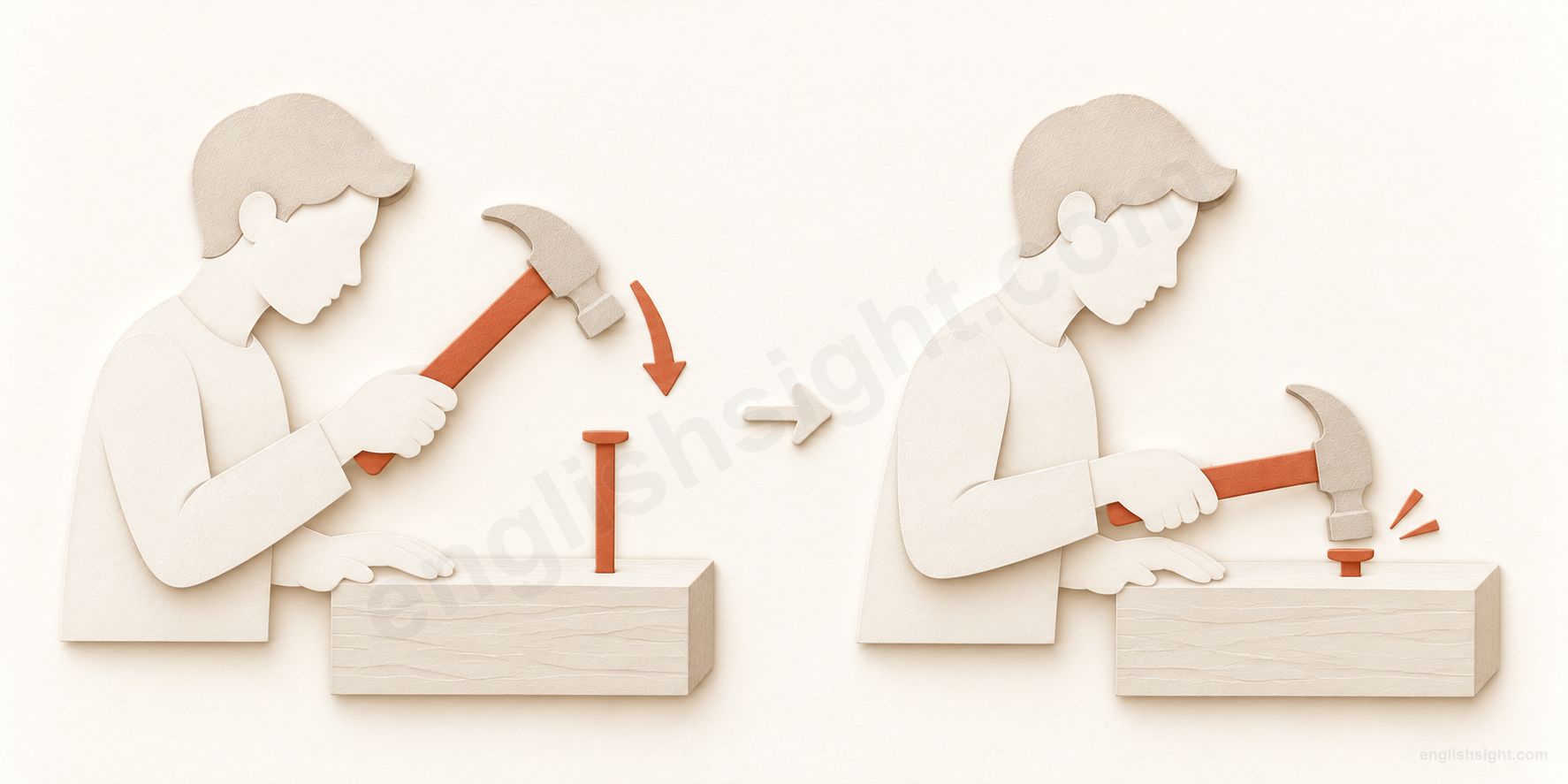
A worker raises a hammer above a nail protruding from wood.
hammer
The same nail now projects only a short distance above the wood.
Downward hammer blows drive the nail farther in.
Repeated hammer blows can drive a nail deeper into wood.
A hammer delivers a concentrated blow to a target; repeated blows can drive or shape it. Many figurative uses suggest comparable force or persistence.
The sketch shows one physical result. Hammer alone does not guarantee a change, imply repetition in every sports use, or predict the meaning of every idiom.
A hammer is a tool that delivers blows. As a verb, hammer can describe using that tool, hitting forcefully, or applying pressure and effort in less literal ways.
The connection is a teaching model, not a claim that every speaker pictures the same scene. Sports objects and fixed expressions need their own context.
01
Tools, blows, and physical results
Start with the tool, then notice what is struck and whether the sentence names a direction or a resulting shape.
01
a / the + hammer; with a hammer; hammer + noun
a hammer
a handled tool used for striking
Situation before
A nail needs driving into wood.
What happens or is meant
You choose a tool that delivers blows.
The noun names the tool, not the action.
A hammer has a head across a handle. Say a hammer for one tool and two hammers for two. With a hammer names the instrument: tap the peg with a hammer.
A hammer blow is a blow delivered by a hammer. A gentle tap with a hammer is possible: owning or using the tool does not mean every stroke is violent.
In a sentence
Please pass me the hammer beside the toolbox.
Watch the difference Hammer is countable here: say I need a hammer, not I need hammer.
02
hammer + object + in; hammer in + noun; hammer + object + into + material
hammer a nail in / into wood
drive something by striking it with a hammer
Situation before
The nail stands above the surface.
What happens or is meant
Repeated strokes drive it farther in.
The nail receives the blows; in or into supplies the direction.
Hammer can take an object, as in hammer a nail, or stand alone when the activity is understood: Someone is hammering upstairs.
Hammer the nail in and hammer in the nail are both possible; with a pronoun use hammer it in. Into needs a following destination: hammer it into the wood. The nail was hammered into the wood is an ordinary passive.
In a sentence
She hammered the nail into the wooden frame.
Watch the difference Do not say hammer into it when it means the nail; say hammer it in or hammer it into the wood.
03
hammer + object + adjective; hammer + object + into shape; hammer out + dent
hammer metal flat / hammer out a dent
change a shape through hammer blows
Situation before
The metal is uneven or bent.
What happens or is meant
The blows flatten or reshape it.
A result word says what the blows achieve.
In hammer the metal flat, flat describes the metal after the action. Hammer it into shape similarly names a result, rather than a place inside something.
Hammer out a dent means remove the dent by hammering; hammer it out places the pronoun before out. This physical use differs from hammer out an agreement, where discussion produces a result.
In a sentence
The metalworker hammered the copper flat.
Watch the difference Hammered describes the action; flat supplies the resulting shape.
04
hammer on / at + surface; hammer + object + with + instrument
hammer on / at the door
hit a surface hard and repeatedly
Situation before
Someone outside wants attention.
What happens or is meant
Repeated loud blows sound at the door.
The action can use fists rather than a tool.
Hammer on the door or hammer at the door describes insistent, noisy knocking. Compare knock on the door, which need not be loud or repeated.
The surface may be the direct object: hammer the door with your fists. Rain hammered on the roof extends the same repeated-impact idea to weather. I heard hammering names the activity or its sound.
In a sentence
Someone was hammering on the locked door.
Watch the difference Do not infer that the person used an actual hammer.
02
Force felt in bodies, sport, and setbacks
The force can be like a hammer blow without involving the tool. A forceful ball strike need happen only once.
05
heart / pulse + hammer; be hammering
my heart was hammering
feel the heart beating strongly and fast
Situation before
You are waiting to hear the result.
What happens or is meant
You notice rapid, forceful beats.
Your heart is the subject; no object is struck.
This vivid description often appears in stories about fear or excitement. It reports a bodily sensation, not literal contact with a tool.
My heart was hammering uses a normal progressive because the beating is in progress. My heart beat faster is more neutral.
In a sentence
My heart was hammering as I opened the results email.
Watch the difference Do not add an object such as hammering me to express this sensation.
06
hammer + ball + direction; hammer + it / ball + home
hammer the ball / hammer it home
strike or kick a ball with great force
Situation before
A player has a chance near the goal.
What happens or is meant
A powerful shot sends the ball in.
In sports language, one hard strike can be enough.
Hammer the ball emphasizes power. Hammer it into the net gives a destination; hammer it home in football means strike it hard and score.
Compare hammer home a point: that expression concerns communication. The object and the sports situation select the ball meaning.
In a sentence
Rosa hammered the ball into the far corner of the net.
Watch the difference Unlike repeated door-banging, a ball strike need not be repeated.
07
hammer + opponent; be hammered; take a hammering
hammer a team
defeat an opponent very easily
Situation before
Two teams compete.
What happens or is meant
One wins overwhelmingly.
The opponent, not the ball, is the object.
This informal sports use describes a heavy defeat. We hammered them 6–0 and We were hammered 6–0 present the same match from opposite sides.
Take a hammering is a related noun expression: We took a hammering in the final. It means suffering a severe defeat in this context.
In a sentence
The visitors hammered us 6–0.
Watch the difference This result does not imply that the players physically attacked one another.
08
hammer + person + for + noun / -ing; take a hammering
hammer someone for something
criticize someone harshly
Situation before
The manager makes an unpopular decision.
What happens or is meant
People criticize her severely.
The blows are a metaphor for strong criticism.
In informal reporting, hammer a person for a decision identifies both the target and the reason. The passive is common: She was hammered for the delay.
The proposal took a hammering at the meeting uses the related noun for severe criticism. Unlike neutral question or discuss, hammer suggests a strong attack.
In a sentence
The manager was hammered in the press for closing the service.
Watch the difference Read the context: a hammering may mean criticism or a heavy sporting defeat.
09
hammer + person / thing; be hammered by + cause
be hammered by rising costs
be affected very badly
Situation before
A shop already has little money.
What happens or is meant
Extra costs create serious pressure.
A harmful cause replaces the literal striking tool.
This informal use can describe businesses, places, or other things suffering badly. By introduces the cause in the passive: The coast was hammered by storms.
Compare criticized: rising costs do not voice an opinion. The subject and cause make the financial or physical harm clear.
In a sentence
Small shops have been hammered by rising energy costs.
Watch the difference Hammered here means badly affected; it does not by itself claim that the harm was unfair.
03
Persistent work, repetition, and agreed results
Read the whole expression: away at sustains effort, into names a learner, home emphasizes a message, and out can produce an agreement or a tune.
10
hammer away at + task; keep hammering away
hammer away at a problem
keep working hard at something
Situation before
A problem resists a first attempt.
What happens or is meant
You keep making efforts to solve it.
Away sustains the activity; at names its target.
Hammer away at a task presents persistent effort, like returning to a surface with more blows. It does not guarantee that the work succeeds.
Keep hammering away is possible when the task is understood. In hammer away at it, the pronoun follows at; away is not a place where the task goes.
In a sentence
We hammered away at the software problem all afternoon.
Watch the difference Say hammer away at it, not hammer it away at.
11
hammer away at + point / issue
hammer away at the same point
repeat or press a point persistently
Situation before
The speaker wants one issue taken seriously.
What happens or is meant
The issue is raised repeatedly.
Persistence concerns a message rather than a practical task.
The same expression can describe repeated argument: She kept hammering away at the cost. Hammer at a theme can also mean return to it forcefully and repeatedly. These uses may sound forceful or wearisome in context.
Unlike hammer out a deal, this does not say an agreement emerged. The repeated point may still be disputed.
In a sentence
He kept hammering away at the need for better lighting.
Watch the difference The expression does not mean physically striking a written point.
12
hammer + information + into + person / person’s head
hammer a rule into someone
make someone learn through forceful repetition
Situation before
A learner keeps forgetting a rule.
What happens or is meant
Someone repeats it insistently to make it stick.
The rule is the object; into introduces the learner.
Hammer the rule into us describes emphatic, repeated instruction. The image is of driving information in, not physically striking a person.
It can sound impatient or overbearing, so explain the rule to someone is more neutral. The fuller expression hammer something into someone’s head stresses the same repeated instruction.
In a sentence
Our coach hammered the safety rules into us before every trip.
Watch the difference Use hammer it into them, not hammer them it; do not transfer the literal violence to the learner.
13
hammer home + message; hammer + message / it + home
hammer home a point
make a message clear through strong emphasis
Situation before
The audience may underestimate a risk.
What happens or is meant
The speaker emphasizes it so it is understood.
Home belongs to the established expression, not a house.
Hammer home the importance of something and hammer a point home both place emphasis on understanding. Repetition is common, but the expression can also describe one especially forceful explanation.
With a pronoun, say hammer it home. Compare hammer it into us, which explicitly identifies the people being taught. Neither phrase means sending the message to a home address.
In a sentence
The final demonstration hammered home the importance of checking the brakes.
Watch the difference Distinguish a message from the ball in hammer it home in a match.
14
hammer out + agreement / details; hammer + it + out
hammer out an agreement
reach an agreed result through sustained discussion
Situation before
People disagree about the arrangements.
What happens or is meant
Discussion produces a workable agreement.
Out presents a result produced through effort.
Common objects include a deal, a compromise, a solution, and the details of a plan. The expression suggests work through disagreements rather than a quick announcement.
Hammer out a deal and hammer a deal out are possible; use hammer it out with a pronoun. A deal was hammered out is a natural passive. We are hammering it out describes work still in progress, not a completed agreement.
The broader result-producing use need not involve several people: I spent the evening hammering out a plan describes developing it through sustained thought and effort. With an agreement or compromise, discussion between people is the usual setting.
In a sentence
After several meetings, we hammered out a fair payment plan.
Watch the difference Do not say hammer out it. Compare hammer away at a problem, which need not achieve a result.
15
hammer out + tune; hammer + it + out
hammer out a tune
play music loudly and heavily
Situation before
Someone sits at a piano.
What happens or is meant
A loud, unsubtle tune comes from the keys.
The object is music, not an agreement.
Hammer out a tune describes forceful playing, often suggesting little skill or delicacy. It is not the neutral way to compliment a careful performance.
The same form has different readings: hammer out a compromise is negotiation; hammer out a tune is noisy performance. The musical use does not necessarily mean composing a new tune.
In a sentence
A beginner was hammering out a tune on the old piano.
Watch the difference Do not assume out always means remove: no tune is being removed from the piano.
04
Other objects and established expressions
Some uses name a specialized object or belong to a fixed expression. Learn their context rather than guessing from the sketch.
16
piano + hammer; the hammers + verb
a piano hammer
a striking part inside an instrument
Situation before
A piano key is pressed.
What happens or is meant
A small hammer strikes the strings.
This noun names a mechanism with a striking action.
A piano has hammers inside it; these are not hand tools held by the pianist. The name connects to their striking function.
Hammer can also name a striking component in a gun. That is recognition vocabulary here, not a lesson in operating the mechanism.
In a sentence
The technician checked the piano’s hammers.
Watch the difference Do not confuse the internal piano hammer with hammer out a tune, which describes the player’s manner.
17
throw the hammer; compete in the hammer; hammer throw
the hammer / hammer throw
a throwing implement or the athletics event
Situation before
An athlete prepares a ball on a wire.
What happens or is meant
The athlete swings and throws it for distance.
The sports hammer is not the household tool.
In athletics, a hammer is a heavy ball attached to a wire and grip. Throw the hammer names using that implement; compete in the hammer names the event.
Hammer throw is the event name too. This specialized noun needs its own recognition image; the nail-driving sketch does not show its shape or technique.
In a sentence
Mina competes in the hammer at national athletics meetings.
Watch the difference The hammer here is an athletics implement, not a tool thrown in ordinary repairs.
18
go / come / be under the hammer; go under the hammer for + price
go / come under the hammer
be offered or sold at auction
Situation before
An owner offers an item to bidders.
What happens or is meant
The auction determines whether and to whom it sells.
The hammer stands for the auctioneer’s gavel.
Under the hammer belongs to auction language. The old clock goes under the hammer tomorrow means it will be offered at auction; it does not promise a buyer.
A completed sale can be reported as The clock went under the hammer for £800. Be under the hammer describes being offered for auction. These are fixed uses, not literal locations beneath a tool.
In a sentence
The collection will go under the hammer next month.
Watch the difference Keep the in under the hammer; this expression does not mean being smashed.
19
go at it hammer and tongs; go at + task + hammer and tongs
go at it hammer and tongs
argue, fight, or work with great energy
Situation before
People begin an argument or a demanding task.
What happens or is meant
They put great energy into it.
The whole idiom conveys intensity.
In They were going at it hammer and tongs over the bill, the context indicates a fierce argument. Actual tools are not involved.
It can also describe energetic work: We went at the cleanup hammer and tongs. Oxford highlights noisy arguments or fighting; Collins also records the broader energetic-effort use. Context chooses the reading.
In a sentence
The neighbours were going at it hammer and tongs over the parking space.
Watch the difference Learn the fixed plural tongs. The idiom is informal and too vivid for many neutral reports.
20
be / get hammered
be / get hammered
be or become very drunk
Situation before
Someone has drunk a lot of alcohol.
What happens or is meant
A speaker describes severe drunkenness informally.
Here hammered is an established informal adjective.
He was hammered at the party can mean he was very drunk. Get hammered describes becoming drunk. This is casual language; very drunk is clearer in a neutral account.
Contrast Our team was hammered 6–0, a defeat, and Shops were hammered by costs, serious harm. The participle’s appearance alone does not determine the meaning.
In a sentence
He got hammered at the party and could barely stand.
Watch the difference Do not read every be hammered as a passive event or assume it always means drunk.
Read the force, the result, and the context
Hammer, hit, tap, and pound
Hit is general and can describe one contact. Tap suggests a light touch. Pound suggests heavy or repeated blows. Hammer can name the tool or suggest its striking action; a powerful sports shot can be a single strike.
Forms and grammar
The verb forms are hammer, hammers, hammered, hammering. Progressive and passive forms are ordinary where the meaning allows them. In hammer the metal flat, flat is a result adjective; in get the nail hammered in, the wider get construction introduces the completed work, not a special causative sense of hammer.
Particles and prepositions do different jobs
Use hammer it in, hammer it out, and hammer it home. Into the wood names a destination, while into someone introduces the learner in a figurative teaching expression. In hammer away at it, at keeps its following object.
Scope of this lesson
The lesson includes practical repair language, figurative force, persistent effort, important multiword expressions, and recognition uses in music, athletics, and auctions. The ear bone called the hammer, specialist industrial names, curling terminology, and uncommon regional expressions are outside the expanded lessons.
Choose the meaning in context
Use the object, result, and situation rather than translating hammer alone.
1. You and a colleague must resolve a disagreement about the schedule. Which sentence has the natural pronoun position?
2. Someone is hammering on the door. What can you safely infer?
3. The demonstration hammered home the danger. What happened?
4. A painting will go under the hammer tomorrow. Which interpretation fits?
5. Which sentence explicitly gives the resulting shape of the object?
6. A beginner hammered out a tune on the piano. What does out contribute in this established use?
Sources and teaching notes
Definitions and usage were checked against the sources below. Explanations, example sentences, and the diagram were written for this lesson; the visual connection is a teaching interpretation.
The sketch explains a physical connection; figurative uses and idioms depend on context.