Follow hand from the body part to useful patterns for work, control, and passing things on.
Direct contact makes handling possible
Direct contact makes handling possible
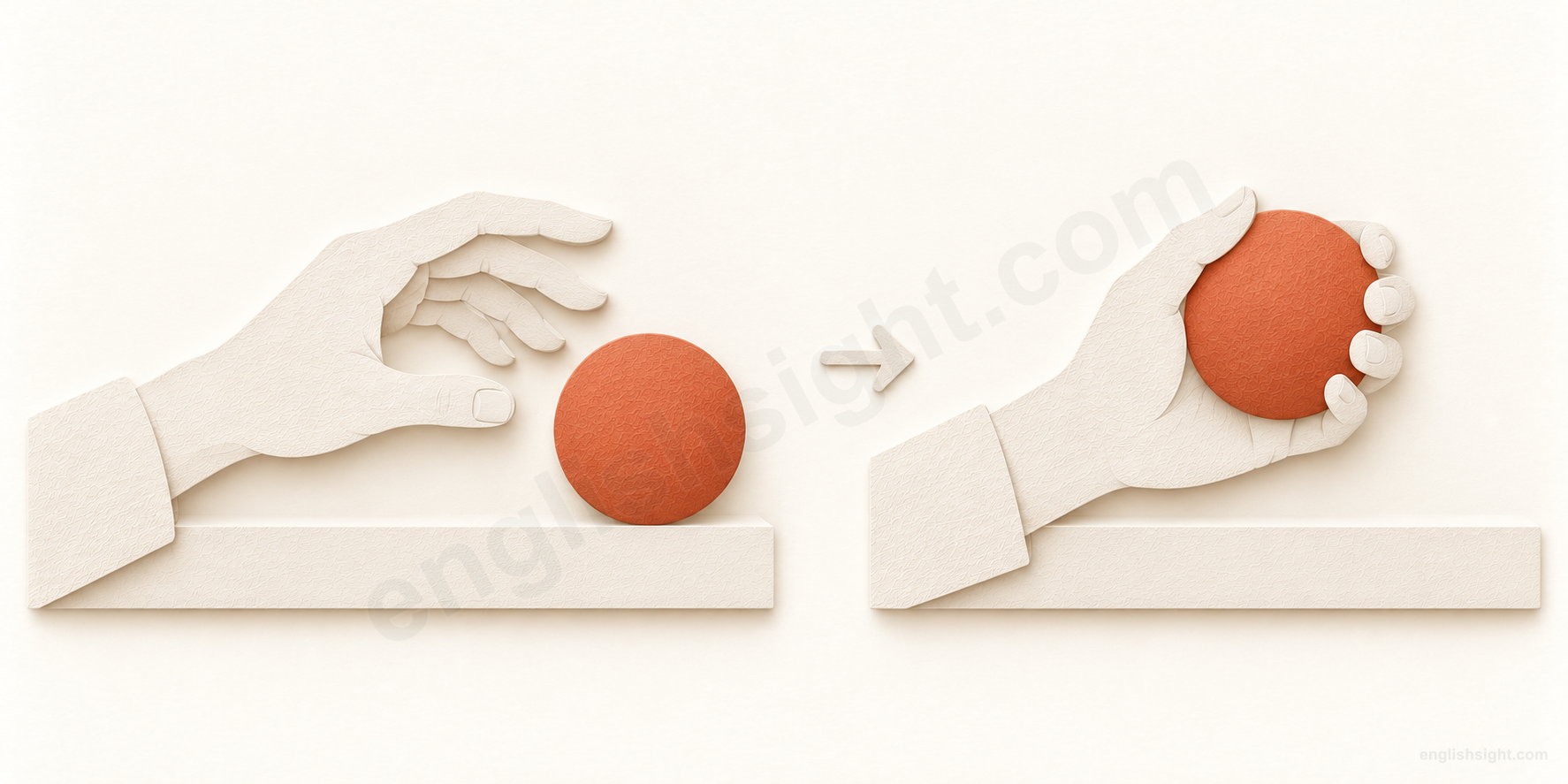
The ball rests on a ledge beside an open hand.
hand
The ball is supported in the hand above the ledge.
The palm, fingers, and thumb make contact and hold the ball.
Direct contact lets a hand hold and handle an object; idioms need their own explanations.
A hand is the body part through which a person can touch, hold, and manipulate something. Holding offers a useful comparison for care and control; helping offers one for shared effort.
This physical starting point connects some uses. Clock pointers, card-game terms, discourse markers, and fixed idioms still require their own explanations. The diagram shows contact, not the transfer meaning of the verb.
Your hand is where you directly touch and hold things. English also uses hand for help, practical ability, involvement, and control. These connections make many expressions easier to remember, but do not turn every idiom into one predictable meaning.
This lesson separates the noun hand from the verb hand and gives the full constructions that make each meaning clear. The picture is a teaching aid, not a claim that all English speakers imagine the same scene.
01
The body part and things named after it
Start with the hand itself, the actions it performs, and established names such as a clock hand or a hand of cards.
01
a / your / left / right hand; plural hands
a hand / both hands
the part of an arm used to touch, hold, and work
Situation / starting point
You need to carry a small object.
Meaning / outcome
Your fingers and thumb hold it.
Hand names the body part; palm names only one surface of it.
A hand includes the palm, fingers, and thumb at the end of an arm. It is a countable noun: one hand, two hands. In ordinary descriptions, a possessive is natural: Wash your hands; she hurt her hand.
You can hold a key in your hand or place your hand on a table. In names such as hand towel and hand drill, hand modifies another noun. Left-handed and right-handed describe which hand someone mainly uses; they are not past-tense verbs here.
In a sentence
I held the shell in my left hand.
Watch the difference Your arm includes much more than your hand; your palm is not the whole hand.
02
raise / put up your hand; vote by a show of hands
raise your hand / a show of hands
signal or vote by lifting a hand
Situation / starting point
A teacher asks who has a question.
Meaning / outcome
A learner lifts a hand to signal.
A raised hand is an action; a show of hands is a group voting method.
Raise your hand and put your hand up are normal ways to request a turn or signal an answer. Hands up! can invite a response; in a threatening situation it can instead order people to raise both hands.
A show of hands means a vote conducted by raising hands. The noun show belongs to the fixed expression: it is not a performance by someone’s fingers. Context distinguishes a classroom request from an order to surrender.
Hold or put your hands up (to something) can also mean admit a mistake or responsibility: I hold my hands up: I missed the email. This is an admission, not a classroom vote. Raise a hand against someone instead means hit or threaten to hit them; the complement changes the meaning.
In a sentence
We chose the new meeting time by a show of hands.
Watch the difference Do not assume Hands up! always means surrender; a teacher can use it to ask for volunteers.
03
shake hands with somebody; shake somebody’s hand; hold hands
shake hands / hold hands
greet by a handshake or maintain physical hand contact
Situation / starting point
Two guests meet for the first time.
Meaning / outcome
They greet each other with a handshake.
Shaking hands is a greeting; holding hands is continuing contact.
Shake hands with a person and shake a person’s hand describe the same greeting. After shake hands, with introduces the other person. Hold hands describes people keeping their hands joined, often for affection, support, or safety.
Hand in hand can describe this same joined position: The children walked hand in hand. Join hands can literally mean forming this contact, or figuratively mean cooperating. These are noun expressions, not particle verbs headed by hand.
In a sentence
I shook hands with our new neighbour.
Watch the difference Say We shook hands or I shook her hand, not I shook hands her.
04
make / wash / write something by hand; hand-painted + noun
by hand / hand-made
using human action rather than an automatic machine
Situation / starting point
A craftsperson shapes each piece directly.
Meaning / outcome
The work is done manually.
By hand describes the method; it does not require literally bare fingers.
Work done by hand can involve a brush, needle, or other hand tool. The contrast is with machine production or automatic processing. For example, checking a calculation by hand contrasts with letting software do it.
A note delivered by hand is taken directly to its destination rather than sent by post. This is a separate delivery use of the same phrase. Compounds such as hand-painted describe a method; a hand drill is a tool operated manually. With your bare hands means without tools, which is a narrower claim.
In a sentence
The labels were painted by hand with a fine brush.
Watch the difference By hand does not mean without tools; with your bare hands does.
05
hour / minute / second hand
the hands of a clock
the pointers that show time on a dial
Situation / starting point
You look at an analogue clock.
Meaning / outcome
Its pointers indicate the time.
This hand is a pointer, not a body part.
A clock can have an hour hand, a minute hand, and a second hand. The noun names the moving pointer. It does not mean a hand touching the outside of the clock.
The second hand shows seconds; second is a time unit here. Compare a second-hand clock, which is a clock previously owned by someone else. Spacing and the surrounding noun help distinguish the expressions.
In a sentence
The minute hand is pointing at six.
Watch the difference A second hand and a second-hand watch mean different things.
06
be dealt a good / bad hand; play a hand
a good hand / another hand
a player’s cards, or one round of a card game
Situation / starting point
The cards are dealt to the players.
Meaning / outcome
Each player has a set to play with.
Hand can name the cards held or a round of play.
Your hand is the set of cards available to you in a game. A good hand gives useful cards; a bad hand gives unhelpful ones. In Let’s play one more hand, hand means a round, not a set of fingers.
Life dealt her a difficult hand transfers the card-game image to circumstances she did not choose. It does not say she caused the difficulties. This card branch also helps explain some strategy idioms later in the lesson.
In a sentence
Can we play one more hand before dinner?
Watch the difference Read the verb and context: inspect your hand concerns your cards; finish a hand can concern the round.
02
Help, work, and skill
A hand can stand for someone’s effort, help, or ability. The whole expression tells you which relationship is intended.
07
give / lend somebody a hand with something; a hand doing something
give / lend somebody a hand
help someone with a task
Situation / starting point
A colleague cannot move a heavy box alone.
Meaning / outcome
You help with the work.
A hand stands for assistance, not a body part being transferred.
Can you give me a hand? is an informal request for help. Add with plus a task or object: a hand with these boxes. A following -ing phrase is also possible: a hand carrying these boxes.
Lend a hand and lend a helping hand likewise mean help; no repayment is implied by lend. The help need not be manual: you can give someone a hand with a spreadsheet. Contrast hand me a box, where hand is the verb and the box is passed.
In a sentence
Could you give me a hand setting up the projector?
Watch the difference Give me a hand asks for help; hand it to me asks for an object.
08
give somebody a (big) hand
give somebody a big hand
applaud someone
Situation / starting point
A performer has finished a song.
Meaning / outcome
The audience claps to show approval.
The same give-a-hand wording can ask for applause rather than help.
An announcer saying Give our next guest a big hand is asking people to clap. Big strengthens the request for enthusiastic applause. An audience and a performance make this reading clear.
Compare Give me a hand with the chairs: with the chairs points to assistance. These are established uses of the noun hand; the verb give alone does not distinguish them.
In a sentence
Please give our young musicians a big hand.
Watch the difference At a performance, a big hand usually means applause, not physical assistance.
09
need an extra pair of hands; a farm / hired hand
an extra pair of hands / a farm hand
a helper or a person employed for physical work
Situation / starting point
There is more work than the team can do.
Meaning / outcome
Another person joins to help.
Hands can stand for people doing work.
An extra pair of hands is an informal way to ask for another helper. It counts one additional person, not two. A farm hand or hired hand is a worker, especially someone employed for physical tasks.
On a ship, hands can mean crew members. All hands on deck! literally calls the crew to work and is also used humorously when everyone must help with an urgent task. This use refers to whole people, not detached body parts.
In a sentence
We need an extra pair of hands to pack the orders.
Watch the difference One extra pair of hands normally means one extra helper.
10
be good with your hands; an old hand at + noun / -ing
good with your hands / an old hand
manually skilled, or experienced in an activity
Situation / starting point
Someone has repaired furniture for years.
Meaning / outcome
They can deal with the work confidently.
Practical skill and long experience are related but different claims.
Good with your hands describes skill in making or repairing things manually. A steady hand can matter for delicate work. An old hand at something is a person with substantial experience, even when the activity is not manual.
Old describes experience in this expression, not necessarily a person’s age. Nora is an old hand at organising conferences says she has done it often. Use an old hand, because hand is a singular countable noun here.
In informal British English, a dab hand at something is someone very good at it: Tia is a dab hand at fixing bikes. With can introduce a tool: a dab hand with a paintbrush. The phrase emphasises skill; an old hand emphasises experience as well as competence.
In a sentence
Nora is an old hand at organising conferences.
Watch the difference Good with your hands is about manual ability; an old hand at negotiations need not make things by hand.
11
try your hand at + noun / -ing; keep your hand in
try your hand at / keep your hand in
try an activity, or maintain an existing skill
Situation / starting point
You are interested in a new activity.
Meaning / outcome
You attempt it to see how you do.
Trying a skill and maintaining a skill are different situations.
Try your hand at pottery or at making pots invites an attempt, often at an unfamiliar activity. At is a preposition, so a verb after it takes the -ing form.
Keep your hand in means continue doing something occasionally so that you do not lose a skill. Turn your hand to something describes taking up a task or being capable of doing it, often with versatility: She can turn her hand to most repairs. These are fixed expressions, not literal rotations of a hand.
In a sentence
I still repair small radios to keep my hand in.
Watch the difference Try your hand at doing something, not try your hand to do something.
12
hold somebody’s hand
hold somebody’s hand
give close support through an unfamiliar or difficult task
Situation / starting point
A new volunteer is nervous about the first session.
Meaning / outcome
Someone guides and reassures them.
Literal hand-holding can become an image of close support.
Hold my hand can be a literal request for touch. In a work or learning situation, it can mean guide and reassure me while I do something difficult. No physical contact is required for that figurative use.
Tone matters: He needs someone to hold his hand through every task may criticise dependence. Offer support carefully if you do not intend that implication. This is different from give someone a hand, which simply offers help with a task.
In a sentence
I can explain the system, but I cannot hold your hand through every booking.
Watch the difference This expression may sound patronising when used about an adult’s ordinary work.
13
sit on your hands; not lift a hand / finger to do something
sit on your hands / not lift a hand
fail to act, or refuse to help
Situation / starting point
A task needs attention and other people are working.
Meaning / outcome
One person does nothing to help.
A body-action image becomes criticism of inaction.
Sit on your hands means take no action when action is expected. It is often critical: We cannot sit on our hands while the roof leaks. The person need not literally be sitting on their hands.
Not lift a hand to help likewise says someone makes no effort to assist; not lift a finger is another familiar version. Contrast have your hands tied, which says restrictions prevent action. A person can be inactive by choice or unable to act for another reason, and these phrases express different judgments.
In a sentence
Everyone was cleaning, but Max did not lift a hand to help.
Watch the difference Do not use hands are tied merely to describe someone choosing not to help.
03
Care, control, and responsibility
Holding something offers a useful comparison for being responsible for it. Learn the fixed grammar: singular hand and plural hands are not freely interchangeable.
14
be in somebody’s hands; leave something in the hands of somebody
in somebody’s hands / in safe hands
under someone’s care, responsibility, or control
Situation / starting point
A specialist takes responsibility for the repairs.
Meaning / outcome
That person now deals with the problem.
Holding becomes a useful comparison for responsibility, not proof of ownership.
The repairs are in Eva’s hands means Eva is responsible for dealing with them. The children are in safe hands says the person looking after them can be trusted. Neither requires literal holding.
Into marks a change: a document falls into the wrong hands when an unsuitable person gains access or control. Private hands can refer to private ownership. Context tells you whether the issue is care, authority, access, or ownership.
In a sentence
I left the arrangements in Eva’s capable hands.
Watch the difference In someone’s hands does not always mean they own the thing.
15
have a hand in + noun / -ing
have a hand in something
take part in or influence what happens
Situation / starting point
Several people contribute ideas to a project.
Meaning / outcome
One person’s involvement is acknowledged.
A hand in an outcome is a contribution, not necessarily sole control.
Have a hand in designing something says that someone played a part in it. The part may be helpful or harmful; the expression alone does not assign praise or blame. In is followed by a noun or -ing form.
The hand of a skilled editor can sometimes be recognised in a text: this points to influence or characteristic work. Compare in the editor’s hands, which puts emphasis on who is responsible rather than who contributed.
In a sentence
Mira had a hand in designing the new timetable.
Watch the difference Have a hand in planning does not mean be entirely in charge of planning.
16
suffer / receive something at the hands of somebody; at somebody’s hands
at the hands of somebody
as a result of what someone does to you, usually something harmful
Situation / starting point
Someone suffers mistreatment or a defeat.
Meaning / outcome
The person or group causing it is identified.
At the hands of identifies an agent, not a location or a helping action.
This formal expression names the person or group responsible for something suffered: mistreatment at the hands of an employer. It is often used for harm, poor treatment, or defeat. The noun does not mean that literal hands must cause the event.
Compare in the hands of a doctor, which describes care or control, and have a hand in the decision, which describes involvement. These prepositions and constructions do different work; they cannot be exchanged freely.
In a sentence
The club suffered another defeat at the hands of its closest rivals.
Watch the difference At the hands of does not mean under someone’s helpful care; in safe hands does.
17
something changes hands
change hands
pass to another owner
Situation / starting point
A family sells its shop.
Meaning / outcome
Another owner takes possession.
The thing changes owner; it need not physically move.
A house, business, or valuable object can change hands when ownership passes to someone else. A building stays in place, so the expression cannot simply describe movement between palms.
The object being transferred is the grammatical subject: The shop changed hands. Compare They handed over the keys, an active passing action with a person as subject. A sale can involve both, but the claims are different.
In a sentence
The bakery changed hands last spring.
Watch the difference Use plural hands in this fixed expression: change hands.
18
have somebody / something on your hands; take something off somebody’s hands
on your hands / off your hands
a responsibility to deal with, or its removal
Situation / starting point
You have several unused chairs to deal with.
Meaning / outcome
Someone else agrees to take them.
On your hands presents a burden or responsibility; off removes it.
We have a problem on our hands means we must deal with it. Let me take those boxes off your hands offers to relieve someone of an object or task. The idiom is about responsibility, not the position of the boxes on skin.
Have time on your hands instead means have time with nothing much to do. It can describe welcome free time or boredom. Contrast have your hands full, which describes being very busy.
In a sentence
If you do not need that desk, I can take it off your hands.
Watch the difference On your hands differs from on hand, which means available.
19
have your hands full with + noun
have your hands full
be too busy to take on much more
Situation / starting point
You are already managing a demanding job.
Meaning / outcome
Another request would be difficult to fit in.
Imaginary full hands represent occupied capacity.
You can have your hands full with a new baby, a project, or several urgent problems. Your actual hands can be empty. The expression says the responsibility is using a lot of your time or effort.
I’ve only got one pair of hands similarly protests that one person cannot do everything at once. It can sound impatient. A literal statement about carrying several objects can also use full, so context still matters.
In a sentence
I have my hands full with the move this week.
Watch the difference Keep the plural possessive phrase your hands full; a full hand has other literal or card-game readings.
20
give somebody a free hand in / to do something; somebody’s hands are tied
a free hand / your hands are tied
freedom to decide, or restrictions that prevent action
Situation / starting point
A manager decides how much authority to allow.
Meaning / outcome
A worker can act freely or is constrained.
Freedom and restriction concern permission, not physical tying.
Give someone a free hand lets them make their own decisions about a task. A free hand in choosing the layout leaves the choice to that person; it does not promise unlimited money or the absence of all rules.
My hands are tied means rules, promises, or circumstances prevent me from taking the action I would like to take. It often explains a refusal: I cannot change the fee; my hands are tied. The speaker need not be physically restrained.
In a sentence
The owner gave us a free hand in choosing the colours.
Watch the difference Hands are tied expresses restricted ability or authority, not simply a lack of interest.
21
a situation gets / is out of hand
get out of hand
become difficult to control
Situation / starting point
An argument becomes louder and more hostile.
Meaning / outcome
People can no longer manage it easily.
Out of hand here describes loss of control.
An argument, spending, or a crowd can get out of hand. Get marks the development into that condition; be out of hand describes the condition itself.
Do not infer this meaning in reject an idea out of hand. That is a separate fixed use meaning immediate rejection without proper consideration. The verb and situation distinguish the two.
In a sentence
The discussion got out of hand when people began shouting.
Watch the difference Out of hand and out of your hands are different: the second can simply mean you no longer control the decision.
22
reject / dismiss something out of hand
reject something out of hand
dismiss it immediately without proper consideration
Situation / starting point
Someone proposes an unfamiliar solution.
Meaning / outcome
Another person refuses even to consider it.
The phrase describes the manner of rejection, not an uncontrolled object.
Reject a request out of hand suggests that the person did not seriously consider it. Dismiss a suggestion out of hand has the same core use. It often conveys the speaker’s criticism of that response.
The word order keeps the object with reject or dismiss: They rejected our plan out of hand. Do not replace it with reject out of their hands; that changes the established expression.
In a sentence
Please do not dismiss the idea out of hand; let me explain it.
Watch the difference This use does not mean the idea got out of control.
23
take matters / something into your own hands
take matters into your own hands
start dealing with a situation yourself
Situation / starting point
Repeated requests for help have failed.
Meaning / outcome
You decide to act yourself.
Into marks taking over action rather than continuing to rely on others.
Take matters into your own hands means start handling a problem yourself, often because those expected to act are not doing enough. It can express initiative, but does not by itself say the action is wise or authorised.
Take the law into your own hands is a stronger, disapproving expression for trying to punish a wrongdoer yourself instead of using the legal authorities. Take someone in hand means manage their behaviour firmly; that is another fixed construction.
In a sentence
When the repairs stalled, the residents took matters into their own hands.
Watch the difference Do not treat taking the law into your own hands as a neutral synonym for solving a problem.
24
wash your hands of somebody / something; be out of your hands
wash your hands of / out of your hands
refuse involvement, or lack continuing control
Situation / starting point
A disagreement has become exhausting.
Meaning / outcome
One participant refuses any further involvement.
Refusing responsibility is different from simply no longer having authority.
Wash your hands of something is a deliberate refusal to remain involved or responsible. It is often disapproving or final. Of introduces what the person is rejecting; the expression is not about washing away physical dirt.
The decision is out of my hands says that I no longer have control over it, perhaps because a committee must decide. It need not suggest that I chose to abandon the problem. Off my hands can instead emphasise relief from a task or burden.
In a sentence
After another broken promise, Lee washed his hands of the project.
Watch the difference Wash your hands of is a choice to withdraw; out of your hands can describe a lack of control without that choice.
25
force somebody’s hand; get / gain / have the upper hand
force somebody’s hand / gain the upper hand
compel a decision, or gain an advantage
Situation / starting point
Someone hopes to delay a decision.
Meaning / outcome
Events make a decision necessary now.
These strategy idioms describe pressure or relative advantage.
Force someone’s hand means make them act or decide when they would prefer not to, or sooner than planned. The person’s literal hand need not be touched.
Gain the upper hand means obtain an advantage or control in a contest or dispute. Strengthen someone’s hand means improve their bargaining position. Play into someone’s hands means help an opponent’s plan through your own actions, often unintentionally. These are established strategy expressions, not rules for making up new combinations.
In a sentence
The sudden deadline forced our hand, so we announced the decision.
Watch the difference Force someone’s hand concerns compelled action; gain the upper hand concerns advantage.
04
Within reach, available, or currently being dealt with
At hand, on hand, to hand, and in hand overlap in some contexts, but each has its own established uses.
26
be (close / near) at hand
at hand / close at hand
near in place or time
Situation / starting point
You may soon need a tool or help.
Meaning / outcome
It is close enough to reach or use.
At hand locates something near; it can also locate an approaching event in time.
Keep a torch close at hand asks for it to be nearby and easy to reach. Help is at hand says help is near or available. The phrase does not have to describe something literally held.
An event can also be at hand: The final day is at hand means it is approaching. For a direct statement that supplies or staff are available, on hand is another natural choice. These phrases overlap, but do not predict every other hand idiom.
In a sentence
Keep a torch close at hand during the power cut.
Watch the difference At hand can refer to time as well as distance; it is not always an object in a palm.
27
have something on hand; be on hand to do something
on hand
present and available for use or help
Situation / starting point
Visitors may need directions.
Meaning / outcome
A volunteer is available to assist.
On hand emphasises readiness or availability.
Staff can be on hand to answer questions; you can keep spare batteries on hand. The person or object is available when needed. Actual holding is irrelevant.
Compare We have a problem on our hands, which presents a responsibility to deal with. Keep the possessive and plural when that is what you mean: on our hands is not merely a longer version of on hand.
In a sentence
A volunteer will be on hand to answer questions.
Watch the difference On hand means available; on your hands usually means yours to deal with.
28
have / keep something to hand
to hand
within easy reach or easy to obtain
Situation / starting point
You need a reference during a call.
Meaning / outcome
You can reach or retrieve it easily.
This established phrase describes accessibility.
I do not have the figures to hand means I cannot readily access them now. It does not necessarily mean the figures do not exist. Keep your booking number to hand asks you to have it ready to use.
Contrast hand the number to me, where hand is a verb and to me introduces the recipient. In have it to hand, to hand is a fixed phrase, not an instruction to pass it.
In a sentence
Please keep your booking number to hand when you call.
Watch the difference To hand is an accessibility expression; to somebody after the verb hand marks a recipient.
29
get / lay your hands on + thing; get your hands on + person
get / lay your hands on something
find or obtain something you want
Situation / starting point
You need a replacement part that is hard to find.
Meaning / outcome
You finally manage to obtain it.
Hands on something can represent access or possession, not just touching.
Get your hands on a copy means manage to obtain or gain access to it. Lay your hands on something can mean find it, especially when you cannot find it readily: I cannot lay my hands on the receipt. The item may be information or a digital copy rather than something physically held.
With a person, get my hands on him can instead suggest catching someone you are angry with, often as a threat. Do not use it as a neutral substitute for contacting a colleague. The object and tone are essential to interpretation.
In a sentence
I finally got my hands on a copy of the original manual.
Watch the difference Getting your hands on a person may sound threatening; say contact or reach when that is what you mean.
30
have something in hand; the task / matter in hand; time / money in hand
in hand / the task in hand
under control, currently being dealt with, or left available
Situation / starting point
A team is making the travel arrangements.
Meaning / outcome
The arrangements are being managed.
In hand has several established readings, so identify the noun and context.
Everything is in hand reassures someone that the situation is under control and being dealt with. The task in hand is the task currently receiving attention; no reassurance is necessarily implied.
Time or money in hand is still available: We finished with twenty minutes in hand. Literal in my hand simply locates something in my grasp. Do not assume a single translation fits all these constructions.
In a sentence
Do not worry about the tickets; everything is in hand.
Watch the difference In hand can mean managed or remaining available; on hand usually means ready for use.
05
Hand as a verb: pass, submit, distribute, and transfer
The verb often describes a deliberate passing action. Particles add a destination, return, distribution, succession, or transfer of responsibility.
31
hand somebody something; hand something to somebody
hand somebody something
pass or give something directly to a recipient
Situation / starting point
You have an object another person needs.
Meaning / outcome
You pass it to that person.
The verb focuses on passing; it need not imply permanent ownership.
Hand me the remote and hand the remote to me are ordinary requests. The subject passes the thing; the recipient is either the first object or the person after to. Hand it to me is the natural order with an object pronoun.
The verb is regular: hand, hands, handed, handing. The past ending in handed has an extra syllable. Passives are natural: I was handed a ticket; the ticket was handed to me. Hand can describe a temporary transfer, so handing someone a pen does not necessarily give it to them to keep.
In a sentence
The assistant handed me a visitor’s badge.
Watch the difference Say Hand it to me, rather than Hand me it, as a safe general learner pattern.
32
hand somebody something; hand something to somebody on a plate
hand somebody a victory / on a plate
allow someone to obtain an advantage, sometimes too easily
Situation / starting point
A team makes a costly mistake.
Meaning / outcome
Its opponent gains an easy advantage.
An abstract result can be presented as something passed to another person.
The error handed our rivals a victory means the mistake enabled the opponents to win. A physical object is not involved, and the result may be accidental even though literal handing is normally deliberate.
Hand something to someone on a plate is an informal expression for making it available without their effort. Nobody will hand you success on a plate rejects the expectation of effortless success; no real plate is required.
In a sentence
Our late mistake handed the visitors a win.
Watch the difference This construction does not require a person deliberately giving away the result.
33
hand something in (to somebody); hand it in
hand something in
submit work, a document, or a found item to the appropriate person
Situation / starting point
You complete an assignment.
Meaning / outcome
You submit it to the teacher.
In points to an official receiving point, not necessarily a physical interior.
Hand in your essay means submit it. The work may be digital; the expression does not require a paper copy. Hand a found wallet in to reception describes giving it to the responsible staff.
Hand in your notice or resignation formally informs your employer that you intend to leave. With a noun, hand in the form and hand the form in are both possible. With a pronoun, put it between the verb and particle: hand it in.
In a sentence
Please hand in your report by noon on Friday.
Watch the difference Hand it in, not hand in it. Hand in differs from have a hand in, which means contribute.
34
hand something out (to people); hand something around / round
hand something out / around
distribute items to people, or pass something around a group
Situation / starting point
One person has the class materials.
Meaning / outcome
Each learner receives a copy.
Out emphasises distribution; around or round can suggest circulation through a group.
Hand out the maps means give maps to members of a group. Hand the maps out is also possible; use hand them out with a pronoun. The related noun handout can name a printed information sheet, but it is not the two-word verb.
Hand around a plate of biscuits means offer or pass it to the people present; round is especially British. One shared item may circulate, so circulation is not identical to giving everyone a separate object. These are separable particle-verb patterns.
In a sentence
The guide handed out maps to everyone on the tour.
Watch the difference Hand them out, not hand out them. A plate passed around need not belong to each person in turn.
35
hand out + advice / punishment / penalties
hand out advice / punishments
give advice or impose penalties
Situation / starting point
A committee decides how to respond to rule-breaking.
Meaning / outcome
It imposes penalties on those involved.
Distribution can extend to things that cannot be held in a hand.
Hand out advice means give advice, often readily and sometimes without being asked. Tone can suggest disapproval of someone who is too eager to advise others.
Hand out punishments or fines means impose them. This is different from handing out the printed notices that announce the fines. Use the object and context to decide whether something physical is distributed or a consequence is imposed.
In a sentence
The club handed out fines for repeated late returns.
Watch the difference Hand out a punishment does not mean politely offer the offender a choice of punishments.
36
hand something back (to somebody); hand something on (to somebody)
hand something back / on
return something or pass it to the next person
Situation / starting point
You have finished using a borrowed tool.
Meaning / outcome
You return it or pass it to the next user.
Back restores an earlier holder; on continues a chain.
Hand the tool back means return it to its owner or previous place. It can also be figurative: powers can be handed back to a local council. Use hand it back with a pronoun.
Hand the message on to the next person means pass it forward for that person to use or deal with. On does not mean the same as back, and does not mean placing the thing on a surface. Say hand it on, not hand on it.
In a sentence
When you finish with the map, hand it on to the next group.
Watch the difference Back means return; on means pass onward. Choose by the intended recipient.
37
hand something / somebody over (to somebody); hand over to somebody
hand something over / hand over
transfer possession, authority, or responsibility
Situation / starting point
A departing manager is responsible for a team.
Meaning / outcome
A successor takes responsibility.
Over highlights giving up or transferring possession or control.
Hand over the keys can describe a formal transfer or a demand to surrender them. Hand a suspect over to the police concerns transfer to official custody. Hand the keys over is also possible; with a pronoun use hand them over.
Hand over responsibility transfers a role, not a physical object. The verb can stand without a direct object when the role is understood: I’ll hand over to the new manager next month. The context need not involve moving anything across a spatial boundary.
In a sentence
I will hand over responsibility for the team to Jo next month.
Watch the difference Hand over can omit the object when a role is understood; ordinary hand usually needs something being passed.
38
hand you over to + person
hand somebody over to somebody
connect a caller or audience with another speaker
Situation / starting point
A caller needs a different department.
Meaning / outcome
Another person continues the conversation.
The transfer concerns who speaks to the caller, not moving the caller’s body.
I’ll hand you over to our technician is normal when transferring a call. A broadcaster can similarly hand over to another presenter. The recipient after to is the new speaker.
Compare The officers handed him over to the police, which concerns custody. The surface pattern is similar, but a phone call or broadcast supplies a different situation. The object you can stand for the caller as a participant in the conversation.
In a sentence
I will hand you over to our bookings team now.
Watch the difference A telephone handover does not mean the caller is being placed in official custody.
39
hand something down (to somebody); be handed down from … to …
hand something down
pass belongings, skills, or traditions to younger people
Situation / starting point
An older generation knows a traditional method.
Meaning / outcome
Younger people learn it and continue it.
Down represents succession through generations, not necessarily physical downward movement.
Clothes can be handed down to a younger sibling. Stories, recipes, and skills can be handed down through a family. The phrase describes transmission; it need not refer to inheritance after a death.
The passive is particularly natural when the thing or tradition is the topic: This song has been handed down for generations. Use hand it down with a pronoun. Compare hand down a decision, a different institutional use.
In a sentence
The weaving technique was handed down from grandparents to children.
Watch the difference Down does not automatically mean the object travels from a higher physical position.
40
a court / judge hands down a decision / sentence
hand down a decision / sentence
officially announce a ruling
Situation / starting point
A court has considered a case.
Meaning / outcome
Its ruling is officially announced.
The object identifies an institutional announcement, not family transmission.
A court can hand down a judgment or a sentence. This reports the official announcement of the ruling or penalty. It is a formal legal use of the particle verb.
The passive makes the ruling the topic: The decision was handed down on Tuesday. Compare hand out fines, which emphasises imposing penalties, often on a number of people. A judicial sentence is a punishment here, not a line of grammar.
In a sentence
The court will hand down its decision next week.
Watch the difference Hand down a sentence is not the same use as handing a family story down to children.
41
hand something off (to somebody); hand it off
hand something off
pass an object or delegate responsibility to someone else
Situation / starting point
One team completes its part of a task.
Meaning / outcome
Another team receives the next responsibility.
Off can mark transferring a task so someone else deals with it.
Hand off a task to another team is a familiar way to describe a transfer of responsibility, especially in American and workplace English. It can describe a planned stage in cooperation or, in a critical context, an attempt to avoid work.
American football uses hand off for passing the ball directly to a nearby teammate. British sports hand somebody off can instead mean push an opponent away with a straight arm. Do not generalise one regional sports meaning to every use.
In a sentence
After the initial checks, we hand the request off to the support team.
Watch the difference Delegating a task and pushing a sports opponent away are distinct uses.
06
Connection, contrast, information, and everyday idioms
Some expressions extend a physical action; others need to be learned as whole units. Use their context rather than inventing a literal hand scene.
42
something goes hand in hand with something
go hand in hand with
be closely connected or occur together
Situation / starting point
A change in a service accompanies another change.
Meaning / outcome
The two developments are closely linked.
Joined hands provide a comparison for linked things, not proof of a universal causal law.
Two people can literally walk hand in hand. Two developments that go hand in hand are closely associated, often supporting or influencing each other. With introduces the accompanying factor.
Whether one causes the other depends on the facts; the expression alone is not evidence of causation. Join hands can also mean cooperate. Hand in glove means cooperate very closely, often with an implication of secrecy or improper activity, so it is not always a neutral substitute.
In a sentence
Better tools must go hand in hand with proper training.
Watch the difference Do not infer that every use claims a proven one-way cause.
43
on the one hand, …; on the other hand, …
on the one hand … on the other hand
consider two contrasting aspects
Situation / starting point
An option has an advantage and a drawback.
Meaning / outcome
You present both sides of the choice.
Hands represent contrasting sides in a fixed discourse expression.
On the one hand introduces one aspect; on the other hand introduces a contrast. You can use on the other hand without first using on the one hand, provided the contrast is clear.
It is not the usual connector for merely adding a similar supporting fact. The contrast may balance advantages against disadvantages rather than contradict the earlier sentence completely.
In a sentence
The room is small. On the other hand, it has a wonderful view.
Watch the difference Keep the article in on the other hand; on other hand is not the standard phrase.
44
see / learn something (at) first hand; hear something (at) second hand
at first hand / at second hand
through personal experience, or through another person’s report
Situation / starting point
Someone wants to understand an event.
Meaning / outcome
They experience it themselves or hear about it from others.
The phrase identifies the source of knowledge, not how many hands touch a document.
Experience something first hand or at first hand means learn through your own direct contact with the situation. Hear about it second hand means receive another person’s account rather than witness it yourself.
Second-hand information can be accurate; the phrase describes its route, not a guaranteed falsehood. A second-hand bicycle is a separate ownership use: someone else previously owned it. That is different again from the second hand on a clock.
In a sentence
I heard about the closure second hand, so I will check with the owner.
Watch the difference First hand means directly experienced, not necessarily the first report in chronological order.
45
have (got) to hand it to somebody
have to hand it to somebody
acknowledge that someone deserves credit
Situation / starting point
You may not agree with a person.
Meaning / outcome
You still recognise their achievement.
The fixed it belongs to an idiom of praise, not an unnamed parcel.
You have to hand it to her: she kept the team together acknowledges ability or achievement. It often expresses slightly reluctant admiration. The it stays in the expression; the achievement is explained by the context or a following clause.
Compare hand it to her when it refers to a pen: that is an ordinary transfer request. Have to hand it to someone in this praise use is a whole idiom, not a rule that hand always means praise.
In a sentence
You have to hand it to Ben: he finished the repair without any help.
Watch the difference The praise idiom does not require an actual object to give to Ben.
46
keep your hands off something; win hands down
hands off / hands down
do not touch or interfere; easily or without doubt
Situation / starting point
Someone reaches toward another person’s work.
Meaning / outcome
They are told not to touch or interfere.
Small changes in a fixed expression can produce a completely different meaning.
Hands off! tells someone not to touch. Keep your hands off my work can also demand no interference. The tone is direct and can sound unfriendly; it is not a polite offer of help.
Hands down means easily or without doubt: Their team won hands down; This is hands down my favourite route. It has nothing to do with lowering hands to obey the earlier instruction. Learn the two expressions separately rather than predicting one from the other.
The adjective hands-off describes allowing other people to act without close involvement: Our supervisor takes a hands-off approach. In contrast, hands-on training gives practical experience through doing, and a hands-on manager gets directly involved in the work. Hands-on need not mean touching an object with bare hands; these adjectives are established compounds, usually written with a hyphen before a noun.
In a sentence
Our team won hands down despite the wet weather.
Watch the difference Hands down is not the same as hand down, the verb used for traditions or court rulings.
47
know something like the back of your hand
know something like the back of your hand
know a place or subject extremely well
Situation / starting point
You have used the same building for years.
Meaning / outcome
You can navigate it with confidence.
The familiar body part provides a comparison for close knowledge.
I know this station like the back of my hand says I am extremely familiar with it. It does not specifically mean I could draw a map from memory, and it need not claim perfect knowledge of every new detail.
Keep back of your hand in the comparison. Hand back, the separable verb for returning something, is unrelated in grammar. The comparison expresses familiarity, not an action of handing an object back.
In a sentence
Ravi knows the old market like the back of his hand.
Watch the difference This is a comparison with like, not know the market by hand.
48
show / tip your hand
show your hand
reveal your intentions or plans
Situation / starting point
You have kept a negotiating plan secret.
Meaning / outcome
Other people learn what you intend.
The card-game image concerns revealing strategy.
Show your hand means let people see your plans or intentions. Tip your hand is another expression, especially in North American English. Neither requires an actual card game.
Overplay your hand means ask for or risk too much because you overestimate your position. Compare play into someone’s hands, where your action benefits an opponent. These strategy idioms are conventional units, not freely interchangeable combinations.
In a sentence
We should not show our hand before the negotiations begin.
Watch the difference Show your hand is not a vote; a show of hands is.
49
live (from) hand to mouth; make / lose money hand over fist
live from hand to mouth / hand over fist
have no money left to save, or gain or lose money very rapidly
Situation / starting point
Income barely covers basic daily needs.
Meaning / outcome
Very little or nothing can be saved.
These two money idioms describe different dimensions of a person’s finances.
Live from hand to mouth means use what you earn on immediate necessities with nothing left to save. It does not literally require eating with your hands. Hand-to-mouth can modify a noun, as in a hand-to-mouth existence.
Make money hand over fist means earn it very rapidly and in large amounts. Lose money hand over fist means lose it at that rate. The idiom describes the speed and amount of change, not whether someone has savings overall.
In a sentence
With irregular work and high rent, they were living from hand to mouth.
Watch the difference Hand over fist is one idiom; it is not the transfer verb hand over followed by an object fist.
Read the full expression
Noun, verb, and fixed grammar
The noun is countable in the body sense: a hand, two hands. The help sense normally uses a hand. Fixed expressions preserve their number and articles: a free hand, your hands are tied, on the other hand. The verb has regular forms hand, hands, handed, handing; handed ends in /ɪd/.
Particles and prepositions do different jobs
Hand it in and hand it over are separable particle verbs. In hand the key to Jo, to introduces a recipient. In have a hand in planning, hand is a noun and in introduces involvement. Do not label every expression containing hand a phrasal verb.
Actions, passives, and limits
The action verb can be progressive: She is handing out maps. Passives such as We were handed a form and The tradition was handed down are natural. Hand is not a productive causative verb: use make someone do something or have someone do something when you mean arrange an action.
Additional recognised uses and the boundary
A hand can measure a horse’s height: one hand is four inches, or 10.16 centimetres. In her own hand means in her own handwriting and is now mainly literary or historical. Ask for someone’s hand in marriage is old-fashioned. These recognition notes do not make the lesson a dictionary of every technical sense or proverb.
Choose the intended relationship
Use the situation, grammar, and whole phrase.
1. A colleague wants you to help move a cabinet. What is the natural request?
2. A spare charger is available whenever needed. Which sentence fits?
3. You have finished a form and need to submit it. Choose the standard pronoun order.
4. They rejected the plan without even considering it. Which expression reports this?
5. A grandmother teaches a traditional song to her grandchildren. Which meaning fits?
6. Rules prevent a worker from changing a fee even though she wants to help. What can she say?
Sources and teaching notes
Dictionary senses and constructions were checked in the linked publisher pages. The teaching explanations, situations, example sentences, and diagram are original; connections between uses are teaching comparisons rather than claims about every speaker’s mental picture.
This diagram helps explain a connection; it is not a picture shared by every native speaker.