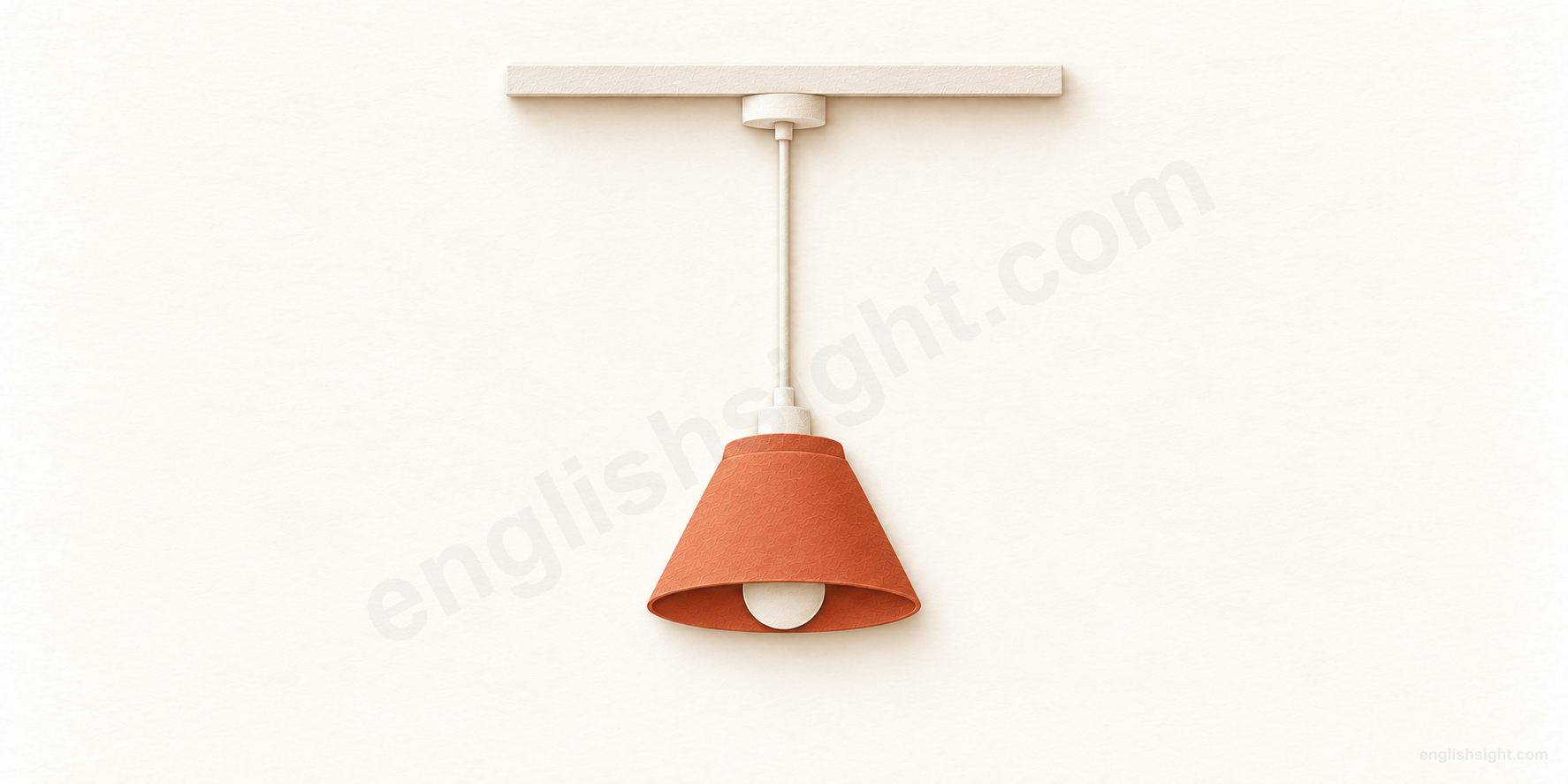
Read hanging as a position, an activity, a noun, or part of a familiar expression.
Supported above, suspended below
An upper connection carries the weight
A ceiling fixing provides support above.
hanging
The lamp stays suspended with space beneath it.
A taut cord carries the lamp’s weight.
The lamp is supported from above; its lower part stays free.
In the central physical use, an object is attached at or near its upper part, and its lower part remains suspended without support underneath.
The lamp shows a continuing relationship, not an obligatory movement. This model helps with literal hanging and some metaphors; it does not derive every compound or particle expression.
Hanging /ˈhæŋɪŋ/ is the -ing form of hang. A lamp can be hanging without moving; a person hanging a lamp is actively putting it in place. The same spelling also occurs in nouns such as a wall hanging.
The physical relationship offers a useful starting point for lingering and uncertainty. Socializing and telephone expressions have conventional meanings that must be learned in their own contexts. The model is a teaching aid, not a shared mental picture attributed to every native speaker.
01
A connection above, a free part below
Start with the supported object, then distinguish its position from the action of putting it there.
01
something + be + hanging + from / on + support
hanging from / on
supported at an upper point, with a lower part free
Situation / starting point
A lamp is connected to a ceiling by a cord.
State / result
Its weight is carried above; nothing supports it underneath.
The connection carries the object while its lower part remains suspended.
In The lamp is hanging from the ceiling, the lamp is the subject and no one is putting it up at that moment. Be + hanging can describe its continuing position. It need not be swinging or moving.
From draws attention to the source of support; on commonly names a hook, wall, or other supporting surface. A coat is hanging on a hook. A picture is hanging on the wall. These prepositions describe relationships, rather than forming one inseparable idiom.
A hanging lamp and a hanging basket use hanging before a noun to describe how the object is supported. A hanging basket normally contains growing flowers or plants, rather than being an empty shopping basket.
In a sentence
A small lamp is hanging from the ceiling above the table.
Watch the difference Lying on the table means the table supports it underneath. Hanging does not mean merely being high up.
02
be + hanging + object + up / out; be + hanging + up / out + noun
hanging something up / out
putting an object into a supported position
Situation / starting point
Clean clothes need to dry.
State / result
Someone attaches them to the outside line.
Here the subject acts on an object; the object is not the person doing the hanging.
In I’m hanging the shirts out, I am the agent and the shirts are the object. Out places them outside, commonly to dry; this laundry use is especially associated with British English. I’m hanging up my coat describes putting it away on a hook or hanger. Out can also mean displaying something outside: We’re hanging a flag out for the celebration. Drying is supplied by the laundry context, not by out alone.
These object patterns allow separation: hanging the shirts out or hanging out the shirts. Put a pronoun in the middle: hanging them out; hanging it up. Compare The shirts are hanging outside, which describes their position.
The base verb also covers hanging pictures, hanging wallpaper, and hanging a door. Wallpaper is being attached to a wall, and a door is being fitted to hinges; neither task requires the whole object to dangle freely. These are established uses of hang with particular objects, not meanings supplied by the grammar alone.
Compare We are hanging pictures in the hall with The hall is hung with pictures. In the second sentence, the room is the subject and the pictures are its decorations. The hall is being hung with pictures describes decorating in progress; is hung with can describe the resulting state.
In a sentence
I’m hanging the clean shirts out before the rain starts.
Watch the difference Hanging out the washing has an object; hanging out with friends is a different, informal social expression.
03
be + hanging + down / loose / open; be + hanging + adverb
hanging down / loose / open
falling or resting in a loose position
Situation / starting point
Long curtains are fixed along their top edge.
State / result
Their fabric falls toward the floor.
Down or a following adjective describes the position of the free part.
Hanging down describes the direction of hair, fabric, leaves, or similar things. Hanging loosely describes how a garment falls on a body: His jacket is hanging loosely on him. It can be perfectly normal; it does not necessarily mean the item is badly fitted.
Loose and open can describe a resulting position: a strap hanging loose, a door hanging open, or someone’s mouth hanging open in surprise. The mouth example is an established description of an open, lowered jaw; do not invent a literal cord supporting it.
In a sentence
The curtains are hanging down almost to the floor.
Watch the difference Loose is an adjective describing the strap; loosely is an adverb describing how a garment hangs.
04
be + hanging + possessive + head; head + be + hanging down
hanging your head
holding your head lowered, often from shame or sadness
Situation / starting point
A player has made an embarrassing mistake.
State / result
He lowers his head rather than meeting anyone’s eyes.
The person lets a part of the body droop downward.
Hanging your head can describe the physical posture and often suggests shame, disappointment, or sadness. The person is the subject and their head is the object. The emotion comes from the context and the familiar association, not from a rule that every lowered head means shame.
Compare a dog’s tongue hanging out or an arm hanging at someone’s side: a body part extends or rests downward. These are descriptions of position. Hanging your head is not the same expression as hanging yourself.
In a sentence
He stood by the goal, hanging his head after the mistake.
Watch the difference Use my, your, his, or another appropriate possessive before head. Do not confuse this posture with the execution sense.
02
An activity, a decoration, or a punishment
The same spelling can name an activity or a countable thing. Articles and context help identify the noun.
05
the hanging of + noun; hanging + object + singular verb
the hanging of pictures
the activity of putting things in place
Situation / starting point
Several pictures need arranging on a wall.
State / result
Their installation is a task that must be planned.
An -ing form can name an activity rather than an ongoing verb phrase.
The hanging of the pictures names the activity of putting them on display. The is the article, hanging is the noun-like head, and of introduces what is installed. In Hanging pictures takes time, the whole -ing phrase functions as the subject.
Compare We are hanging pictures: here are + hanging is the verb phrase, and pictures is its direct object. Not every occurrence of hanging is an adjective or a countable noun.
In a sentence
The hanging of the pictures will take most of the morning.
Watch the difference Do not add an article to a progressive verb phrase: We are hanging pictures, not We are a hanging pictures.
06
a wall hanging; plural wall hangings
a wall hanging / wall hangings
a decorative piece of fabric displayed on a wall
Situation / starting point
You want a soft textile decoration above a sofa.
State / result
You choose one woven piece to display.
A hanging can be the object displayed, not the act of displaying it.
A wall hanging is a decorative textile, such as a woven or embroidered panel. It is a countable noun: one hanging, two hangings. The word is often plural when describing a room’s decorations.
Compare a picture hanging on the wall, where hanging describes the picture’s position. A hanging is not the usual general name for every item on a hook: a hanging coat is still a coat.
In a sentence
A woven wall hanging adds color to the room.
Watch the difference Do not use hanger for this decoration. A hanger is normally a support used for clothes.
07
death by hanging; a hanging; plural hangings
death by hanging / a hanging
execution by suspension from the neck
Situation / starting point
A history book discusses an old punishment.
State / result
The text identifies the method of execution.
This is a separate serious noun sense, not a neutral household activity.
In death by hanging, hanging names the method of execution and is uncountable. A hanging refers to one such event; hangings refers to several. This sense is needed to understand historical, legal, and news texts.
For the corresponding verb, careful standard English normally uses hanged as the past tense and past participle when a person is executed: He was hanged. For ordinary objects, use hung: The picture was hung yesterday. Hanging is the -ing form in both uses.
A hanging offence in historical discussion means an offence punishable by this method. A hanging judge is a judge known for imposing severe sentences, especially death sentences. These are context-specific compounds, not descriptions of a judge’s physical position.
In a sentence
The exhibition explains the history of punishment, including death by hanging.
Watch the difference Was hanging describes an ongoing action or position; was hanged is passive. They are not interchangeable tense forms.
03
What stays present or remains unresolved
These extensions concern lingering things, worries, unanswered questions, and uncertain outcomes. Learn each complete expression.
08
smoke / a smell / clouds + be + hanging + in / over + place
hanging in the air
remaining in the air for a time
Situation / starting point
Smoke spreads across a street.
State / result
It stays there instead of clearing quickly.
Suspended presence can be described without a visible attachment.
Smoke, mist, a smell, or a cloud can be hanging in the air. No cord is implied: the expression describes lingering presence. Low can describe height, as in clouds hanging low over the hills.
The same wording can extend to a question that remains unanswered. That figurative use concerns a lack of response, not particles physically floating in a room; see the question entry below.
In a sentence
Smoke was still hanging in the air when we opened the windows.
Watch the difference A balloon may literally be hanging from a string; smoke hanging in the air has no such fixed support.
09
problem / threat + be + hanging over + person / situation
hanging over someone
remaining as a source of worry or threat
Situation / starting point
A company may close a local factory.
State / result
Workers continue to worry about losing their jobs.
An unwelcome possibility stays mentally present.
A threat, debt, investigation, or difficult decision can be hanging over someone. Over presents it as an unwelcome presence affecting the person. It may concern an event that could happen or a problem already affecting them.
Hanging over someone’s head is a fuller familiar form. A question mark hanging over a plan means there is doubt about it. These are figurative relationships: the speaker does not claim that an object is physically overhead.
In a sentence
The threat of closure is hanging over the whole team.
Watch the difference Hangover, written as one word, is a different noun. Do not use it for an unresolved threat.
10
leave + question / issue / sentence + hanging; be left hanging (in the air)
leave a question hanging
fail to answer or settle a question
Situation / starting point
Someone asks who will pay for the repairs.
State / result
The meeting moves on without addressing it.
The question remains unresolved after the conversation.
Leave a question hanging means let it remain unanswered or unsettled. Leave + object + hanging describes the state that remains; it is not a separable phrasal verb called leave hanging.
A question or remark left hanging in the air can suggest that people avoid dealing with it. A sentence left hanging can instead be unfinished. Read what the object is: an unanswered question and an unfinished sentence are related but different outcomes.
In a sentence
They discussed the schedule but left the question of payment hanging.
Watch the difference The object goes between leave and hanging: leave it hanging. The hanging describes its continuing state.
11
leave + person + hanging; person + be left hanging
leave someone hanging
give no expected response or conclusion
Situation / starting point
You ask a friend whether she can help tomorrow.
State / result
She gives no answer, so you cannot plan.
Someone is left waiting for a response they expected.
Informally, Don’t leave me hanging asks the listener to answer, explain, or finish what they started. The missing response depends on the situation: a reply to an invitation, the end of a story, or even a returned handshake.
The object is the person waiting. In passive form, I was left hanging describes that person’s experience. It does not normally mean they were physically suspended; literal contexts are possible, so use the surrounding information.
In a sentence
Please tell me whether you can help; don’t leave me hanging.
Watch the difference Do not infer that the silence is always deliberate or that this expression always describes romantic rejection.
12
life / future / agreement + be + hanging by a thread
hanging by a thread
very close to failing, ending, or being lost
Situation / starting point
A business can barely pay its bills.
State / result
One further setback could force it to close.
The imagined support is so slight that survival is precarious.
The idiom can describe a life in danger or the fragile survival of a job, relationship, agreement, or organization. By a thread supplies the image of extremely weak remaining support.
It expresses serious vulnerability, not certain failure. Compare physically hanging by a strap: that simply identifies the support unless the context shows danger.
In a sentence
With only one customer left, the business is hanging by a thread.
Watch the difference Do not use this for every ordinary delay; it suggests that something important is at risk.
13
future / outcome / life + be + hanging in the balance
hanging in the balance
remaining uncertain between possible outcomes
Situation / starting point
Funding for a course has not been approved.
State / result
Its continuation is still uncertain.
The outcome is undecided, whether or not failure is very near.
Hanging in the balance describes an unresolved outcome, often something important. The future of the course is hanging in the balance means it might continue or might not.
Compare hanging by a thread: that emphasizes a dangerous lack of security. In the balance emphasizes uncertainty. The fixed phrase uses the; it is not a description of someone literally suspended in a weighing device.
In a sentence
The future of the course is hanging in the balance while funding is reviewed.
Watch the difference Keep the full expression in the balance. Balance alone does not supply this idiomatic meaning.
14
identify / tackle / start with + low-hanging fruit
low-hanging fruit
goals or tasks that are relatively easy to achieve
Situation / starting point
A team lists several possible improvements.
State / result
They start with changes that need little effort.
The metaphor is fruit within easy reach, rather than every kind of suspended object.
Low-hanging fruit is an informal expression used especially in work and planning. It identifies the easier opportunities in a set, without claiming they are unimportant.
The hyphen links low and hanging before fruit. The whole phrase carries the figurative meaning; hanging fruit by itself would normally be literal. In a planning context fruit is commonly used collectively rather than as a count of separate fruits.
In a sentence
Fixing the broken links is low-hanging fruit for the website team.
Watch the difference Do not assume that easy improvements will solve the entire problem. The phrase compares effort, not overall sufficiency.
04
Spending time and holding back
In these combinations the particle and the situation matter. Hanging out with friends does not involve physical suspension.
15
be + hanging out + with + person / at + place
hanging out with friends
spending relaxed time together
Situation / starting point
Friends have no special task planned.
State / result
They spend the afternoon together at a café.
Out belongs to the informal social expression; it does not require being outdoors.
Hanging out with someone describes relaxed time together, often without a planned activity. You can hang out at someone’s house or online. With introduces the people; at introduces a place. This social use has no direct object between hang and out.
Just hanging and hanging with friends are also informal, especially North American, alternatives. Hanging around with someone likewise describes spending time in their company. These expressions do not automatically mean a date.
In a sentence
We’re hanging out at Mia’s apartment after class.
Watch the difference Say hanging out with Mia, not hanging Mia out. An object in that position creates a different construction.
16
be + hanging around / about + (place)
hanging around / about
staying nearby, often with little to do
Situation / starting point
Your friend is not ready to leave.
State / result
You wait near the entrance.
Around suggests remaining in the area rather than following a route.
Hanging around can mean waiting or spending time in a place without much purposeful activity. Hanging about is a British alternative. A speaker may sound impatient, but the words do not always express criticism.
Compare hanging out: that often highlights relaxed leisure or company. Hanging around outside a shop emphasizes staying nearby, possibly waiting. In hanging around with friends, with shifts attention toward company.
In a sentence
I’m hanging around outside the station until Leo arrives.
Watch the difference Around here means in this area; it does not mean walking in a circle.
17
be + hanging back; be + hanging back from + noun / -ing
hanging back
staying behind or hesitating to take part
Situation / starting point
Other students approach the speaker after a talk.
State / result
One student stays behind, unsure whether to ask a question.
Back concerns delayed participation or remaining behind the others.
Hanging back can describe staying after others have left, or hesitating because you are nervous. For the first use: I’m hanging back to ask the teacher something privately. For the second: She’s hanging back from joining the discussion.
These meanings can overlap, but staying behind does not prove that someone is afraid. From + an -ing phrase can name the activity someone hesitates to undertake.
In a sentence
She’s hanging back from joining the discussion because she feels nervous.
Watch the difference Hanging back is not the same as going back: the person need not return to a previous place.
18
story / account / people + be + hanging together
hanging together
remaining coherent or supporting one another
Situation / starting point
You compare different parts of an explanation.
State / result
The details either fit or contradict each other.
Together can concern the fit of ideas or the solidarity of people.
An account that hangs together is consistent: its parts make sense in relation to one another. The story isn’t hanging together suggests that its details do not fit. A coherent story is not necessarily true, however.
With people as the subject, hanging together can mean supporting one another during difficulty: The neighbors are hanging together through the dispute. This is more purposeful solidarity than hanging out together for fun.
In a sentence
His explanation isn’t hanging together: the times and places don’t match.
Watch the difference Choose from the subject and context: a story fitting together differs from people helping each other.
05
Keeping a grip, waiting, and continuing
Hanging on can describe several kinds of continuing. Its following words tell you whether someone is gripping, waiting, persisting, or depending.
19
be + hanging on + (to + object); be + hanging on tight
hanging on (to something)
holding firmly rather than letting go
Situation / starting point
A bus turns suddenly.
State / result
A passenger grips the rail.
On marks continuing contact; to introduces what is gripped.
Hanging on can describe holding tightly. Hanging on to the rail makes the object explicit. For dear life adds a strong sense of fear or determination: He was hanging on for dear life.
The person may be standing on the floor; their whole body need not be suspended. Compare a child hanging from a bar, where from identifies the upper support. Hanging on emphasizes maintaining a grip.
In a sentence
I was hanging on to the rail as the bus turned.
Watch the difference Keep to before an explicit grip object: hanging on to it. Do not place a pronoun between hang and on for this meaning.
20
be + hanging on to + noun / pronoun
hanging on to something
keeping something instead of giving it up
Situation / starting point
You still have your old phone.
State / result
You decide to keep it as a spare.
Continued possession is distinct from physically gripping the object.
Hanging on to old letters, a ticket, a job, or an idea can mean retaining it. The object need not be in your hands. This use is informal and can suggest that letting go is an alternative.
In I’m hanging on to it, to belongs to the expression and takes an object. It is not an infinitive marker. Hanging on to a receipt is different from hanging on for a receipt: the latter means waiting to get one.
In a sentence
I’m hanging on to my old phone as a spare.
Watch the difference Use hanging on to it, not hanging it on to, for keeping possession.
21
keep + person + hanging on; be + hanging on for + response
keep someone hanging on
make someone continue waiting
Situation / starting point
An office has not answered your application.
State / result
You remain waiting for its decision.
Here on expresses continued waiting, with no physical grip.
Keep me hanging on describes causing me to wait for a response or event, often longer than I want. I’m hanging on for their reply also describes waiting. For introduces what is awaited.
Hang on! is a common informal request to wait, including on the telephone. Hang on a minute can also interrupt or challenge what someone has just said. The imperative is worth learning alongside the -ing form, but it is not itself spelled hanging.
In a sentence
The office has kept me hanging on for a decision all week.
Watch the difference Do not interpret every hanging on as waiting: hanging on to a rail is gripping, and hanging on to a ticket can mean keeping it.
22
be + hanging in there; be + hanging on
hanging in there / hanging on
continuing despite difficulty
Situation / starting point
A small shop faces a difficult trading period.
State / result
It keeps operating even though things are hard.
Continued effort or survival matters, rather than location.
Hanging in there is informal: a person or business is managing to continue under pressure. I’m hanging in there may be a modest answer to How are you doing? It need not mean that everything is going well.
Hang in there! encourages someone to continue. Hanging on can similarly describe persisting in difficulty. The expression can reassure, but it does not promise success or solve the problem itself.
In a sentence
The first week has been hard, but I’m hanging in there.
Watch the difference There is part of a familiar expression here; do not search for a particular physical place.
23
outcome / future + be + hanging on + deciding factor
hanging on a decision
depending on a particular outcome
Situation / starting point
A project needs the committee’s approval.
State / result
Its future depends on what the committee decides.
On can link an outcome to the factor that determines it.
Our future is hanging on this decision means that the decision is crucial to what happens next. The subject is the dependent matter, not someone waiting on the phone.
A lot hangs on this is a common simple-present form of the same relationship. Hanging on for a decision instead emphasizes waiting. Hanging in the balance says the outcome is uncertain without naming its deciding factor.
In a sentence
The project’s future is hanging on tomorrow’s vote.
Watch the difference On a decision expresses dependence; for a decision expresses waiting. Do not silently swap the prepositions.
24
be + hanging on + possessive + every word
hanging on someone’s every word
listening with unusually close attention
Situation / starting point
A speaker begins an absorbing account.
State / result
Listeners give their full attention to every detail.
Attention is sustained; no literal support or grip is involved.
Hanging on someone’s every word describes eager, close listening, often to a person the listeners admire. Every strengthens the sense of attention. Hanging on their words is also possible.
This is an established whole expression. It describes how someone listens, not proof that they understand, believe, or obey everything said.
In a sentence
The children were hanging on the storyteller’s every word.
Watch the difference Keep word singular after every. This idiom is different from waiting for someone to speak.
06
Ending a call
Hanging up has a conventional telephone meaning, including on a mobile phone.
25
be + hanging up; be + hanging up on + person
hanging up / hanging up on someone
ending a phone call, sometimes abruptly
Situation / starting point
You are speaking on the phone.
State / result
One person disconnects the call.
The established telephone meaning does not require a physical hook.
I’m hanging up now means I am ending the call. It remains natural with a mobile phone. Compare I’m hanging up my coat, where there is an ordinary object being put on a support.
Hanging up on someone emphasizes cutting off the other person, commonly abruptly or before they have finished. On introduces the affected caller: hanging up on me. It does not mean calling that person.
Hanging up your boots or dancing shoes can figuratively mean retiring from an activity. That use needs its characteristic object and context; it cannot be inferred from every sentence with hang up.
In a sentence
She keeps hanging up on me before I can explain the problem.
Watch the difference Be hung up on something means being preoccupied with it. It is a different expression from being in the act of hanging up a call.
Check the form and the whole expression
Hanging, hung, and hanged
Hang → hanging keeps one g before -ing. Ordinary past forms are hung, hung; execution normally uses hanged, hanged in careful standard usage. A picture is hanging describes its position; a picture is being hung describes installation in progress; it has been hung describes a completed installation.
The subject changes the interpretation
The coat is hanging on a hook describes the coat. I am hanging the coat on a hook describes my action. Keep the subject and object clear. Have someone hang a picture is an ordinary causative arrangement, not a special meaning of hanging.
Scope and boundaries
This lesson covers the Basic English headword hanging and selected common modern uses of its base verb needed to understand that form. It is not a complete course on every hang idiom. Regional slang for unpleasantness, chess, typography, specialist geography, and historical expressions are not expanded here.
Metaphors need their words
A suspended lamp, a question left hanging, and friends hanging out are not interchangeable scenes. The diagram explains a physical relationship. Figurative and conventional meanings require the complete construction and context.
Choose the relationship
Use the subject, object, and following words to identify the meaning.
1. A worker is currently attaching a lamp to the ceiling. Which sentence describes the installation in progress?
2. Mia and her friends are relaxing together indoors. Which phrase fits?
3. You already have a ticket and intend to keep it. Which sentence fits?
4. The meeting ends without anyone answering who will pay. What happened?
5. A caller disconnects before you finish speaking. Which description fits?
6. Which sentence uses hanging as a countable decorative object?
Sources and teaching notes
Definitions and usage were checked against the sources below. Explanations, example sentences, and the diagram were written for this lesson; the visual connection is a teaching interpretation.
The diagram explains a teaching relationship; it is not a mental picture shared by every native speaker.