Use happy for a feeling, a satisfactory arrangement, or willing cooperation—and learn the fixed expressions separately.
Feeling good in a situation
A person feels good in their situation
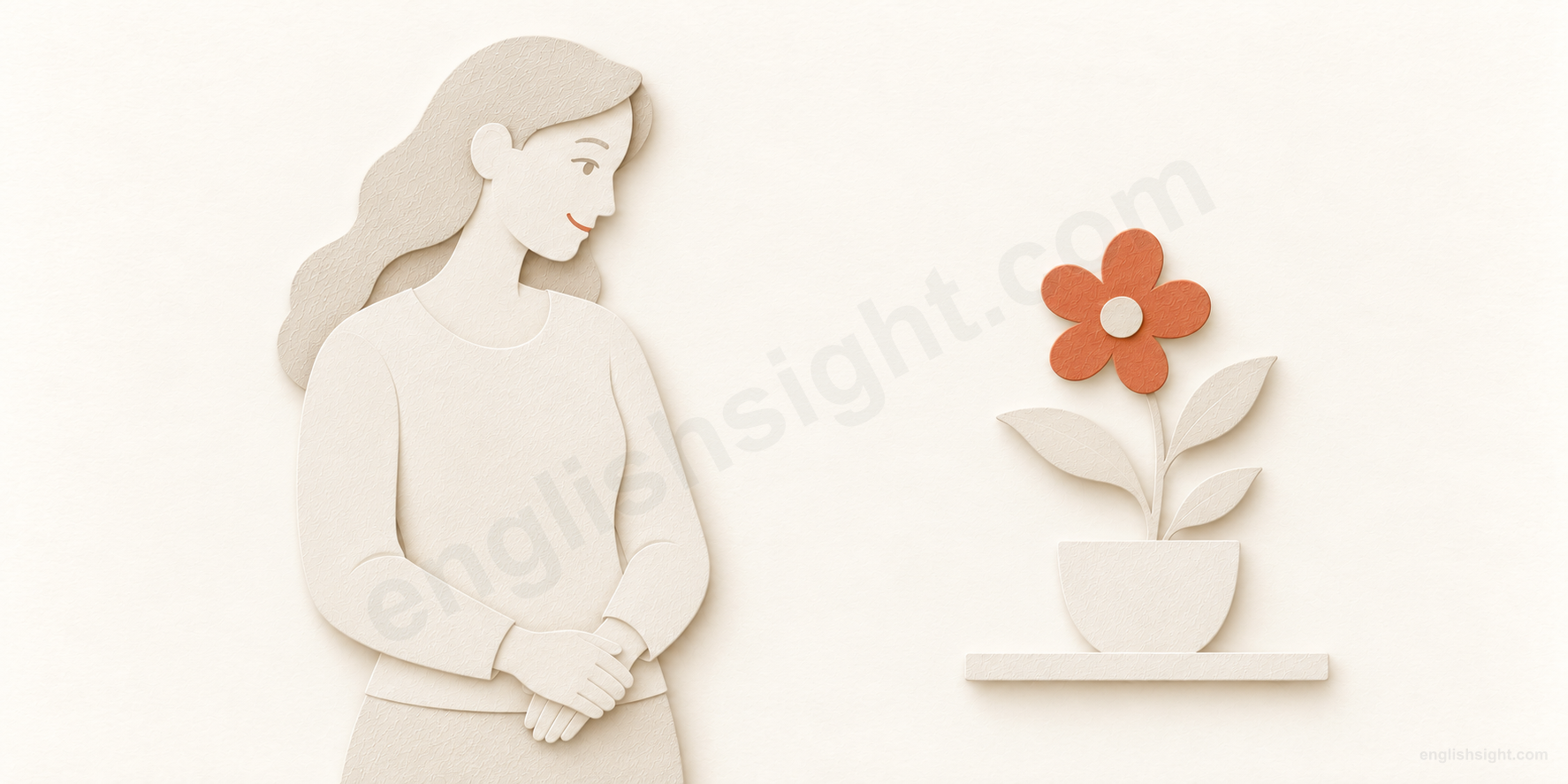
A quiet moment beside a flowering plant
happy
A relaxed smile expresses that feeling.
The person feels pleasure or contentment.
A quiet smile illustrates feeling happy; contentment need not be visible.
Someone feels pleasure or contentment in their situation; happy can also describe what brings or expresses that feeling.
The smiling person beside a flowering plant illustrates one pleasant moment. Happiness need not be visible or caused by getting something. Willingness, fortunate outcomes, apt wording, and fixed expressions require their own context.
Happy /ˈhæpi/ is an adjective. It can describe a short-lived feeling or a more settled sense that life is going well. The comparative is happier and the superlative is happiest.
Begin with someone feeling good in a situation. Then notice whether the sentence describes that person, evaluates an experience, accepts an arrangement, or offers help. A positive feeling is a useful connection, not a formula that predicts every phrase.
01
Feeling good and sharing good news
Start with the person who feels pleasure. The following words identify the situation, the news, or the person whose good fortune matters.
01
be / feel / look / seem + happy; a happy + noun
feel happy
experience pleasure or contentment
Situation
You spend a quiet afternoon with friends.
What the speaker means
You describe how you feel.
Happy describes a state, which may be quiet or excited.
You can be happy, feel happy, or look happy. Be states the condition, feel presents your experience, and look presents an impression. A happy person may be peacefully content rather than laughing loudly.
Happy is an adjective. In a happy smile, it describes an expression of pleasure. Compare She smiled happily, where the adverb describes the smiling. Cheerful emphasizes a bright manner; happy can describe an inner feeling even when someone is quiet.
In a sentence
I feel happy when we cook together.
Watch the difference Say I am happy, not I happy or I have happy. After feel or look describing your state, use happy, not happily.
02
happy about + noun / -ing
happy about the news
feel pleased about an event or situation
Situation
Your sister’s travel plans have worked out.
What the speaker means
You react positively to that news.
About points to the matter that prompts your reaction.
Use happy about to name the news, event, or situation you are reacting to. With a following action, use an -ing form: happy about moving closer to work.
Not happy about often introduces a concern or objection: I’m not happy about the extra charge. It need not describe deep sadness. The negative wording can make a complaint less blunt, though the context may still show strong anger.
In a sentence
We’re happy about the change of date.
Watch the difference Do not use about plus a bare verb: happy about moving, not happy about move.
03
happy for + person
happy for someone
share pleasure in another person’s good fortune
Situation
A friend gets the job she wanted.
What the speaker means
You celebrate her success.
For identifies the person whose good news you welcome.
I’m happy for you focuses on your pleasure at something good happening to the other person. You may have gained nothing yourself.
Compare I’m happy with you, which can evaluate the person or their behavior, and I’m happy about your new job, which names the event. The preposition changes the relationship; happy for does not mean that you feel emotions instead of the other person.
In a sentence
You got the place on the course? I’m so happy for you!
Watch the difference Use for to congratulate someone on their good fortune; with usually expresses satisfaction with them.
04
be happy + (that) + subject + verb
happy that…
state the fact that pleases you
Situation
Your friend can join the trip.
What the speaker means
You explain why you feel pleased.
A full clause supplies the welcome fact.
After happy, a that-clause can say exactly what pleases you: I’m happy that you can come. That may be omitted in ordinary conversation.
The person before happy is the one with the feeling. The clause can have a different subject: We’re happy she is staying. Do not confuse the whole clause with a noun object; happy remains an adjective.
In a sentence
I’m happy that we have time to talk.
Watch the difference Give the clause a subject and verb: happy that you came, not happy that come.
05
be happy + to-infinitive (pleasure)
happy to see you
feel pleased about an experience
Situation
A friend arrives after a long absence.
What the speaker means
You express pleasure at the reunion.
The infinitive names a welcome experience.
Happy to see, hear, know, or be somewhere often expresses pleasure, not an offer to perform a task. In I’m happy to be home, being home is the welcome situation.
Compare I’m happy to carry your bag, which normally offers willing help. The grammar is the same, but the verb and context guide the reading. Pleased or glad can often replace happy here; glad is not normally used before a noun as in a happy child.
In a sentence
I’m happy to see you again.
Watch the difference Happy to hear your news describes a reaction; it does not normally promise to listen later.
02
Being satisfied or willing
Happy can express acceptance without great excitement. Compare a satisfactory arrangement, an enjoyable activity, and a willing offer.
06
happy with + person / thing
happy with the result
judge something satisfactory
Situation
You inspect the repaired window.
What the speaker means
You accept the quality of the work.
With identifies what meets your expectations.
Happy with commonly evaluates a result, choice, arrangement, or person’s work. You need not feel excited: I’m happy with this price can simply mean the price is acceptable.
About and with overlap, but their focus can differ. Happy about the repair can welcome the fact that a repair happened; happy with the repair can approve its quality. This is a useful contrast, not a rule that makes every other combination wrong.
In a sentence
Are you happy with the repair?
Watch the difference I’m not happy with it is a natural complaint. It does not necessarily mean I feel generally unhappy.
07
happy + -ing; happy in + area of life
happy doing something
be content while engaged in an activity
Situation
You could go out, but you enjoy working in the garden.
What the speaker means
You say the current activity suits you.
The -ing phrase describes an activity you are content to be doing.
I’m happy working here can describe satisfaction with your working life. I’m happy just sitting here can mean that you need nothing more at the moment. In happy in my work, in names the area of life in which you feel content.
Compare happy to work late, which can express willingness to do extra work, and happy about working late, which evaluates that prospect. The forms can overlap, so use the whole situation rather than treating each ending as a separate automatic meaning.
In a sentence
I’m happy just sitting here and watching the birds.
Watch the difference Happy doing something need not mean agreeing to begin it; it can describe an activity already in progress.
08
be / would be happy to + verb; more than happy to; only too happy to
happy to help
be willing to do something
Situation
Someone asks how to complete a form.
What the speaker means
You offer assistance.
Happy to plus an action can signal willing cooperation.
I’d be happy to help is a courteous offer. I’m happy to wait accepts a delay; it need not mean waiting is exciting. Would makes the offer less direct, while will can promise future help.
More than happy to help and only too happy to help strengthen the offer. In only too happy, too is part of an established positive expression; it does not mean too happy to be able to help. In Happy to help! the subject and be are understood from context.
In a sentence
I’d be happy to show you how it works.
Watch the difference Happy to help can express willingness, so do not infer that the task has already happened.
09
make / keep + person + happy
make / keep someone happy
cause or maintain pleasure or satisfaction
Situation
Your brother feels low; you call him.
What the speaker means
The call improves his mood.
Make introduces a result; keep maintains a state.
In The call made him happy, him is the person affected and happy describes the resulting state. Keep him happy describes maintaining pleasure or satisfaction. Neither makes happy a verb.
Keeping customers happy often means meeting their needs rather than entertaining them. Context can also make keep someone happy sound like doing something mainly to avoid their complaints. The meaning of causing or maintaining comes from make or keep.
In a sentence
A call from his friends made Ben happy.
Watch the difference Say made him happy, not made he happy or made him happily.
03
Pleasant experiences, wishes, and good outcomes
Happy can describe an experience or a favorable result rather than a person’s present mood. Some uses are conventional or formal.
10
a happy + period / relationship / memory / ending
a happy childhood / ending
describe experiences associated with pleasure
Situation
A story’s characters solve their main problem.
What the speaker means
The ending gives them a good outcome.
An experience can be happy without literally having feelings.
A happy childhood describes a period with many pleasant experiences. A happy home or marriage describes life or relationships experienced positively by the people involved. A happy memory may recall something pleasant and give pleasure now.
A happy ending is a favorable resolution, especially in a story. It need not mean that every detail is perfect. The adjective extends from the person’s feeling to the experience or outcome associated with it.
In a sentence
After all their troubles, the sisters finally got a happy ending.
Watch the difference A happy memory is about pleasure; a good memory can instead mean a strong ability to remember.
11
Happy + occasion!; Many happy returns!
Happy birthday!
wish someone an enjoyable special occasion
Situation
It is a colleague’s birthday.
What the speaker means
You offer a conventional good wish.
The greeting expresses a wish rather than a report of someone’s mood.
Happy birthday!, Happy New Year!, and Happy holidays! are established greetings. The speaker hopes the other person enjoys the occasion; no subject or ordinary statement verb is needed.
Many happy returns is another birthday wish, especially familiar in British English. Here returns refers to future birthdays, not returning a gift. Reply Thank you when someone gives you a birthday wish; You too fits a shared occasion such as New Year, but usually not someone else’s birthday.
In a sentence
Happy birthday, Mina! I hope you have a lovely day.
Watch the difference Use Happy birthday, not Happy birth. Learn greetings as conventional phrases.
12
a happy coincidence / accident; in the happy position of + -ing
a happy coincidence
describe a chance event with a welcome result
Situation
Two old friends independently choose the same café.
What the speaker means
They unexpectedly meet there.
Happy can evaluate good fortune rather than someone’s mood.
A happy coincidence or happy accident has a welcome outcome that was not planned. An accident here can simply be an unexpected occurrence, not necessarily a crash or injury.
In the happy position of being able to choose, happy means fortunate. This use evaluates the circumstances. It is related to pleasure through the good result, but does not say that a coincidence or position can itself feel an emotion.
In a sentence
By a happy coincidence, our seats were next to each other.
Watch the difference The lucky reading is especially natural in established combinations; do not replace lucky with happy everywhere.
13
a happy choice of words / turn of phrase
a happy choice of words
describe wording that fits a situation well
Situation
You need a tactful way to announce a delay.
What the speaker means
Someone finds wording that works well.
In this more formal use, happy evaluates suitability.
A happy choice of words is well judged for its purpose. It need not sound cheerful: careful wording about a serious matter may be apt without being joyful.
That wasn’t the happiest choice of words can criticize an unsuitable expression indirectly. In everyday conversation, a good choice of words or well-chosen words is often clearer. Learn this as a limited formal branch rather than a general synonym for suitable.
In a sentence
Calling the delay a “small adventure” was not a happy choice of words.
Watch the difference This use concerns how well the words fit, not whether the words describe happiness.
04
Established phrases and related forms
Learn these as complete expressions. Their meanings and tone cannot always be predicted from a smiling face.
14
find / strike a happy medium between + two alternatives
a happy medium
a satisfactory balance between alternatives
Situation
One timetable is too busy and another too empty.
What the speaker means
You choose a workable balance.
Medium names an intermediate solution; happy evaluates its suitability.
Find or strike a happy medium between two demands means reach a balance that works. You might seek a happy medium between saving money and enjoying your free time.
The expression does not demand the exact mathematical midpoint or equal quantities. It is a conventional phrase for a practical compromise. Medium here is a noun; happy does not describe a person who contacts spirits.
In a sentence
We found a happy medium between speed and careful checking.
Watch the difference Use a happy medium, not a happy middle, for this established expression.
15
be (not) a happy camper; be (not) a happy bunny
not a happy camper
be displeased with a situation
Situation
Your train has been cancelled twice.
What the speaker means
You describe your annoyed reaction informally.
The expression can describe someone who is not camping.
A happy camper is someone pleased with their situation; not a happy camper expresses dissatisfaction. It is informal and often mildly humorous. British English also uses not a happy bunny.
Because the wording can make annoyance sound playful, choose it with care when someone is seriously distressed. A neutral alternative is She isn’t happy about it. The complete expression supplies the figurative person-description.
In a sentence
After the second cancellation, I wasn’t a happy camper.
Watch the difference The phrase does not imply tents, travel, or an actual rabbit.
16
(as) happy as a clam; (as) happy as Larry
as happy as a clam / Larry
be very happy
Situation
A child enjoys a whole afternoon of painting.
What the speaker means
You describe her obvious delight playfully.
These comparisons intensify happy rather than identify a literal comparison target.
As happy as a clam is especially associated with US English. As happy as Larry is informal British, Australian, and New Zealand usage. Both mean very happy.
You can say She’s as happy as a clam or She’s happy as a clam. Larry does not identify a real person the listener must know. These are familiar playful formulas, not scientific claims about the emotions of shellfish.
In a sentence
Give Nora some paints and she’s as happy as a clam.
Watch the difference Keep a in a clam and the capital L in Larry. Avoid inventing a literal origin story.
17
a happy-go-lucky + person / attitude; be happy-go-lucky
happy-go-lucky
describe a carefree attitude
Situation
A traveler is relaxed about an uncertain plan.
What the speaker means
You describe his usual approach to life.
The compound describes a disposition, not a momentary burst of pleasure.
A happy-go-lucky person does not worry much about what will happen next. A happy-go-lucky attitude can sound pleasantly relaxed, though the situation may make that lack of concern seem unwise.
This is a complete adjective with hyphens: a happy-go-lucky traveler. Do not parse it as a direction to go somewhere and become lucky. Compare a happy traveler, who may simply be pleased about today’s journey.
In a sentence
His happy-go-lucky attitude helped him enjoy the unplanned trip.
Watch the difference Happy-go-lucky does not promise good luck or mean that someone is always excited.
18
during happy hour; a happy-hour offer
happy hour
a period of reduced drink prices
Situation
A bar advertises an early-evening promotion.
What the speaker means
Customers can buy certain drinks more cheaply.
The compound names a commercial offer, not an emotion.
At a pub or bar, happy hour is a period when alcoholic drinks cost less than usual, often in the early evening. The advertised details determine which drinks and times are included.
The name does not guarantee a period of exactly sixty minutes. Compare We spent a happy hour talking, where happy simply describes an enjoyable hour and no discount is implied. Context and the presence of an advertised promotion distinguish the readings.
In a sentence
The bar sells cheaper drinks during happy hour.
Watch the difference A pleasant hour is not automatically the promotional happy hour.
19
trigger-happy + person / group; noun + -happy in established compounds
trigger-happy
too ready to use violence, especially guns
Situation
A report criticizes armed guards who react too quickly.
What the speaker means
The writer condemns their readiness to shoot.
The compound has a negative meaning despite happy.
Trigger-happy is informal and disapproving. It describes excessive readiness to use violence, especially guns. It does not praise a cheerful or skilled person.
More generally, -happy in some compounds suggests excessive enthusiasm or readiness for something, as in gadget-happy. This combining use is a separate established pattern; learners should check unfamiliar compounds rather than assume any noun plus happy is natural.
In a sentence
The article criticized the trigger-happy guards.
Watch the difference Do not read trigger-happy as a compliment or as ordinary emotional happiness.
20
live happily ever after
happily ever after
continued happiness as a story ending
Situation
A fairy tale reaches its final resolution.
What the speaker means
The narrator presents a lasting happy future.
Happily is the adverb; ever after extends the time from that point onward.
They lived happily ever after is a conventional fairy-tale ending. It presents happiness continuing after the main events. Outside stories it can be used playfully, sometimes with skepticism about a perfect future.
Compare a happy ending, where the adjective describes a noun. In lived happily, the adverb describes how they lived. The phrase is a related form to recognize, not another adjective construction or a promise about real relationships.
In a sentence
The story ends with the neighbors living happily ever after.
Watch the difference Use happily after lived here, not They lived happy ever after in standard written English.
Choose the construction as well as the word
Happy, happily, happiness, unhappy
Happy is an adjective; happily is an adverb; happiness is the usually uncountable noun. Unhappy can mean sad or dissatisfied. Happily can also mean willingly or fortunately, so its meaning depends on context: I’ll happily help offers willingness; Happily, no one was hurt means fortunately.
Not every positive word fits the same place
A happy child is natural; a glad child is not the usual neutral choice. Glad to hear it and pleased with the result are natural alternatives in those contexts. Content emphasizes being satisfied with what you have; cheerful emphasizes a bright manner. These words overlap without being interchangeable everywhere.
Comparison and degree
Use happier than before and the happiest day, changing y to i before -er or -est. Very happy and really happy increase the degree; happy enough can mean sufficiently pleased or content. More than happy to help is an established strong offer, not the ordinary comparative form.
Grammar and scope
Happy has no verb tense, direct object, passive form, or phrasal-verb family. Be happy describes a state; become or get happy describes a change. Make and keep supply causing or maintaining. This lesson covers modern everyday uses and selected recognizable expressions, not every slang, literary, or regional compound.
Read the situation and choose
Notice who feels pleased, what is being evaluated, and whether the expression is conventional.
1. Your friend has won a scholarship. You want to share her pleasure, rather than evaluate her behavior. What fits best?
2. A visitor asks for directions. You say “I’d be happy to help.” What are you doing?
3. You want a plan that balances price and comfort. Which expression fits?
4. A formal review calls a phrase “a happy choice of words.” What is being praised?
5. Choose the standard sentence describing the manner in which children played.
Sources and teaching notes
Dictionary uses and constructions were checked in the publisher pages below. The explanations, examples, and visual model are original teaching material; the diagram is an illustration, not evidence for a single mental image.
The picture illustrates one pleasant situation, not a mental image shared by every English speaker.