Connect firmness with difficulty and effort, then learn the expressions that need their own context.
Resistance and the effort it calls for
Resistance and the effort it calls for
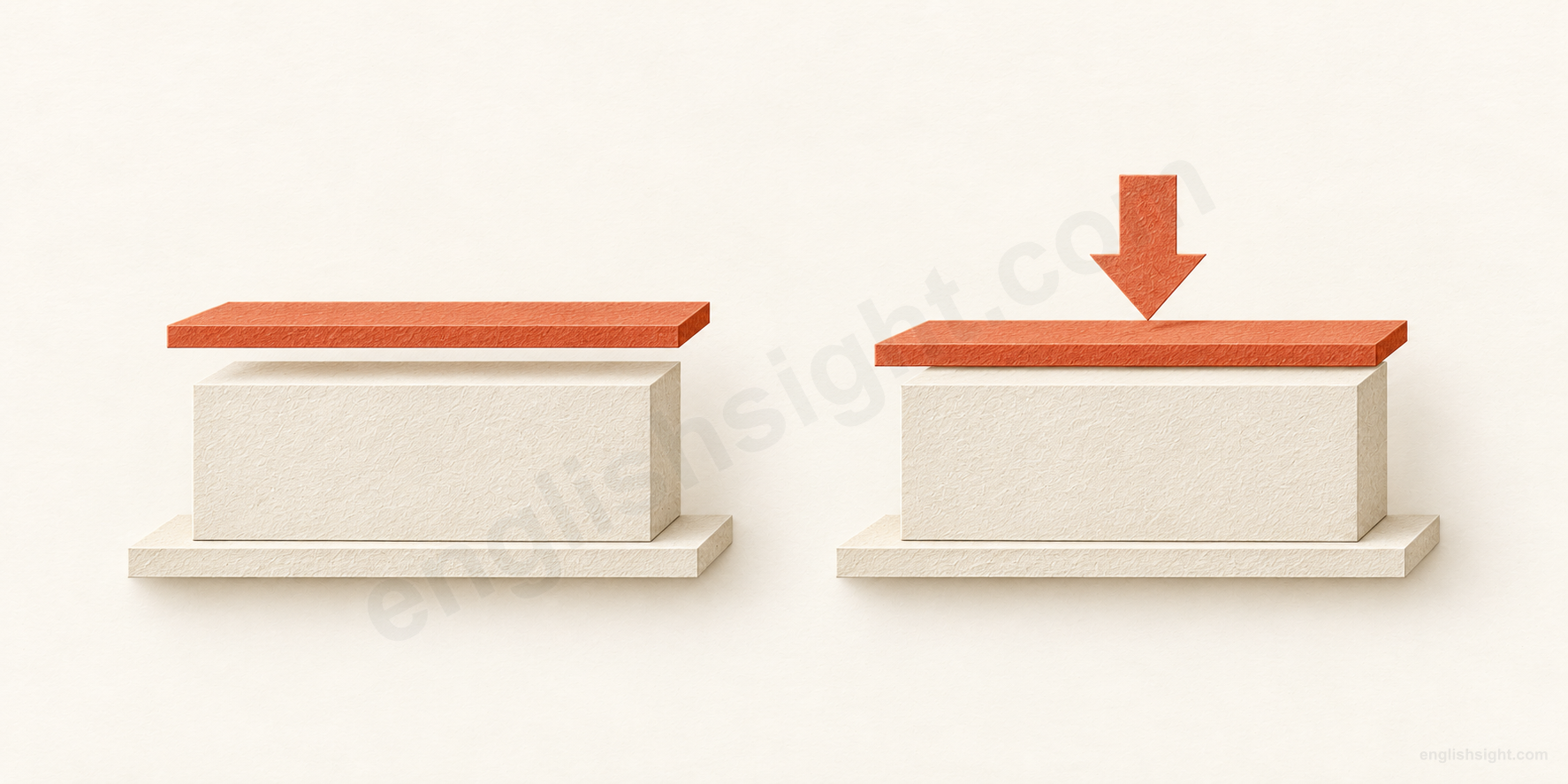
The plate is raised above the block.
hard
The block retains its shape under this pressure.
The plate presses down on the block.
The hard block resists changing shape under this pressure. Hard does not mean indestructible.
A hard material does not readily yield to pressure; many everyday extensions concern difficulty, force, or a lack of gentleness.
The sketch illustrates physical resistance. It is a memory aid for some extensions, not a literal explanation of every idiom or a picture shared by all English speakers.
Press a hard surface and it resists giving way. That physical relation is a useful starting point for a lesson: a hard task resists an easy solution, and hard work calls for substantial effort. These are teaching connections, not a claim that every use has one physical meaning.
Hard is both an adjective and an adverb. What it describes matters: a hard chair, a hard choice, and working hard express different relationships. Fixed combinations such as hard water and no hard feelings need their own explanations.
01
Materials and physical conditions
Start with resistance to pressure, then learn the specific meanings used for food, water, and weather. Not every hard thing is heavy, strong, or impossible to break.
01
hard + noun; be / feel / become / go hard
a hard surface; go hard
resist pressure, bending, or cutting
Situation or starting point
You press on a piece of stone.
Meaning in context
Its surface does not readily give way.
Hard describes resistance; it does not mean unbreakable.
A hard surface does not easily yield when something presses against it. A hard chair can be uncomfortable because it gives little cushioning. Compare a soft cushion, which compresses readily.
Hardness is different from weight and strength: a small hard object can be light, and a hard material can still crack. Go hard describes a change of state: The glue has gone hard. Harder and hardest compare degrees of hardness.
In a sentence
The clay became hard after it dried.
Watch the difference A hard surface is not a difficult surface unless the context supplies a difficult task.
02
hard + food noun; hard-boiled + egg
hard bread; a hard-boiled egg
describe firmness in food
Situation or starting point
You check the texture of some food.
Meaning in context
You describe how firm it is.
The food and preparation determine whether firmness is wanted.
Bread that has become hard is difficult to bite or cut; it may have dried out or become stale. Hard cheese, however, can name a normal firm kind of cheese. Hard does not itself mean that all food is spoiled.
A hard-boiled egg has a firm white and yolk, unlike a soft-boiled egg with a softer yolk. Learn hard-boiled as a cooking compound rather than treating boiled as something the word hard acts on.
In a sentence
The bread was so hard that I could not cut it.
Watch the difference Hard-boiled describes cooking and texture; it does not mean the egg was difficult to boil.
03
hard water; the water is hard
hard water
water containing mineral salts
Situation or starting point
Minerals are dissolved in the water.
Meaning in context
Soap lathers poorly and deposits may form.
Hard water is still liquid; hard is a conventional water-quality term.
Hard water contains dissolved minerals such as calcium compounds. You may notice scale in a kettle or need more soap to make a lather. Here the noun water selects a special meaning.
The opposite term is soft water. Ice is frozen water; calling water hard in this sense does not say that it is frozen, dirty, or unsafe.
In a sentence
Hard water leaves a white deposit inside our kettle.
Watch the difference Do not use hard water as another name for ice.
04
a hard + frost / winter
a hard frost; a hard winter
describe severe cold conditions
Situation or starting point
Cold conditions become severe.
Meaning in context
The weather is described as hard.
Hard evaluates the severity of the conditions.
A hard frost is a severe frost. A hard winter is a severe winter, often difficult for people, animals, or plants to endure. Winter is not a solid object being pressed.
The idea of something that gives little relief can help connect this to hard conditions. This is a teaching link, not a rule for putting hard before every weather noun; heavy rain and a strong wind are the usual choices for those nouns.
In a sentence
A hard frost damaged the young plants overnight.
Watch the difference Say heavy rain or it is raining hard, rather than using a hard rain as the general learner pattern.
02
Tasks, experiences, and limited resources
Hard can describe what demands effort or is unpleasant to live through. The construction tells us who faces the difficulty and what they are trying to do.
05
hard + noun; something is hard
a hard question; a hard decision
require effort or be difficult to resolve
Situation or starting point
You face a question or choice.
Meaning in context
You judge that it is not easy.
The task creates difficulty; the object need not be physically firm.
A hard question may require knowledge or careful reasoning. A hard decision can be emotionally painful even when the alternatives are easy to understand. The kind of difficulty comes from the noun and context.
Hard and difficult overlap widely here: a hard exam and a difficult exam can describe the same exam. A hard day also suggests exhausting effort or unpleasant experiences, not necessarily complicated work.
In a sentence
Choosing which job to accept was a hard decision.
Watch the difference Hard does not always mean complicated: a simple choice can still be emotionally hard.
06
something is hard to + verb; it is hard (for someone) to + verb
hard to open; hard for me to open
connect difficulty to an action and its participant
Situation or starting point
Someone tries to open a jar.
Meaning in context
The opening requires effort.
In The jar is hard to open, the jar receives the action of open.
The jar is hard to open means opening the jar is difficult. The sentence has active infinitive form, even though the jar is what you open. Do not add a second object: “The jar is hard to open it” is incorrect.
It is hard for me to open this jar names the person facing the task. The same pattern handles judgments: It is hard to say means certainty is difficult; hard to believe expresses disbelief; hard to come by means difficult to obtain. A person who is hard to please is difficult for other people to satisfy.
Too hard to do something says the difficulty is beyond what can be managed in the context: This puzzle is too hard for me to solve alone. Hard enough can instead mean sufficiently difficult or demanding. These are degree patterns, not new senses of hard.
In a sentence
This lid is hard for me to open with one hand.
Watch the difference Use for me for the person facing the difficulty; the ordinary pattern is not hard to me to open.
07
find it hard to + verb; find + object + hard to + verb
find it hard to…
report your experience of difficulty
Situation or starting point
You try to concentrate.
Meaning in context
You report that concentrating is difficult for you.
It can stand in for the following activity.
I find it hard to concentrate describes my experience, not a search for an object called it. The activity follows the adjective in a to-infinitive.
I find this text hard to read is another construction: this text is the object of find and the thing you read. Make it hard to concentrate instead describes something causing the difficulty: The noise makes it hard to concentrate.
In a sentence
I find it hard to concentrate when people talk nearby.
Watch the difference Say find it hard to concentrate, not find hard to concentrate.
08
have a hard time + -ing; have a hard time with + noun
have a hard time doing something
experience difficulty with an activity
Situation or starting point
An activity is not going smoothly.
Meaning in context
You describe the struggle you experience.
Have describes the experience; the -ing form names the activity.
Have a hard time doing something is a familiar way to say you struggle with it. I am having a hard time can refer to current problems even without naming an activity. Time here means an experience or period, not a rigid clock.
Compare give someone a hard time, where someone else makes the experience unpleasant. Having a hard time does not identify another person as responsible. A related pattern is have a hard job doing something, especially in British usage.
In a sentence
We had a hard time finding a room near the station.
Watch the difference Use finding after have a hard time in this pattern, not to find.
09
find + something + hard going; make hard work of + noun / -ing
hard going; make hard work of…
describe a demanding process or unnecessary difficulty
Situation or starting point
You work through a slow or demanding task.
Meaning in context
You assess the effort it takes.
Hard going evaluates the task; make hard work of can criticize the way it is done.
This book is hard going means reading or understanding it takes substantial effort. Going is part of an established expression, not necessarily physical travel.
Make hard work of something often means someone makes a task more laborious than it needs to be. We made hard work of packing suggests an inefficient struggle. Too much like hard work is an informal way of rejecting something as more effort than you want to spend.
In a sentence
I found the first chapter hard going because of all the unfamiliar terms.
Watch the difference Hard going does not mean the book is physically moving with difficulty.
10
have a hard life; times are hard; fall on hard times
hard times; fall on hard times
live through hardship, often financial
Situation or starting point
A person or community loses security or resources.
Meaning in context
Life becomes difficult to manage.
The expression concerns lived conditions, often a shortage of money.
Hard times are difficult periods, especially when money or work is scarce. Fall on hard times describes a change into those conditions; it does not mean falling to the ground.
A hard life is broader and can include illness, loss, demanding work, or poverty. A hard day may be a temporary experience; a hard life describes a much wider history.
In a sentence
The family fell on hard times after their shop closed.
Watch the difference Use plural times in fall on hard times; it is not fall on a hard time.
11
be hard up; be hard up for + noun
be hard up; hard up for ideas
lack money or another needed resource
Situation or starting point
You have less money or material than you need.
Meaning in context
You describe the shortage informally.
Up belongs to the established expression; it does not indicate upward movement.
I am hard up usually means I have little money, often for the moment. It is informal and can describe a temporary budget problem rather than permanent poverty.
Hard up for ideas or hard up for news extends the expression to a shortage of something useful. For names the missing resource. Do not infer these meanings from separate definitions of hard and up.
In a sentence
I am a bit hard up this month, so I will cook at home.
Watch the difference Be hard up is an adjective expression, not a phrasal verb hard up.
12
be hard pressed / pushed / put to + verb
be hard pressed to…
be unlikely to manage something without great difficulty
Situation or starting point
A task exceeds the time, resources, or ability available.
Meaning in context
You doubt that someone can manage it.
To introduces the task; the expression describes difficulty, not a physical push.
You would be hard pressed to find a cheaper room means finding one would be very difficult. Hard pushed, especially in British usage, and hard put are related established forms.
Before a noun, hard-pressed also describes someone under pressure with too much to do or too few resources: hard-pressed staff. This does not always imply an attempt at the particular action expressed by a following infinitive.
In a sentence
With only ten minutes left, we will be hard pressed to finish.
Watch the difference Keep to before the verb: hard pressed to finish, not hard pressed finishing.
03
Effort, attention, force, and intensity
As an adverb, hard describes how an action happens. Work hard and hard work share a spelling but have different grammar; hardly is a different word.
13
verb + hard; hard + work / worker; be hard at work
work hard; hard work; hard at work
put substantial energy into an activity
Situation or starting point
Someone undertakes an activity.
Meaning in context
They put a lot of effort into it.
Hard can describe the effort of the worker or the demands of the work.
Work hard, study hard, and try hard describe effort. A hard worker puts effort in; hard work is work that takes effort. Neither expression guarantees success or long hours. Try harder compares effort; try your hardest describes your greatest effort.
Be hard at work means be very busy working: They are hard at work repairing the roof. Informal hard at it can mean the same in context. In hard-earned money and a hard-won victory, the participle identifies what the effort achieved.
In a sentence
The repair was hard work, but the team worked hard and finished it.
Watch the difference Hard work is normally uncountable in this sense: a lot of hard work, not many hard works.
14
think / listen / look + hard; take a long, hard look at + noun
think hard; a long, hard look
direct careful, concentrated attention
Situation or starting point
You need to understand or evaluate something.
Meaning in context
You concentrate carefully on it.
Here hard measures attention, not the physical firmness of the thinker.
Think hard about something means give it concentrated thought. Listen hard means make a serious effort to hear. Look hard at the figures can ask for careful examination rather than merely directing your eyes toward them.
Take a long, hard look at a plan suggests serious, realistic consideration. Compare a hard stare: that can describe an unfriendly expression. Context distinguishes scrutiny from hostility.
In a sentence
We thought long and hard before agreeing to move.
Watch the difference Think hard is natural; think hardly does not mean think with great concentration.
15
verb + hard; a hard + push / kick / blow
push hard; a hard blow
apply strong physical force
Situation or starting point
Someone applies force to an object.
Meaning in context
The action has substantial force.
The verb supplies the action; hard describes its force.
Press hard and push hard say how strongly to act. A hard kick describes the same kind of intensity with hard as an adjective before a noun. Neither construction says that the object being pushed is itself hard.
Turn hard left or hard right is a specific directional use: make a sharp turn. It does not generally mean turning is difficult. Learn that use with left and right, rather than extending it to every direction word.
In a sentence
Push hard on the handle to release the catch.
Watch the difference A hard push describes force; a difficult push describes difficulty. The ideas may coincide, but they are different.
16
rain / snow / breathe / laugh + hard
rain hard; breathe hard; laugh hard
describe an intense action or process
Situation or starting point
Rain falls heavily or a bodily activity becomes intense.
Meaning in context
You describe the strength of the process.
Hard can intensify an event without anyone deliberately trying.
It is raining hard means the rain is heavy. Breathing hard describes strong or labored breathing, often after exercise. Laughing hard means laughing intensely; it does not mean struggling to laugh.
The subject and verb determine the event. The meaning here is not always effort by a willing person: rain has no intention. Hard is not a universal substitute for very; choose the established verb combination.
In a sentence
It was raining so hard that we could barely see the road.
Watch the difference Use raining hard or heavy rain; hardly raining means almost no rain.
17
work hard; hardly work; can hardly + verb
hard versus hardly
distinguish great effort from almost no activity
Situation or starting point
You choose between two similar-looking adverbs.
Meaning in context
The choice changes the message substantially.
Hardly is not the regular effort adverb of hard.
She works hard says she puts in a lot of effort. She hardly works says she does almost no work. Hard usually follows the verb or its object; hardly normally comes before the main verb, after a modal, or after be.
I can hardly hear you means hearing you is only just possible. That overlaps with difficulty, but it still does not make hardly interchangeable with hard: listen hard is an effortful action. Hardly ever means almost never. This lesson covers the contrast, not every use of hardly.
In a sentence
I worked hard all morning and hardly stopped for a break.
Watch the difference Do not add -ly to hard to express effort. I hardly worked means I did almost no work; worked hardly is not the ordinary word order for that meaning.
04
Treatment, feelings, and reactions
People may be strict, circumstances may cause suffering, and news may hurt. Keep these relationships separate, especially the different uses of hard on.
18
hard + person / expression / voice; be hard
a hard person; a hard voice
show little sympathy or tenderness
Situation or starting point
Someone responds without warmth or sympathy.
Meaning in context
Their manner is described as hard.
The lack of softness concerns behavior, not the texture of a body.
A hard voice or a hard expression can show coldness or severity. Calling someone a hard person can suggest they are unsympathetic. As hard as nails intensifies a judgment of toughness or lack of sympathy.
In informal contexts, especially British ones, someone described as hard may be tough, fearless, or ready to fight. A hard worker instead praises effort. A hard line on an issue is a strict, uncompromising position; it need not describe a hostile personality.
In a sentence
Her voice became hard when she asked who had broken the window.
Watch the difference A hard worker is diligent; a hard person may be cold or tough. The following noun matters.
19
be hard on + person; be hard on oneself
be hard on someone
treat or criticize someone severely
Situation or starting point
A person makes a mistake or faces expectations.
Meaning in context
Someone treats them strictly or criticizes them.
The subject is the person applying strict treatment.
Do not be so hard on her asks someone to reduce criticism or demands. A teacher who is hard on students sets strict expectations or treats mistakes severely. Context determines whether this is considered justified.
You are too hard on yourself means you judge yourself too severely. Compare The long journey was hard on her: there the subject is a circumstance causing strain, not a person choosing to criticize.
In a sentence
Do not be too hard on yourself over one mistake.
Watch the difference Keep on: be hard on someone. Hard for someone usually describes their difficulty instead.
20
a condition / activity + be hard on + affected person / thing
be hard on the eyes; hard on families
cause strain, damage, or an unfair burden
Situation or starting point
An activity or situation affects someone or something.
Meaning in context
It causes strain or makes life difficult.
On names what bears the harmful effects.
A rough road can be hard on a car; bright light can be hard on the eyes. The subject is a cause of wear or discomfort, not an intentional critic.
The new timetable is hard on parents says it burdens them, perhaps unfairly. It is hard for parents to arrive by eight instead identifies a difficult task. These uses overlap in practical circumstances, but their grammar highlights different relationships.
In a sentence
Carrying that heavy bag every day is hard on my shoulder.
Watch the difference Do not assume every hard on sentence describes strict treatment by a person.
21
give + person + a hard time (about / over + noun)
give someone a hard time
make another person’s experience unpleasant
Situation or starting point
Someone questions, criticizes, or teases another person.
Meaning in context
The other person has an unpleasant experience.
Give identifies a source of the difficulty.
Give someone a hard time commonly means criticize, hassle, or tease them. It can describe unpleasant pressure or lighter teasing among friends; the relationship and tone matter.
Compare I had a hard time getting home, which reports my own difficulty without saying anyone deliberately caused it. In They gave me a hard time about being late, about identifies what triggered the criticism.
In a sentence
My friends gave me a hard time about arriving in two different shoes.
Watch the difference This does not mean giving someone extra time to finish a hard task.
22
something hits + person / thing + hard; be (hard) hit by + cause
be hit hard; be hard hit by…
suffer a severe effect
Situation or starting point
A loss or event affects a person, place, or business.
Meaning in context
Its effects are severe.
A figurative impact does not require a physical blow.
The closure hit local shops hard means the shops suffered serious effects. The subject supplies the cause, and the object names what was affected. Hard describes the severity of hit.
Local shops were hard hit by the closure turns the affected shops into the subject. Before a noun, hard-hit describes them: hard-hit shops. This is an ordinary active/passive relationship of hit, not a passive form of a verb hard.
In a sentence
The floods hit small farms particularly hard.
Watch the difference In hard-hit farms, the hyphen joins the compound modifier; hard is still not a verb.
23
take + event / news / it + hard
take something hard
react with deep distress
Situation or starting point
Someone receives unwelcome news.
Meaning in context
They are very upset by it.
The person taking the news is the one feeling distress.
Take a rejection hard describes a painful emotional reaction. It does not mean accepting a physically hard object or handling a difficult task competently.
Compare The news hit her hard, which presents the news as having a strong effect, and She took the news hard, which presents her reaction. Hard modifies take; keep an object such as it or the news in the construction.
In a sentence
He took the rejection hard and stayed home for several days.
Watch the difference Take it hard does not mean take it seriously in every context; the expression specifically concerns distress.
24
be / feel hard done by
feel hard done by
feel that others have treated you unfairly
Situation or starting point
Someone receives less favorable treatment than others.
Meaning in context
They feel unfairly treated.
The expression evaluates treatment, not the amount of completed work.
Feel hard done by is informal and especially British. It often presents the person’s own sense of unfairness; using feel does not prove that the complaint is justified.
Learn the complete expression, including final by. It is not built by taking hard work and adding done. You can explain the reason separately: She felt hard done by because everyone else got a day off.
In a sentence
I felt hard done by when everyone else received a bonus.
Watch the difference Hard done by does not mean exhausted after working hard.
25
No hard feelings.; no hard feelings about + noun
no hard feelings
keep or restore friendliness after disagreement
Situation or starting point
A disagreement, rejection, or contest could cause resentment.
Meaning in context
A speaker signals a wish to stay friendly.
Hard feelings here are resentment, not emotional strength in general.
No hard feelings can reassure someone that you are not angry about a disappointment, or ask whether things are still friendly. A question intonation can make it a tentative check.
The expression suits small disputes and competitions. Saying it does not guarantee that the other person feels fine; after serious harm, a fuller acknowledgment or apology may be needed. Learn the plural feelings as part of the expression.
In a sentence
You won the game fairly—no hard feelings.
Watch the difference No hard feelings does not mean having no emotions at all.
05
Facts, rules, and established expressions
Some expressions suggest firmness or resistance; others have a conventional meaning that must be learned as a whole. Use the situation to choose among them.
26
hard + evidence / facts / data
hard evidence; hard facts
stress concrete, verifiable support
Situation or starting point
A claim needs support.
Meaning in context
You ask for information that can be checked.
Hard contrasts with guesses or unsupported impressions.
Hard evidence emphasizes concrete support for a claim. Hard facts highlights established information rather than speculation or wishful thinking. Hard normally comes before these nouns in this sense.
The firmness in the physical sketch offers a memory link, but evidence is not literally a stone. Calling evidence hard also does not make every inference from it correct; the word presents the support as strong and checkable.
In a sentence
We need hard evidence before we accuse anyone.
Watch the difference Evidence is normally uncountable: some hard evidence or a piece of evidence, not a hard evidence.
27
a hard and fast rule; no hard and fast rules
hard and fast rules
describe fixed rules or limits
Situation or starting point
You ask how much flexibility a rule allows.
Meaning in context
The rule is described as fixed, or flexibility is left open.
Fast contributes the idea of being firmly fixed, not speed.
There are no hard and fast rules means there is no inflexible rule that covers all cases. It often introduces advice that depends on circumstances.
A hard-and-fast rule can also be stated positively when the speaker means an unchanging requirement. The whole pairing is conventional; it is not a rule that is both difficult and quick.
In a sentence
There is no hard and fast rule about how long a visit should last.
Watch the difference Do not interpret fast as quickly in this expression.
28
learn (something) the hard way
learn the hard way
learn through mistakes or painful experience
Situation or starting point
Someone ignores advice or lacks experience.
Meaning in context
An unpleasant consequence teaches them.
The way of learning involves difficulty or consequences.
Learn the hard way often means learning from your own costly mistake rather than from a warning. The sentence does not praise the mistake or say that suffering was necessary.
Do something the hard way can more generally describe using a demanding method when an easier one was available. The expression names a manner or route to a result; it does not involve a physically solid road.
In a sentence
I learned the hard way to save a copy before editing.
Watch the difference Learning the hard way is not simply studying hard; it highlights difficult experience or consequences.
29
drive / strike a hard bargain
drive a hard bargain
negotiate firmly for favorable terms
Situation or starting point
Two sides negotiate a price or agreement.
Meaning in context
One side presses firmly for its own terms.
Firmness concerns negotiation, not the quality of the item bought.
Someone who drives a hard bargain is demanding in negotiation and does not concede easily. A seller may resist a price cut; a buyer may insist on one. The phrase does not tell you which side is speaking.
A bargain by itself can be a low-priced purchase, but a hard bargain describes tough negotiation. The physical firmness model is only a memory aid; drive and strike belong to the established expression.
In a sentence
She drove a hard bargain and secured free delivery as well.
Watch the difference A hard bargain is not an object that is physically hard or necessarily overpriced.
30
be caught / stuck between a rock and a hard place
between a rock and a hard place
face two unpleasant alternatives
Situation or starting point
You have two available choices.
Meaning in context
Each choice has an unwanted consequence.
The two obstacles stand for two bad options.
The idiom describes a dilemma in which neither alternative is attractive. For example, paying for an urgent repair may leave no money for rent, but delaying it may cause more damage.
The wording evokes being trapped between resistant surfaces, but the real situation need not be physical. Say the complete phrase; a hard place alone can simply mean a difficult location or situation without this two-choice structure.
In a sentence
Paying the repair bill would leave no rent money, but waiting would ruin the roof; we were between a rock and a hard place.
Watch the difference The idiom needs competing bad options, not just one difficult task.
31
habits / traditions + die hard
old habits die hard
persist despite efforts or pressure to change
Situation or starting point
People try to change a familiar behavior.
Meaning in context
The behavior persists.
Die is metaphorical; hard means with difficulty here.
Old habits die hard says established behavior is difficult to stop. You can use it when someone falls back into a routine, even a harmless one.
The saying does not mean change is impossible. It stresses persistence, not literal death, and it does not advise anyone to keep a harmful habit.
In a sentence
I still reach for a paper map—old habits die hard.
Watch the difference Use die hard, not die hardly, to say a habit is resistant to change.
32
play hard to get
play hard to get
deliberately appear reluctant or uninterested
Situation or starting point
Someone wants another person’s interest or agreement.
Meaning in context
That person acts less interested or available than they really are.
Play adds deliberate presentation to the ordinary difficulty of getting something.
In dating or negotiation, play hard to get describes acting reluctant so another person will try harder or value the agreement more. The expression attributes a strategy to the person.
Compare Tickets are hard to get, which simply describes difficulty obtaining tickets. A refusal does not by itself prove someone is playing hard to get: they may really be uninterested. Use the idiom only when the context supports the deliberate behavior.
In a sentence
He wanted the contract but played hard to get during the talks.
Watch the difference Hard to get alone does not imply pretending; play supplies that part of the idiom.
33
Hard luck!; hard luck on + person
Hard luck!
express sympathy about an unsuccessful outcome
Situation or starting point
Someone misses an opportunity or loses a contest.
Meaning in context
You acknowledge their disappointment.
This is a conversational expression of sympathy, especially in British English.
Hard luck! can respond to an unlucky or disappointing result. Tone matters: it can sound friendly when sincere and dismissive or mocking in other contexts. In It was hard luck on Mia that the concert was cancelled, on names the person affected by the disappointing outcome.
Hard luck is not an explanation of why the outcome happened. A person may have lost through skill, chance, or circumstances; the expression acknowledges that it was disappointing for them.
In a sentence
“I missed the last train.” “Oh, hard luck!”
Watch the difference Do not assume the words are always kind; the speaker’s tone can reverse the effect.
34
a hard / tough nut to crack; a hard / tough nut
a hard nut to crack; a hard nut
a difficult problem; a person difficult to influence
Situation or starting point
A problem resists your attempts to solve it.
Meaning in context
You compare it with a shell that is difficult to open.
The whole image describes resistance to solving.
A hard nut to crack can describe a difficult technical, practical, or social problem. You need more than a single easy attempt to resolve it.
The shell gives a clear memory link with physical hardness. Nevertheless, learn the full idiom: crack means solve in this expression, and no actual nut is involved. Tough nut to crack is a common alternative.
Informally, a hard nut or a tough nut can also mean a person who is difficult to deal with or influence: Our new client is a hard nut; she rejects every compromise. Oxford lists this person use separately from the problem expression. The context tells you whether someone is stubborn, demanding, or otherwise difficult to deal with.
In a sentence
Finding a safe crossing point was a hard nut to crack.
Watch the difference Do not interpret crack as physically damaging the real problem.
35
be a hard / tough act to follow
a hard act to follow
set a standard that a successor will struggle to match
Situation or starting point
A person or performance is notably successful.
Meaning in context
The next person faces a demanding standard.
The difficulty lies in matching a predecessor, not simply coming next.
An excellent teacher can be a hard act to follow for a replacement. The phrase also works for an impressive event or performance. It usually recognizes how good the predecessor was.
Follow is about coming after and being compared with someone, not necessarily copying their movements. The expression does not predict that the successor will fail; it says the standard is demanding.
In a sentence
Our previous captain was a hard act to follow.
Watch the difference A hard act to follow is often praise of the earlier person, not criticism of their replacement.
06
Useful labels with their own meanings
These familiar combinations name a hearing condition, a printed document, a kind of drink, or a letter sound. The physical sketch alone cannot predict them.
36
be hard of hearing; hard-of-hearing + noun
hard of hearing
have difficulty hearing well
Situation or starting point
Someone does not hear speech or other sounds well.
Meaning in context
You describe their hearing condition.
This expression concerns hearing ability, not willingness to listen.
Hard of hearing describes someone who has limited hearing. The words of hearing form an established expression; do not replace them with to hear and expect the same meaning.
Compare His voice is hard to hear, where the voice is difficult for a listener to hear. Someone who is hard of hearing may prefer written information or another way of communicating. Use their own preferred description when known.
In a sentence
My uncle is hard of hearing, so he prefers messages to phone calls.
Watch the difference Hard of hearing does not mean stubborn or unwilling to pay attention.
37
a hard copy of + document; in hard copy
a hard copy
a document printed on paper
Situation or starting point
A document exists electronically.
Meaning in context
A paper version is printed.
Hard copy names the physical format, not a difficult text.
A hard copy is a paper printout of information, commonly from a computer. You may keep both a digital file and a hard copy of the same document.
Paper is flexible, so this expression cannot be predicted by literal resistance to pressure. Learn the compound as a format label: Could you bring a hard copy? asks for a printed version.
In a sentence
Please bring a hard copy of the booking confirmation.
Watch the difference A hard copy is not a document that is hard to understand or a hardcover book.
38
hard liquor; hard cider (American English)
hard liquor; hard cider
identify alcoholic drinks in established combinations
Situation or starting point
A drink is classified by its kind.
Meaning in context
The combination with hard identifies an alcoholic category.
The following noun determines the particular drink meaning.
Hard liquor means strong alcoholic spirits, such as whisky or vodka. Here hard does not mean the drink is frozen or difficult to swallow.
In American English, hard cider means alcoholic cider, contrasting with nonalcoholic apple cider. This does not mean cider is a spirit or is as strong as hard liquor. In British English, cider normally already means an alcoholic drink.
In a sentence
The menu lists beer, wine, and hard liquor separately.
Watch the difference Do not apply the spirits meaning of hard liquor to every drink with hard in its name.
39
hard c / g; soft c / g
a hard c; a hard g
name particular letter pronunciations
Situation or starting point
You discuss how a letter is pronounced in a word.
Meaning in context
You identify one of its conventional sound values.
Hard is a teaching label for the pronunciation, not its loudness.
In ordinary English spelling instruction, hard c means the /k/ sound in cat and hard g means the /ɡ/ sound in go. Soft c is /s/, as in city; soft g is /dʒ/, as in giant.
These labels are useful for these English letters. They are not a universal division of all speech sounds into hard and soft, and they do not tell you to speak forcefully.
In a sentence
The g in garden is a hard g.
Watch the difference A hard g is not simply a loudly spoken g.
Choose the relationship before the translation
Adjective and adverb share a form
Hard, harder, and hardest work as adjectives and adverbs. A harder task describes the task; work harder describes effort. Hard is not an ordinary modern verb here: use harden to describe making or becoming firm. Passive, causative, and particle-verb families of hard are therefore not productive lesson categories.
Hard, difficult, strong, and tough overlap only in context
A hard question can be difficult; a hard surface is not called a difficult surface on that basis. Strong concerns strength or capacity; hard concerns resistance or firmness in the physical sense. Tough can describe resistance to damage, endurance, or difficulty. A hard material can still be brittle.
Constructions carry part of the meaning
For names the person facing a task in hard for me to do. On can mark a person receiving strict treatment or something suffering strain. Up, of hearing, and the words in fixed idioms must be learned as combinations; they are not all phrasal verbs.
Common coverage with explicit limits
This lesson covers the adjective, the adverb, and useful established expressions. It does not claim every historical, regional, slang, or specialist use. Water, letter sounds, and familiar compounds are separate branches rather than forced deductions from the sketch.
Read the whole expression
Choose the sentence or interpretation that matches the situation.
1. You studied with a lot of effort. Which sentence says that?
2. The lid resists opening. Which sentence is grammatically complete?
3. “Do not be so hard on yourself.” What is the speaker asking?
4. You struggled to locate a hotel. Which pattern fits?
5. A notice says the area has hard water. What does that mean?
6. “She took the news hard.” What happened?
Sources and teaching notes
The source pages below were read to check meanings, constructions, expressions, and usage labels. Explanations and examples are original; the diagram and links between meanings are teaching aids.
The diagram illustrates a teaching relation, not a shared mental image of all native speakers.