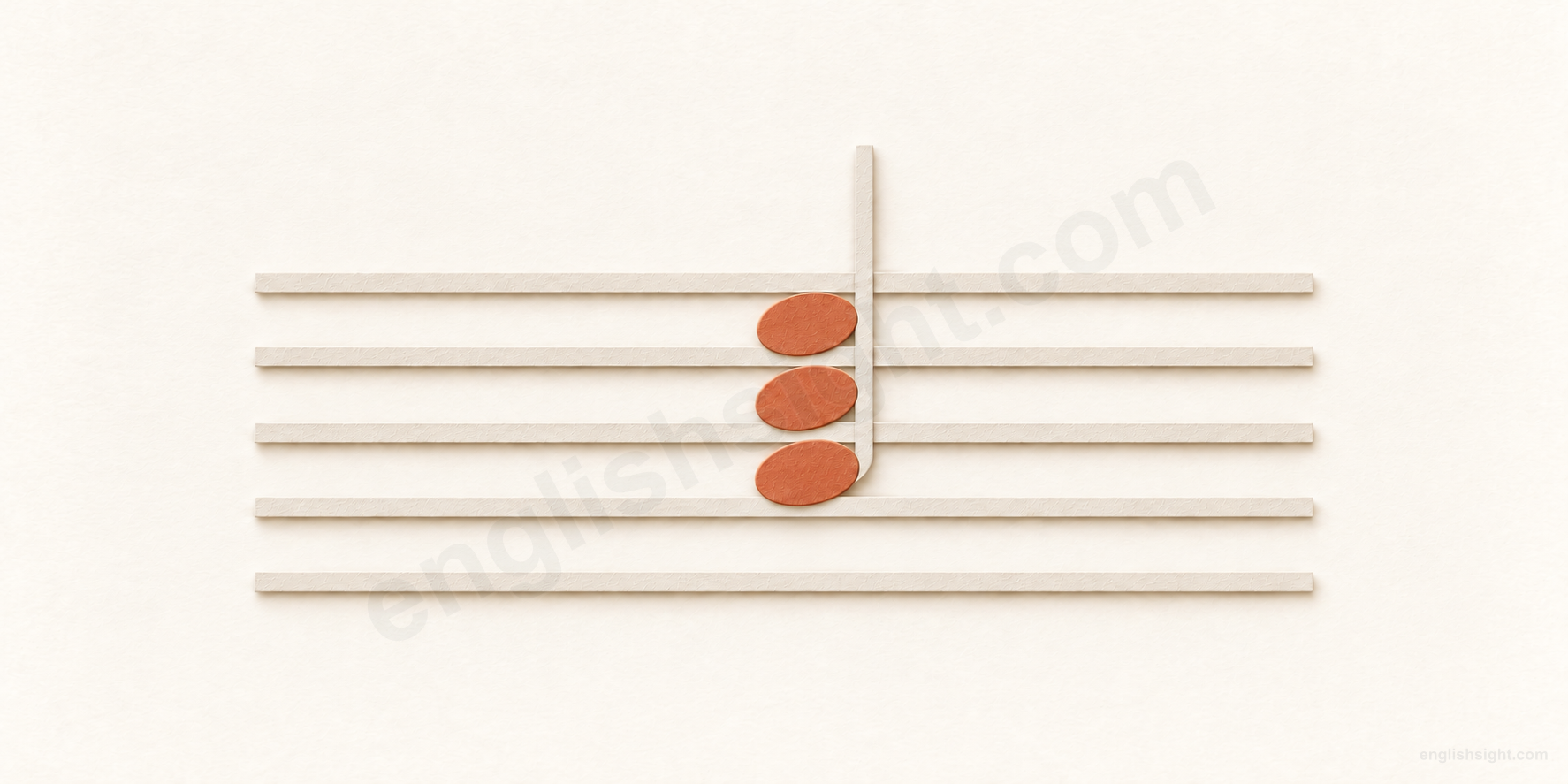
Use harmony for peaceful relationships, things that fit together, and notes that combine.
Distinct parts that fit together
Distinct parts that fit together
The three noteheads sit at different heights.
harmony
The distinct pitches form one chord.
Their shared stem shows that the notes sound together.
Different pitches sound together as one chord.
Different parts can keep their own identity and still work well together. Everyday harmony describes agreement or a good fit; musical harmony concerns notes combined into chords.
The diagram uses simultaneous musical notes to illustrate a relationship, not a journey or a required change from conflict to agreement. In technical music, harmony can include tension. Social harmony does not require identical opinions.
Different people can cooperate without becoming alike. Different colours can belong in one design. Different notes can sound together. Harmony helps us talk about these relationships, with a more specialized meaning in music.
A useful teaching connection is that distinct parts can retain their differences while contributing to a whole. It is a memory aid, not a claim about a picture shared by every English speaker or a rule that predicts every specialist expression.
01
Living and working together
Talk about peaceful relationships, the people involved, and efforts to keep or recover a good relationship. Harmony can also describe a sense of calm within a person.
01
live / work + in harmony + (with somebody)
live / work in harmony
live peacefully or work together without damaging conflict
People / parts / context
Two flatmates have different routines.
Relationship / result
They make room for each other’s needs.
Harmony describes their relationship, not identical habits.
Live in harmony describes getting along peacefully. Work in harmony applies the same idea to cooperation: people can have different tasks and still work well together.
With names the other person or group: live in harmony with your neighbours. In harmony describes a state or manner; it does not say that one person moves inside another.
Perfect harmony strengthens the description. Relative harmony allows some disagreement. The ordinary word does not require everyone to share every opinion, and the expression can sound more idealized than simply get along.
Peace and harmony is a familiar pairing that emphasizes peaceful relations: We hope the families can live in peace and harmony. Peace highlights the absence of conflict; harmony adds the sense of getting along well.
In a sentence
Despite their different routines, the two flatmates live in harmony.
Watch the difference Harmony is a noun: They work in harmony, or They work harmoniously. Do not say They work harmony.
02
harmony between + people / groups; harmony among + group members; social / racial / domestic harmony
harmony between groups
a peaceful relationship linking people or groups
People / parts / context
A town has several communities with different traditions.
Relationship / result
They cooperate and treat one another well.
Between identifies the relationship; a modifier can identify its setting.
Harmony between the teams points to the relationship connecting those teams. Harmony among team members presents harmony within a group. Between is not limited to exactly two when distinct groups and their relationships are being considered.
Social harmony concerns relationships within society; racial harmony concerns relationships between people of different racial backgrounds. Domestic or marital harmony concerns home or married life. These modifiers narrow the context; they do not create different grammatical kinds of harmony.
In these relationship uses, harmony is normally uncountable. Say There is harmony between them, without a before harmony.
In a sentence
The community garden has helped build harmony between the town’s different communities.
Watch the difference Use harmony between the groups for their relationship. The groups are in harmony describes the groups themselves.
encourage, preserve, or recover a cooperative relationship
People / parts / context
An argument has unsettled a team.
Relationship / result
A discussion helps the members cooperate again.
The verb tells us whether harmony is encouraged, kept, or brought back.
Promote harmony means encourage good relationships. Create or bring harmony focuses on producing that state. Maintain harmony means keep an existing good relationship going.
Restore harmony means bring harmony back after it has been lost. The return comes from restore, not from a special new sense of harmony. The same distinction matters when choosing between maintain and restore.
These are ordinary verb–noun combinations. Harmony is the object of the verb; there is no separable particle or special pronoun position to learn.
In a sentence
An open discussion helped restore harmony within the team after the argument.
Watch the difference Restore implies recovery of an earlier state; maintain means preserving a state that already exists.
04
inner harmony; a sense of harmony; be in harmony with yourself
inner harmony
a feeling of calm and agreement within yourself
People / parts / context
Someone feels pulled between competing wishes and worries.
Relationship / result
They feel more settled within themselves.
The relationship is internal rather than between different people.
Inner harmony describes a calm, settled feeling within a person. The teaching connection is that thoughts, feelings, and priorities feel less at odds with one another.
A sense of harmony names the feeling or impression of harmony. In harmony with yourself likewise presents a person as feeling at peace internally. These expressions often occur in reflective writing and discussions of well-being.
This is not a medical diagnosis or a promise that someone has no difficult feelings. You can describe a temporary sense of inner harmony without claiming permanent happiness.
In a sentence
For a few quiet minutes in the garden, I felt a sense of inner harmony.
Watch the difference Inner harmony concerns your internal state; harmony between friends concerns their relationship.
02
Fitting with a setting, an idea, or a design
People are not the only things that can be in harmony. A way of living, a policy, or the elements of a room can fit well with something else.
05
live + in harmony with nature / the environment; design something + in harmony with its surroundings
live in harmony with nature
live in a way that fits and respects the natural environment
People / parts / context
A community considers how its daily activities affect a wetland.
Relationship / result
Its choices allow local wildlife and people to coexist.
With names the environment that a way of life should fit.
In harmony with nature applies the idea of a workable relationship to human activity and the environment. It suggests avoiding destructive conflict with the natural world.
It does not mean that nature literally agrees with a person. With links the way people live to their surroundings. The phrase is common in environmental discussion, but by itself it gives no measurable environmental standard.
The construction can follow other verbs: design homes in harmony with their surroundings. The verb supplies the activity; in harmony with describes how that activity or its result fits its setting.
In a sentence
The village aims to live in harmony with nature by protecting the nearby wetland.
Watch the difference Nature follows with directly: in harmony with nature, not in harmony to nature.
06
be in harmony with + idea / standard; be out of harmony with + setting / principle
be in harmony with a principle
be consistent with an idea, plan, or standard
People / parts / context
An organization compares a proposal with its stated values.
Relationship / result
The proposal fits those values rather than contradicting them.
Abstract things can agree without anyone singing or having a friendship.
A proposal in harmony with our values is consistent with those values. This is a fairly formal way to describe compatibility; agrees with or is consistent with may be plainer alternatives.
Out of harmony with reverses the relationship: something clashes with or does not fit its context. A bright extension might be out of harmony with an older building; a rule might be out of harmony with an organization’s principles.
With introduces the thing used for comparison. The in / out of contrast is a conventional way of expressing fit or mismatch, not a literal location or a phrasal verb.
In a sentence
The new refund policy is in harmony with our promise to treat customers fairly.
Watch the difference Use with for this comparison. In harmony of our values does not express the same relationship.
07
harmony of + colour / form; a harmony of + colours / shapes / textures
a harmony of colour and shape
an attractive relationship among the elements of a whole
People / parts / context
A designer chooses several colours, shapes, and textures.
Relationship / result
They form an attractive overall arrangement.
The elements can differ while still belonging together.
In art and design, harmony concerns how the elements relate within a whole. Harmony of colour draws attention to that quality; a harmony of colours can name a particular pleasing combination.
This artistic sense can be countable or uncountable. The countable pattern is often descriptive: The room is a harmony of warm colours and simple shapes. It does not license a harmony in every other sense.
Of identifies the elements or quality making up the arrangement. Compare The curtains are in harmony with the walls, where with compares one element with another. Harmony need not mean everything has the same colour or shape.
In a sentence
The reading room is a harmony of soft colours and simple shapes.
Watch the difference A harmony of colours is possible in design writing; We live in a harmony is not the ordinary expression for a peaceful relationship.
03
Different notes in one musical whole
In music, harmony concerns notes sounding together and the chords they form. Learn how this differs from a tune, a shared rhythm, and singing the same notes.
08
sing / play + in harmony; sing / play + in unison
sing / play in harmony
combine different notes sounding at the same time
People / parts / context
Two singers have different musical lines.
Relationship / result
Their notes sound together as a coordinated combination.
Together does not mean at the same pitch.
When singers sing in harmony, they combine different pitches at the same time. Instruments can play in harmony too. This is the musical example represented by the lesson diagram.
Compare singing in unison: singers follow the same notes at the same pitch or in octaves. Harmony is not simply a group singing at once. Different parts contribute different pitches to a combined sound.
In everyday description, harmony often suggests a pleasing blend. In technical music use, harmony includes chords that sound tense as well as settled ones; it does not mean that every chord is sweet or relaxing.
In a sentence
One singer held a low note while the other sang a higher note in harmony with her.
Watch the difference In unison and in harmony are not interchangeable descriptions of musical pitch.
09
sing harmony; add a harmony; sing a harmony part
sing harmony
sing a part that combines with the main tune
People / parts / context
One performer sings the melody.
Relationship / result
Another adds a different part that supports it.
Harmony can name a singer’s musical contribution.
Sing harmony often means sing a supporting part rather than the main tune. Add a harmony or sing a harmony part can identify one particular additional part.
Sing in harmony describes the relationship among simultaneous sounds; sing harmony can identify what role a singer takes. A harmony part is still a musical line with its own changing notes.
Melody is the tune heard as a sequence of notes. Harmony concerns how notes combine at the same time. A singer can know the melody well but need practice to find a harmony part.
In a sentence
I’ll sing the melody, and Jo will sing harmony on the final line.
Watch the difference Sing harmony is established musical usage; do not generalize it into They live harmony.
10
sing in + three-part / four-part harmony; close harmony
three-part / four-part harmony
harmony arranged for a stated number of musical parts
People / parts / context
A choir divides a song into several distinct parts.
Relationship / result
Those parts combine when the choir sings.
The number counts parts, not necessarily individual singers.
Three-part harmony has three distinct musical parts; four-part harmony has four. Many singers may sing each part, so a choir of twelve can sing in three-part harmony.
The hyphen joins three-part before the noun. Part remains singular in this compound. It describes the structure of the music, not how long a performance lasts.
Close harmony is a particular singing style whose different notes lie close together in pitch. Close describes the spacing of the notes, not how near the singers stand or how friendly they are. It is useful recognition vocabulary rather than a separate everyday social sense.
In a sentence
Our twelve-member choir sings the last verse in three-part harmony.
Watch the difference Three-part harmony does not require exactly three people. Close harmony concerns pitch spacing.
11
vocal / rich / complex + harmonies; the harmony of + a song; study + harmony
vocal harmonies / study harmony
particular combinations of notes, or the musical system behind them
People / parts / context
A musician listens to the notes and chords beneath a tune.
Relationship / result
They notice particular combinations and learn how those combinations are organized.
Countability changes with particular results versus the musical subject.
Vocal harmonies names the combinations or parts produced by voices. Rich harmonies and unusual harmonies likewise refer to particular musical combinations or arrangements. The plural is harmonies, not harmonys.
Study harmony uses harmony as an uncountable name for a subject: how chords are formed, related, and used in a piece. The harmony of a song refers to that aspect of its musical structure.
Harmony, melody, and rhythm describe different aspects of music. Harmony concerns simultaneous pitch relationships and chords; melody follows a tune through time; rhythm concerns the timing and pattern of sounds. Advanced analysis of chords is beyond this lesson.
In a sentence
We admired the choir’s rich vocal harmonies, and I decided to study harmony.
Watch the difference Use harmonies for particular musical combinations, but harmony for the subject of study and usually for peaceful social relations.
Keep the differences clear
A noun with several countability patterns
Harmony is a noun, pronounced /ˈhɑːməni/ in British English and /ˈhɑːrməni/ in American English, with first-syllable stress. Peaceful relationships and the musical subject are normally uncountable. Particular musical combinations can be harmonies, and descriptive design writing can use a harmony of colours.
Read the preposition
In harmony describes a state or manner; with identifies the other person, thing, or standard. Harmony between teams identifies a relationship, while a harmony of colours identifies the elements in an arrangement. These are noun phrases and prepositional patterns, not phrasal verbs.
Related words have their own grammar
Harmony is the noun; harmonious is an adjective, and harmoniously is an adverb. Harmonize, also spelled harmonise in British English, is a related verb. This lesson focuses on harmony rather than a full lesson on those derived words.
Agreement is not uniformity
A harmonious relationship can allow different opinions and roles. In music, harmony differs from unison, and technical harmony includes tense chords. The teaching model should not turn these distinctions into a promise of perfect agreement or pleasant sound in every context.
Choose the relationship
Look at the people or parts involved, then choose the expression and interpretation that fit.
1. Two neighbours have different habits but get along peacefully. Which sentence is natural?
2. Two singers follow the same tune at the same pitch. Which expression specifically describes this?
3. A team used to cooperate well. After a serious argument, a meeting helps recover that relationship. Which verb emphasizes recovery?
4. A policy agrees with the organization’s values. Complete: The policy is in harmony ___ our values.
5. A choir of twelve sings in three-part harmony. What does three-part tell you?
Sources and teaching notes
The linked dictionary entries support the senses and usage distinctions in this lesson. Explanations, examples, and the diagram are original teaching material; the unifying visual connection is a teaching interpretation.
The diagram illustrates a useful connection; it is not a picture shared by every native speaker.