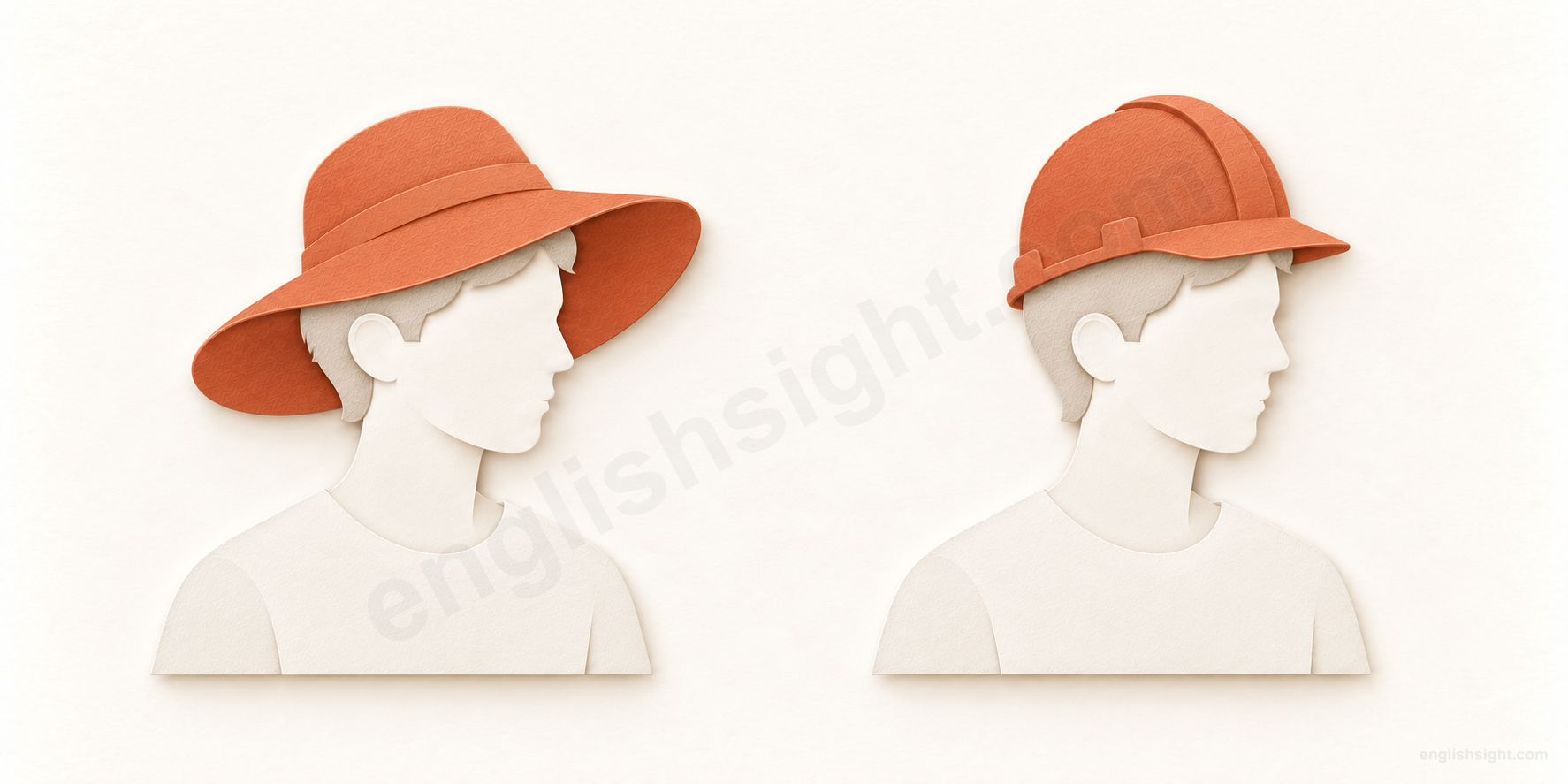
Start with what goes on the head, then read the whole expression.
Headwear and the roles it can suggest
A covering on the head; sometimes a sign of a role
The same wearer in a sun hat
hat
The same wearer in a hard hat
Different head coverings can suggest different purposes or roles.
A hat covers the head; its type can suggest a purpose or role. Figurative roles need no real hat, and fixed idioms have their own meanings.
A hat is a covering worn on the head; in figurative role expressions, the hat someone wears stands for the capacity in which they act.
The two versions of one wearer connect the physical object with differences of purpose and role. No change of clothing is required in the role sense, and fixed idioms have meanings of their own.
A hat is something worn on the head. Different hats serve different purposes, and a distinctive hat can also identify a person’s role. That gives a useful bridge to wearing several hats at work.
Other combinations have established meanings: hats off praises, under your hat asks for secrecy, and out of a hat can concern chance or an unexpected solution. Learn their full wording and context; one picture cannot predict every idiom.
01
The object and how to wear it
Name, count, describe, put on, and remove headwear. Start with these literal uses.
01
a / the / possessive + hat; plural hats
a hat / two hats
a piece of clothing worn on the head
Situation
You are choosing something to wear outdoors.
What the speaker means
You choose a covering for your head.
Hat names the item; it does not name the head or the act of dressing.
Hat is a countable noun: one hat, two hats. Use a determiner with a singular item: a hat, the hat, or my hat. Say I need a hat, rather than I need hat.
The part over the head is the crown; an edge projecting out around it is a brim. Many hats have a brim, but a woolly hat need not. The sketch uses two recognizable kinds, rather than setting a rule that every hat must look like them.
A cap is a more specific name for headwear such as a baseball cap, often with a projecting part at the front; other caps fit closely for a purpose, as in a swimming cap. Hat can be a broad category, so the categories overlap.
Example in context
I left my hat on the train.
Watch the difference Headwear is an uncountable category noun; one individual item is a hat, not a headwear.
02
put on / wear / take off + a hat; have a hat on; in a + adjective + hat
put on / wear / take off a hat
distinguish a dressing action from the state of being dressed
Situation
The hat is in your hand.
What the speaker means
After you put it on, you are wearing it.
Put on begins the state; wear describes it; take off ends it.
Put on your hat describes placing it on your head. Wear your hat or have your hat on describes the resulting state. Take off your hat describes removing it. The action comes from the verb, while hat remains its noun object.
With a noun, put your hat on and put on your hat are both possible; with a pronoun, say put it on. Similarly, take it off, not take off it. The noun hat is not itself a phrasal verb.
A person in a red hat is a person wearing one. On your head describes where the hat rests: The hat is on my head. The person is in the hat in the clothing description, but is not physically inside a container.
Example in context
Put your hat on before we leave.
Watch the difference I am wearing a hat describes the current state; I am putting on a hat describes the dressing action.
03
modifier + hat; sun hats / hard hats
a sun hat / a hard hat
name hats by purpose, material, or shape
Situation
You plan a beach visit or a visit to a building site.
What the speaker means
You choose headwear suited to that situation.
The word before hat narrows the kind of head covering.
A sun hat is worn to shield the head and neck from the sun. A hard hat is protective headwear used on building sites and in similar work. These are useful names to learn as complete combinations.
A straw hat names a material; a woolly hat is warm knitted headwear; a wide-brimmed hat describes the projecting edge. A top hat has a tall crown. These are varieties of the object, not unrelated meanings of hat.
A hard hat may suggest a worker’s role, but its literal meaning is protective equipment. Conversely, wearing your manager’s hat in a conversation can describe a role even if you have no headwear on.
Example in context
Visitors must wear a hard hat on this building site.
Watch the difference A sun hat and a hard hat serve different purposes; hat alone does not specify the protection needed.
02
One person, different roles
The established figurative sense lets a hat stand for a job, capacity, or viewpoint.
04
wear + two / several / many + hats; with + possessive + role + hat on
wear several hats / with my teacher’s hat on
have several roles or speak from one particular role
Situation
One person teaches classes and also organizes the school budget.
What the speaker means
The same person acts in different capacities.
The person stays the same; the responsibility or viewpoint changes.
Wear two, several, or many hats means perform different jobs or roles. This is an informal figurative use: a person can teach, manage, and handle accounts without changing clothes.
With my teacher’s hat on, I would encourage daily practice identifies the capacity in which I am speaking. Put on my teacher’s hat similarly means take up that role or viewpoint for the moment.
This extension is understandable because distinctive headwear can identify a job. It is a teaching connection supported by the established role sense, not a rule that any invented hat phrase will be understood. The diagram’s two kinds of headwear provide an anchor; the role language need not refer to real hats.
Example in context
At our small company, I wear several hats: designer, trainer, and bookkeeper.
Watch the difference Several hats counts roles, not necessarily separate employers or paid jobs.
03
Praise, secrets, reactions, and familiarity
These whole expressions do social work. Their meanings are conventional, so keep the wording and the situation together.
05
hats off to + person; take + possessive + hat off to + person; tip + possessive + hat to + person; for + noun / -ing
hats off to someone
express admiration or give credit
Situation
A team completes a difficult job.
What the speaker means
You publicly acknowledge its achievement.
Removing or tipping a hat can suggest respect; the words can do that without a physical gesture.
Hats off to the team! praises what the team has done. I take my hat off to them expresses the same admiration. For can introduce the achievement: hats off to them for keeping everyone safe.
I tip my hat to someone is a related expression, especially in North American English. Oxford marks take my hat off and hats off as especially British. These are tendencies, not rules excluding speakers elsewhere.
In Take your hat off indoors, removal is literal. Adding to someone in the admiration expression identifies the person receiving credit; it does not mean give that person your hat.
Example in context
Hats off to the volunteers for cleaning the beach.
Watch the difference Use Hats off to them, not Hats off them. The short exclamation uses plural hats.
06
keep + information / it + under + possessive + hat
keep something under your hat
keep information private
Situation
A friend tells you a plan that has not been announced.
What the speaker means
You agree not to tell other people.
The object of keep is the information, not a hat.
Keep it under your hat is an informal request not to disclose what you have heard. The possessive matches the person keeping the secret: I kept it under my hat; please keep it under yours.
You can use concealment as a memory aid, but the conventional expression is about information. It does not instruct you to hide a physical object beneath headwear, and under is not replaceable by in while keeping this idiom.
Example in context
We are planning a farewell party, but keep it under your hat for now.
Watch the difference The phrase asks for secrecy; it does not promise that the secret will remain safe.
07
verb phrase + at the drop of a hat
at the drop of a hat
act immediately or without hesitation
Situation
Someone suggests a trip.
What the speaker means
You are ready to go with almost no delay.
The whole phrase describes readiness or a very easily triggered reaction.
At the drop of a hat can show enthusiasm: I would go back there at the drop of a hat. It can also criticize a reaction that happens too easily: He starts an argument at the drop of a hat.
The expression modifies an action or willingness to act. No hat needs to fall, and the phrase does not simply mean accidentally. Treat the wording as an established unit rather than deriving the meaning from drop alone.
Example in context
Maya would join another hiking trip at the drop of a hat.
Watch the difference Keep a in at the drop of a hat. This is a figurative expression, not a literal timing instruction.
08
something + be / seem + old hat
be old hat
be so familiar or dated that it is no longer fresh
Situation
A speaker presents a supposedly new idea.
What the speaker means
Listeners recognize something long familiar.
Old hat evaluates familiarity or lack of originality, rather than the age of a garment.
An idea, joke, style, or technique can be old hat when people have known it for so long that it feels unoriginal or out of date. The tone may be dismissive, so consider whether that judgment is appropriate.
Compare This joke is old hat with This is an old hat. The second sentence normally identifies a worn or long-owned item of clothing. The figurative phrase often follows be and normally has no article before old hat.
Example in context
That camera trick is old hat now; audiences have seen it for years.
Watch the difference Old hat does not automatically mean useless or false; it evaluates novelty or style.
09
hold / hang on to + your + hat / hats
hold on to your hat
tell someone to prepare for a surprise
Situation
You are about to announce unexpected news.
What the speaker means
Your listeners are warned that the news may astonish them.
The command can be figurative even when nobody is wearing a hat.
Hold on to your hat! and Hang on to your hat! are colloquial ways of introducing a surprise. Addressing several people, you can say Hold on to your hats!
The same words can be literal in strong wind. Context distinguishes gripping headwear from preparing for startling news. This is a conventional expression with a light, dramatic tone, not a general meaning of hat.
Example in context
Hold on to your hats—we have won the national final!
Watch the difference Do not interpret every command about holding a hat as an idiom; in windy weather it may be practical advice.
04
Contests, contributions, choices, and requests
Check whether the situation concerns competing, collecting money, chance, a surprise solution, disbelief, or a humble request.
10
throw + possessive + hat into the ring
throw your hat into the ring
announce that you will compete or seek a position
Situation
A club is looking for a new chair.
What the speaker means
You make yourself a candidate.
The whole idiom marks entry into a contest, not victory in it.
Throw your hat into the ring means put yourself forward as a competitor or candidate. Elections, leadership contests, and other competitions provide typical contexts.
The possessive refers to the candidate: She threw her hat into the ring. The ring is the conventional setting within the expression; neither a physical hat nor a boxing match is required. This is an idiom containing the noun hat, not a phrasal verb formed from hat.
Example in context
Nora has thrown her hat into the ring for the club presidency.
Watch the difference Entering a contest does not say you will win or that others have accepted you as the best choice.
11
pass the hat (round / around); pass the hat for + purpose / person
pass the hat (round / around)
ask a group of people to contribute money
Situation
The group wants to help a colleague.
What the speaker means
Small contributions are collected from several people.
The expression describes collecting contributions, whether or not a hat is used.
Pass the hat can mean collect money from a group for a gift, help, or another shared purpose. A hat passed among people is an easy way to remember the expression, but a real hat is unnecessary.
Pass the hat round or around is especially associated with British usage; the shorter pass the hat is usual in American English. For introduces the purpose or beneficiary. Compare the literal Pass me my hat, which simply asks for a piece of clothing.
Example in context
We passed the hat around to help pay for the community garden.
Watch the difference The idiom concerns money, not passing responsibility to someone else.
12
draw / pick + name / number / entry + out of a / the hat; be drawn out of a hat
draw / pick a name out of a hat
choose randomly rather than by preference
Situation
Several people have entered a prize draw.
What the speaker means
A winner is chosen by chance.
Out of a hat describes a random selection in this competition context.
Drawing names from a hat is a familiar method of random selection. The expression can describe the method or a random choice made another way. The point is chance rather than judging whose name or entry is best.
The thing drawn may be a name, a number, or an entry. Passive wording is natural: The winning name will be drawn out of a hat. Both a hat and the hat occur, depending on whether a particular container is already understood.
The words out of a hat do not always mean randomly. Producing an unexpected solution out of a hat is a different established use, explained next.
Example in context
We picked a name out of a hat to decide who would go first.
Watch the difference A random draw is different from choosing the most qualified person.
13
pull a rabbit / something out of a / the hat
pull a rabbit out of the hat
unexpectedly produce a useful solution or success
Situation
The project seems unable to continue.
What the speaker means
Someone finds an unexpected way to save it.
The effect is surprising success, not a random choice.
Pull a rabbit out of the hat uses the familiar idea of a magician producing something unexpected. In a problem-solving context, it means suddenly achieve something helpful when success looked unlikely. Collins notes its use in journalism.
The shorter pull something out of the hat can similarly describe producing a solution. In I can’t pull a solution out of a hat, the speaker emphasizes that a useful answer cannot simply be produced on demand.
Compare picking a name out of a hat: that is a random selection. Here the context of a difficult problem and a surprising answer creates the established figurative reading. The hat diagram anchors the physical noun, not every detail of this idiom.
Example in context
When the venue cancelled, Lena pulled a rabbit out of the hat and found us a hall that evening.
Watch the difference The expression praises an unexpected result; it does not say actual magic occurred or explain the method.
14
if + present clause, I’ll eat my hat
I’ll eat my hat
emphasize that you think something will not happen
Situation
Someone predicts an unlikely success.
What the speaker means
You express strong, often playful disbelief.
The absurd promised action makes the prediction emphatic.
If that happens, I’ll eat my hat means that you consider it very unlikely. It is a humorous exaggeration rather than a serious offer to eat clothing.
Oxford labels it informal; Collins Easy Learning calls it old-fashioned. It is useful for recognizing a playful line in conversation or a story, while I really doubt it is a plainer choice. The condition usually uses a present-tense verb even though it concerns the future.
Example in context
If Ben finishes that giant puzzle before lunch, I’ll eat my hat.
Watch the difference The speaker is confident about a prediction, not reporting evidence that guarantees it.
15
go + hat in hand + to + person; for + help / money
go hat in hand to someone
approach someone humbly to ask for help
Situation
A club cannot cover its costs.
What the speaker means
Its organizers ask a sponsor for assistance from a weaker position.
Hat in hand describes a deferential manner, not just a carried item.
Go hat in hand to someone means ask very humbly for help, especially money. It can suggest an uncomfortable dependence on the person being asked, rather than simply good manners.
The expression is especially North American; British English usually has go cap in hand. To names the person approached; for names what is requested. With the literal wording She stood with her hat in her hand, carrying the hat alone does not establish that she is asking for anything.
Example in context
The club went hat in hand to a local business for money to repair the roof.
Watch the difference Hat in hand has no article before hat in this fixed expression.
05
A home or something to rely on
Two North American uses with hang have different meanings. The surrounding words show which one is intended.
16
a place to hang + possessive + hat; hang + possessive + hat + place phrase
a place to hang your hat
a place to live or make your home
Situation
You move to a new town.
What the speaker means
You find somewhere you can regard as home.
Hanging a hat can stand for settling in a place.
A place to hang your hat can mean a home or somewhere to live. Oxford marks this use as informal and North American. A real hat or hook is not required.
Compare Hang your hat on that hook, which is a literal instruction about an object. The home reading depends on the expression and context, not on a new general meaning of the verb hang in every sentence.
Example in context
After months of travel, I wanted a place to hang my hat.
Watch the difference The home idiom differs from relying on evidence in hang your hat on something.
17
hang + possessive + hat on + evidence / idea / result
hang your hat on something
rely on a fact, idea, or piece of evidence
Situation
A report makes a claim based on a small survey.
What the speaker means
You question whether that evidence is a sound basis.
The support is figurative: an argument rests on evidence.
Hang your hat on something means rely on it. A fact, result, or explanation can provide the basis for a position or decision. This is an informal North American expression.
In We can’t hang our hat on one survey, the speakers say that one survey is insufficient support. The phrase need not refer to a hat, a hook, or a home. Learn it alongside rely on rather than treating on as proof that something is physically hanging.
Example in context
We need more evidence; we can’t hang our hat on one small survey.
Watch the difference A place to hang your hat concerns a home; something to hang your hat on concerns a basis you can rely on.
Keep the noun and the full expression distinct
Hat, cap, and headwear
Hat is countable; headwear names a category. Cap is a more specific headwear word, but the boundaries overlap. A brim is common on hats, not obligatory. A woolly hat remains a hat.
Verbs carry the actions
Wear describes the state, put on the change into it, and take off the removal. Hat is their noun object. Role expressions reuse that clothing language figuratively; the noun does not acquire all the meanings of the verbs around it.
Tone and regional tendencies
Most idioms here belong to informal speech or writing. Hat in hand and the two hang expressions are especially North American; cap in hand is the usual British request expression. I’ll eat my hat can sound old-fashioned or deliberately playful.
Coverage boundaries
The noun, its role sense, practical clothing combinations, and familiar fixed expressions are the focus. The verb hat (hatted, hatting), meaning provide with a hat, is recorded by dictionaries but is outside the everyday production target. Older talk through your hat, my hat, and knock something into a cocked hat are left for reference; sports and specialist compounds need their own contexts.
Read the hat in context
Choose the wording or meaning that matches the situation.
1. The hat is already on Imani’s head. Which sentence describes her current state?
2. One volunteer keeps the accounts and organizes events. What does “She wears two hats” mean here?
3. You want to praise the team that repaired the bridge. Which expression fits?
4. The host picked a name out of a hat to choose the prize winner. What does the expression emphasize?
5. A colleague says, “We can’t hang our hat on this one result.” What does she mean?
6. Your friend says, “Keep the news under your hat until Friday.” What should you do?
Sources and teaching notes
The meanings and usage notes were checked against the dictionary pages below. Explanations and examples are original. The picture is a teaching connection, not evidence that every expression can be predicted from an image.
The diagram is a teaching aid; English speakers do not all share one mental picture for hat.