Recognize strong dislike, unwelcome experiences, and reluctant ways of speaking.
Strong aversion toward a target
Strong aversion toward a target
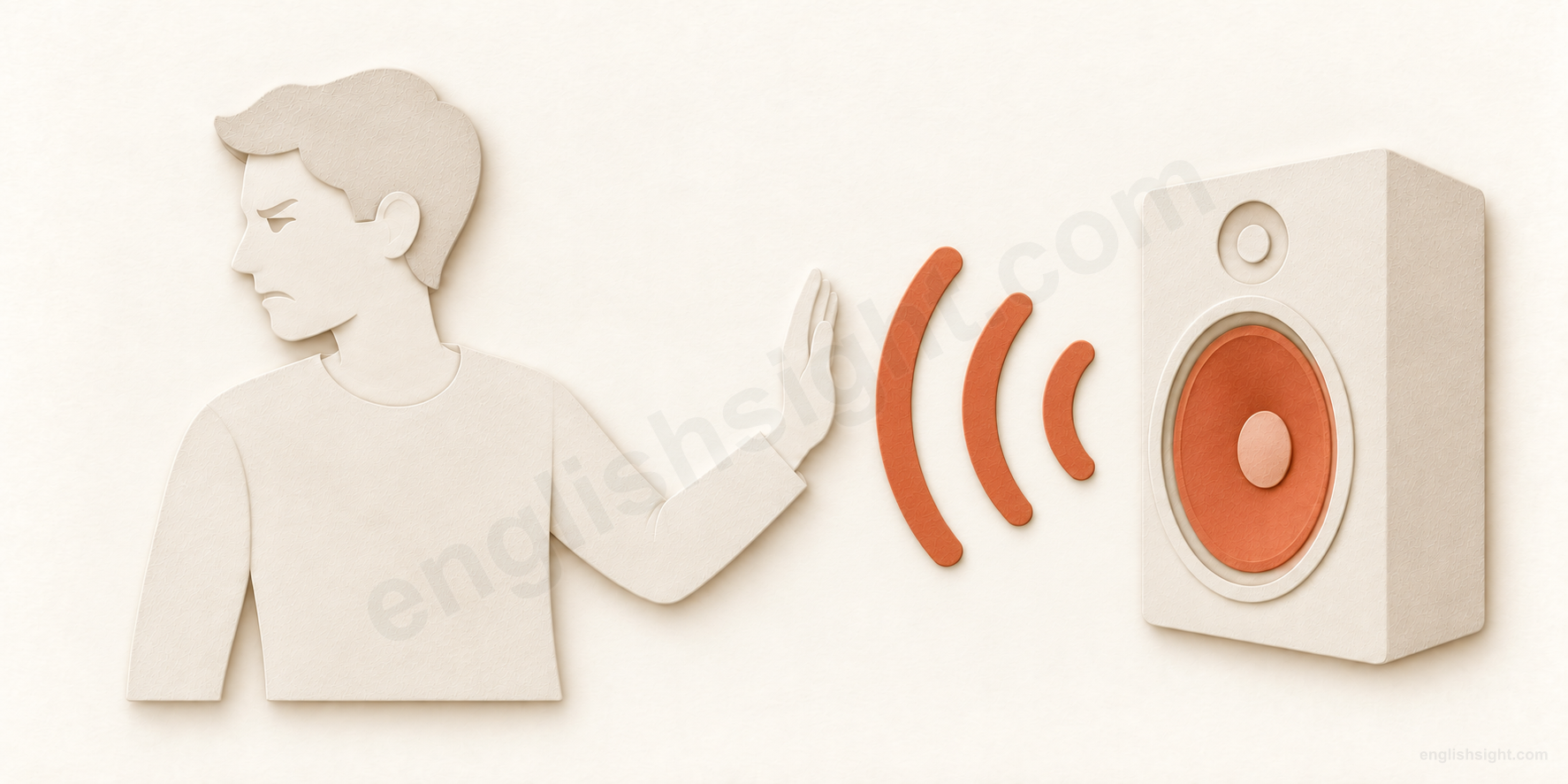
Unwelcome noise comes from a loudspeaker.
hate
Strong dislike is directed at the noise.
The listener frowns, turns away, and raises an open hand toward the source.
The noise is the target of strong aversion; hate names the feeling, not a required movement or harmful act.
Hate expresses strong negative feeling toward someone, something, or an experience; some constructions voice how unwelcome an action or possibility is.
Aversion is an attitude, not a required physical movement or an act of harm. Informal emphasis, polite reluctance, and fixed expressions need their own context.
Hate connects a person with something they feel strongly against. The target may be a person, an activity, a fact, or a possibility. Everyday complaints can use the same word less gravely.
The grammar and the full expression tell you what is unwelcome. I hate waiting, I’d hate to miss it, and I hate to bother you do different jobs in conversation.
01
People, things, and reasons
Identify who feels the dislike, what it concerns, and how strong the words sound in that situation.
01
hate + person / thing
hate someone / something
feel strong dislike toward a person or thing
Situation
A person considers deliberate cruelty.
What the words express
They express strong rejection of it.
The subject feels the dislike; the object is its target.
Hate can name a serious feeling, especially toward a person, a group, or harmful behavior. In I hate cruelty, I is the person with the feeling and cruelty is what the feeling concerns.
Hate takes its object directly: hate him, not hate to him. The sentence describes an attitude; it does not by itself say that the speaker harms, avoids, or even meets the target. Hate can also occur without a stated target: They were taught to hate leaves the target general.
Compare I don’t like that neighbor with I hate that neighbor. The second can sound much more hostile. Not hating someone does not necessarily mean liking them.
In a sentence
I hate cruelty, even when people call it a joke.
Watch the difference Do not treat hate, don’t like, and don’t hate as three interchangeable statements.
02
(really / absolutely) hate + thing / the way… / the idea of…
really / absolutely hate something
emphasize an everyday dislike
Situation
The alarm rings early every morning.
What the words express
The speaker complains strongly about that experience.
In casual speech, hate can be emphatic without expressing lasting hostility.
In conversation, hate can describe a strong everyday dislike: food, weather, noise, or a disliked routine. Really and absolutely strengthen the complaint; they do not create a different verb sense.
The example concerns early alarms, not an enemy. Compare I don’t like getting up early for a milder statement. Context matters more than any fixed numerical scale of emotion.
I hate the way this lid sticks and I hate the idea of moving again direct the dislike toward a feature or an idea. The way and the idea identify what bothers the speaker.
In a sentence
I absolutely hate the sound of that alarm.
Watch the difference A casual complaint about an alarm does not show how seriously I hate you will be received.
03
hate + someone / reflexive pronoun + for + noun / -ing
hate someone / yourself for…
name a reason for the dislike
Situation
A person realizes that they broke a promise.
What the words express
Their anger or dislike is directed at themselves.
For introduces the reason; the first object names the target.
In hate someone for something, someone receives the dislike and for explains why. After for, use a noun or an -ing form: for the lie or for lying.
When the target is the same person as the subject, use a reflexive form: I hated myself. Compare She hated him for lying: she has the feeling, and his lying is the reason.
Self-directed hate is a strong way to describe self-reproach. I regret what I said describes regret without necessarily saying that I dislike myself.
In a sentence
I hated myself for breaking my promise.
Watch the difference Say for breaking, not for to break. For gives a reason, not a recipient.
The passive subject is what people dislike, not the person having the feeling.
Users hate the rule becomes The rule is hated by users. By names the people with the feeling; for can still give the reason.
A much-hated rule and a widely hated leader use hated to describe a target of dislike. These forms do not mean that the rule or leader is feeling hate.
The passive works with ordinary dislike. It does not turn the conversational opening I hate to say this into a useful passive expression.
In a sentence
The new rule was hated by users for making simple tasks harder.
Watch the difference Keep by and for distinct: hated by users, hated for causing delays.
02
Activities, situations, and unwelcome possibilities
Read what follows hate: an activity, a whole situation, another person’s action, or something the speaker would rather avoid.
05
hate + -ing; hate + to-infinitive; hate being / to be + past participle
hate doing / hate to do
dislike an activity or experience
Situation
There are forms to complete before a visit.
What the words express
The speaker finds completing them unpleasant.
Both an -ing form and a to-infinitive can follow ordinary hate.
I hate filling in forms and I hate to fill in forms can both express dislike of the activity. The -ing form readily presents an activity as an experience; do not invent a rule that it must be past while the infinitive must be future.
The understood doer is normally the subject: in I hate waiting, I do the waiting. In I hate being interrupted, I receive the interruption; being interrupted is passive inside the -ing phrase.
I hate to be interrupted also has a passive infinitive. It says what experience is unwelcome, not that hate itself is passive.
In a sentence
I hate filling in the same form twice.
Watch the difference Use waiting or to wait after hate, not the bare verb wait.
06
hate it when + clause; hate (it) that + clause; hate the fact that + clause; hate it + place expression
hate it when / hate it that…
dislike a whole situation or fact
Situation
People interrupt you before you finish.
What the words express
You complain about that recurring situation.
The following clause identifies the event or fact you dislike.
In I hate it when people interrupt, it points forward to the situation described by when. The complaint concerns the interruption, not necessarily the people as people.
I hate it that we have so little time presents an unwelcome fact. I hate that we have so little time and I hate the fact that we have so little time can also express this; the longer the fact that wording makes the noun structure clear.
Compare I hate it here: here identifies the setting, and it can refer broadly to life or conditions there. No when-clause is needed.
In a sentence
I hate it when people interrupt me before I finish.
Watch the difference In I hate it when…, it points to the following situation rather than a particular physical object. A clause after when needs its own subject and verb.
07
hate + someone / someone’s + -ing
hate someone doing something
dislike another person’s action
Situation
A flatmate uses your bicycle without asking.
What the words express
You object to that behavior.
The person after hate performs the -ing action.
I hate him using my bike does not simply mean I hate him. Him is understood as the person using the bike, and the whole action is what I dislike.
I hate his using my bike is also possible, with a possessive form, but can sound more formal. I hate it when he uses my bike often makes the intended complaint clearer.
This is not a causative construction: hate neither makes him use the bike nor prevents him from doing so.
In a sentence
I hate him using my bike without asking.
Watch the difference Compare hate him and hate him doing that: the second can target the behavior rather than the whole person.
08
would hate to + verb; would hate + someone + to + verb; would hate for + someone + to + verb
would hate to… / would hate for someone to…
say that a possible event would be very unwelcome
Situation
A route may cause you to miss a family celebration.
What the words express
You express how unwelcome missing it would be.
Would places the dislike in a possible situation.
I’d hate to miss the wedding says that missing it would be very unpleasant. It does not report a present habit of missing weddings.
I’d hate you to miss it and I’d hate for you to miss it name someone else as the person who might miss it. Both are established patterns; for introduces the person whose possible action is unwelcome.
Compare I hate waiting with I would hate to wait outside all night. The first readily describes a general dislike; the second considers an unwelcome possibility. In this would hate pattern, choose the to-infinitive.
In a sentence
I’d hate for you to miss the wedding because of a late train.
Watch the difference In I’d hate you to miss it, you is the possible doer of miss, not simply the target of personal hate.
09
I hate to + say / tell / admit / bother / trouble…, but + clause
I hate to say / bother / trouble…
signal reluctance before speaking or making a request
Situation
You need help while someone is busy.
What the words express
You acknowledge the interruption before asking.
Hate expresses reluctance about your own next action.
I hate to bother you, but… softens an interruption or request. The speaker normally goes on to ask anyway; this is not a refusal to communicate.
I hate to say this, but… and I hate to tell you, but… introduce unwelcome information. I hate to admit it, but… acknowledges something the speaker would prefer not to concede.
The regret concerns bothering, saying, telling, or admitting. It does not mean that the speaker hates the listener. Tone still matters: the opening does not automatically make a blunt remark considerate.
In a sentence
I hate to trouble you, but could you check this address?
Watch the difference Keep to: I hate to tell you, not I hate tell you. This conversational use is not normally passive.
10
hate to think + question clause; would hate to think (that) + clause; hate to see + object + complement
hate to think / hate to see…
find an idea or an observed situation distressing
Situation
You consider the possible cost of repairing a damaged roof.
What the words express
You express how unpleasant it is to contemplate.
The unpleasant target can be an idea rather than a direct personal experience.
I hate to think how much it will cost emphasizes reluctance to contemplate the amount. It does not mean that the person is unable to think.
I’d hate to think that nobody noticed can express a hope that the unwelcome idea is untrue. Context distinguishes this from a simple general dislike of thinking about a topic.
I hate to see food being wasted focuses on distress at witnessing the waste. In I hate to see her upset, her is the person seen and upset describes her state. Neither example expresses hatred of food or of her.
In a sentence
I hate to think how much the roof repairs will cost.
Watch the difference Hate to see you upset expresses concern about your distress, not dislike of you.
03
Fixed expressions and the noun hate
Some combinations name hostility, personal annoyances, or mixed feelings. Learn their full wording and tone.
11
hate + possessive + guts; hate the sight of + person / thing
hate someone’s guts / hate the sight of…
express particularly intense personal dislike
Situation
Two characters have become bitter enemies.
What the words express
One says that even seeing the other is unbearable.
These full expressions intensify dislike; they are not descriptions of anatomy.
Hate someone’s guts is a forceful informal idiom. Guts does not identify an internal organ as the literal target of a separate feeling.
Hate the sight of someone similarly conveys intense aversion to the person, not simply an opinion about their appearance. It can also be used with a thing: after an exhausting project, someone might hate the sight of another spreadsheet.
These are useful to recognize in stories and conversation. Compare I disagree with him: disagreement alone does not convey this hostility.
In a sentence
In the story, the two rivals hate each other’s guts.
Watch the difference These expressions can sound aggressive when directed at a real person; they are stronger than saying that you disagree.
12
hate on + person
hate on someone
express hostile criticism of someone
Situation
A performer receives insulting online comments.
What the words express
Someone asks people to stop attacking her.
The informal combination describes expressed criticism, not only an inner feeling.
Hate on is an informal phrasal verb used for hostile criticism or offensive comments. In the example, the issue is what commenters are saying about the performer.
Keep the target after on: hate on her, not hate her on. On is part of this established expression; it does not mean physical contact.
Compare I hate that singer, which reports an attitude, with They keep hating on that singer, which presents repeated hostile expression. The latter readily describes an activity.
In a sentence
People keep hating on her because she changed her style.
Watch the difference For neutral feedback, criticize or comment on may be more suitable; hate on suggests hostility.
13
full of / filled with + hate; hate for + person / thing
hate / hate for someone
name the feeling itself
Situation
An argument has left strong hostility behind.
What the words express
The speaker names that emotion as a thing being felt.
The noun hate usually names an uncountable feeling.
In full of hate, hate is a noun: it names the feeling rather than serving as the sentence’s verb. You can also speak of hate for someone.
Compare They hate him with their hate for him. The first is a clause; the second is a noun phrase and needs a verb to become a complete sentence.
Hatred is another noun for this feeling. In this meaning, use much hate or a lot of hate, not many hates. The countable annoyance meaning is a separate pattern below.
In a sentence
His voice was full of hate after the argument.
Watch the difference Distinguish I hate it, with a verb, from full of hate, with a noun.
14
a pet hate; one of someone’s pet hates; a particular hate of mine
a pet hate
a particular personal annoyance
Situation
Noisy phone calls on trains repeatedly annoy you.
What the words express
You name that habit as one of your particular dislikes.
Here a hate is a disliked thing, not a quantity of the emotion.
A pet hate is something that especially annoys you. It is a British expression; pet peeve is the usual North American counterpart.
Pet does not mean an animal here. The countable pattern allows one of my pet hates. A particular hate of mine also uses hate to mean a disliked thing.
Compare full of hate, which names the emotion. Someone describing a pet hate about train travel need not be expressing bitter personal hostility.
In a sentence
Loud phone calls on trains are one of my pet hates.
Watch the difference Keep the noun countable here: one of my pet hates, with plural hates.
15
have a love-hate relationship with + person / thing; love to hate + person / thing
a love-hate relationship / love to hate
describe mixed feelings or enjoyable dislike
Situation
A runner likes the result of training but dislikes the effort.
What the words express
They describe both sides of the same relationship.
Love and hate can be combined without cancelling each other.
A love-hate relationship with something combines attraction and strong dislike. It can concern work, a hobby, or a person, not only a romantic relationship.
Love to hate is different: you enjoy disliking someone or something, as with a fictional villain whose behavior keeps you interested. It need not mean you both love and hate the person in the same way.
These combinations add their own relations: mixed feelings in the first, enjoyment of disliking in the second. The aversion sketch alone cannot predict those meanings.
In a sentence
I have a love-hate relationship with running: I love the energy it gives me but hate the early starts.
Watch the difference A love-hate relationship is not the same expression as love to hate.
16
receive + hate mail; hate speech + against + group; a hate crime / hate crimes
hate mail / hate speech / hate crime
recognize compounds naming forms of hostility
Situation
A report discusses abuse and attacks on a community.
What the words express
The full compound identifies the kind of hostility.
Hate modifies another noun; the full compound carries a specific meaning.
Hate mail means hostile or threatening letters, emails, or similar messages sent to someone. Mail names the communication, and hate characterizes its hostility; it does not mean ordinary mail that the recipient happens to dislike.
Hate speech names speech or writing attacking or threatening a group, especially over an identity such as race or religion. It is not simply any sentence beginning I hate.
These are vocabulary explanations. Hate mail and hate speech are normally uncountable: some hate mail, an example of hate speech. To count messages, say three abusive emails or three pieces of hate mail.
Hate crime refers to criminal attacks motivated by hostility toward people’s identity, such as their race or sexual orientation. It can name the category, or one incident: a hate crime, two hate crimes. This gives the everyday vocabulary meaning, not legal criteria for classifying a particular case.
In a sentence
The forum removed hate speech against a religious community.
Watch the difference Do not use hate speech as a label for every negative review or personal dislike.
Choose the target, construction, and tone
Forms and pronunciation
Hate /heɪt/: hate, hates, hated, hated, hating. Drop the final e before -ing. Hated has two syllables, /ˈheɪtɪd/. The noun has the same pronunciation as the base verb.
Usually a state
Ordinary hate normally uses simple tenses: I hate this noise. Informal I’m hating this course can emphasize a current unpleasant experience, so do not say the progressive is impossible. Hate on describes expressed behavior and readily allows ongoing or repeated action.
Near meanings
Don’t like is often milder; can’t stand emphasizes finding something intolerable; despise adds contempt or lack of respect. None is an automatic replacement in I hate to trouble you.
What the picture can explain
The sketch illustrates aversion, not a universal mental image or a rule for predicting idioms. It does not show that hate necessarily causes avoidance or aggression. Polite reluctance and noun compounds need the explanations above.
Scope
This lesson covers modern verb and noun uses, main complement patterns, and selected established expressions. Related words such as hateful, hater, and hatred do not receive full separate lessons here; specialized legal uses of hate crime are outside this language lesson.
Find the target and the intention
Read the whole construction before choosing an interpretation.
1. “I hate him borrowing my laptop without asking.” What is the direct complaint about?
2. “I hate to bother you, but could you unlock the door?” What is the speaker doing?
3. You are worried that a friend might miss a wedding. Which sentence expresses that unwelcome possibility?
4. A British colleague says, “That is one of my pet hates.” What do they mean?
5. “People are hating on her online.” What is especially in focus?
Sources and teaching notes
Usage and constructions were checked against the dictionary pages below. Explanations, examples, and the aversion sketch are original teaching material.
The diagram illustrates aversion as a teaching aid; speakers need not share a single mental picture.