Head: body parts, thinking, leadership, and direction
Connect the physical head with thinking, leading parts, leadership, and a course of movement.
A head within a larger whole
A distinct part at the upper or front end
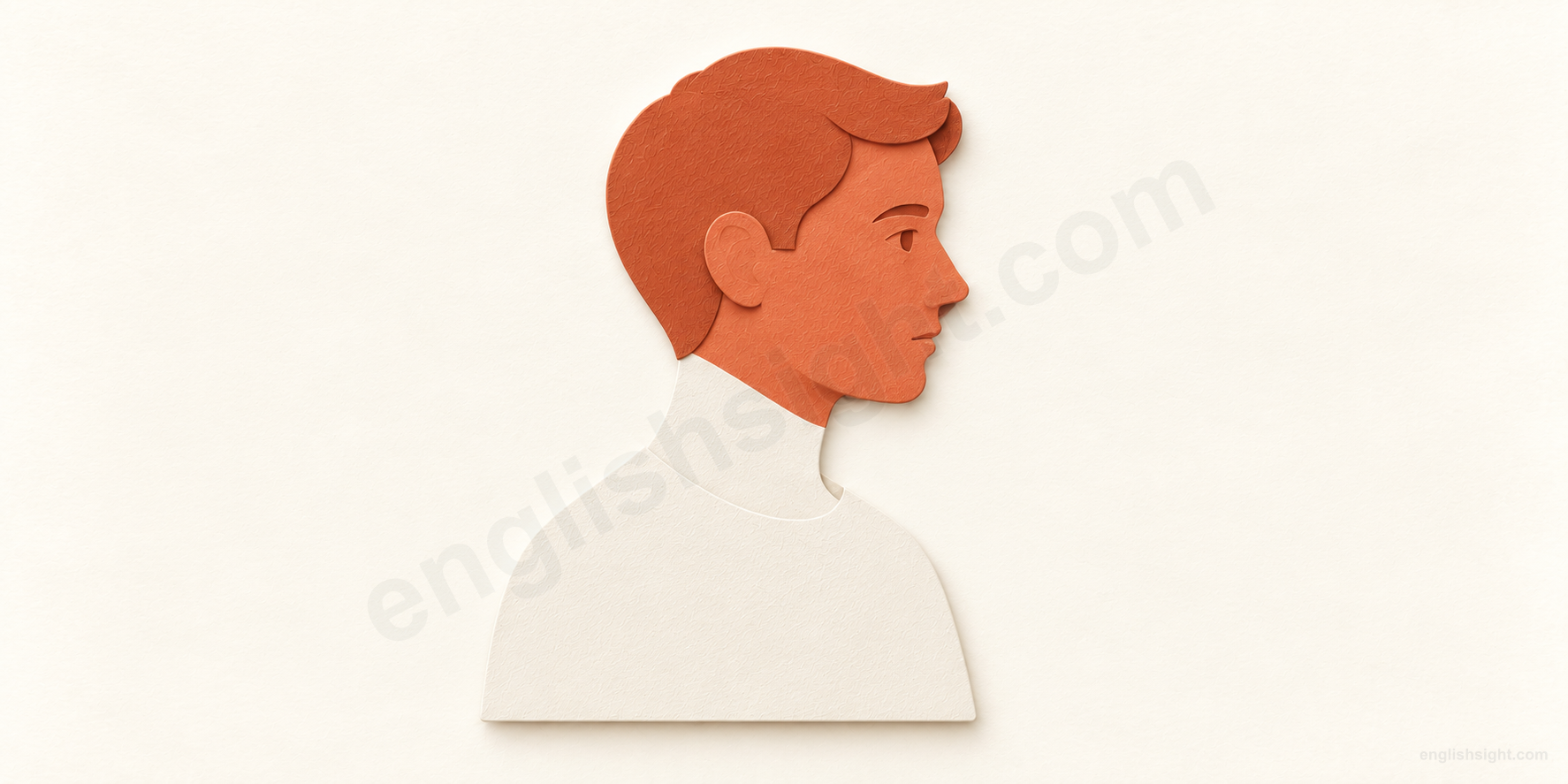
A person’s head is shown with the neck, shoulders, and upper torso.
head
The head stays attached to the body: this is a part–whole relationship, not an action.
Terracotta highlights the head above the ivory neck.
Head identifies a distinct part of a larger whole. Other senses need their own context.
A head is a distinct upper or front part of a body. The human head contains the brain and main sense organs; familiar extensions concern thought, leadership, and the leading part of something.
The drawing identifies a part of a whole. It shows no event or required before-and-after change. Thought, leadership, movement, and fixed idioms are explained in their own sections; no single body picture predicts them all.
Head begins with a recognizable body part. Modern English also uses it for the mind, a person in charge, a distinguished end or front, and the action of moving in a direction.
These connections form a useful learning map, not a formula for translating every expression. Fixed phrases such as a heads-up or come to a head need their own context and grammar.
01
The body and its movements
Start with the physical head. Possessives, body-part prepositions, and the verb heading describe different relationships.
01
possessive + head; hit / pat + person + on the head
your head
the body part containing the brain and main sense organs
Situation
A low branch crosses the path.
Meaning in context
You lower your head to pass under it.
The head belongs to the person; it is distinct from the neck, face, and hair.
Use a possessive when identifying whose head you mean: my head, her head, the dog’s head. Head includes more than the face; face names the front surface with the eyes, nose, and mouth.
For contact with a body part, English also uses a person as object followed by on the head: The ball hit me on the head. On locates the contact; it does not mean inside the head.
In a sentence
I lowered my head under the branch.
Watch the difference Say my head, not the head of me. Use neck for the connecting body part.
02
nod / shake / turn + possessive + head
nod / shake your head
make a head movement that can communicate a response
Situation
Mina is asked whether she wants more soup.
Meaning in context
She shakes her head and says no.
The movement comes from nod or shake; head names the body part moved.
A nod is typically an up-and-down movement; a shake is typically a side-to-side movement. In many English-speaking situations these accompany yes and no, respectively, but context and cultural conventions matter.
Turn your head describes changing the direction your face points, without specifying a yes/no message. Keep the possessive aligned with the person: He shook his head, not my head.
In a sentence
Mina shook her head when I offered more soup.
Watch the difference Do not infer a fixed message from every movement; a nod can also acknowledge someone.
03
possessive + head + hurt; have a headache
My head hurts.
describe pain located in the head
Situation
You are asked why you want a quiet room.
Meaning in context
You explain where the pain is.
Head names the location; hurts supplies the experience of pain.
My head hurts is a straightforward sentence about pain. I have a headache uses the separate countable noun headache; both can explain why someone needs quiet.
A bad head can mean a headache in informal British usage. This is a regional expression rather than a rule that head always means pain. A head injury, by contrast, is an injury to that body part.
In a sentence
My head hurts, so I would prefer a quiet room.
Watch the difference For the noun headache use an article in I have a headache. Do not say I have a head to mean a headache.
04
from head to toe / foot
from head to toe / foot
over the whole body
Situation
You have walked through a muddy field.
Meaning in context
Your clothes and body are dirty all over.
Two body endpoints describe the whole extent.
From head to toe and from head to foot emphasize that a condition or covering extends over the person. Neither requires a precise inspection of every patch of skin.
The head is one endpoint and foot the other; the meaning belongs to the full from…to… expression. It describes extent, not the order in which something happened.
In a sentence
We were covered in mud from head to foot.
Watch the difference Do not add an article before head, toe, or foot in these fixed expressions.
05
have / keep + a roof over + possessive + head; put a roof over + someone’s head
a roof over your head
shelter or a place to live
Situation
Someone is looking for somewhere to stay.
Meaning in context
A relative offers a room, providing basic accommodation.
The roof above a person stands for the shelter provided by a home.
Have a roof over your head means have somewhere to live or stay. Put a roof over someone’s head means provide that shelter. The expression often emphasizes a basic need rather than the quality or size of the home.
The possessive identifies the person receiving shelter: a roof over my head, a roof over their heads. It does not mean owning the building, and a rented room can provide a roof over your head. The full roof-over-head phrase supplies this meaning; head alone does not mean home.
In a sentence
My aunt gave me a roof over my head while I looked for a flat.
Watch the difference This refers to accommodation, not merely standing beneath any object that happens to be overhead.
06
head + ball + direction; ball + be headed + direction
head the ball
send a ball in a direction by striking it with the head
Situation
A cross reaches a football player.
Meaning in context
She directs the ball toward a teammate with her head.
The noun becomes an action verb naming the body part used.
In football, head is transitive: the player heads the ball. A direction phrase can say where the ball goes; heading it toward the goal does not guarantee a goal.
He headed the ball and The ball was headed away illustrate active and passive forms. This action sense is different from head for the stadium, where the subject travels.
In a sentence
She headed the ball back to her teammate.
Watch the difference A header is the related name for the action or shot; the verb is head.
02
Fronts, tops, objects, and counting
Head can name a distinguished part of something, a person counted as a unit, or a conventional side of a coin. Learn the relevant object and pattern together.
07
the head of + whole; at the head of + queue / stairs / table
at the head of the queue / stairs
at the front or upper end of something
Situation
Several people are waiting in a queue.
Meaning in context
You identify the person at its front.
The object determines whether head means front, top, or a designated end.
The head of a queue is its front. The head of the stairs is the upper end. The head of a bed is the end where a sleeper’s head normally rests, and the head of a table is a distinguished end often used by the person presiding.
These are established part–whole uses, not permission to replace every top or front with head. At the head of locates something at that part; of connects the part to the larger whole.
In a sentence
The guide waited at the head of the queue.
Watch the difference The head of the bed remains that end even when nobody is sleeping in it.
08
the head of + tool / screw; hammer / screw + head
the head of a hammer
the distinct working or projecting part of a tool
Situation
A hammer has a handle and a metal striking part.
Meaning in context
You name the metal part separately.
Head picks out a particular end or working component, not the whole tool.
A hammer head is the part used for striking; a screw head is the wider end where the screwdriver engages. Both contrast with the narrower handle or shaft.
The tool or object supplies the exact shape and function. This resemblance can help organize the vocabulary, but head is not a technical name for any arbitrary piece sticking out.
In a sentence
The head of the hammer was loose.
Watch the difference Use handle for the part held in the hand; a hammer head is not the entire hammer.
09
a head of + lettuce / cabbage; two heads of + plant
a head of lettuce
a compact mass of leaves or flowers
Situation
You are choosing vegetables for a salad.
Meaning in context
You buy one whole leafy head.
Head can count a compact plant structure as one item.
A head of lettuce or cabbage is the compact leafy part treated as a unit. A flower head is a cluster or compact flowering part; it is not a human head hidden in a plant.
Use heads in ordinary plural counting: two heads of lettuce. The plant noun identifies what kind of head you are buying; a loose handful of leaves is a different amount.
In a sentence
Please buy a head of lettuce for the salad.
Watch the difference Do not apply this measure to all vegetables: a head of carrot is not the ordinary name for one carrot.
10
a + adjective + head; a head on + beer
a head on the beer
a layer of foam at the surface
Situation
A drink is poured into a glass.
Meaning in context
Bubbles gather as a layer at the top.
The surface layer is conventionally called a head.
In this use head is a countable noun often used in the singular: a thick head, a head of foam, or a head on the beer. It names the foam, not the glass rim.
The top-position connection is easy to remember, but head is not a general synonym for any surface layer. A layer of oil is not ordinarily called a head in everyday English.
In a sentence
The beer had a thick head when it was poured.
Watch the difference Read the surrounding noun: this head is foam, not the drinker’s body part.
11
heads or tails; call heads; land / come down heads
heads or tails
the two conventional outcomes of tossing a coin
Situation
Two friends need a random way to decide who goes first.
Meaning in context
One calls heads before the coin lands.
Heads is a conventional name for one side of a coin.
Heads usually identifies the side with the principal design or a portrait; tails identifies the other side. The exact design depends on the coin.
Say It landed heads or I called heads. The final -s is part of the established coin expression; it does not mean several body parts are involved.
In a sentence
I called heads, but the coin landed tails.
Watch the difference Use heads in a coin call, not the ordinary singular head.
12
amount + a head / per head; count heads
ten dollars a head
an amount for each person
Situation
A group is sharing the cost of a meal.
Meaning in context
Each person pays ten dollars.
A body part stands for one whole person in counting.
A head and per head mean for each person after an amount. They are useful when sharing a bill or comparing resources across a population.
Count heads means count how many people are present. It counts people, not only their visible heads. These uses do not make head a neutral substitute for person in every sentence.
In a sentence
The picnic will cost about ten dollars a head.
Watch the difference A head is two words here; ahead is a different word.
13
number + head of + cattle / livestock
twenty head of cattle
twenty individual cattle
Situation
A farmer describes the size of a herd.
Meaning in context
You learn how many animals are in it.
This livestock counting construction uses the unchanged form head.
After a number, head of cattle counts individual animals. Twenty head of cattle means twenty cattle, not twenty herds.
This is a specialized but familiar counting pattern. Unlike two heads of lettuce, the livestock unit normally stays head after a plural number. Ordinary body-part counting still uses heads.
In a sentence
The farm keeps twenty head of cattle.
Watch the difference Keep head singular in this unit pattern; do not generalize it to ordinary two heads.
03
Thought, understanding, and self-control
The physical head provides a useful link to mental activity. Established expressions specify memory, ability, belief, emotion, or difficulty.
14
in + possessive + head; get + something + out of + possessive + head
in your head
in thought, memory, or mental calculation
Situation
A tune keeps returning to your thoughts.
Meaning in context
You describe it as staying in your head.
The physical head stands for mental activity.
A song in your head is remembered or imagined, not physically inside your skull. Do a sum in your head means calculate mentally, without writing the steps down.
Get something out of your head means stop thinking about it. The object may be an unwelcome idea or simply a catchy tune; the phrase alone does not establish whether it is true.
In a sentence
I can’t get that tune out of my head.
Watch the difference In my head describes mental experience; on my head normally locates something physically above or against it.
15
have a (good) head for + field / task
have a head for figures
have an ability for a type of mental task
Situation
A coworker quickly spots errors in totals.
Meaning in context
You describe their ability with numbers.
For introduces the area of aptitude.
A head for figures means an ability to work with numbers. A good head for business similarly praises practical business judgment.
Head here concerns capacity, not the physical size of someone’s head. The full have a head for pattern expresses aptitude; it is not the movement verb head for.
In a sentence
Nora has a good head for figures.
Watch the difference Compare Nora headed for the office: that describes where she went, not what she is good at.
16
have / not have + a head for heights
have a head for heights
feel comfortable in high places rather than afraid
Situation
Two friends consider a walk along a high ridge.
Meaning in context
One explains that being far above the ground does not frighten her.
The full expression concerns coping with height, rather than calculating it.
Have a head for heights describes being able to be in a high place without feeling afraid. Cambridge labels the expression UK. For example, I don’t have a head for heights explains why someone may dislike a high balcony.
Compare a head for figures, which concerns skill with numbers. The shared have a head for pattern expresses a capacity, but heights gives it a specific fear-related meaning. It does not mean being tall or having climbing expertise.
In a sentence
Lena has a head for heights, so the high balcony did not bother her.
Watch the difference Comfort at height does not establish that an activity is safe or that someone has the necessary practical skills.
17
get + idea / it + into + possessive + head; get it into your head that + clause
get an idea into your head
form a settled belief or finally take in an idea
Situation
Arun wrongly thinks the office is closed.
Meaning in context
The belief becomes difficult to change.
Into suggests an idea becoming established; the whole expression gives the attitude.
Get it into your head that… can describe coming to believe something, often stubbornly or without good reason. The speaker may disagree with the belief.
It also describes finally understanding or accepting something: I can’t get it into my head that the shop has moved. This can sound frustrated or critical. The following that-clause states the idea; it is not automatically a fact endorsed by the speaker.
In a sentence
Arun got it into his head that the office was closed.
Watch the difference Do not treat every belief reported with this expression as true; context establishes that.
18
get + possessive + head + around + thing / wh-clause
get your head around something
come to understand or accept something difficult
Situation
A new booking system is confusing.
Meaning in context
After trying it, you begin to understand how it works.
The head represents understanding; around belongs to a fixed mental expression.
Get your head around a problem means reach an understanding of it, often after effort. A surprising change can require emotional acceptance as well as intellectual understanding.
The person is the subject, and the difficult material follows around. This is conversational wording; understand is a straightforward alternative. No circular physical motion is required.
In a sentence
I’m finally getting my head around the new booking system.
Watch the difference Do not confuse this with get something into your head, which can suggest a stubborn belief.
19
off the top of + possessive + head
off the top of my head
without preparation or checking details
Situation
Someone asks for an estimate during a conversation.
Meaning in context
You offer a quick answer before checking your notes.
The whole phrase marks an immediate, unprepared answer.
Off the top of my head often introduces an estimate, suggestion, or answer given without preparation. It can signal that you should verify details before relying on them.
The phrase describes how the answer was produced, not a guaranteed level of accuracy. An unprepared answer can happen to be correct. Use my, your, or another possessive to identify the person answering.
In a sentence
Off the top of my head, I’d allow two hours for the journey.
Watch the difference It is not the ordinary expression for carefully researched information.
20
thing + be / go + over + possessive + head
go over your head
be too difficult for you to understand
Situation
A speaker uses unfamiliar technical ideas.
Meaning in context
You cannot follow the explanation.
The material exceeds the listener’s current understanding.
The explanation went over my head describes a failure to understand it. It can concern a joke, an argument, or instructions, not just academic subject matter.
Be over my head describes the same relationship as a state. This does not establish a permanent lack of ability; an explanation may simply assume knowledge the listener does not yet have.
In a sentence
Most of the technical explanation went over my head.
Watch the difference Distinguish a person going over a manager’s head to higher authority; that has a different meaning.
21
be / get + in over + possessive + head
be / get in over your head
be or become involved in a situation too difficult to manage
Situation
A volunteer accepts responsibility for a project without realizing its demands.
Meaning in context
The work proves too much to handle without help.
Involvement beyond someone’s capacity is expressed by the whole idiom.
Be in over your head describes being involved in something you cannot manage with your current resources or experience. Get in over your head describes becoming involved in that situation: I got in over my head when I agreed to run the project alone.
Keep in as part of the idiom. Compare The explanation went over my head, which describes not understanding an explanation. Being in over your head concerns managing the situation, and can involve workload or responsibility as well as understanding.
In a sentence
After accepting three projects at once, I realized I was in over my head.
Watch the difference Do not use go over my head for this meaning; that expression has separate comprehension and authority uses.
22
keep / lose + possessive + head
keep / lose your head
stay calm or lose emotional control under pressure
Situation
The lights fail during an event.
Meaning in context
One organizer stays calm and gives clear instructions.
Head stands for judgment and emotional control.
Keep your head praises composure when events become difficult. Lose your head describes panic or loss of calm; it does not normally mean losing consciousness.
The possessive follows the person affected: They kept their heads. These are established idioms, not directions to hold or remove a physical body part.
In a sentence
Leah kept her head when the lights went out.
Watch the difference Lose your temper focuses on anger; lose your head can describe panic or other loss of calm.
23
praise / success + go to + possessive + head
success goes to your head
success makes you excessively proud or self-important
Situation
Someone receives a great deal of praise.
Meaning in context
They begin acting as if they are better than everyone else.
A change in judgment is attributed to praise or success.
In this idiom success or praise is the subject, and the person affected appears in to their head. It usually criticizes inflated self-importance.
Don’t let it go to your head is a familiar warning after a compliment. Head supplies a link to judgment, but the proud attitude is a meaning of the full expression.
In a sentence
The award went to his head, and he stopped listening to advice.
Watch the difference This does not simply mean that he remembered winning the award.
24
alcoholic drink + go to + possessive + head
the wine went to my head
the drink made me feel its intoxicating effects
Situation
Someone drinks wine with dinner.
Meaning in context
They feel affected by the alcohol.
The same expression has a separate drink-related interpretation.
When wine or another alcoholic drink goes to someone’s head, the expression reports feeling drunk, dizzy, or mentally affected. It is a language description, not a measure of how much alcohol was consumed.
Compare The praise went to her head: praise makes her conceited, whereas the wine affects her through alcohol. The subject and context distinguish the two established meanings.
In a sentence
That wine went to my head surprisingly quickly.
Watch the difference Do not translate this as the wine making someone proud; check the subject.
25
put + plural possessive + heads + together
put our heads together
think and discuss a problem jointly
Situation
Two people have different pieces of useful information.
Meaning in context
They discuss them to find a solution.
Plural heads represent the people contributing their thinking.
Put our heads together invites collaboration, often when one person cannot solve a problem alone. It emphasizes pooling ideas rather than merely being in the same room.
Use a plural possessive matching the people: Let’s put our heads together. The phrase does not require actual head-to-head contact, and it does not guarantee a solution.
In a sentence
Let’s put our heads together and work out a better route.
Watch the difference Keep heads plural when several people contribute.
26
cannot make head or tail / head nor tail / heads or tails of + thing
can’t make head or tail of it
cannot understand it at all
Situation
Instructions seem disorganized and unclear.
Meaning in context
You cannot find a meaningful interpretation.
The complete negative idiom emphasizes a lack of understanding.
I can’t make head or tail of the instructions is informal and emphatic. Can’t make head nor tail of is another established form. The plural variant can’t make heads or tails of is also used, including in American English: I can’t make heads or tails of this diagram.
The phrase requires of before the thing you cannot understand. It does not refer to tossing a coin, despite sharing head and tail with that vocabulary.
In a sentence
I can’t make head or tail of these instructions.
Watch the difference Learn the full negative expression; a literal head-and-tail interpretation misses its purpose.
27
thing / person + do + possessive + head + in
do my head in
make me very annoyed or frustrated
Situation
A repeated noise continues while you try to work.
Meaning in context
You express strong irritation.
This British informal idiom describes a mental reaction.
Something is doing my head in is a strongly informal complaint. The annoying thing or person is the subject; the possessive identifies who is frustrated.
The phrase concerns irritation, not physical injury to the head. Use annoys me or frustrates me when you want a less colloquial alternative or a broader international audience.
In a sentence
That constant beeping is doing my head in.
Watch the difference This is British informal usage; it is unsuitable for a neutral formal report.
04
Leaders and first positions
A head may be a person in charge, an organizational role, or the first part of an ordered whole. The verb can describe leading or adding a title.
28
the head of + organization; department head; head + job noun
the head of a department
the person in charge of a group or organization
Situation
A department needs someone to make final decisions.
Meaning in context
You identify the person with that responsibility.
A leader relates to the organization as its directing part.
The head of the department identifies a person with overall responsibility. Head teacher and, especially in British English, the head can refer to the person in charge of a school; principal is familiar in American school contexts.
Before a job noun, head means chief or senior: head chef, head waiter. Dictionaries may label this adjective use or a noun used as a modifier. The head of a group is a person; the head of a queue can simply be its front.
Head office is a related compound naming an organization’s main office. It names a place or central office, whereas the head of the office names the person in charge. Head here contributes the idea of chief or main.
In a sentence
Please send the request to the head of the department.
Watch the difference Head is not a general substitute for boss in every construction: say the head of the department.
29
head + organization; head up + organization; head + pronoun + up; be headed by + leader
head / head up a team
be responsible for leading a group or activity
Situation
A new project is assigned a leader.
Meaning in context
Rosa takes responsibility for directing the team.
The organization is the direct object of the leadership verb.
Rosa heads the team and Rosa heads up the team both describe leadership. With head up, a pronoun goes between verb and particle: Rosa heads it up.
The passive The team is headed by Rosa names the organization first. This is not the same as Rosa is headed for the station, which describes direction. Head up the hill, by contrast, can be ordinary movement with up indicating the route.
In a sentence
Rosa heads up the design team.
Watch the difference Say heads it up, not heads up it. Leadership does not mean that Rosa physically walks in front all day.
30
head + list / procession
head the list / procession
occupy the first or leading position
Situation
A procession is arranged in order.
Meaning in context
The band goes first.
Head as a verb can put its subject at the front or top.
The band heads the procession describes physical order. A name that heads a list appears first; a book that heads a sales list ranks highest on that list.
The direct object is the ordered whole. No for is needed: heading a list and heading for a place have different grammar and meanings. Being first does not by itself mean having managerial authority.
In a sentence
The school band headed the procession.
Watch the difference The word following head is the thing led or topped, not a travel destination.
31
be headed + title; head + document + with + title / name
a section headed “Costs”
a section with a particular title at its beginning
Situation
A report is divided into sections.
Meaning in context
One section starts with the title Costs.
The title occupies the beginning of a written unit.
Be headed + title identifies the words used as a heading. A section headed “Costs” is a shortened form of a section that is headed “Costs”.
You can also head a page with a date or name. This writing use commonly appears in the passive; it describes a label at the beginning, not someone managing the report.
In a sentence
Look at the section headed “Costs”.
Watch the difference A heading is a title or label; headed is the participle used in this construction.
32
person + go over + possessive + head + to + higher authority
go over a manager’s head
approach a higher authority without using the usual manager
Situation
An employee disagrees with a manager’s decision.
Meaning in context
The employee complains directly to the director.
The person bypassed is named by the possessive.
Go over my head to the director means bypass me and appeal to someone above me in authority. The person doing the bypassing is the subject.
This often implies that the expected chain of authority was ignored. Compare The explanation went over my head: here the explanation is the subject, and the sentence describes my failure to understand it rather than bypassing anyone’s authority.
In a sentence
She went over her manager’s head and contacted the director.
Watch the difference This describes authority, not the physical height of the director or the manager.
05
Direction, departure, interception, and prevention
Head as a movement verb gives a course or destination. Objects and particles distinguish leaving from intercepting someone or preventing a problem.
33
head for / to / toward(s) + place; head + north / home; be heading / headed + direction
head for / to the station
move toward a place or in a direction
Situation
You finish your visit and set out for a train.
Meaning in context
Your destination is the station.
The subject moves; for or to names the destination.
Head for the station and head to the station both describe a course toward that place. Head north gives a direction directly, and head home needs no preposition.
Where are you heading? asks about direction or destination. Where are you headed? is also natural, especially in American English. Neither form by itself says that the traveler has arrived.
In a sentence
We headed for the station after lunch.
Watch the difference Say head home, not head to home. Head for a place does not guarantee arrival.
34
be heading / headed for / toward(s) + outcome
be heading for trouble
be developing toward a likely result
Situation
A team keeps missing important deadlines.
Meaning in context
Someone warns that serious problems are becoming likely.
A result is treated as a destination in a developing situation.
Heading for trouble presents the current course as likely to lead to problems. Headed for disaster uses headed in the same directional way, especially in American English.
The subject may be a person, business, or situation rather than a physical traveler. The warning often invites a change of course; it does not state that the predicted outcome is already complete or unavoidable.
In a sentence
If we keep missing deadlines, we’re heading for trouble.
Watch the difference For here introduces a likely outcome, not an intended goal: people do not necessarily want trouble.
35
head back (to + place); head out (of + place); head off (to + place)
head back / out / off
go back, go out, or set off
Situation
A visit has ended.
Meaning in context
You leave and start the return journey.
The directional word modifies ordinary movement.
Head back means go toward the place you came from. Head out means leave or go outside. Head off can mean set off: We headed off early. Further phrases identify the route or destination: head back to the hotel, head out of town, head off to work.
In these examples the subject travels and there is no person or problem being stopped. Compare head someone off and head off a crisis, where an object changes the interpretation.
In a sentence
We headed back to the hotel before dark.
Watch the difference Head off to school means set off for school; head a bus off means intercept it. Read the object and prepositions.
36
head off + person / animal / vehicle; head + object + off
head someone off
intercept someone by getting in front of their course
Situation
A horse is moving toward an open gate.
Meaning in context
Someone gets ahead of it and redirects it.
The object’s course is intercepted, not followed.
Head the horse off describes moving into its path to stop it or make it change direction. A person or vehicle can also be the object.
This phrasal verb is separable: head off the horse or head the horse off. With a pronoun, put it between head and off: head it off. This is different from an intransitive subject simply heading off to a destination.
In a sentence
The farmer headed the horse off before it reached the road.
Watch the difference Say head it off, not head off it. This sense normally involves getting ahead of a moving target.
37
head off + unwanted event; head + unwanted event / pronoun + off
head off a problem
act early enough to prevent an unwanted event
Situation
A misunderstanding might cause an argument.
Meaning in context
A quick explanation prevents the argument.
Interception extends to stopping an event before it develops.
Head off a dispute or head off trouble means take action in advance to prevent it. The direct object names the unwanted event, not a place to travel toward.
The phrasal verb is separable: head a problem off; head it off. Compare deal with a problem, which may happen after it has arisen. Head off emphasizes prevention or stopping a developing threat.
In a sentence
A clear explanation headed off an argument.
Watch the difference The expression describes prevention, not necessarily solving an argument that is already fully under way.
06
Everyday expressions and comparisons
These combinations have meanings of their own. The body image may help you remember them, but it does not let you invent replacements freely.
38
give / get / have + a head start (on + task / competitor)
a head start
an initial advantage or a favorable early beginning
Situation
One runner is allowed to leave before the other.
Meaning in context
They begin with an advantage.
The front-position idea is useful, but the advantage belongs to the full noun phrase.
A five-minute head start is an advantage from beginning five minutes earlier. In work or study, preparation can give someone a head start without a literal race.
Get a head start on the report means begin early and gain an advantage on that task. A head start on other competitors compares people’s starting positions; context tells you whether on introduces a task or competitors.
In a sentence
Reading the brief tonight will give us a head start tomorrow.
Watch the difference Head start is a countable noun phrase: use a head start, not head starting.
39
give + person + a heads-up (about + thing / that + clause); Heads up!
give someone a heads-up
give advance information that helps someone prepare
Situation
You learn that tomorrow’s meeting has moved.
Meaning in context
You tell a colleague before they make plans.
The full noun heads-up names a useful alert.
A heads-up is informal advance notice. Give me a heads-up if the time changes asks for an alert; Thanks for the heads-up acknowledges one.
Heads up! is also an exclamation warning people to watch out, especially for danger above them. Head up the team is a leadership verb with a different structure; it is not the same expression.
In a sentence
Thanks for the heads-up about the room change.
Watch the difference Write a heads-up with an -s and normally a hyphen when it is the noun.
40
collide head-on; a head-on collision; tackle / face + problem + head-on
head-on
with the fronts meeting, or by facing a difficulty directly
Situation
A team has been avoiding a recurring problem.
Meaning in context
They decide to address it directly.
A front-to-front relationship extends to direct confrontation.
Two vehicles can collide head-on, with their fronts making the first contact. A head-on collision uses the same word as an adjective before a noun.
Tackle a problem head-on means confront it directly rather than avoid it. This figurative use need not involve hostility or physical contact. Head-on describes the manner; head for names a destination.
In a sentence
We need to tackle the payment problem head-on.
Watch the difference Keep head-on distinct from the verb head plus on: the hyphenated form expresses direct contact or confrontation.
41
go / compete + head-to-head (with + opponent); a head-to-head contest
go head-to-head
compete or confront one another directly
Situation
Two teams reach the final.
Meaning in context
They compete directly for the title.
The complete compound emphasizes a direct encounter between opponents.
Go head-to-head with someone puts the opponents in a direct contest or confrontation. Teams, candidates, or products can be compared this way.
A head-to-head contest uses the compound before a noun. It does not necessarily mean only two individual people: two teams may each have several members.
In a sentence
The two school teams will go head-to-head in the final.
Watch the difference This is not the ordinary phrase for joint problem-solving; use put our heads together for that.
42
be / stand + head and shoulders above + comparison group
head and shoulders above
much better than the people or things compared
Situation
You compare several strong applications.
Meaning in context
One candidate is clearly better than the rest.
A height image expresses a large difference in quality.
Be head and shoulders above the others is an emphatic comparison of ability or quality. It can describe a person’s work as well as the person.
The idiom uses singular head and plural shoulders. It is an evaluation, so a speaker should give reasons when that judgment matters. It does not assert anything about the candidate’s physical height.
In a sentence
Her proposal was head and shoulders above the rest.
Watch the difference Use above to introduce the comparison, not than after the full phrase.
43
thing / performance + turn heads
turn heads
attract admiring or favorable attention
Situation
An unusual design is presented at a show.
Meaning in context
People notice and admire it.
The imagined turning of heads stands for attracting attention.
A striking outfit, an attractive design, or an impressive performance can turn heads. The expression often suggests that people are impressed.
Compare turn your head, which can simply describe a bodily movement. In the idiom the noticeable thing is the subject, and heads is the object without a possessive.
In a sentence
The bright new stage design turned heads at the festival.
Watch the difference Turn heads does not necessarily say that anyone physically turned their head.
44
keep + possessive + head + down
keep your head down
avoid drawing attention to yourself
Situation
An office is tense after a disagreement.
Meaning in context
You choose to remain unobtrusive.
A lowered head provides a memory image for a low profile.
Keep your head down can mean avoid notice or involvement, often when attention might cause trouble. It is informal, and the context explains why the person wants a low profile.
It can also be a literal instruction about posture or safety in a physical situation. In the office example the intended meaning is social behavior; it does not require looking at the floor.
In a sentence
I kept my head down while the office argument continued.
Watch the difference Do not confuse keeping your head down with keeping your head, which means staying calm.
45
bury / hide + possessive + head + in the sand; have your head in the sand
bury your head in the sand
refuse to acknowledge an unpleasant problem
Situation
Bills are accumulating unopened.
Meaning in context
Someone refuses to face the situation.
The established image describes avoidance of reality.
Bury your head in the sand criticizes refusing to recognize or deal with an unwelcome situation. Have or hide your head in the sand can convey the same avoidance.
The phrase is about willingness to face the issue, not simply lacking information. The problem remains even while the person ignores it. Its meaning is conventional; it is not an instruction involving real sand.
In a sentence
Ignoring the overdue bills is just burying your head in the sand.
Watch the difference This usually criticizes deliberate avoidance, so it can sound accusatory.
46
keep + possessive + head + above water
keep your head above water
just manage to avoid serious difficulty
Situation
A small business has high costs and little spare money.
Meaning in context
It manages to continue but cannot relax.
The survival image expresses limited coping rather than success without difficulty.
Keep your head above water is often used about finances or business. It can also describe managing a heavy workload: you are coping, but only just.
The phrase does not mean becoming wealthy or having everything under control. A literal swimming context is possible too, so check whether the speaker is discussing water or difficulties.
In a sentence
The shop is keeping its head above water, but there is little money left over.
Watch the difference Keep above water indicates coping; it does not promise growth or comfort.
47
be / fall + head over heels in love (with + person)
head over heels in love
deeply and completely in love
Situation
Two people begin a relationship.
Meaning in context
One describes very strong romantic feelings.
The familiar love expression is a conventional intensifier.
Be head over heels in love with someone describes intense romantic feeling. Fall head over heels describes the change into that state; context may supply in love without repeating it.
Head over heels can also describe tumbling as in a somersault. The love meaning is established, not a literal calculation of which body part is higher.
In a sentence
They fell head over heels in love during the summer.
Watch the difference Do not interpret ordinary be head over heels in love as a physical fall or injury.
48
laugh / scream + possessive + head + off
laugh / scream your head off
laugh or scream a great deal or very loudly
Situation
A comedy show makes the audience laugh repeatedly.
Meaning in context
You emphasize how much they laugh.
The exaggerated body image strengthens a particular action.
Laugh your head off is informal emphasis for laughing a lot. Scream your head off emphasizes a great amount of screaming or loud screaming.
The head remains physically attached. The possessive matches the person: We laughed our heads off. This is an established expression, not a general rule allowing every verb before your head off.
In a sentence
We laughed our heads off at the final scene.
Watch the difference Use heads with plural we in this example; do not invent combinations merely by swapping any verb.
49
bite + person’s / possessive + head + off
bite someone’s head off
suddenly respond with excessive anger or criticism
Situation
Someone asks a harmless question.
Meaning in context
The reply is unexpectedly harsh.
The person affected owns the head in this fixed expression.
Bite my head off means speak angrily or very critically to me, often without a sufficient reason. It is informal and commonly describes an overreaction.
Don’t bite my head off! protests against such a reply. The verb forms are bite, bit, bitten. This is different from laugh your head off: bite targets another person with a harsh reaction.
In a sentence
I only asked about the time; there was no need to bite my head off.
Watch the difference The possessive identifies the target of the anger: he bit my head off means he was harsh to me.
50
turn / stand + idea / argument + on its head
turn an idea on its head
radically reverse or rethink an idea or usual arrangement
Situation
People have long accepted one explanation.
Meaning in context
New evidence leads them to consider an opposite interpretation.
An upside-down image represents a reversal in thinking.
Turn an argument on its head or stand an argument on its head means treat it in a radically new way, often reversing its usual assumptions.
The object is the idea being reconsidered, and its refers back to that object. A physical object can literally be upside down; the abstract example concerns the organization of thought instead.
In a sentence
The new evidence turned our explanation on its head.
Watch the difference Its refers to the explanation, not to the person producing the evidence.
51
problem + come to a head; event + bring + problem + to a head
come / bring something to a head
reach or cause a critical point requiring action
Situation
A disagreement has grown for several weeks.
Meaning in context
A final incident makes action unavoidable.
This fixed expression marks a crisis point, not a leader or a travel destination.
The dispute came to a head describes the dispute reaching a critical stage. A missed payment brought the dispute to a head names the event that caused that change.
Come is intransitive here; bring takes the developing problem as its object. Reaching this point does not mean the problem has been solved. The outcome still needs to be decided.
In a sentence
The dispute came to a head when the next payment was missed.
Watch the difference Do not say come the dispute to a head. Use bring when naming a cause with a direct object.
52
hit the nail on the head
hit the nail on the head
identify or express something exactly right
Situation
Someone explains the real cause of a delay.
Meaning in context
You agree that the diagnosis is accurate.
The whole expression uses accurate striking as a memory image.
You hit the nail on the head is a conversational way to agree that someone has stated the point accurately. It can respond to a diagnosis, comment, or explanation.
The physical nail has a head, but the idiom does not describe actual building work. It praises an accurate judgment or statement; it need not endorse every detail of a person’s wider position.
In a sentence
You hit the nail on the head: the instructions were too vague.
Watch the difference Keep the conventional nail and head wording; substituting another object usually loses the idiom.
53
have + possessive + head + in the clouds
have your head in the clouds
be unrealistic or disconnected from practical realities
Situation
Someone makes grand plans while ignoring basic costs.
Meaning in context
A friend questions whether the plans are realistic.
The fixed image puts attention away from practical reality.
Have your head in the clouds can criticize impractical expectations. In the example, the speaker thinks the planner is overlooking everyday limits rather than simply being optimistic.
The possessive follows the person: He has his head in the clouds. No actual clouds or altitude are involved. The wording can sound dismissive, so explain the practical concern when giving feedback.
In a sentence
He has his head in the clouds if he thinks the whole trip will cost ten dollars.
Watch the difference This is not a neutral synonym for having a creative idea. It carries a criticism of practicality.
54
be / feel like + banging + possessive + head + against a (brick) wall
bang your head against a brick wall
feel frustrated by attempts that make no progress
Situation
You repeatedly ask for a necessary approval.
Meaning in context
The person responsible keeps refusing to respond.
The fixed image expresses effort meeting an unyielding obstacle.
It feels like banging my head against a brick wall describes repeated, frustrating attempts blocked by an uncooperative situation or person. The shorter against a wall also occurs.
This is figurative language, particularly familiar in British English. The person’s head stands for their effort in the whole expression; it is not a suggestion to injure yourself.
In a sentence
Trying to get an answer from that office feels like banging my head against a brick wall.
Watch the difference The phrase expresses lack of progress, not simply any difficult task that is progressing slowly.
Use the whole pattern
Forms and word classes
The body-part noun normally has plural heads. The verb has forms head, heads, headed, heading. Livestock counting uses unchanged head after a number. Coin calls conventionally use heads. Head before a job noun means chief; dictionaries differ in whether they label such modifying uses as adjectives or noun modifiers.
Objects and prepositions change the reading
Head a team takes the team as a direct object and means lead it. Head for the office gives a destination. Head off a problem means prevent it. A head for figures describes ability. Do not treat every sequence of head and a short word as the same phrasal verb.
Grammar is local to each meaning
Movement head is commonly intransitive and can be progressive: We are heading home. Leadership, titles, and ball-striking can take objects and passive forms. Head does not have a general causative meaning equivalent to make someone do something; learn the actual object and complement.
A teaching map with limits
The highlighted head is a physical anchor, not a claim that every English speaker sees one shared image. Specialized engineering pressure, anatomical subparts, nautical toilets, grammatical heads, offensive slang, and rare historical verbs are outside the expanded lesson. Common compounds such as headache, heading, and head office are separate vocabulary items; this lesson gives only the connections needed here.
Read the relationship
Choose the sentence that matches the situation. Focus on the object, preposition, and full expression.
1. Rosa leads the design team. Which sentence expresses her role?
2. A clear explanation prevents a possible argument. Which expression fits?
3. An employee bypasses a manager and contacts the director. What happened?
4. Six friends each pay twelve dollars for lunch. Which wording gives the individual cost?
5. A farmer has thirty individual cattle. Which form is the established counting construction?
6. “The praise went to his head.” What is the intended criticism?
7. A dispute has reached the point where action is needed, but it is not yet resolved. Which sentence fits?
Sources and teaching notes
The linked dictionary pages were used to check senses, grammar, and expressions. The explanations, examples, and physical part–whole diagram are original teaching material.
The diagram is a teaching aid. English speakers do not necessarily share one mental picture for this word.