Explore the ability to hear, the range of a voice, and the chance for a case to be heard.
From sound to perception
Detecting sound
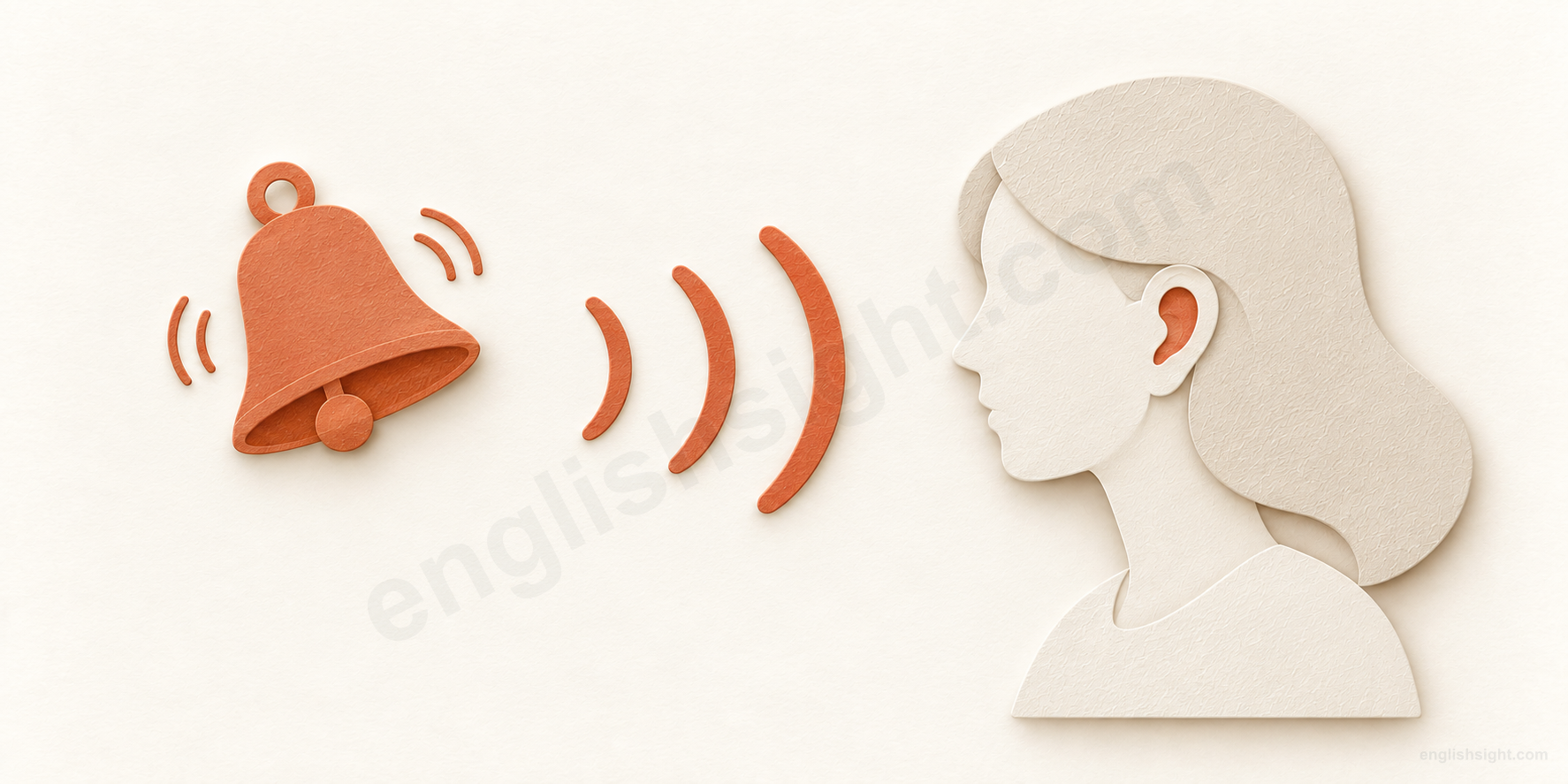
A bell rings.
hearing
The listener detects the sound.
Its sound reaches the nearby listener.
Hearing is perceiving sound; it does not by itself mean understanding or agreement.
Hearing is the ability or process by which a listener perceives sound.
The diagram focuses on sound perception. A fair hearing extends to attention to a case; an official hearing names an event. Neither meaning follows from sound waves alone.
Hearing usually names the sense that lets a person or animal detect sounds. The same word also appears in expressions about audible distance and in a hearing: an opportunity or official occasion for a case to be considered.
These meanings are related enough to compare, but hearing a sound, paying attention, understanding, and agreeing are different. The diagram is a teaching aid, not a claim about a picture shared by all English speakers.
01
The sense of hearing
Talk about the ability to hear, changes in that ability, and familiar words used around it.
01
have + adjective + hearing; possessive + hearing + be + adjective
good / poor hearing
how well a person or animal can detect sounds
Starting situation
A quiet bell rings nearby.
What this expresses
Someone notices the faint sound.
Hearing names a sense or ability, not a sound itself.
My hearing describes my capacity to hear. Good, excellent, poor, or acute hearing describe that capacity; acute emphasizes sensitivity to sounds that may be faint.
In this sense hearing is uncountable. Say She has good hearing or Her hearing is good. A hearing normally points instead to a meeting or an opportunity to explain something.
Hearing is not the same as listening: someone may hear your voice without deliberately paying attention. Nor does hearing a language guarantee understanding it.
In a sentence
Even in the next room, the dog noticed the quiet whistle because of its acute hearing.
Watch the difference Use hearing for the ability and a sound for what is detected; do not count abilities as two hearings.
02
lose / regain + possessive + hearing; get + possessive + hearing + back; hearing loss; loss of hearing
lose your hearing / hearing loss
a reduction or loss of the ability to hear
Starting situation
A person previously heard sounds more clearly.
What this expresses
Their ability to hear is now reduced.
Hearing can change; the noun still names the ability.
Lose your hearing means lose some or all of that ability, as the context specifies. Hearing loss names the condition; loss of hearing expresses the same general idea.
Hearing problems and hearing impairment also concern difficulty hearing. In hearing loss, hearing modifies loss: the plural, if needed, belongs to the head noun, not hearing.
Contrast I couldn’t hear the announcement because of the crowd: that sentence can describe a noisy situation without saying that the person has hearing loss.
Get your hearing back or regain your hearing describes recovering this ability. Hearing can deteriorate when it becomes worse, or come back when it returns. These expressions describe a change in ability, not a change in distance from a sound.
In a sentence
The leaflet explains how loud noise can damage your hearing.
Watch the difference Failing to hear one quiet sentence does not by itself mean losing your hearing.
03
person + be + hard of hearing
be hard of hearing
have difficulty hearing
Starting situation
A speaker talks very quietly.
What this expresses
The listener asks them to speak more clearly.
The whole adjective phrase describes reduced hearing.
Hard of hearing describes someone who cannot hear well. Use be, become, or another suitable linking verb before the expression: My uncle is hard of hearing.
Hard belongs to an established phrase here. It does not describe trying hard to listen, stubbornness, or refusing to understand. Keep of: hard of hearing, not hard to hearing.
The hard of hearing can refer collectively to people who have difficulty hearing. People who are hard of hearing is another way to name this group.
In a sentence
I’m hard of hearing; could you face me while you speak?
Watch the difference Difficulty hearing and unwillingness to listen are different things.
04
wear / use + a hearing aid; hearing aids
wear a hearing aid
use a small device that helps someone hear
Starting situation
Someone has difficulty hearing speech.
What this expresses
They use a device to make sounds easier to hear.
In this compound, aid is the countable object.
A hearing aid is a small device worn at or in the ear to help someone who has difficulty hearing. Wear a hearing aid describes using it on the body.
One hearing aid and two hearing aids are possible. Hearing remains singular because it tells us the kind of aid. Similarly, a hearing test is a test of hearing, rather than a formal hearing about a test.
In a sentence
She keeps spare batteries for her hearing aids in her bag.
Watch the difference A hearing aid is a device; a hearing test checks ability; a court hearing is a meeting.
05
hearing + people / person
deaf and hearing people
people who can hear, contrasted with deaf people
Starting situation
A class includes people with different hearing abilities.
What this expresses
Everyone learns some sign language together.
Before people, hearing can describe people who can hear.
In deaf and hearing people, hearing functions as an adjective. It identifies people who can hear, rather than people attending a hearing or deliberately listening at this moment.
This use is especially useful when discussing deaf and hearing communities. It does not mean that every hearing person has equally sensitive hearing.
In a sentence
The workshop welcomes both deaf and hearing participants.
Watch the difference The adjective hearing describes ability here, not attention or attendance.
02
Close enough to hear
These expressions describe who can hear a conversation because of distance or position.
06
say something + in / within + possessive + hearing; within hearing
in / within someone’s hearing
close enough for someone to hear what is said
Starting situation
Two people begin a private conversation.
What this expresses
Another person nearby can hear their words.
The named person is within the audible range of the speech.
In someone’s hearing and within someone’s hearing place the speech where that person can hear it. In my hearing often means in my presence and audible to me.
Within hearing without a possessive also means close enough to hear. Within earshot is a useful equivalent. These expressions concern audibility, not whether the listener agrees, understands, or actually notices every word.
In a sentence
Please don’t discuss the surprise in Leo’s hearing.
Watch the difference Do not add a: in her hearing, not in her a hearing.
07
be / move + out of (someone’s) hearing
out of hearing
too far away to hear, or to be heard
Starting situation
Someone can still hear the conversation.
What this expresses
They move far enough away that it is no longer audible to them.
Out of hearing changes the distance relationship, not the person’s ability.
Out of hearing and out of someone’s hearing describe being beyond the relevant audible range. Out of earshot gives the same general relationship.
The context identifies who cannot hear whom. Wait until we are out of her hearing means move far enough away that she cannot hear us. The phrase does not mean that anyone has become deaf.
In a sentence
We waited until the children were out of hearing before discussing their presents.
Watch the difference Out of hearing concerns range; hearing loss concerns ability.
03
A chance to be listened to
Hearing can mean that someone’s explanation or proposal receives attention, in everyday discussion or a formal setting.
08
give + someone / something + a hearing; get / deserve + a hearing
give someone a hearing
allow someone to explain their views
Starting situation
A proposal has not yet been explained.
What this expresses
Other people listen while its author explains it.
A hearing here is an opportunity for words or ideas to receive attention.
Give someone a hearing means allow their explanation or opinion to be heard. Get a hearing presents the same opportunity from the speaker’s side; deserve a hearing says their ideas merit attention.
This can happen in an ordinary meeting. No judge or court is required. The connection with sound is a useful teaching link, but the established expression includes considering what is said, not merely detecting a voice.
In a sentence
Before rejecting the proposal, let’s give its author a hearing.
Watch the difference Give someone a hearing does not necessarily mean arrange a court session.
09
give + person / idea + a fair hearing; get + a fair / sympathetic hearing
give / get a fair hearing
receive an open-minded chance to explain a position
Starting situation
People disagree with a suggested change.
What this expresses
They still listen to the reasons before deciding.
Fair describes how the ideas are considered, not the speaker’s hearing ability.
A fair hearing allows someone’s case or opinion to be considered without being dismissed in advance. You can give a person or their ideas a fair hearing, and the speaker can get one.
A sympathetic hearing suggests a receptive or supportive response to the case. Neither expression guarantees agreement, approval, or success. Fair hearing can also be used in a legal setting, but is not restricted to one.
In a sentence
The committee gave our proposal a fair hearing but voted against it.
Watch the difference A fair hearing is compatible with a negative decision.
10
hold / conduct / attend / schedule / adjourn + a hearing; at a hearing
hold / attend a hearing
conduct or take part in an official session for considering a matter
Starting situation
A complaint needs an official examination.
What this expresses
The responsible panel receives evidence and explanations.
A countable hearing is a formal event, rather than the sense of hearing.
At a hearing, an authorized person or group considers facts, evidence, or arguments. A court hearing, appeal hearing, or disciplinary hearing names its setting or purpose.
The organizer holds or conducts the hearing; a participant attends it. Schedule sets its time, and adjourn pauses it until later. Use a hearing, the hearing, and plural hearings.
A hearing need not be the full trial or the final decision. A preliminary hearing may deal with an earlier stage; its exact legal role depends on the system and context.
In a sentence
The panel will hold a hearing about the complaint on Thursday.
Watch the difference Attend a hearing means be present at an event; have good hearing describes an ability.
11
hold + a public / committee hearing + on / about + topic
a public hearing on something
an official session open to the public for examining a matter
Starting situation
A council is considering a local proposal.
What this expresses
Members of the public can attend the session about it.
Public tells us about access to an official hearing.
A public hearing can allow people to hear evidence and present views about a proposal or problem. A committee hearing identifies the organizing body; it does not by itself say whether the public may attend.
On or about can introduce the topic: a hearing on the new road. The word hearing does not promise that the proposal will be accepted or that every attendee will speak.
In a sentence
The council announced a public hearing on the proposed bridge.
Watch the difference A public hearing is a particular kind of official event, not simply any conversation in public.
04
When hearing is a form of hear
The same spelling can belong to a verb construction. Read the surrounding grammar before choosing a meaning.
12
on / after + hearing + object; can hear + sound
on hearing the news
when or immediately after learning something
Starting situation
News reaches someone.
What this expresses
That person reacts to the information.
Hearing can retain the verb hear’s meaning and take an object.
In On hearing the news, Mina called home, hearing is an -ing form of hear and the news is its object. On introduces the occasion or immediate trigger for the call; no official meeting is involved.
Compare Mina’s hearing is excellent: that noun describes her sense of hearing. The spelling alone does not tell us the grammar.
For an ordinary sound perceived now, I can hear a bell is the usual choice. The existence of the form hearing does not make I am hearing a bell the neutral everyday pattern. Other senses of hear can allow progressive forms, as in The court is hearing the case.
In a sentence
On hearing the news, Mina called her brother.
Watch the difference Read the object and the surrounding construction; hearing the news is not a countable hearing.
13
be + hearing things
be hearing things
think you hear a sound that is not really there
Starting situation
Someone thinks a phone rings.
What this expresses
They cannot find any real source of the sound.
This informal expression concerns an imagined sound.
I must be hearing things can be an informal, sometimes humorous response when you think you heard a sound that apparently did not occur.
Learn the whole expression. Things does not mean particular objects being listened to. This is a familiar exception to a beginner’s rule that hear is normally not progressive for immediate perception; do not replace ordinary I can hear you with I am hearing you on that basis.
In a sentence
Was that the doorbell, or am I hearing things?
Watch the difference This expression is about an apparently unreal sound, not automatically about a medical condition.
Choose the sense from the construction
Ability or event?
Hearing as a sense is uncountable: good hearing, my hearing. An official meeting is countable: a hearing, two hearings. A chance to explain is commonly singular: give someone a hearing.
Not every -ing word is a noun
Hearing the news and hearing things retain verb grammar. The base verb is hear, with past and past participle heard. This lesson highlights those overlaps, rather than teaching every phrase and idiom of hear.
The diagram has a boundary
Sound perception does not require agreement or complete understanding. Giving ideas a hearing adds the established meaning of attending to a case; an official hearing can also consider documents and other evidence.
Which kind of hearing?
Use the article, the surrounding words, and the situation to decide.
1. You want to say that Nora can detect quiet sounds. Which sentence fits?
2. You move away so that Sam cannot hear your private conversation. Which expression describes your position?
3. The board listened fairly to your reasons but rejected your proposal. Can you say you got a fair hearing?
4. The panel will officially consider evidence about a complaint. Which sentence describes that event?
5. In “On hearing the news, Mina called home,” what does hearing mean?
Sources and teaching notes
Dictionary entries support the meanings and constructions below. The explanations, examples, and visual model were written for this lesson.
The diagram is a teaching model, not a picture shared by every native speaker.