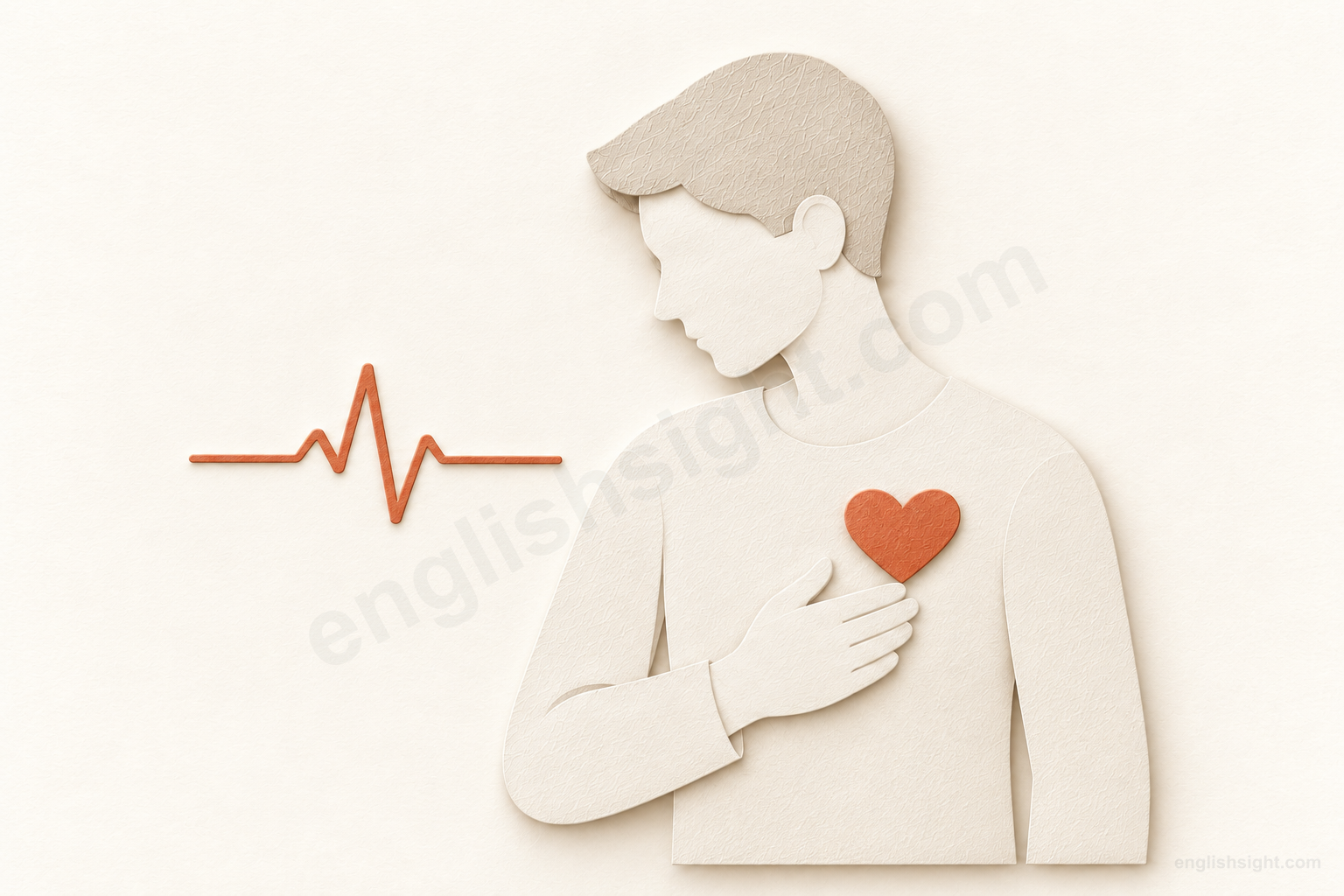
From a beating organ to care, courage, and a central part.
An inner, vital centre
An inner, vital centre
The pulse line recalls the beating organ in the chest.
heart
The heart symbol highlights feeling, care, or courage.
A hand resting over the chest links the bodily heart with inner feeling.
The bodily heart connects with an inner life of feeling, care, and courage.
Heart names a bodily organ and often represents an inner source of feeling, care, or courage; it can also name a central or essential part.
This is a teaching connection among established uses, not a claim that every meaning follows one rule or that all speakers imagine the same scene.
Heart names the organ that pumps blood. In many everyday expressions, it also presents a person’s inner feelings, kindness, wishes, or courage. Outside people, it can name a central or essential part.
These connections help organize the word, but the complete expression still matters. Learn by heart, lose heart, and lose your heart as different uses; a single picture cannot predict their meanings.
01
The organ, the symbol, and everyday labels
Begin with the body organ, then distinguish a love symbol, a card suit, and an informal online action.
Heart is a countable noun: one heart, two hearts. A person’s heart beats and pumps blood; after exercise, someone may describe it as pounding or racing.
My heart was racing can describe a bodily sensation during fear or excitement as well as exercise. The situation supplies the cause. Put a hand on your heart refers to the chest area over the organ.
In a sentence
After the climb, I could feel my heart beating fast.
Watch the difference A heart symbol is not an accurate drawing of the organ.
02
heart + noun; a heart condition / a heart attack
heart rate / heart disease
heart used before another noun
Situation
You read everyday health vocabulary.
What it expresses
The second noun tells you the topic.
Heart can modify a noun without becoming an adjective.
Heart rate names the rate of beating. Heart disease, heart surgery, and a heart transplant concern the organ. In these noun combinations, heart normally stays singular.
A heart attack is the established name of a serious medical condition. Informally, You nearly gave me a heart attack! can exaggerate a sudden fright. It does not normally mean ordinary disappointment; break my heart describes deep emotional sadness.
In a sentence
The screen displayed her heart rate.
Watch the difference Say heart problems, not hearts problems.
03
a heart; heart-shaped + noun
draw a heart
a conventional shape associated with love
Situation
A child decorates a card.
What it expresses
A pointed shape with two rounded top parts appears.
A heart can be a drawn shape or a symbol.
You can draw a heart, cut out two hearts, or choose a heart-shaped box. The familiar shape often represents love or affection, though its meaning depends on context.
In a message such as I ♥ this place, the symbol can stand for love. This symbolic use is different from naming the organ.
In a sentence
She drew a small heart beside the message.
Watch the difference Use heart-shaped for the shape of an object; heart alone does not mean shaped like a heart.
04
the + rank + of hearts; play + a heart
the queen of hearts
a suit of playing cards, or one card in it
Situation
Players look at their cards.
What it expresses
One card belongs to the red heart suit.
Hearts names the suit; a heart can name one card.
The queen of hearts and the two of hearts use plural hearts for the suit. Play a heart means play one card from that suit, not necessarily a card with only one symbol.
Hearts is also the name of a card game. Card-game rules are outside this lesson; recognizing the name and the suit is enough here.
In a sentence
I had the queen of hearts and two clubs.
Watch the difference Keep hearts plural in queen of hearts.
In your heart points to inner feeling, not publicly proved evidence.
Know or feel in your heart that… introduces something a person deeply believes. In your heart of hearts makes the private conviction more emphatic.
Follow your heart means let your feelings guide your choice. A contrast between head and heart presents reasoning and feeling as different guides; it is a conventional metaphor, not a scientific division of the body.
In a sentence
In my heart, I knew I wanted to stay.
Watch the difference A strong personal conviction need not be correct or supported by evidence.
07
have + a + adjective + heart; a heart of gold / stone
have a kind heart
be kind or generous in character
Situation
A neighbour repeatedly helps people.
What it expresses
You describe the care behind those actions.
The heart represents someone’s emotional and moral character.
A kind, good, big, or generous heart describes a caring person. Have a heart of gold praises exceptional kindness; a heart of stone suggests a lack of sympathy.
The same idea appears in kind-hearted and cold-hearted. A cold heart concerns emotional character, not body temperature. Out of the goodness of her heart means she acts kindly without seeking a benefit for herself.
In a sentence
He has a big heart and always makes new people feel welcome.
Watch the difference A big heart here is praise for generosity, not a claim about the organ’s size.
08
Have a heart!; have no heart
Have a heart!
ask someone to show kindness
Situation
A rule is being applied harshly.
What it expresses
You appeal for a kinder response.
This informal appeal asks for compassion.
Have a heart! is a complete informal request to be more sympathetic or reasonable. It often responds to a refusal or an unnecessarily harsh demand.
You have no heart is a criticism of someone as uncaring. It differs from not having the heart to do a particular hurtful thing.
In a sentence
Have a heart! Let her finish her lunch before you ask her to work.
Watch the difference The imperative is not an instruction to obtain an organ.
09
not have the heart + to-infinitive
not have the heart to tell someone
be unwilling to do something that would hurt someone
Situation
You must give a child disappointing news.
What it expresses
You hesitate because it would upset her.
The obstacle is sympathy for the person who would be hurt.
I didn’t have the heart to tell her explains why the speaker avoided an upsetting action. Use the heart followed by a to-infinitive.
This is usually a negative expression. Do not confuse it with have no heart, which accuses someone of lacking kindness; not having the heart to hurt someone can show kindness.
In a sentence
I didn’t have the heart to throw away his handmade card.
Watch the difference Keep the in this idiom: didn’t have the heart to…, not didn’t have a heart to….
10
possessive + heart + be + in the right place
your heart is in the right place
your intentions are kind despite mistakes
Situation
A friend gives awkward help.
What it expresses
You recognize that he meant well.
Good intentions can coexist with a poor result.
His heart is in the right place defends someone’s caring intentions while allowing that their action, judgment, or manner may be flawed.
The phrase evaluates motivation. It does not guarantee competence, a good outcome, or that every action should be excused.
In a sentence
His advice was unhelpful, but his heart was in the right place.
Watch the difference Right place is figurative; this is not about the organ’s position.
11
have + someone’s (best) interests / welfare + at heart
have your best interests at heart
care about what benefits someone
Situation
Someone questions your advice.
What it expresses
You explain whose welfare motivates it.
Interests means someone’s welfare, not their hobbies.
Have someone’s interests at heart means want what is good for that person. Best often strengthens the expression, and welfare can replace interests.
The person who cares is the subject; the person who may benefit is identified by your, her, the children’s, and so on. This is a claim about concern, not proof that the advice is right.
In a sentence
Our coach has the whole team’s interests at heart.
Watch the difference Do not replace at with in in this fixed expression.
12
be + close / dear / near + to + possessive + heart
close to your heart
personally important or dear
Situation
You choose a cause to support.
What it expresses
One subject matters especially deeply to you.
Emotional closeness means personal importance.
A cause or subject close, dear, or near to your heart matters greatly to you. The expression can describe a project, a place, or a concern, not only a loved person.
Have a special place in my heart similarly expresses lasting affection. Neither phrase requires physical closeness.
In a sentence
Access to books is a cause close to her heart.
Watch the difference Close to her heart describes importance; close to her house describes location.
13
win / steal + someone’s heart; lose your heart to + someone
win someone’s heart
make someone love you
Situation
Two people grow closer.
What it expresses
One gains the other’s affection.
Heart can stand for love or affection.
Win someone’s heart and steal someone’s heart mean gain their love. Steal is figurative here; it does not describe theft, and the expression can sound literary or romantic. The way to someone’s heart means a way to gain their affection: Sharing her love of music was the way to her heart.
Lose your heart to someone means fall in love with them and is relatively formal. Give your heart to someone is another expressive way to talk about love; affairs of the heart refers to romantic relationships.
In a sentence
Her warmth and humour won his heart.
Watch the difference Lose your heart means fall in love; lose heart means become discouraged.
14
break + someone’s heart; be heartbroken; a broken heart
break someone’s heart
cause very deep sadness
Situation
A relationship ends or a painful loss occurs.
What it expresses
Someone experiences intense emotional pain.
Heartbreak is emotional suffering, not a broken organ.
A person, an event, or seeing someone suffer can break your heart. Romantic separation is a familiar context, but the expression is not limited to romance.
A broken heart names the sadness; heartbroken describes the person. It breaks my heart to see… puts the upsetting situation in a to-infinitive.
In a sentence
It broke her heart to leave the home where she had grown up.
Watch the difference Break someone’s heart does not mean give them a heart attack.
15
possessive + heart(s) + go(es) out to + person
my heart goes out to you
express deep sympathy
Situation
A family has suffered a loss.
What it expresses
You express care for them.
The feeling is directed toward someone in distress.
My heart goes out to you is an expression of sympathy. Our hearts go out to the families is common in a message from a group.
The people receiving sympathy follow to. The phrase expresses feeling and concern; it does not itself promise practical help.
In a sentence
Our hearts go out to everyone who lost their home.
Watch the difference Go out to is part of the full idiom; it is not physical travel.
16
possessive + heart + sink / leap / skip a beat
my heart sank / leapt
describe a sudden emotional reaction
Situation
You receive unexpected news.
What it expresses
You suddenly feel dismay or joy.
The verb determines the emotional direction.
My heart sank signals sudden disappointment or dread. My heart leapt signals sudden joy or excitement; both leapt and leaped are standard past forms of leap.
My heart skipped or missed a beat can describe a sudden shock, fear, or excitement. In a story it may be figurative; in a health conversation the same words may describe a bodily sensation. Context matters.
It does my heart good to see you well means that seeing you well makes me happy. This is a warm reaction to a welcome sight or piece of news, not a medical benefit.
Something that touches your heart moves you emotionally, often with sympathy or affection: The children’s welcome touched my heart. If your heart melts, you begin to feel tenderness: Her heart melted when the puppy fell asleep on her lap. These expressions describe feelings rather than physical changes to the organ.
In a sentence
My heart sank when I saw the cancelled flight.
Watch the difference A sinking heart is not joy; a leaping heart usually suggests excitement or happiness.
17
with + a heavy heart; possessive + heart + be + in possessive + mouth
with a heavy heart / heart in your mouth
describe sadness or intense nervousness
Situation
You face a sad goodbye or a frightening moment.
What it expresses
The whole phrase names the feeling.
Weight and location are conventional emotional images.
With a heavy heart means feeling sad. A light heart suggests a cheerful or carefree mood, not a physically lighter organ.
My heart was in my mouth means I was extremely nervous or frightened. It does not mean I was sad, and it is not a literal description of where my heart was.
In a sentence
With a heavy heart, he packed the last of his belongings.
Watch the difference Use my heart was in my mouth, with the possessives matching the person.
03
Confidence, desire, and involvement
These expressions describe what keeps someone trying, what they want, and how much they care about an activity.
18
lose heart; do not lose heart
lose heart
lose confidence or hope
Situation
A learner makes slow progress.
What it expresses
She begins to feel that trying is pointless.
Here heart means the spirit that keeps someone trying.
Lose heart means become discouraged, especially when effort is not producing the hoped-for result. Don’t lose heart encourages someone to keep going. Heart can also name courage or determination without lose: The losing team still showed plenty of heart.
Heart has no article or possessive in this expression. Lose your heart to someone has a different meaning: fall in love with them.
In a sentence
Don’t lose heart if the first attempt fails.
Watch the difference Say lose heart for discouragement, not lose your heart.
19
take heart (from + noun); give + person + (fresh) heart
take heart from something
become encouraged
Situation
A team sees its first sign of progress.
What it expresses
The improvement gives them fresh confidence.
From identifies what supplies encouragement.
Take heart can stand alone as encouragement: Take heart! A from-phrase names the encouraging fact or event.
Give someone heart presents the same encouragement from the other direction: the news gave us fresh heart. Neither expression involves moving a physical object.
In a sentence
We took heart from the encouraging comments.
Watch the difference Take heart from praise means feel encouraged; take criticism to heart often means feel hurt.
20
set your heart on + noun / -ing; have your heart set on + noun / -ing
set your heart on something
want something very strongly
Situation
A child dreams of a particular bicycle.
What it expresses
It becomes the thing she especially wants.
On introduces the desired thing or activity.
Set your heart on a new bike describes strong desire. Set your heart on becoming a pilot uses an -ing form because on is a preposition.
Have your heart set on something describes the resulting wish. It is stronger than a casual preference, but it does not guarantee that the wish will be fulfilled.
In a sentence
She has her heart set on studying music.
Watch the difference After on, use studying, not study or to study.
21
put + possessive + heart (and soul) + into + noun / -ing; possessive + heart + be not in + noun
put your heart into something
work with genuine care and enthusiasm
Situation
Two singers perform the same song.
What it expresses
One gives a committed, emotionally involved performance.
The expression concerns involvement, not merely time spent.
Put your heart into your work or into singing means do it with feeling and commitment. Put your heart and soul into it emphasizes wholehearted effort.
My heart isn’t in it says I do not really care about or feel enthusiastic about the activity, even if I continue doing it. It can explain why a technically adequate performance feels uncommitted.
In a sentence
He put his heart and soul into preparing the concert.
Watch the difference Into takes a noun or -ing form: into preparing, not into prepare.
22
take + something / it + to heart
take something to heart
be hurt by something, or take it seriously
Situation
You hear a critical remark or useful advice.
What it expresses
It affects you deeply or guides what you do.
The object and situation distinguish hurt from serious attention.
With criticism or an insult, take it to heart commonly means let it upset you deeply. Don’t take it to heart advises against treating the remark as a deeply personal blow.
With advice or a warning, it can mean consider it seriously: I took her advice to heart and began saving. This need not imply hurt feelings. Take heart from something instead means gain encouragement.
In a sentence
He took the criticism to heart and worried about it all evening.
Watch the difference Keep the object before to heart: take it to heart, not take to heart it.
23
have + a change of heart (about + noun / -ing)
have a change of heart
change your attitude or decision
Situation
You first refuse an invitation.
What it expresses
Later, you feel differently and agree.
A changed attitude can lead to a changed decision.
A change of heart concerns how someone feels about a proposal, person, or plan. It often leads to a new decision, but it is not limited to romantic feelings.
About can name the topic. Have a change of mind is a broader way to describe reconsidering a decision; change of heart tends to draw attention to attitude or feeling.
In a sentence
He had a change of heart about moving away and decided to stay.
Watch the difference Use a change of heart, not a change of the heart, for this idiom.
24
verb + to + possessive + heart’s content
to your heart’s content
as much as you want
Situation
You have free access to a quiet garden.
What it expresses
You can spend as long there as you wish.
The expression marks freedom to enjoy an activity fully.
Read, play, talk, or wander to your heart’s content means continue as much as you want. The phrase describes the extent of the activity.
Heart’s is singular possessive for one person; several people can play to their hearts’ content. This is a fixed expression, not a request to inspect someone’s emotions.
In a sentence
In the garden, we could wander to our hearts’ content.
Watch the difference Keep the apostrophe: your heart’s content; our hearts’ content.
04
Sincerity, conversation, and fixed expressions
Learn these complete expressions with their grammar. A heart image alone cannot predict a promise, memorization, or a teasing remark.
25
speak + from the heart; from the bottom of + possessive + heart
from the bottom of my heart
sincerely and deeply
Situation
You thank someone for important help.
What it expresses
You emphasize that you mean your words.
From the heart presents words as coming from real feeling.
Speak from the heart means speak sincerely. From the bottom of my heart strengthens a thank-you, apology, or heartfelt wish.
Use the heart in the shorter expression but a possessive in the longer one: from the heart; from the bottom of her heart. These concern sincerity, not memorization.
In a sentence
Thank you, from the bottom of my heart, for staying with me.
Watch the difference By heart means from memory; from the heart means sincerely.
26
verb + with all + possessive + heart
with all your heart
with complete feeling or conviction
Situation
You wish someone a good future.
What it expresses
You express the wish without reservation.
All emphasizes the strength and completeness of feeling.
With all your heart expresses wholehearted feeling: love someone with all your heart, believe something with all your heart, hope with all your heart that something happens, or wish someone well with all your heart. With your whole heart is a similar form.
Heart and soul can also express complete support or commitment. The full phrase, rather than heart alone, supplies the emphasis.
In a sentence
I hope with all my heart that your new life is a happy one.
Watch the difference With all my heart strengthens feeling; it does not mean using only memory.
27
open your heart to + person; pour your heart out to + person
open your heart to someone
share private feelings
Situation
A friend has kept worries to himself.
What it expresses
He tells someone what he really feels.
The person after to is the listener.
Open your heart to someone means speak honestly about private feelings. Pour your heart out to someone suggests a fuller, often emotional account of worries or troubles.
The feeling is pictured as becoming accessible to a listener. This is a teaching metaphor; no physical opening or liquid is involved.
In a sentence
At last she opened her heart to her sister.
Watch the difference Use to for the listener: opened her heart to me, not opened her heart me.
28
have + a heart-to-heart + with + person; a heart-to-heart talk
have a heart-to-heart
have a frank personal conversation
Situation
Two friends need to discuss a private problem.
What it expresses
They speak openly about their feelings.
A heart-to-heart is an honest conversation, not just a chat.
Have a heart-to-heart with someone names a private, candid discussion, especially between people who know each other well.
You can also have a heart-to-heart talk. The hyphenated compound works as a countable noun or before talk; it does not describe two organs touching.
In a sentence
We had a heart-to-heart about why we had stopped spending time together.
Watch the difference Keep the article: have a heart-to-heart, not have heart-to-heart.
Visible feelings are contrasted with hidden feelings.
Wear your heart on your sleeve means show emotions openly through words or behaviour. It can refer to love, disappointment, or other feelings.
The sleeve is an image for making something inward publicly visible. It does not require a heart tattoo, a badge, or a literal clothing design.
In a sentence
He wears his heart on his sleeve, so we knew he was disappointed.
Watch the difference Open your heart usually concerns confiding in someone; wear your heart on your sleeve concerns how visible your feelings are.
30
know / learn + object + by heart; off by heart (British English)
know something by heart
remember it without needing to read it
Situation
You have practised a poem many times.
What it expresses
You can recite it without looking.
This fixed phrase concerns memory.
Know a poem by heart describes having it memorized. Learn it by heart describes the learning process. Off by heart is also used in British English.
Memorizing words and understanding their meaning are different achievements. The phrase says you can recall the material, not that you speak sincerely or understand every detail.
In a sentence
She knows the whole poem by heart.
Watch the difference Do not replace by with from when you mean memorized.
31
be + description + at heart; young at heart
at heart / young at heart
in your real nature or outlook
Situation
Someone looks serious and reserved.
What it expresses
You describe their underlying character.
At heart contrasts an inner nature with outward appearance.
She is an optimist at heart describes what she is really like, even if circumstances make her seem gloomy. Young at heart describes a youthful outlook regardless of age.
This use differs from in my heart, which often introduces a private feeling or belief. It also differs from at the heart of a problem, which identifies a central issue.
In a sentence
He seems strict, but he is gentle at heart.
Watch the difference No the in at heart for character; use the in at the heart of the matter.
32
a person / man / woman + after + possessive + own heart
someone after your own heart
someone whose tastes or opinions agree with yours
Situation
A new friend shares your favourite way to spend a day.
What it expresses
You express pleased recognition.
The phrase expresses a welcome match in preferences.
A person after my own heart likes the things I like or shares my outlook. It can warmly praise a choice or preference without implying romance.
Own adds emphasis, and after is fixed here. The phrase is not a statement that someone is pursuing your affection.
In a sentence
You brought a book for the train? You’re a person after my own heart.
Watch the difference After my own heart does not mean after my heart in a romantic chase.
33
Cross my heart!; clause + cross my heart
Cross my heart!
strongly assure someone that you are truthful
Situation
A friend doubts your promise.
What it expresses
You add a familiar informal assurance.
The expression reinforces a promise or claim.
Cross my heart! means I really promise or I am telling the truth. It is informal and often sounds childlike or playful.
A longer traditional form is cross my heart and hope to die. It is an emphatic formula, not normally a literal wish to die; the short form is enough for ordinary learning.
In a sentence
I won’t tell anyone—cross my heart!
Watch the difference This expression is unsuitable as a formal guarantee or legal commitment.
34
cry / sob / sing + possessive + heart out
cry / sing your heart out
do something with great emotional intensity or effort
Situation
A person cries after a loss or sings with full energy.
What it expresses
The action is intense and wholehearted.
The verb and context determine sadness or enthusiastic effort.
Cry or sob your heart out means cry intensely, typically for a long time. Sing your heart out means sing with all your energy and feeling; it does not imply sadness.
The pattern is established with particular verbs, not a rule for attaching heart out to any action. Eat your heart out has its own idiomatic meanings.
In a sentence
The crowd sang their hearts out during the final song.
Watch the difference Do not interpret sing your heart out as remove an organ or necessarily express grief.
35
Eat your heart out, + name!; eat your heart out over + noun
Eat your heart out!
tease someone by suggesting they should be envious
Situation
You show off a successful homemade cake.
What it expresses
You jokingly compare yourself with a famous expert.
The exclamation is a boast or teasing comparison.
Eat your heart out, followed by a person’s name, jokingly suggests your achievement is impressive enough to make that person jealous. Tone and relationship matter; it can sound boastful.
In a different construction, eat your heart out over something means suffer with longing, envy, or regret. She ate her heart out over the lost opportunity describes distress, not a cheerful challenge.
In a sentence
Look at my cake—eat your heart out, top chefs!
Watch the difference Neither use is about eating; distinguish the teasing exclamation from a description of suffering.
05
The central or essential part
Beyond people, heart can name an important centre, a key issue, or the tender inside of a vegetable.
36
in + the (very) heart of + place
in the heart of the city
in the central part of a place
Situation
You describe where a hotel stands.
What it expresses
The listener places it centrally within the city.
A place can have a heart without being alive.
In the heart of a city, forest, or region places something within its central area. Very can emphasize centrality: in the very heart of town.
This is a spatial extension, although a city’s heart can also suggest its active or important centre. It is not necessarily the exact mathematical midpoint.
In a sentence
The small theatre is in the heart of the old town.
Watch the difference Use in for being within an area; do not assume heart always means the busiest place.
37
the heart of + issue; be / lie at the heart of + noun; get to the heart of + noun
at the heart of the matter
at the most important part of an issue
Situation
A discussion has many details.
What it expresses
You identify the central concern.
Importance, rather than physical location, makes this a heart.
The heart of the matter or problem names its essential issue. Something at the heart of a debate is central to understanding it; it need not be the only cause.
Get to the heart of something means reach its essential point. Tear the heart out of a community means destroy something vital to its life; this is a strong, emotional extension.
In a sentence
Trust lies at the heart of this disagreement.
Watch the difference At heart describes an underlying nature; at the heart of identifies an essential part or concern.
38
the heart of + vegetable; lettuce / cabbage / celery hearts
lettuce hearts
the compact inner leaves of a vegetable
Situation
You remove a lettuce’s outer leaves.
What it expresses
The smaller central leaves remain.
Here heart names a physical inner part.
The heart of a lettuce or cabbage is its compact centre of smaller leaves. Lettuce hearts can be sold as food; plural hearts refers to more than one such centre.
This concrete centre sense connects with the spatial branch of the lesson. It does not suggest that the vegetable has emotions or a blood-pumping organ.
In a sentence
She sliced the lettuce hearts for the salad.
Watch the difference A vegetable heart is not the same thing as a heart-shaped vegetable.
Read the whole expression
Countable organ, variable abstract uses
A physical organ, a drawn shape, and one playing card are countable: a heart, two hearts. Abstract uses vary by expression: a kind heart, have heart, lose heart, take heart. Learn the determiner with the phrase rather than applying one rule everywhere.
Small words change the meaning
By heart concerns memory; from the heart concerns sincerity. At heart describes underlying nature; at the heart of concerns a central part. Lose heart means become discouraged; lose your heart means fall in love. Take heart gains encouragement; take something to heart concerns hurt or serious attention.
Grammar and word family
Heart is mainly a noun in this lesson. Heart a post is an informal transitive verb. Heart disease uses a noun before another noun. Kind-hearted, heartbroken, and heart-shaped are related adjectives. These noun idioms are not phrasal verbs just because they contain short words such as in, out, or on.
Coverage boundary
The lesson selects modern everyday senses and established expressions, without claiming a frequency ranking or every literary use. Specialized anatomy, agricultural soil condition, heartwood, historical verbs, military awards, and detailed card-game rules are outside the main teaching scope.
Choose the meaning that fits
Use the situation and the complete expression.
1. You can recite a speech without reading it. Which sentence says this?
2. A learner is discouraged after several failed attempts. Which encouragement fits?
3. A rude comment upset Lee deeply. Which sentence expresses that?
4. You cannot bring yourself to tell a child that you lost her picture because the news will upset her. Which sentence fits?
5. Trust is the essential issue in a disagreement. Which sentence expresses this?
6. Nora strongly wants to become a nurse. Which form is standard?
Sources and teaching notes
Usage and grammar were checked against the dictionary pages below. The explanations, examples, and visual teaching connection were written for this lesson.
The diagram is a teaching aid, not a picture shared by every English speaker.