Use heat for warmth, for making things warmer, and in familiar expressions of pressure and excitement.
A source makes something warmer
A source makes something warmer
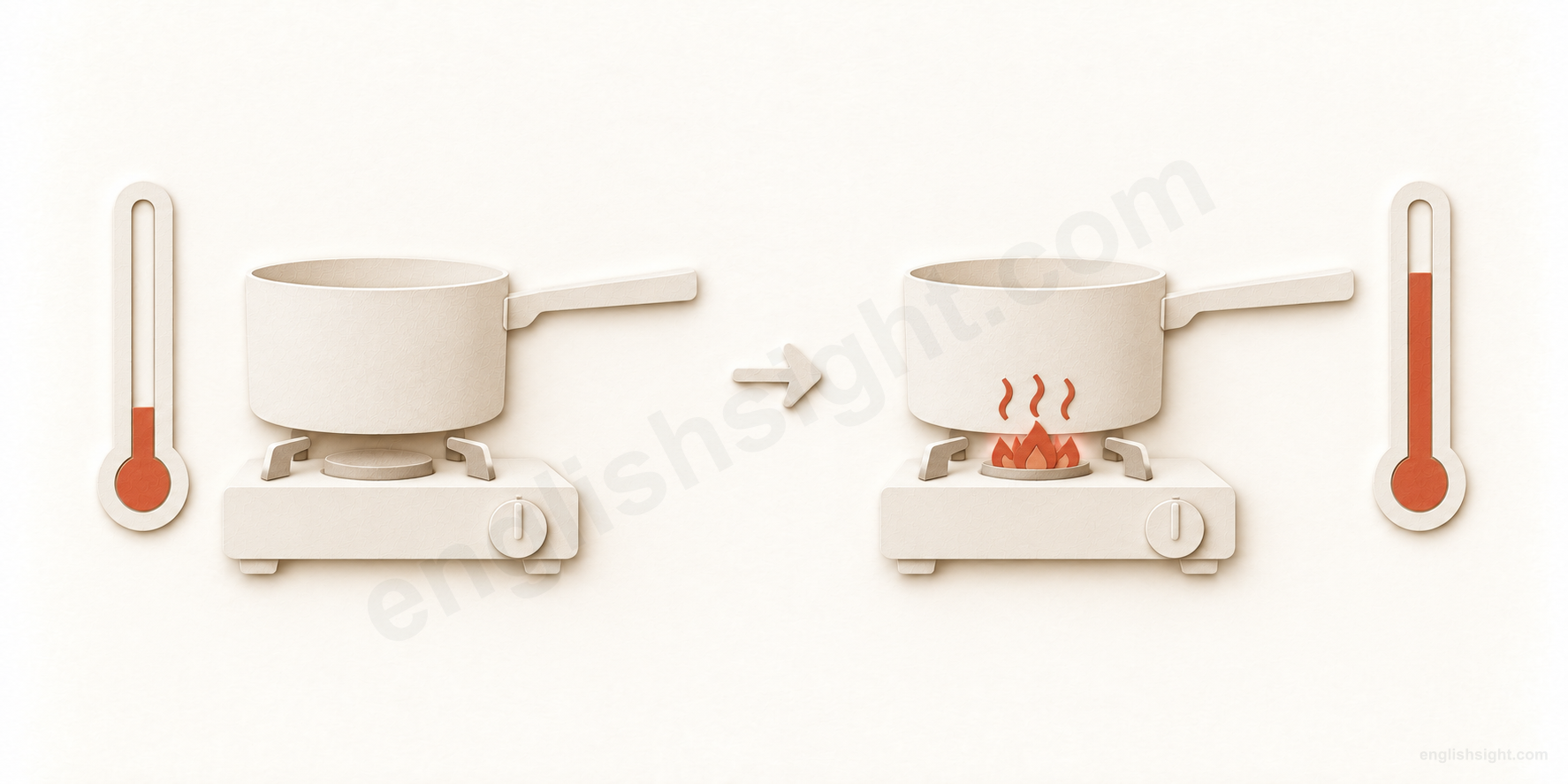
Cooler pan; burner off.
heat
Warmer pan; burner on.
The active burner supplies heat, and the same pan becomes warmer.
Heat from the burner makes the pan warmer.
Heat can name warmth; to heat something is to supply energy that makes it warmer or hotter.
The picture illustrates ordinary warming. Heating can also cause changes such as melting without a continuing temperature rise. Figurative and fixed expressions need their own context.
A pan warms when a heat source supplies energy to it. That gives us a useful starting point for heat as a noun and a verb.
English also uses heat for spicy taste, emotional intensity, and pressure. Competition heats and animals in heat are separate established branches; the physical picture cannot predict every meaning.
01
Warmth, weather, and everyday settings
Heat can name warmth itself, a cooking setting or source, household heating, or the burning sensation of spicy food.
01
feel / give off / absorb / retain / lose + heat; heat from / of + source
feel / give off / retain heat
warmth and thermal energy
Starting situation
A radiator is hot; the room is cooler.
Result or interpretation
Warmth spreads into the room.
The noun names warmth, not the object that is hot.
Heat is usually uncountable here. A radiator gives off heat; a thick wall can retain it. Heat from the sun identifies a source, while the heat of the sun connects the warmth with that source.
In everyday speech, heat can also mean how hot something is: Check the heat of the bath before you step in asks you to check its temperature. In physics, however, heat concerns energy transfer because of a temperature difference; heat and temperature are different quantities. The sketch shows one familiar result of heating, not every possible thermal change.
In a sentence
The stone floor absorbs heat during the day.
Watch the difference Say The floor is hot or I can feel the heat, not The floor is heat. Hot is an adjective; heat is a noun or verb.
02
in + (the / this / adjective +) heat; the heat of the day
in the heat / the heat of the day
hot weather or hot surrounding conditions
Starting situation
It is very hot outside.
Result or interpretation
You choose a cooler time to walk.
The heat can describe the conditions around people.
The heat often means the hot weather already relevant to a conversation. Intense heat, summer heat, and the heat of the day describe its strength or timing. The last expression points to the hottest part of the day.
Compare It is hot today with I cannot work in this heat. The first uses the adjective; the second treats the hot conditions as a noun. Heatwave, also written heat wave, names a period of unusually hot weather; it is a related compound.
In a sentence
We finished the walk before the heat of the day.
Watch the difference For an ordinary weather report, say It is hot, not It is heat.
03
over / on + (a) low / medium / high heat; turn up / down the heat
over low heat / turn down the heat
the strength of a cooking heat source
Starting situation
The sauce is bubbling too strongly.
Result or interpretation
You lower the cooker setting.
Low, medium, and high describe the heating level.
In recipes, cook over low heat and cook over a low heat both occur. Turn down, lower, or reduce the heat asks for less heating; turn up the heat asks for more. The setting is the focus, rather than moving the food.
Turn the heat down is also possible. With a pronoun, say Turn it down. This is turn down with heat as its object; it is different grammar from The pan heats up, where heat itself is the verb.
In a sentence
Cook the onions over low heat until they soften.
Watch the difference High heat does not promise a particular temperature; it is an instruction about cooking intensity.
04
remove / take + pan + from / off the heat; return + pan + to the heat
remove the pan from the heat
the burner or other cooking heat source
Starting situation
The pan is on the active burner.
Result or interpretation
You move it away from that source.
Here the heat stands for a source used for cooking.
Remove the pan from the heat tells you to move the pan away from the heating source. Return it to the heat reverses that movement. Off the heat describes the pan’s position relative to the source.
Turning off the heat switches the source off; taking a pan off the heat moves the pan away from it. A switched-off electric ring may still supply heat while it cools. These actions can have the same practical purpose, but they describe different things.
In a sentence
Remove the pan from the heat before adding the cream.
Watch the difference Off the heat does not mean the food has already become cold.
05
turn + the heat + on / off / down; rent includes heat
turn the heat on / heat included
a system supplying warmth to a home
Starting situation
The apartment feels cold.
Result or interpretation
The heating system starts supplying warmth.
Especially in North America, heat can mean household heating.
The heat is on can literally mean that the heating system is operating. Turn the heat on, turn it off, and turn it down describe controls. Rent includes heat means the cost of heating is included.
British English commonly uses heating for this system: turn the heating on. Compare The heat is on in a discussion of a deadline, where the same words can instead mean that pressure is strong.
In a sentence
Does the rent include heat, or do we pay for it separately?
Watch the difference Heat included does not necessarily mean that electricity or every other utility is included.
06
add + heat + to + food; the heat of / from + spice
add heat to a dish
the burning sensation of spicy food
Starting situation
The curry tastes mild.
Result or interpretation
Chilli makes it taste hotter.
Spicy heat is a sensation, not necessarily a higher serving temperature.
A little chilli adds heat means it increases spiciness. This extends the experience of burning warmth to taste. The food can have cooled while still having plenty of heat from spices.
Hot soup can therefore be high in temperature or spicy; context decides. Heat from chilli makes the spicy reading clearer. Compare Heat the soup, which normally asks you to raise its temperature.
In a sentence
The yoghurt softens the heat of the chilli.
Watch the difference Do not assume that extra heat on a menu means a hotter plate or more cooking.
02
Making or becoming warmer
The verb describes a change. Identify what gets warmer, whether a cause is named, and what up or through adds.
07
heat + object; heat + object + to + temperature / by + temperature difference
heat water / heat a room
make something warmer or hotter
Starting situation
The water is cool.
Result or interpretation
Energy supplied to it raises its temperature.
The object is the thing that becomes warmer.
Heat takes an object when someone or something causes the change. A stove heats a room; you heat water in a kettle. Heat does not by itself mean boil, burn, or cook completely.
Heat the oven to 180°C gives a target; heat the water by ten degrees gives an increase. Passive forms are natural: The room is heated by a stove. Preheat means heat beforehand, and reheat means heat again.
In a sentence
The sun heats the dark roof during the afternoon.
Watch the difference Keep the object after transitive heat: Heat the water. Use hot to describe a state: The water is hot.
08
thing + heat(s) / is heating
the oven is heating
become warmer or hotter
Starting situation
The oven has just been switched on.
Result or interpretation
Its temperature is rising.
The subject can itself undergo the change without a direct object.
Heat can be intransitive: While the oven is heating, prepare the tray. No person needs to be named as the subject. The oven heats up is another ordinary way to describe this warming process.
Compare The oven is heated every morning, a passive clause about something being done to it, with The oven is heating, an active clause describing its current change. Heated can also describe a facility supplied with warmth: a heated pool.
In a sentence
The oven is heating while I prepare the vegetables.
Watch the difference An active sentence with a thing as subject is not automatically passive.
09
heat up + noun; heat + noun / pronoun + up
heat up the soup / heat it up
make something hot, often food that has cooled
Starting situation
Yesterday’s soup is cold.
Result or interpretation
You make it hot for a meal.
Heat up allows a noun on either side of up, but a pronoun goes in the middle.
Heat up the soup and heat the soup up mean the same thing. With it, use heat it up. This separable phrasal verb is useful for leftovers, but is not restricted to food that was cooked earlier.
Up often highlights the move to a warmer state. It does not guarantee boiling or heating every part sufficiently. Reheat specifically says again; heat up can describe a first heating too.
In a sentence
There is soup in the fridge; I can heat it up for lunch.
Watch the difference Say heat it up, not heat up it.
10
heat + food / pronoun + through; be heated through
heat the food through
make the food hot all the way to the middle
Starting situation
The outside is warm but the middle is still cool.
Result or interpretation
The warmth reaches the middle too.
Through adds completeness across the food, rather than merely a rise in temperature.
Heat through is useful when the centre matters. Heat the food through focuses on the whole portion, not just its surface. With a pronoun, say heat it through; recipes can also say heat through once the food is understood.
Heat up and heat through are not identical instructions. The first asks for warming; through makes the inside explicit. Neither phrase supplies an exact cooking time or temperature by itself.
In a sentence
Stir gently until the sauce is heated through.
Watch the difference Heated through does not mean heat has passed through the food and disappeared.
03
Feelings, activity, and pressure
These uses compare intensity with physical heat. Learn each established expression and its tone; a thermometer cannot explain the whole idiom.
11
with / without heat; heat in + voice; a heated + argument / debate
with heat / a heated argument
anger, excitement, or strongly expressed feeling
Starting situation
A discussion becomes emotional.
Result or interpretation
A speaker answers with force or anger.
Emotional intensity is compared with warmth; no temperature change is asserted.
Heat in someone’s voice and reply with heat describe strong feeling. Without heat describes speaking without that emotional force. These noun uses are more descriptive than simply saying angrily.
A heated argument or heated debate is an emotionally intense exchange. Here heated is an adjective; it does not mean that someone warmed the participants with a heater. The physical comparison helps memory, but the conventional meaning must still be learned.
In a sentence
He answered with heat when I questioned his decision.
Watch the difference Heated does not mean physically hot when it describes an argument.
12
in the heat of the moment + clause; clause + in the heat of the moment
in the heat of the moment
act or speak impulsively because of strong feeling
Starting situation
An argument makes you angry.
Result or interpretation
You say something before thinking it through.
The whole idiom connects an impulsive action with immediate emotion.
In the heat of the moment explains why someone spoke or acted without their usual reflection. Anger and excitement are typical contexts. A later apology is possible, but regret is not built into every use.
The moment is not just any short period. The idiom highlights emotional pressure at that instant. It may explain an action without excusing it or proving that it was accidental.
In a sentence
I agreed in the heat of the moment, then wished I had waited.
Watch the difference Learn in the heat of the moment as a fixed expression; do not replace heat with hot.
13
in the heat of + intense activity
in the heat of battle / an argument
during the most intense part of an activity
Starting situation
An activity becomes demanding and absorbing.
Result or interpretation
A person acts while caught up in it.
Heat of an activity refers to its intensity, not only someone’s anger.
In the heat of battle locates an action within intense conflict. In the heat of an argument similarly focuses on an absorbing exchange. The activity after of tells us what is intense.
This overlaps with in the heat of the moment, but need not claim an impulsive mistake. You could perform well in the heat of battle. Do not invent this phrase for every routine activity just because it happens quickly.
In a sentence
In the heat of the argument, nobody noticed the phone ringing.
Watch the difference Of names the intense activity; in locates the action within it.
14
situation / competition + heat(s) up
the competition heats up
a situation becomes more active, exciting, or intense
Starting situation
Several teams begin chasing the same prize.
Result or interpretation
The contest grows more intense.
A situation can heat up without becoming physically warmer.
The campaign heats up and competition is heating up describe increasing activity or excitement. A discussion heating up may be becoming more emotional, but heat up does not always imply anger.
This intransitive use has no direct object to move around. Compare Heat it up, where it is food and the speaker causes warming. British English also has hot up for a situation becoming more exciting.
In a sentence
Competition for the last two places is heating up.
Watch the difference Read the subject: food heating up and competition heating up have different kinds of change.
15
the heat is on; put / turn up the heat on + person; take the heat off + person
the heat is on / turn up the heat on someone
strong pressure to perform or do what someone wants
Starting situation
A group has not met a demand.
Result or interpretation
Others increase the pressure on that group.
Heat can represent demands and pressure directed at someone.
The heat is on means the pressure is strong. Turn up the heat on the company means increase pressure on it. Put the heat on someone similarly directs pressure at them; context may involve competition, criticism, or demands.
Take the heat off someone reduces the pressure or attention directed at that person. Compare Turn up the heat in the kitchen, which can be literal. The words around heat and the situation determine the reading.
In a sentence
Customers are turning up the heat on the company to explain the delays.
Watch the difference In turn up the heat on them, on them identifies the target; heat is a noun, not the verb.
16
take / get + (a lot of) heat + for + noun / -ing
take / get heat for something
receive criticism or angry reactions
Starting situation
A decision disappoints other people.
Result or interpretation
They criticize the person responsible.
Heat can be criticism received rather than a demand to act.
Take heat for a decision and get a lot of heat for it mean receive criticism because of it. This is informal and particularly associated with American usage. For introduces the reason for the criticism.
Compare take the heat, which can mean bear the pressure or criticism, with take the heat off someone, which removes it from that person. Taking heat does not mean physically carrying warmth.
In a sentence
The coach took heat for leaving the captain out of the team.
Watch the difference Heat stays uncountable here: a lot of heat, not many heats.
17
take + the heat + out of + situation / argument
take the heat out of a situation
make an emotional situation calmer
Starting situation
A disagreement is becoming tense.
Result or interpretation
A response reduces the emotional intensity.
Out of marks reduction of intensity, not physical removal of energy.
Take the heat out of the argument means make the exchange less angry or tense. A pause, explanation, or apology may do this. The expression does not promise that everyone now agrees.
Compare take the heat off the manager: that shifts or reduces pressure on a person. Take the heat out of the situation focuses instead on calming the situation itself.
In a sentence
A short break took some of the heat out of the discussion.
Watch the difference Out of a situation and off a person are different established combinations.
18
if you can’t stand the heat, get out of the kitchen
If you can’t stand the heat, get out of the kitchen.
stop doing a demanding task if you cannot cope with its pressure
Starting situation
Someone complains about a demanding role.
Result or interpretation
Another person bluntly tells them to cope or leave.
The kitchen is a metaphor for a difficult role or situation.
This informal saying compares pressure with a hot kitchen. Stand means tolerate here. The first half, If you can’t stand the heat…, is sometimes enough for listeners to recognize the saying.
It can sound dismissive or challenging, especially when someone has a reasonable complaint. It is not a neutral way to offer help, and the person need not be doing any cooking.
In a sentence
When I complained about the workload, he said, “If you can’t stand the heat, get out of the kitchen.”
Watch the difference Stand is tolerate, not remain upright; kitchen is part of the fixed saying.
04
Competition and animal reproduction
A heat in a competition and an animal in heat have established meanings to learn separately from the temperature model.
19
a / the + qualifying / first / second + heat; win a heat; in the heats
a qualifying heat / the heats
one round or preliminary contest in a competition
Starting situation
Competitors enter separate early races.
Result or interpretation
Their results decide who proceeds.
A competition heat is countable and is not a measure of temperature.
A heat can be an early race used to select competitors for a later round. She won her heat says she won that particular contest; it does not say she won the final. The heats is a normal plural.
Some competitions use heat for one race in a series more generally. This sports meaning is an independent vocabulary branch for learners; do not try to calculate it from the heating diagram.
In a sentence
Maya finished second in her heat and qualified for the final.
Watch the difference Unlike ordinary warmth, this sense allows a heat and several heats.
20
finish in / be in + a dead heat
finish in a dead heat
a tied result, or competitors level in a contest
Starting situation
Two runners approach the finish together.
Result or interpretation
Neither finishes ahead of the other.
Dead heat is an established compound meaning a tie.
Finish in a dead heat means finish level, with neither competitor ahead. It can describe the result of a race. In American usage, candidates in a dead heat in a poll are level even before the contest has ended.
Dead does not describe a person dying, and heat does not mean hot weather here. A dead heat need not be a preliminary heat; a final can end in one too.
In a sentence
The two runners finished in a dead heat.
Watch the difference Do not confuse winning a heat with finishing in a dead heat: the second expression means a tie.
21
female mammal + be + in heat (AmE) / on heat (BrE)
in heat / on heat
a female mammal is in its receptive reproductive phase
Starting situation
An animal enters a phase of its reproductive cycle.
Result or interpretation
It is receptive to mating.
This is a biological expression, not a report about the weather.
In heat is usual in American English; on heat is a British alternative. A female dog or cat in heat is in the reproductive phase when she is receptive to mating. The phrase concerns animals, not an ordinary description of human attraction.
Compare A cat is in the heat, with the, which could simply place the animal in hot surroundings. In heat is a fixed expression without the article.
In a sentence
Their cat is in heat and keeps calling at night.
Watch the difference Do not translate this as feeling hot or use it as a neutral description of a person.
Keep the word class and context clear
Heat, hot, and warmth
Heat is a noun or verb; hot is an adjective. Warmth often suggests a milder or more pleasant degree, while heat can be neutral or intense. Say I am hot for a bodily feeling, not I am heat.
Countability depends on meaning
Warmth, weather, spiciness, and pressure normally use uncountable heat. Singular expressions such as a fierce heat and a low heat also occur. Competition heat is straightforwardly countable: one heat, three heats.
Forms and constructions
The regular verb has heat, heats, heated, heating. It can take an object, appear without one, or be passive. Heating is a process; heated can also describe a pool or an emotional debate. There is no need to add a special causative grammar: ordinary Heat the water already expresses causing a change.
The picture has limits
The warming model is a teaching aid, not a claim about a picture shared by every speaker. Spiciness, pressure, and emotion are conventional extensions; race heats, dead heat, and in heat need separate learning. Specialist metallurgy and slang are not developed here.
Choose the meaning and construction
Check the subject, the word class, and the whole expression.
1. The soup is cold. Which instruction has the normal pronoun position?
2. The cold sauce has a lot of heat from chilli. What does heat mean?
3. The surface is hot but the centre is cool. Which instruction focuses on making the whole portion hot?
4. A deadline is close, and the manager says “The heat is on.” What is the likely meaning?
5. A runner wins her heat. What can you safely conclude?
6. You want a tense discussion to become calmer. Which phrase directly expresses that?
Sources and teaching notes
Usage was checked against the dictionary pages below. Lesson explanations and examples are original; the visual connection is a teaching model.
The picture illustrates ordinary warming; other meanings need their own context.