From a hollow in the ground to gaps in a plan—and the expressions to learn as a whole.
Material around a hollow or opening
Material around a hollow or opening
Surrounding solid material
hole
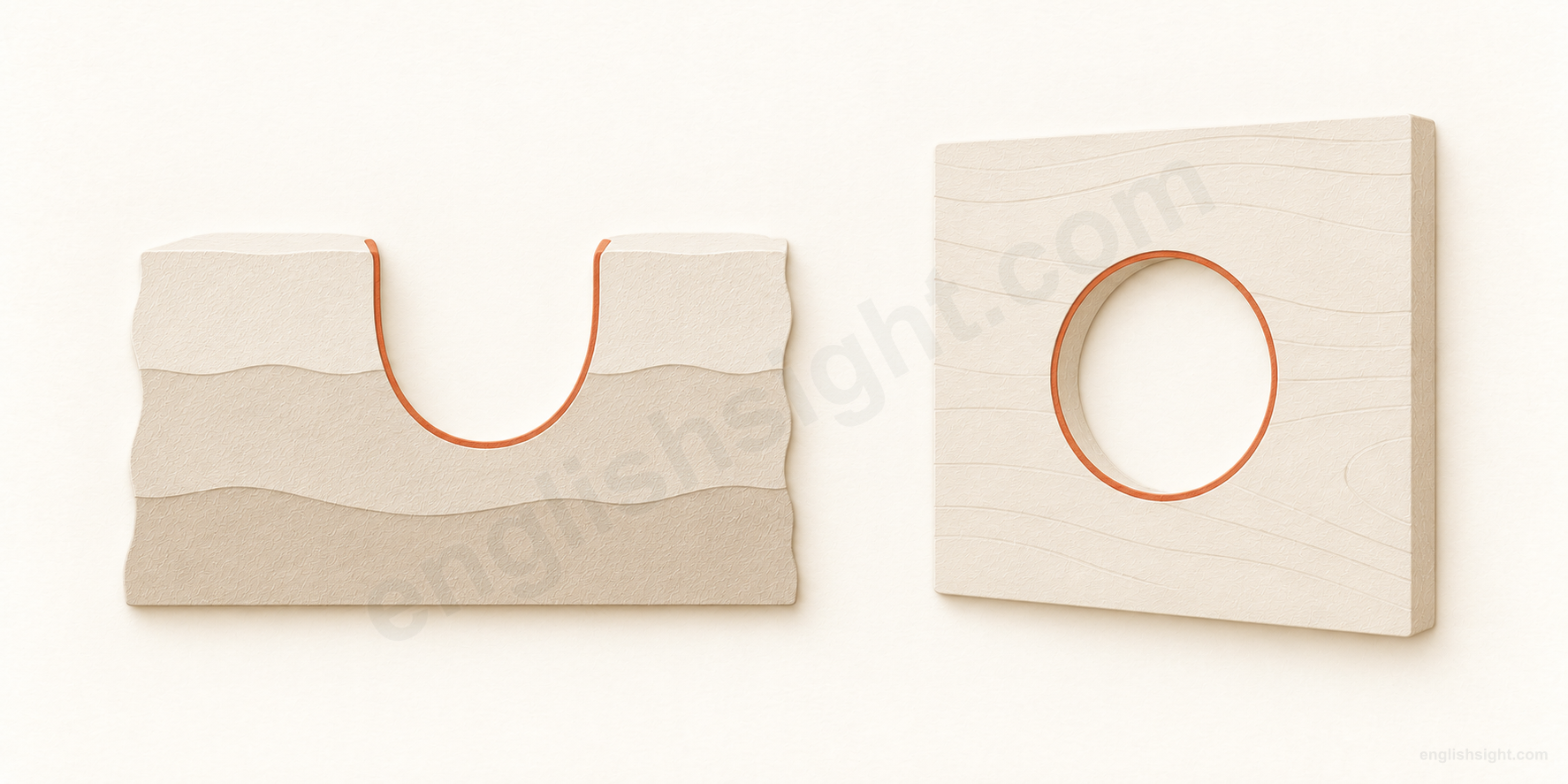
A hollow with a bottom, or an opening all the way through
An opening leads into an empty space.
Both are holes: the left has a bottom; the right passes through.
A hole is a bounded hollow or opening where the surrounding solid material is absent.
The space may end within the material or extend through it. Figurative gaps use a related image of incompleteness; this teaching model does not predict every idiom.
Hole often directs attention to a hollow or opening in something solid. The surrounding material gives the space its boundary: a hole in the earth, a sock, or a board.
English also uses hole for missing contributions and weaknesses. Those connections can help memory, while fixed expressions such as hole up and an ace in the hole need to be learned in their own right.
01
Hollows, openings, and repairs
Start with the material around the space. A hole may stop inside something or go all the way through it; it can be useful, natural, or unwanted.
01
a / the + hole + in + material or surface
a hole in the ground
a hollow that opens at a surface
Situation / starting point
You need space for a young tree’s roots.
What is meant
The soil contains a deep hollow.
A hole can have a bottom; it need not go through the ground.
Hole is a countable noun: a hole, the hole, two holes. In names the material or surface containing it. Deep describes the distance inward; wide describes the opening.
Compare a hole in the ground with a mark on the ground. A mark may change only the appearance. Hole identifies a hollow space. The space may later contain water or soil; calling it a hole does not promise that it is completely empty.
In a sentence
We dug a hole in the garden for the new tree.
Watch the difference Do not assume every hole has an exit on the opposite side.
02
a hole in / through + object; put something through a hole
a hole through a board
an opening that reaches the other side
Situation / starting point
A cord must pass through a wooden board.
What is meant
A drilled opening provides a route through it.
Through specifies passage across the full thickness.
A hole in a board locates the opening in the board. A hole through a board makes its full depth explicit. Put the cord through the hole describes the cord’s route; into the hole would describe entry without necessarily reaching the other side.
The same noun works for an opening worn in a sock or cut in paper. A hole can be deliberate or accidental. Its shape need not be circular: a long tear may leave an irregular hole.
In a sentence
Feed the cord through the hole in the board.
Watch the difference In locates the hole; through can describe either the hole’s extent or an object’s path.
03
make / drill / cut / punch / dig a hole; fill a hole with something; plug / patch a hole
make / fill / plug a hole
create an opening or close an unwanted space
Situation / starting point
An opening lets rain enter the roof.
What is meant
A repair stops the leak.
The verb tells you whether material is removed, restored, or used to block the opening.
Drill, cut, punch, and dig specify different ways to make a hole. Punch two holes in the paper uses a hole punch; dig a hole normally concerns soil or similar material. These are ordinary verb–noun combinations, not phrasal verbs.
Fill a hole with something puts material into the space. Plug a hole blocks the opening; patch a hole repairs or covers a damaged area, for example in fabric. Full of holes and riddled with holes describe many holes, usually as damage; riddled is emphatic.
In a sentence
We plugged the hole in the roof before the next storm.
Watch the difference Say fill the hole with cement. The hole is the space being filled; cement is the filling material.
04
a rabbit / mouse hole; go into / disappear down a hole
a rabbit hole
an animal’s home or shelter in the ground
Situation / starting point
A rabbit reaches an opening in the bank.
What is meant
It disappears into its underground home.
The hole can name a burrow, not merely damage to a surface.
The first noun in rabbit hole or mouse hole identifies the animal associated with the space. Rabbit stays singular in rabbit holes: the final noun takes the plural.
Into a hole describes movement inward; in a hole describes location. A rabbit hole can also be figurative, as in the later unit about following a topic deeper and deeper.
In a sentence
The rabbit vanished down a hole beside the fence.
Watch the difference A rabbit hole may be a home, even though a hole in your coat is damage.
05
place + be + a (disapproving adjective) hole
This place is a hole.
an insulting description of an unpleasant place
Situation / starting point
A room is dirty and badly maintained.
What is meant
A visitor complains strongly about it.
The speaker is judging a place rather than measuring an opening.
Calling a room, building, or town a hole is informal and disapproving. Adjectives such as awful can intensify the complaint. The place need not be underground or literally hollow.
This is stronger and less polite than saying The room is uncomfortable. Use a specific description when making a neutral complaint; calling someone’s home a hole can offend them.
In a sentence
We paid far too much to stay in this awful hole.
Watch the difference This is a judgment, not the neutral name for any small room.
02
Missing parts, weaknesses, and resources
A story, team, or budget has no physical surface. Hole can present something as incomplete; the surrounding words tell you what is missing or damaged.
06
a hole / holes in + argument, plan, story, or theory
holes in a story / argument
missing support, inconsistencies, or other weaknesses
Situation / starting point
An explanation seems complete at first.
What is meant
Some facts do not fit it.
A figurative hole is a weakness in something expected to hold together.
An argument or account can have holes when it fails to explain relevant facts. Full of holes is a strong criticism. It does not mean that words have physically disappeared from a page.
In a story, a hole may be an unexplained event or inconsistency. This does not by itself establish that the storyteller is lying: an account can be incomplete or mistaken. The surrounding context supplies that conclusion.
In a sentence
Her story has a hole: she never explains how she got home.
Watch the difference Hole criticizes completeness or soundness; it does not automatically mean deliberate deception.
07
pick holes in + proposal / argument / it
pick holes in something
point out flaws in an idea or explanation
Situation / starting point
A team proposes a plan.
What is meant
A colleague identifies its weak points.
The criticism belongs to pick holes in as a whole expression.
The person picking holes examines something critically. The object after in is the plan, argument, or proposal being criticized. You can say pick holes in it; it follows in, not pick.
The phrase can suggest an overly negative approach, especially in complaints such as You only pick holes in my ideas. It does not mean choosing physical holes or improving the plan; constructive help may follow, but is not promised.
In a sentence
Before you pick holes in the plan, tell us what you would change.
Watch the difference Keep in before the thing criticized: pick holes in it.
08
leave / fill a hole in + team / life
leave / fill a hole in something
leave or supply something that is needed or missed
Situation / starting point
An experienced colleague leaves the team.
What is meant
The team lacks the contribution she used to make.
The absence is pictured as a space in a larger whole.
A departure can leave a hole in a team or in someone’s life. Fill the hole presents another person or activity as meeting that need. This is a teaching link with physical filling, not a rule that every absence is called a hole.
Gap is often more neutral: a gap in the schedule can simply be free time. A hole in my life emphasizes a felt loss. Choose the noun for the situation rather than replacing every use of gap with hole.
In a sentence
When Ada moved away, she left a real hole in our weekly gatherings.
Watch the difference An emotional hole describes a felt absence, not a location inside the body.
09
expense + make a (big) hole in + savings / resources
make a hole in your savings
use up a substantial part of a resource
Situation / starting point
You have money saved for later.
What is meant
A costly repair uses a noticeable part of it.
The resource becomes smaller; no physical opening is needed.
The expense or purchase can be the subject of make a hole in. In this figurative expression, hole means a noticeable reduction. Savings is the amount being reduced.
The expression can also concern supplies of food or drink. With a physical object, make a hole in may instead be literal: making a hole in a bottle damages it, while the idiom about a supply concerns consuming it. Context matters.
In a sentence
Replacing the boiler made a big hole in our savings.
Watch the difference This does not necessarily mean all the savings are gone or that you now owe money.
10
setback / cost + blow a hole in + plan / budget
blow a hole in something
seriously weaken a plan or sharply reduce funds
Situation / starting point
A schedule depends on getting a permit.
What is meant
A refusal disrupts the plan.
Blow adds force to the idea of damage or reduction.
A setback can blow a hole in a plan: it makes the plan less workable. New evidence may similarly damage an argument. This is a figurative expression, not a claim about an explosion.
With a budget or fund, it can mean a large financial reduction. Compare The repair blew a hole in our budget with The refusal blew a hole in our plans. The first concerns money; the second concerns feasibility.
In a sentence
The permit refusal blew a hole in our opening plans.
Watch the difference Read the object: a plan can be undermined without any money being spent.
03
Trouble, spending, and familiar images
Learn these expressions as units. Their conventional meanings depend on the whole phrase, including its articles and prepositions.
11
be in a hole; get into / out of a hole; dig + reflexive pronoun + into a hole
be in a hole; dig yourself into a hole
be in trouble or create a difficult position for yourself
Situation / starting point
You promise two clients the same delivery time.
What is meant
You cannot keep both promises.
A difficult position is imagined as hard to climb out of.
Be in a hole is informal, especially in British English: you face a difficult or embarrassing situation. Get into a hole describes entering it; get out of a hole describes escaping it. There need not be a literal pit.
Dig yourself into a hole adds personal responsibility: your actions create or worsen the problem. Match the reflexive pronoun to the subject: I dug myself into a hole; she dug herself into a hole; we dug ourselves into a hole. More excuses may dig you into an even deeper hole.
In a sentence
I dug myself into a hole by promising delivery before I checked the stock.
Watch the difference In a hole can mean general trouble. Keep it distinct from the financial expression in the hole.
12
be + (amount) + in the hole
be in the hole
owe money or have a financial deficit
Situation / starting point
Costs exceed the money available.
What is meant
The group finishes with money owing.
The fixed article the is part of this financial idiom.
In North American informal English, be in the hole concerns debt or a financial shortfall. An amount can come before it: $200 in the hole tells you the size of the negative position.
Compare We are in a hole because the venue cancelled: that can describe general trouble. We are $200 in the hole explicitly concerns money. In literal conversation, in the hole can of course locate something in a particular physical hole.
In a sentence
After paying the final bill, our club was $200 in the hole.
Watch the difference Do not treat a and the as freely interchangeable inside these idioms.
13
money / bonus + burn a hole in + possessive + pocket
money burns a hole in your pocket
having money makes you eager to spend it
Situation / starting point
You receive a cash gift.
What is meant
You immediately start thinking about purchases.
The money is the grammatical subject; the urge to spend is the meaning.
This informal, often humorous expression describes temptation to spend money as soon as you have it. It does not say that the money has already been spent.
In My bonus is burning a hole in my pocket, is burning fits the current temptation. Compare a real hole in a pocket, which may let coins fall out. The idiom involves no actual heat or damaged clothing.
In a sentence
That birthday money is burning a hole in Leo’s pocket.
Watch the difference The phrase describes eagerness, not necessarily wastefulness or actual spending.
14
need + unwanted thing + like a hole in the head
need something like a hole in the head
strongly reject an unwanted addition
Situation / starting point
You already have too many tasks.
What is meant
Someone suggests another meeting.
The comparison reverses the apparent positive meaning of need.
I need another meeting like a hole in the head means I really do not want another meeting. The speaker presents it as something that would add trouble, despite the positive verb need.
The expression is informal, emphatic, and often sarcastic. It can sound rude when aimed at a person. It is not a literal wish for an injury, and it is usually unsuitable for a tactful refusal.
In a sentence
I need another password to remember like a hole in the head.
Watch the difference Do not interpret positive need literally here; the whole comparison expresses rejection.
15
have + an ace in the hole; someone / something + be + an ace in the hole
an ace in the hole
an advantage kept ready for use if needed
Situation / starting point
A team has a useful contact it has not mentioned.
What is meant
It can call on that contact if negotiations become difficult.
The expression names a reserve advantage, not an empty space.
This expression is especially associated with North American English. A skill, contact, resource, or piece of information may be an ace in the hole when it can give you an advantage at a crucial moment.
Learn an ace in the hole as a whole noun phrase. It need not refer to a playing card, and hole alone does not mean advantage. An ace up your sleeve is a familiar alternative.
In a sentence
Our bilingual guide was our ace in the hole when the talks stalled.
Watch the difference A reserve advantage need not guarantee success.
16
be / feel like + a square peg in a round hole
a square peg in a round hole
a person whose role or situation does not suit them
Situation / starting point
Someone enjoys creative work and flexibility.
What is meant
A rigid role leaves them uncomfortable.
The shapes represent a poor fit between a person and a situation.
The person is the square peg; the role or environment is the round hole. The expression describes a mismatch. It does not mean that the person is useless or incapable in every setting.
You can say feel like a square peg in a round hole about your own experience, or describe another person that way. It can be critical, so explain the actual mismatch when discussing someone’s work.
In a sentence
In that highly formal office, I felt like a square peg in a round hole.
Watch the difference Do not confuse being a poor fit for one role with having no ability.
17
go / fall / disappear down a rabbit hole (of + topic)
go down a rabbit hole
be drawn deeply into a complicated or distracting subject
Situation / starting point
You look up one small question online.
What is meant
Each link leads to another topic, and you lose track of time.
Down suggests increasing involvement; the rabbit hole is figurative.
A literal rabbit hole leads underground. In figurative use, following a subject can lead into a confusing or absorbing situation that is hard to leave. Online searching is a familiar setting, but not the only possible one.
An of-phrase can identify the subject: a rabbit hole of old film reviews. The expression often suggests distraction or unexpected complexity; it does not automatically prove that the information is false or the activity harmful.
In a sentence
I went down a rabbit hole of camera reviews and missed lunch.
Watch the difference Learn the figurative expression separately from the animal’s physical home.
04
Places to retreat to and golf
Some established combinations concern hiding, small places, or a sport. They need their own explanation rather than one general rule about empty space.
18
hole up + location; be holed up + location
hole up / be holed up
hide or shut yourself away in a place
Situation / starting point
A writer wants to work without interruption.
What is meant
She stays secluded in a cabin.
Up belongs to an established phrasal verb; it does not mean upward motion.
Hole up somewhere is informal. It can describe hiding from others or withdrawing so that nobody disturbs you. Be holed up describes the resulting secluded situation; it does not require someone else to have shut you in.
Use a location after in or at: hole up in a cabin; be holed up at home. There is no object to move between hole and up in this use. Compare hold up, a different verb whose meanings include delaying something.
In a sentence
She holed up in a cabin to finish the final chapter.
Watch the difference Spell it holed up, not hold up. Holing drops the final e.
19
a hole in the wall; a hole-in-the-wall + café / shop
a hole in the wall
a small establishment, or a British cash-machine expression
Situation / starting point
Someone recommends a tiny restaurant.
What is meant
You learn what kind of place they mean.
The fixed expression has meanings beyond a literal damaged wall.
Especially in North American English, a hole in the wall can mean a small, unassuming shop or restaurant. It need not be bad: a modest-looking café may serve excellent food. Before another noun, use hyphens: a hole-in-the-wall café.
In British informal English, a hole in the wall can mean a cash machine. I got cash from the hole in the wall therefore need not describe reaching into damaged brickwork. The situation and variety of English decide the reading.
In a sentence
Their favourite café is a little hole in the wall near the station.
Watch the difference Do not assume this expression is always an insult like This place is a hole.
20
play + number + holes; a hole-in-one; holes-in-one
play nine holes; a hole-in-one
the target or a section of a golf course; reaching the target in one shot
Situation / starting point
Golfers start at the tee.
What is meant
They complete one section when the ball reaches its target hole.
Hole can name the target and, by extension, a whole section of play.
The ball drops into the hole refers to the target opening. We played nine holes counts sections of the course, not nine holes made by digging. In an eighteen-hole course, hole is singular inside the compound modifier.
A hole-in-one is achieved when the first shot from the tee sends the ball into the target hole. It is not any successful final putt. The plural is holes-in-one.
In a sentence
Nina got her first hole-in-one on the sixth hole.
Watch the difference A hole-in-one counts shots from the tee, not just the last stroke near the cup.
21
hole + ball / putt; hole (out) from + distance
hole a putt / hole out
hit a golf ball into the target hole
Situation / starting point
A player aims at the cup.
What is meant
The ball goes into it.
As a golf verb, hole describes a successful result.
Hole can take an object, as in hole a putt or hole the ball. It also occurs without an object: She holed from six feet. Hole out is another intransitive form used for getting the ball into the hole.
The putt is the shot; the ball is the object moved. Neither use means making a new opening in the ground. Past holed and participle holed are regular; the -ing form is holing.
In a sentence
He holed a short putt to finish the round.
Watch the difference Hole out in golf differs from hole up, which concerns seclusion.
22
boat / hull + be holed (by + cause)
be holed
have an opening made in the structure
Situation / starting point
A boat hits a submerged rock.
What is meant
Its hull has an opening that needs repair.
The thing damaged is the subject of this passive construction.
As a transitive verb, hole can mean make a hole in something. It is especially used in reports about boats or ships, often in the passive: the hull was holed. By can introduce the cause.
In ordinary instructions, drill a hole in the board or make a hole in the lid is clearer than using hole as a general-purpose verb. This damage sense and the golf sense have different object types and different results.
In a sentence
The boat was holed when it struck a submerged rock.
Watch the difference Be holed is physical damage; be holed up describes hiding or seclusion.
Keep the boundaries clear
Hole, whole, gap, and cavity
Hole and whole sound the same but have different spellings and meanings: a hole in the sock is an opening; the whole sock means all of it. Gap is a broader word for an interval or missing part. Cavity is often more formal or technical, as in a cavity in a tooth.
Grammar follows the expression
The noun is countable: a hole, holes. The verb forms are hole, holes, holed, holing. Ordinary noun combinations such as dig a hole are not phrasal verbs. Hole up is a phrasal verb; pick holes in is an idiom with the noun holes.
A useful connection, not a universal mental picture
A hollow, a weakness, and a felt absence can be compared as spaces within something. Golf, seclusion, and fixed idioms have conventional details that the sketch cannot supply. No claim is made that every speaker imagines the same picture.
Choose the meaning that fits
Use the situation and the entire expression, including a, the, in, and up.
1. You dig a hollow for a tree, but it stops within the soil. Can you call it a hole?
2. A club ends the year owing $200. Which informal North American expression specifically fits the money problem?
3. A novelist shuts herself away to work without interruption. Which expression fits?
4. His gift money is burning a hole in his pocket. What does this tell us?
5. Someone picks holes in your plan. What are they doing?
Sources and teaching notes
The sources below support the usage inventory. The explanations, examples, and visual teaching model were written for this lesson.
The diagram is a teaching aid, not a picture shared by every English speaker.