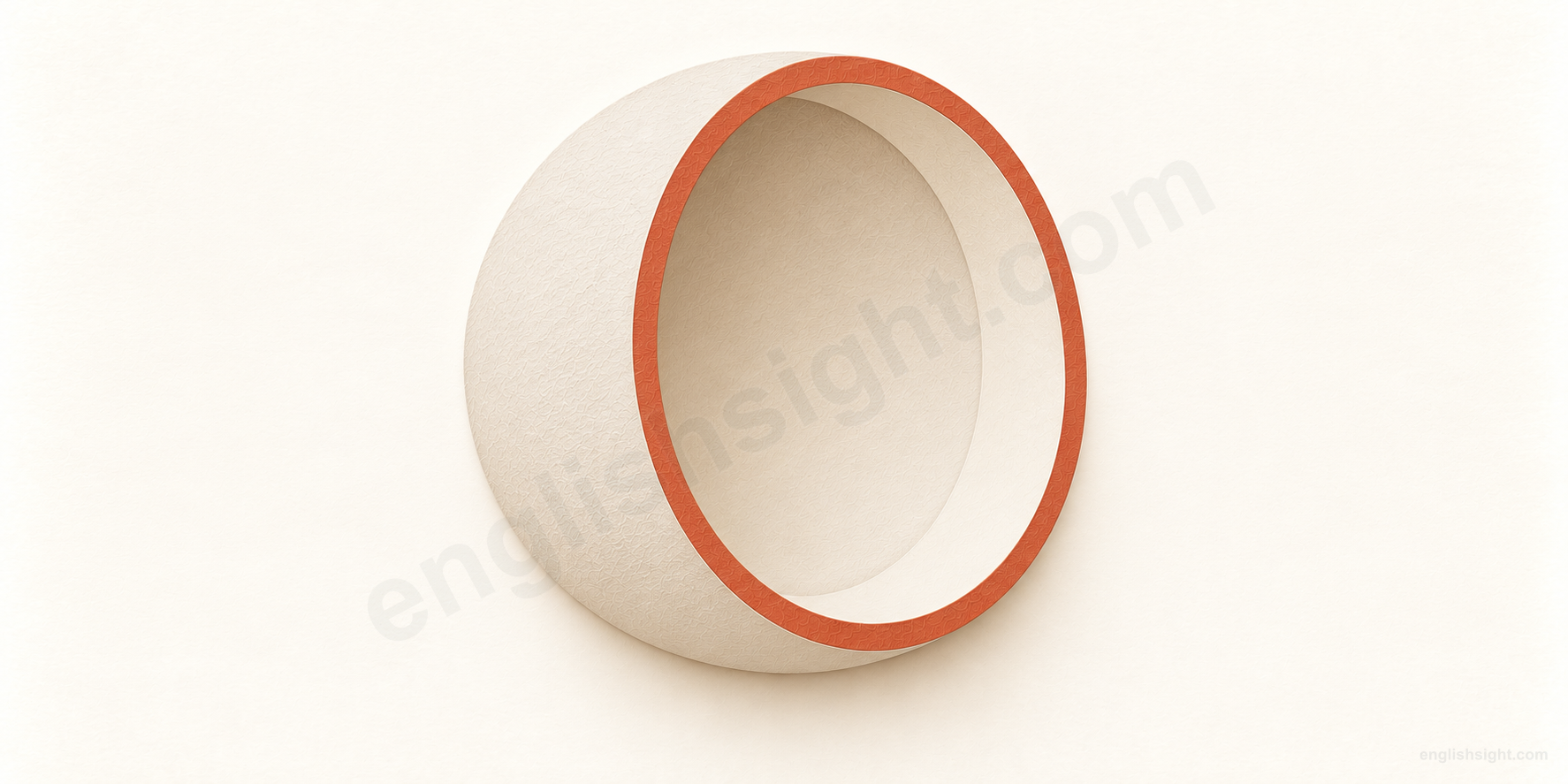
Use hollow for internal space, inward shape, and things that lack expected substance.
An outer structure, a space within
An outer structure, a space within
The shell has an outer wall.
hollow
A cavity lies inside the wall.
The cutaway reveals a space within the shell.
Hollow describes the shell’s internal structure, rather than whether it currently contains anything.
Something hollow has a space inside instead of being solid all the way through.
The picture shows a state, not an action. Inward curves, sensations, and judgments about sincerity or value are related uses; fixed expressions must still be learned in context.
A hollow object has a space within its outer structure. This offers a useful starting point for understanding several uses, but the noun, construction, and context still matter.
A hollow sound, hollow cheeks, and a hollow promise describe different things. The connections below are a teaching model, not a claim that every speaker sees one shared mental picture.
01
Inside, shape, sound, and feeling
Start with a space inside an object. Then distinguish an inward shape, an echoing sound, and a felt sense of emptiness.
01
hollow + noun; subject + be + hollow (inside)
a hollow tube / hollow inside
have a space within, rather than being solid throughout
Situation / starting point
You inspect the cut end of a metal tube.
Meaning / result
You see a wall surrounding a central space.
Hollow describes the object’s internal structure.
A tube can be hollow even when water is running through it. Hollow contrasts with solid; empty tells us that something currently contains nothing. An empty room is not usually called a hollow room.
Use hollow before a noun or after be: a hollow ball; The ball is hollow. Hollow inside emphasizes where the space is. Neither expression says that every part of the object is absent.
In a sentence
The handle is hollow, so the cable can run through it.
Watch the difference A hollow object can contain something; hollow and empty are not interchangeable.
02
hollow + cheeks / eyes; cheeks + look + hollow
hollow cheeks / eyes
look deeply sunken or curved inward
Situation / starting point
You notice the shape of someone’s face.
Meaning / result
The cheeks look drawn inward.
This describes a surface shape, not a hole through the face.
Hollow cheeks and hollow eyes describe a sunken appearance. Cheeks may look drawn and eyes may appear deeply set; the words do not say that these body parts are missing.
The related description hollow-eyed is useful to recognize. Appearance alone does not establish why someone looks this way; avoid treating the adjective as a diagnosis.
In a sentence
His cheeks looked hollow in the old photograph.
Watch the difference Do not substitute empty cheeks: empty describes contents, not this facial shape.
Sound hollow can describe acoustic quality without proving an object’s construction.
Here sound is a linking verb and hollow describes the subject as heard. A hollow knock, hollow voice, or hollow groan describes a quality resembling a sound from an empty enclosure.
The resemblance connects this use with internal space. It does not require a loud noise, and a hollow voice does not necessarily mean an insincere speaker.
In a sentence
The panel sounded hollow when I tapped it.
Watch the difference For a physical sound, hollow describes its quality; for an apology, sounded hollow can instead judge sincerity.
04
feel + hollow; a hollow feeling + in + one’s stomach
feel hollow
feel emptiness in the body or emotionally
Situation / starting point
You have not eaten since early morning.
Meaning / result
You notice an empty feeling in your stomach.
Context distinguishes hunger, fear, and emotional emptiness.
My stomach feels hollow can describe hunger or an unsettling sensation, including fear. A hollow feeling in my stomach similarly names the sensation, not an anatomical cavity newly created.
After a disappointment, I feel hollow can mean emotionally empty or lacking fulfillment. These uses extend physical emptiness into experience; they do not all mean hungry.
In a sentence
I had missed lunch, and my stomach felt hollow.
Watch the difference Look for the cause in context: missed food suggests hunger; bad news may suggest fear or emotional emptiness.
02
A hollow: the space itself
As a countable noun, a hollow names a cavity or a low place. The surrounding material or land stays outside that space.
05
a hollow in + object; in / into + a / the hollow
a hollow in a tree
a cavity within something
Situation / starting point
There is an opening at the base of a tree.
Meaning / result
Beyond the opening is a space inside the trunk.
The noun names the cavity; the adjective describes the surrounding object.
An animal can shelter in a hollow in a tree. Compare a hollow tree: that adjective describes the tree, whereas a hollow names an internal space.
Use an article for one cavity and -s for several: a hollow, two hollows. In a hollow describes location; into a hollow describes movement to its interior.
In a sentence
A small owl was resting in a hollow in the trunk.
Watch the difference Hollow is countable here: say in a hollow, not in hollow.
06
a hollow in / between + place; the hollow of + body part
a hollow in the ground / the hollow of…
a low or inward-curving place in a surface
Situation / starting point
Rain falls on uneven ground.
Meaning / result
Water gathers in a low spot.
A hollow can be an open depression rather than an enclosed hole.
A hollow in the ground is below the surrounding surface. A hollow between hills can be a small valley; it need not be underground or covered.
The hollow of your hand names its cupped depression, and the hollow of the throat names an inward area at the base of the neck. Of identifies the larger part whose depression you mean.
In a sentence
Rainwater collected in a shallow hollow beside the path.
Watch the difference A hollow can be shallow. Do not assume that every hollow is a deep pit or a tunnel.
03
An outward form without enough behind it
Promises, laughter, and victories can exist while lacking sincerity or satisfaction. Read the noun and the situation to identify what is missing.
07
hollow + promise / threat / words / praise
hollow promises / threats
lack genuine intent, support, or likely effect
Situation / starting point
Someone promises help but repeatedly fails to act.
Meaning / result
You doubt that the words have anything dependable behind them.
What is missing is substance behind the words, not words themselves.
A hollow promise lacks sincerity or practical backing. A hollow threat is unlikely to be carried out or have the claimed force. The noun determines exactly what kind of support is missing.
This is a critical judgment, usually with hollow before the noun. It is stronger than saying a promise is vague: a detailed promise can still be hollow.
In a sentence
After three broken agreements, their latest promise seemed hollow.
Watch the difference An unsuccessful promise is not automatically dishonest; hollow expresses the speaker’s judgment about its substance.
08
give / let out + a hollow laugh
a hollow laugh
laughter without real amusement
Situation / starting point
Someone jokes about a problem that still hurts you.
Meaning / result
You laugh, but find nothing funny.
The outward act of laughing lacks the expected enjoyment.
A hollow laugh signals little or no genuine amusement. It can convey bitterness or discomfort rather than a calculated attempt to deceive.
The context separates this emotional judgment from the acoustic use of hollow. A laugh could echo in a hall and still be cheerful; a hollow laugh need not occur in a large room.
In a sentence
When he called the repair cheap, she gave a hollow laugh and showed him the bill.
Watch the difference Hollow laughter is not simply quiet laughter; the missing enjoyment matters.
09
a hollow victory; a victory + feel / seem + hollow
a hollow victory
a real success that brings little value or satisfaction
Situation / starting point
You win, but the result no longer matters to you.
Meaning / result
The official success feels unsatisfying.
The victory happened; its expected value is missing.
A hollow victory can be a genuine win whose circumstances remove its satisfaction or usefulness. The contrast is between the outward achievement and what that achievement gives you.
Do not read hollow as a simple synonym for false. A hollow promise may lack sincerity, but a hollow victory need not involve any lie.
In a sentence
Winning the argument was a hollow victory: I had lost my friend’s trust.
Watch the difference A hollow victory is still a victory; it is not the same as losing.
10
statement / apology / promise + ring + hollow
ring hollow
seem unconvincing or insincere
Situation / starting point
The company expresses concern but ignores every complaint.
Meaning / result
Its message fails to sound genuine.
Ring hollow judges how a statement strikes a listener.
Promises, explanations, apologies, and claims can ring hollow. Ring here means give an impression; no bell, telephone, or physical echo is needed.
Use ring, rang, rung: The apology rang hollow; Their assurances have rung hollow. Hollow follows ring directly in this expression. The positive contrast is ring true.
In a sentence
Their claim to care about customers rang hollow after they ignored our letters.
Watch the difference Ring hollow does not mean telephone someone, and the expression is not ring hollowly.
04
Making a hollow, or removing what sustains something
Hollow and hollow out describe changes. Notice whether the object is the material being emptied, the space being made, or an organization losing capacity.
11
hollow out + noun; hollow + noun / pronoun + out
hollow something out
remove interior material to leave a cavity
Situation / starting point
A pumpkin contains flesh and seeds.
Meaning / result
You remove material from inside while leaving its outer wall.
The object is the thing whose interior is removed.
Hollow out a pumpkin and hollow a pumpkin out both describe making room inside it. Out highlights removal from the interior; it does not mean moving the whole pumpkin outside.
With a pronoun, put it between the verb and particle: hollow it out, not hollow out it. A passive is possible: The pumpkin has been hollowed out. A hollowed-out pumpkin describes the resulting object.
In a sentence
Hollow the pumpkin out before cutting the face.
Watch the difference Hollow out it is incorrect; use hollow it out.
12
hollow + result + out of + material; result + be hollowed out of + material
hollow a space out of something
create a cavity or object by removing material
Situation / starting point
You begin with a solid block of wood.
Meaning / result
You carve away wood to form a bowl.
The object can name the result being formed rather than the material being emptied.
Compare hollow out a log, where the log is altered, with hollow a bowl out of a log, where the bowl is the result. The out of phrase names the source material.
The same construction can describe a space formed by natural forces. In A cave was hollowed out of the rock, passive grammar focuses on the result rather than naming an agent.
In a sentence
They hollowed a shallow bowl out of a block of wood.
Watch the difference Out of names the material the result comes from; it is not a destination.
13
surface + be hollowed + by + cause
be hollowed by wear
become curved inward through removal or pressure
Situation / starting point
Many feet cross the same part of a stone step.
Meaning / result
Its surface develops an inward dip.
The bare verb can describe a surface becoming concave.
Be hollowed by something describes an inward shape produced over time. Out is not required in this surface use. The by phrase names what caused the change.
Forms are hollow, hollows, hollowed, hollowing. Broader dictionaries also allow intransitive hollow, meaning become hollow, as in cheeks that have hollowed; everyday instructions more often use hollow something out.
In a sentence
Years of footsteps had hollowed the middle of the stone step.
Watch the difference Hollowed describes a change or its result; hollow alone can simply describe an existing shape.
14
hollow out + organization / service; the hollowing out of + organization
hollow out an organization
remove resources or capacity so little substance remains
Situation / starting point
A service loses skilled staff and funding.
Meaning / result
Its name remains, but its ability to operate is greatly reduced.
This extension describes loss of internal capacity rather than a literal cavity.
In public affairs and business writing, cuts can hollow out an institution or service. The expression suggests that an outward structure remains while much of what sustains it has gone.
This is an evaluative description of serious weakening, not a neutral synonym for every reduction. Hollowing out can name the process: the hollowing out of local services.
In a sentence
Repeated cuts have hollowed out the library service, leaving only one librarian.
Watch the difference This use does not say the institution has closed completely; explain what capacity has been lost.
05
One fixed expression to recognize
Beat someone hollow has its own established meaning. A physical cavity does not explain the whole idiom.
15
beat + opponent + (all) hollow
beat someone hollow
defeat someone completely
Situation / starting point
Two teams play a very unequal match.
Meaning / result
One side wins overwhelmingly.
Hollow intensifies defeat in this established informal expression.
Beat someone hollow means defeat them decisively. Collins marks it British informal. It is useful for recognition in conversation and reading, rather than a default expression for a formal report.
The object is the defeated person or team: They beat us hollow. Merriam-Webster also records the form beat someone all hollow. Learn the combination; do not generalize hollow into an intensifier for any verb.
In a sentence
Our team was new, and the visitors beat us hollow.
Watch the difference This describes a decisive defeat, not physical injury or an empty victory.
Separate structure, contents, and judgment
Hollow, empty, solid, and hole
Hollow contrasts with solid when describing structure. Empty contrasts with full when describing contents. Hole names an opening or cavity; hollow can describe the surrounding object or name a cavity or depression. An empty bottle has no contents; its hollow structure does not disappear when you fill it.
Part of speech follows the sentence
In a hollow log, hollow is an adjective. In a hollow in the log, it is a countable noun. In hollow the log out, it is a verb. Ring hollow and beat someone hollow are established combinations; dictionary analyses of their final word differ, so learn the whole construction.
Scope and related forms
Hollowly and hollowness are related words, not interchangeable substitutes for hollow. More hollow and hollower are possible comparisons where degrees make sense. This lesson selects useful modern uses rather than ranking them by frequency or covering technical manufacturing terminology.
Choose the meaning in context
Identify whether the sentence concerns structure, contents, sincerity, or a change.
1. Water is flowing through a metal tube. Can it still be hollow?
2. An apology rings hollow after the same behavior happens again. What is being judged?
3. You want someone to remove a pumpkin’s interior. Which instruction has the correct pronoun position?
4. You win the dispute but damage an important friendship. What does a hollow victory mean here?
5. Rainwater gathers in a hollow beside a path. What is the hollow?
Sources and teaching notes
The linked dictionaries support the usage inventory. Explanations and examples are original, and the picture offers a teaching connection rather than a claim about every speaker’s mental image.
The picture illustrates internal space; context determines the meaning of each expression.