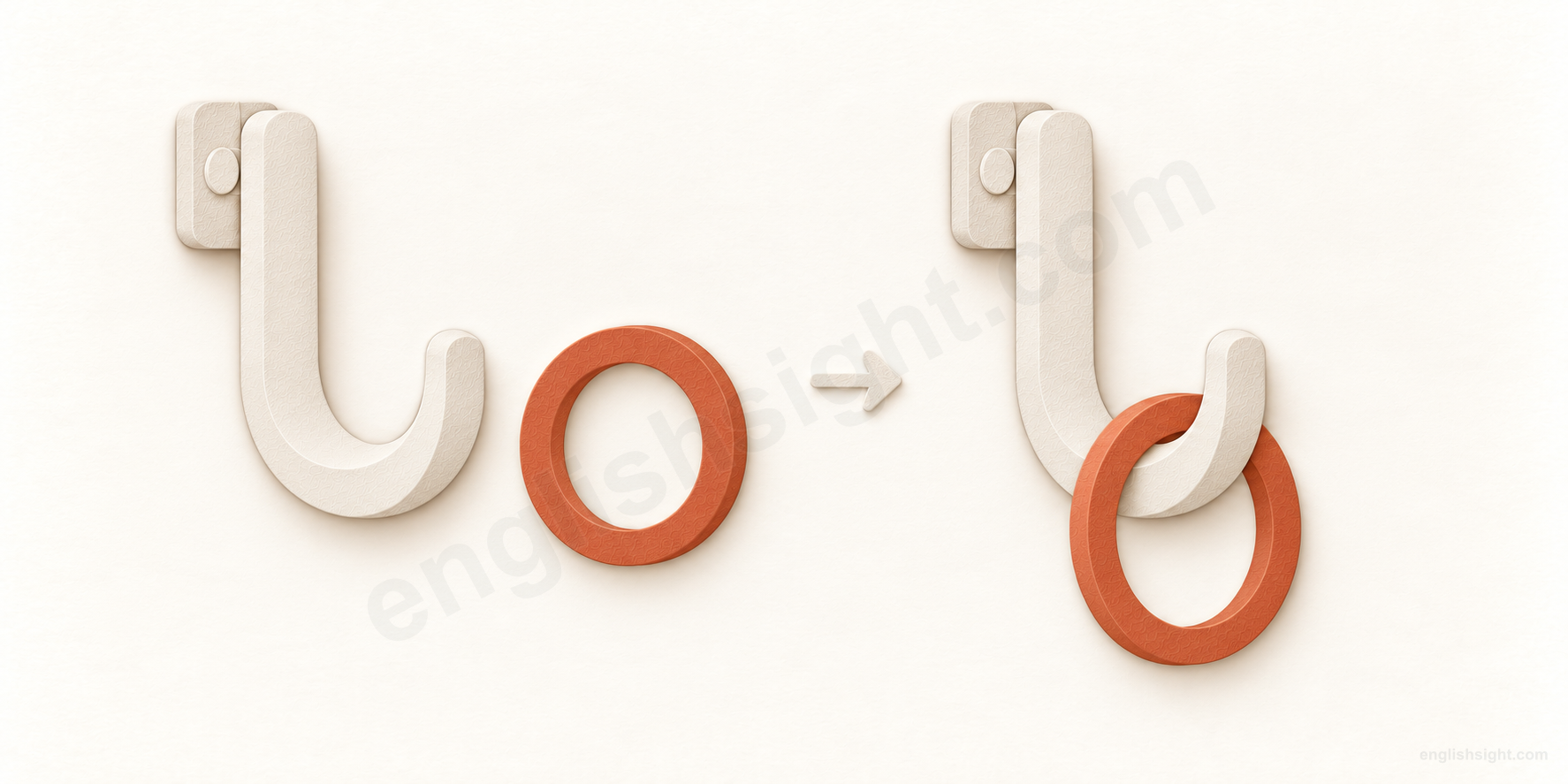
Use hook for catching shapes, strong interest, connections, and familiar fixed expressions.
Catch and hold through a bend
Catch and hold through a bend
The hook and ring are separate.
hook
The ring hangs from the hook’s bend.
The ring is placed over the hook’s open tip.
The bend catches and supports the ring. This physical relationship is a starting point for related figurative uses.
A bent or curved part catches another object and helps keep it attached or held.
The sketch shows the physical relationship. Attention and involvement can be understood figuratively as being caught; sporting terms and fixed idioms still require their own explanations.
A hook has a bend that catches or holds something. This concrete relationship offers a useful starting point for physical actions and for figurative attention or involvement.
English also uses hook in sporting terms and established phrases. Read the whole construction: hooked on a series, hooked up to a monitor, and off the hook describe different relationships.
01
A curved object catches or holds
Start with the countable object, then use hook as a verb for fastening, reaching, and fishing. The accompanying preposition tells you where the contact is made.
01
a + noun + hook; hang something on / from a hook
a coat hook / a fish hook
a bent device used to hang, hold, pull, or catch something
Situation / starting point
A coat needs somewhere to hang.
Result / relationship
Its loop rests on a curved support.
The noun names the device, not the object hanging on it.
Hook is countable: one hook, two hooks. A coat hook supports clothing; a curtain hook holds a curtain; a fish hook catches a fish. The first noun identifies the job of the hook.
We hang something on a hook, and it can hang from a hook. The bend helps stop the supported object from simply slipping away. Not every hook is sharp: a coat hook usually has a blunt end.
In a sentence
There is a spare hook behind the door for your coat.
Watch the difference A hanger is a shaped frame for a garment; a hook is the bent catching or supporting part. They can work together without being the same object.
02
hook something to / onto / over something; something hooks + place
hook the strap onto the ring
attach something using a hook or a similar catch
Situation / starting point
The strap and ring are separate.
Result / relationship
The strap’s hook is attached to the ring.
Hook tells us how the attachment is made.
The person doing the fastening is the subject; the thing attached is the object. To or onto names the attachment point. Compare The strap hooks onto the ring: the strap becomes the subject when you describe how it attaches.
Over describes placement across a support: hook a rope over a branch. A dress that hooks at the back fastens there with hooks. The passive The strap is hooked onto the ring describes an attached state or, with an agent, an action.
A hook-and-eye fastener joins a small hook to a small metal loop, called an eye. It is one familiar fastening device, not a separate figurative meaning.
In a sentence
Hook the safety strap onto the metal ring.
Watch the difference Connect is broader and need not involve a hook or catching shape; hook is more specific in this physical use.
03
hook + body part + around / under / over / through + object
hook a finger under something
bend a body part around or under something to hold or move it
Situation / starting point
A handle lies too flat to grip normally.
Result / relationship
A curved finger catches beneath it.
The finger acts like a hook; no separate metal device is needed.
The object of hook can be an arm, leg, foot, or finger. The preposition gives its position: hook your arm around a branch, or hook your foot under a stool to pull it closer.
This extends the physical catching shape to the body. It does not mean every contact is a hook: resting a flat hand on a surface lacks the curved catching action.
In a sentence
She hooked a finger under the handle and lifted the lid.
Watch the difference Do not call around or under a detachable particle here: each introduces the thing the body part is placed around or under.
04
hook + fish; a fish is hooked
hook a fish
catch a fish on a fishing hook
Situation / starting point
A fish takes the bait.
Result / relationship
The hook catches in the fish’s mouth.
Hooking describes catching on the hook; landing the fish is a further step.
The fish is the direct object: she hooked a fish. A fish can also be hooked, using a passive form. The fishing equipment is understood from the context.
The verb does not guarantee that you bring the fish onto the boat or shore. You can hook a fish and then lose it. Catch is a broader word and also works for nets and other methods.
In a sentence
I hooked a small fish, but it escaped before I could reel it in.
Watch the difference Hook a fish is different from bait a hook: baiting puts food or a lure on the hook before the catch.
02
Curved shapes and sporting movements
Some uses name a shape or a curved movement rather than fastening two objects together. Learn the sport with its meaning.
05
hooked + noun
a hooked beak
a beak curved like a hook
Situation / starting point
You describe the shape of a bird’s beak.
Result / relationship
Its end curves down rather than remaining straight.
Here hooked describes shape, not an earlier catching event.
Hooked can be an adjective for a curved shape: a hooked beak or a hooked finger. The curve is what connects this description to the physical hook.
Compare a hooked fish, where hooked can be a past participle meaning caught on a hook. The noun and the context help distinguish a shape description from the result of an action.
In a sentence
The bird has a strong hooked beak.
Watch the difference Hook-shaped also describes shape. Do not interpret every hooked + noun as addicted.
06
throw / land + a left / right hook
a left hook
a boxing punch made with a bent arm in a curved movement
Situation / starting point
A boxer bends the arm at the elbow.
Result / relationship
The fist swings in toward the opponent from the side.
The movement curves; the boxer is not fastening anything.
This countable noun names a kind of punch. Left and right identify the arm used: a left hook, a right hook. Throw a hook describes making the punch.
The shape and movement provide a useful link to hook, but the sporting meaning is conventional. It is not a general name for every punch or every bent arm.
In a sentence
The boxer blocked a left hook in the second round.
Watch the difference A jab is a different punch, generally delivered straight out. It is not another name for a hook.
07
hook + ball / shot; hit + a hook
hook a shot / a hook
hit a ball so that it goes to the side; a shot with a curved path
Situation / starting point
A player strikes the ball.
Result / relationship
The ball travels to one side rather than straight ahead.
Read the sport: the same word does not specify one universal direction.
Hook can be a verb with the ball or shot as object, and a noun naming the shot. In golf, a hook is often an unwanted curve. In cricket, a hook is a deliberate stroke against a high ball.
The direction of a golf hook depends on whether the player is right- or left-handed. Learn the specialist technique within the sport rather than treating hook as a general synonym for hit.
In a sentence
He hooked his tee shot into the rough.
Watch the difference In golf, hook and slice describe different curves. Hook does not always mean a ball curves left for every player.
03
Catch attention and keep an interest
Attention can be caught figuratively. A hook attracts interest; hooked describes a strong continuing interest or, in a different context, dependence.
08
a hook for + audience; use something as a hook
a story hook / a musical hook
a feature that catches people’s attention
Situation / starting point
A reader or listener has not yet become interested.
Result / relationship
A striking opening or memorable musical phrase draws attention.
The hook is the attractive feature, not a physical fastener.
A story can begin with a hook that makes readers want to continue. A song’s hook is a memorable, catchy musical part; it need not be the entire chorus. Advertising can also use a hook to attract customers.
This is a figurative catching relationship. The attraction may be enjoyable or manipulative, depending on context; hook alone does not prove that someone is being deceived.
In a sentence
The opening mystery gives the story a strong hook.
Watch the difference A musical hook is a catchy feature; a chorus is a structural section of a song. They can overlap without being identical.
09
hook + person / audience; be hooked
hook the audience
attract people strongly and draw them into something
Situation / starting point
An audience is deciding whether to keep watching.
Result / relationship
An unexpected question catches its interest.
The audience is the object of the verb; attention is caught figuratively.
A speaker, opening scene, or product feature can hook people. This informal use presents interest as being caught and held. It can describe effective entertainment, not only a trick.
The source of attraction is the subject: The first scene hooked me. The affected person can become the subject in I was hooked. That sentence may describe fascination rather than literal capture.
In a sentence
The first scene hooked me with an unanswered question.
Watch the difference Interest is a more neutral verb. Hook suggests a stronger catch on attention; it does not promise the person will remain interested forever.
10
be / get / become hooked on + noun / -ing; keep somebody hooked
be / get hooked on something
become very interested in an activity or subject
Situation / starting point
You try a puzzle game once.
Result / relationship
You want to keep playing it.
Be describes the continuing interest; get or become marks its beginning.
Informal hooked on can describe strong enjoyment. On introduces what interests you: hooked on a series, hooked on climbing, or hooked on solving puzzles. Use an -ing form when an activity follows on.
You can also say I’m hooked when the activity is already clear. Keep someone hooked means sustain that interest. This enjoyable sense is distinct from the dependence sense in the next entry.
A cause can appear with get + person + hooked: That first class got me hooked on pottery. The class caused the strong interest; it did not physically attach me to anything.
In a sentence
After one lesson, I was hooked on pottery.
Watch the difference Say hooked on making things, not hooked to make things, for this meaning.
11
be / get hooked on + substance
hooked on a drug
dependent on a substance
Situation / starting point
Someone starts using a drug.
Result / relationship
They feel a strong need to continue using it.
The same informal pattern can express dependence, not just enthusiasm.
With drugs, hooked on commonly means addicted. The phrase describes a harmful need or dependence; the surrounding noun changes how we interpret the expression.
The grammar is the same as in hooked on a television series, but the practical meaning is different. Choose addicted or dependent when you need a more precise, less conversational description.
In a sentence
He described how he had become hooked on the drug.
Watch the difference Do not assume that every casual I’m hooked is a clinical statement about addiction.
04
Connect equipment, people, and opportunities
Hook up has several established meanings. Objects, prepositions, and the surrounding situation distinguish a technical connection from meeting, collaborating, providing help, or sexual contact.
12
hook something up (to something); hook it up; be hooked up to
hook something up to something
connect equipment to another device or a supply
Situation / starting point
The monitor and computer are separate.
Result / relationship
They are connected so they can work together.
Up is a particle; to names the connection point.
Hook up can describe electrical, data, water, or medical connections. No metal hook is required. A patient may be hooked up to a monitor; a house can be hooked up to a water supply.
The equipment use is separable: hook up the monitor or hook the monitor up. A pronoun goes between verb and particle: hook it up. The passive is also common: The monitor is hooked up to the computer.
In a sentence
Can you hook the monitor up to this laptop?
Watch the difference Use to for the device or supply in this pattern. Hook up does not mean switch on: connected equipment may still be turned off.
13
hook into + system / activity; be hooked into + network
hook into a network
connect to a system or become involved in a network
Situation / starting point
You are outside a communications or professional network.
Result / relationship
You establish a connection with it.
Into introduces the system or circle you gain access to.
Hook into can describe a technical connection, such as access to the internet. In informal, especially American use, it can also mean become involved with a group or activity.
The figurative version can also be passive: be hooked into a network of local contacts. That describes participation or access, not addiction. The object of into tells us which kind of connection is meant.
In a sentence
The team is hooked into a network of local researchers.
Watch the difference Be hooked into a network describes access or involvement; be hooked on an activity describes strong interest or dependence.
14
hook up with + person; people hook up
hook up with a friend
meet someone and spend time together
Situation / starting point
Two friends are traveling separately.
Result / relationship
They arrange to meet during the trip.
This informal meeting sense needs enough context to avoid ambiguity.
Hook up with someone can mean meet and spend time with them. With names the companion; a plural subject can also occur without with: We hooked up later.
The expression has a sexual meaning too. If you simply mean an ordinary meeting, meet up with is often clearer, especially when the situation does not already make your intention obvious.
In a sentence
We hooked up with some old friends for lunch during the trip.
Watch the difference Hook up with is not a reliably neutral replacement for meet in every context.
15
hook up with + collaborator; people hook up to + verb
hook up with a musician
start working together
Situation / starting point
A singer needs someone to record with.
Result / relationship
The singer and a guitarist begin a shared project.
Work context selects collaboration rather than social or sexual contact.
In an informal account of a project, people hook up with others to work together. Musicians, companies, and teams can use the expression for establishing a working connection.
With introduces the new collaborator. The connection may lead to a long project, but hook up itself does not specify its length or create a formal employment relationship.
In a sentence
The singer hooked up with a local guitarist to record two songs.
Watch the difference For a formal report, teamed up with or began working with is usually clearer.
16
hook up (with + person)
hook up (with someone)
have a casual sexual encounter or relationship
Situation / starting point
Two adults meet at a party.
Result / relationship
They have sexual contact.
This is an established informal meaning, not ordinary technical connection.
In a social or dating context, hook up can imply casual sexual contact, with or without with someone. It does not by itself establish a continuing romantic relationship.
What happened may remain vague in conversation. Do not infer an exact sexual act from this expression alone, and do not assume that every use of hook up with has this sense.
In a sentence
They hooked up after the party, but they never dated.
Watch the difference Dating describes a different kind of relationship or activity. Hooking up does not necessarily mean becoming a couple.
17
hook + person + up with + contact / item
hook someone up with something
help someone get a useful contact or something they want
Situation / starting point
A friend needs a reliable repair service.
Result / relationship
You introduce someone who can help.
The person helped is the direct object; with introduces the contact or item.
Informal hook someone up with can mean arrange a useful introduction: hook me up with a mechanic. It can also mean obtain something wanted: hook us up with tickets.
The pronoun belongs before up: hook me up, not hook up me. This helping construction has a direct object, unlike I hooked up with a mechanic, which says that I met or became involved with that person.
In a sentence
Could you hook me up with someone who repairs bicycles?
Watch the difference This informal request can sound too casual in a formal message; put me in touch with is a useful alternative.
05
Responsibility, telephones, and fixed expressions
Learn these expressions as whole units. The catching image may help you remember some of them, but it cannot supply all their conventional meanings.
18
be / get off the hook; let / get + person + off the hook
let someone off the hook
free someone from blame, punishment, or an awkward obligation
Situation / starting point
Someone is expected to explain a mistake.
Result / relationship
Another person stops pressing them for an explanation.
The whole phrase expresses release from pressure.
Be off the hook describes being free of the difficulty; get off the hook describes escaping it. Let someone off the hook says that another person allows this escape. You can also get someone off the hook by helping them.
The hook is figurative here. Someone who refuses to let you off the hook is insisting that you still answer, act, or take responsibility; there need be no physical hook or legal charge.
In a sentence
The manager would not let me off the hook until I explained the error.
Watch the difference Let me off the hook does not mean let me down: let down usually means disappoint.
19
be on the hook for + amount / cost / obligation
on the hook for the cost
responsible for paying an amount or meeting an obligation
Situation / starting point
A contract sets out who must pay.
Result / relationship
One party is committed to the cost.
For introduces the sum, cost, or responsibility.
In informal, especially North American English, be on the hook for an amount means be responsible for paying it. The phrase presents that responsibility as something holding you in place.
It can concern a bill that has not yet been paid. It does not itself mean the person is guilty of a crime. Off the hook can describe release from the responsibility, but read the situation rather than assuming a legal meaning.
In a sentence
Under the agreement, we are on the hook for the repair costs.
Watch the difference Do not confuse on the hook for with on the lookout for: the latter means watching or searching for something.
20
take / leave + phone / receiver + off the hook
leave the phone off the hook
leave a landline receiver away from its normal resting place
Situation / starting point
A landline receiver normally rests on its base.
Result / relationship
It is left lifted, so incoming calls cannot ring normally.
This refers to a receiver and its support, not to fascination or responsibility.
Take the phone off the hook describes lifting the receiver; leave it off the hook describes keeping it away from its resting position. In traditional landline systems, this can stop callers getting through normally.
The wording reflects older telephone design. It still appears in descriptions of landlines, but it is not the usual instruction for silencing a mobile phone.
In a sentence
Someone left the office phone off the hook, so callers could not get through.
Watch the difference Off the hook here does not mean switched off. Compare the figurative responsibility sense in the earlier entry.
21
a phone + be / have been + ringing off the hook
ring off the hook
receive one phone call after another
Situation / starting point
Many customers try to contact an office.
Result / relationship
The phone rings repeatedly with new calls.
The complete expression emphasizes the volume of calls.
This idiom commonly appears in progressive forms: The phone is ringing off the hook, or The phones have been ringing off the hook. It is especially associated with American usage, though it is understood more widely.
The phone need not have a physical hook. Unlike leave the phone off the hook, this expression says calls keep arriving; it does not describe a disconnected receiver.
In a sentence
Since the sale began, our phones have been ringing off the hook.
Watch the difference Do not read off the hook separately here. The full phrase means constant calls, not freedom from blame.
22
by hook or by crook + clause; clause + by hook or by crook
by hook or by crook
by any available means, with strong determination
Situation / starting point
An important objective is difficult to reach.
Result / relationship
The speaker insists on finding some way to reach it.
This fixed phrase emphasizes the means and determination, not a literal tool.
By hook or by crook means somehow, using whatever methods are necessary. Depending on context, it can suggest willingness to use dishonest methods; in a lighthearted promise it may simply stress determination.
Learn the phrase as a unit. You do not need to invent a story about a metal hook to understand a present-day speaker’s intention, and the expression does not literally identify a tool to use.
In a sentence
By hook or by crook, we will find a way to get everyone home.
Watch the difference Because the phrase can suggest dubious methods, avoid it when you need to stress that a procedure will be entirely proper.
23
fall for / swallow + story / it + hook, line and sinker
fall for something hook, line and sinker
believe a deception completely
Situation / starting point
Someone offers a false story.
Result / relationship
The listener accepts the whole story without questioning it.
The fishing equipment forms a fixed intensifier meaning completely.
Hook, line and sinker commonly follows fall for it or swallow a story. It emphasizes complete acceptance, especially of something deceptive. American punctuation often adds a comma before and.
The image can help you remember total capture, but the idiom is not a list of actual equipment being swallowed. It does not mean merely that someone found a story interesting.
In a sentence
I fell for the fake announcement hook, line and sinker.
Watch the difference Fall for a person can mean become romantically attracted; fall for a trick means be deceived. This example uses the deception meaning.
Keep the shape, the grammar, and the whole expression distinct
Forms and pronunciation
Hook /hʊk/ rhymes with book in standard British and American pronunciations. The noun is countable: hooks. The regular verb forms are hook, hooks, hooked /hʊkt/, and hooking. Dynamic actions allow progressive forms and transitive uses allow passives: They are hooking up the monitor; the monitor was hooked up yesterday.
The preposition matters
Hooked onto a ring describes physical attachment; hooked into a network describes connection or involvement; hooked up to equipment describes a working connection; hooked on an activity or drug describes fascination or dependence. These are not interchangeable variants of one meaning.
A teaching connection, not a universal picture
The catching relationship links several uses, but it does not predict every sporting term or idiom. The diagram is a learning aid, not a claim about what every native speaker sees in the mind.
Recognize regional and specialized uses
Sling your hook is a British informal, often rude order to go away. Get the hook can mean be abruptly removed from a performance or role, especially in American contexts. These are recognition notes, not recommended neutral requests. Detailed craft techniques, computing hooks, rare slang, and specialist sporting rules are outside this introductory lesson.
Choose the relationship
Use the object, preposition, and situation to decide what the whole expression means.
1. You want someone to connect the new monitor. Which request places the pronoun correctly?
2. Your friend loves a new puzzle game and wants to keep playing. Which sentence fits?
3. A colleague offers to handle a task you were expected to do. You are relieved of that obligation. What can you say?
4. After an advertisement, customers phone your shop one after another. Which description fits?
5. In an informal work conversation, someone offers to hook you up with an electrician. What are they offering?
6. You believed a fake story hook, line and sinker. How much of it did you accept?
Sources and teaching notes
Usage was checked against the publisher pages below. The explanations and examples are original; the diagram presents a teaching connection, not an etymological proof.
This diagram helps explain a connection; it is not a picture shared by every native speaker.