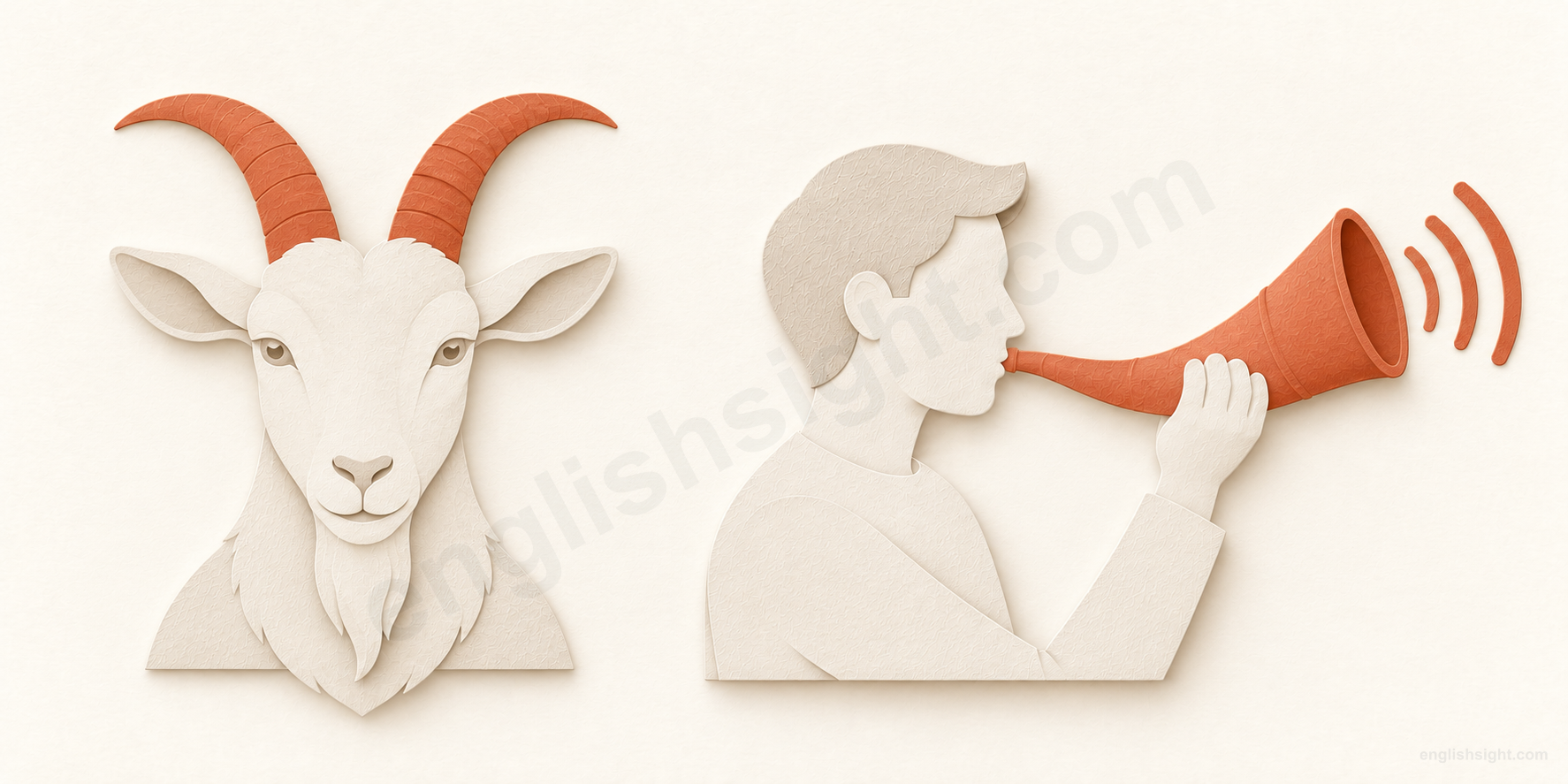
Connect animal horns, materials, and sound, then learn the fixed expressions on their own terms.
Shape and sound form related branches
Shape and sound form related branches
A goat has two hard, curved, pointed horns.
horn
A person blows a separate hollow horn to make sound.
Compare related uses, not stages of a transformation.
Animal horns and sounding horns show related shape and sound uses. Vehicle horns need not have this shape; idioms are learned separately.
A horn can be a hard, pointed animal growth; related uses name its material, objects with a similar shape, and instruments or devices that make sound.
The two outlines compare an animal’s horns with a hollow sounding horn. They are related uses, not before-and-after stages of one object. Modern vehicle horns need not have this shape; idioms require their own explanations.
Horn is usually a noun. It can name a part of an animal, the material of that part, a similarly shaped object, or a device or instrument that makes sound. The situation and accompanying words select the meaning.
The physical shape and sound branches offer useful connections, but they do not explain every fixed phrase by themselves. This lesson uses a teaching model, not a claim about one image shared by every English speaker.
01
Animal horns, material, and shape
Begin with the physical object, then distinguish what something is made of from what it resembles.
01
a horn; plural horns; an animal with + adjective + horns
a horn / horns
a hard, pointed growth on an animal’s head
Situation / starting point
You notice two curved points on a goat’s head.
Meaning / result
You identify them as its horns.
Horn names the growth, not the whole head or any sharp body part.
This is a countable noun: one horn, two horns. A goat with long horns describes a feature the animal has; the horns belong to the goat, so we can also say the goat’s horns.
Horns are often paired and curved, but neither feature is required in every case. A rhinoceros can have a horn on its nose. For a deer’s branching growths, antlers is the more specific word; dictionaries also record horns in broader usage.
The adjective horned means having horns, as in a horned animal. It does not mean that the animal is making a loud noise.
In a sentence
The goat with the curved horns is standing by the gate.
Watch the difference Do not call a tooth or claw a horn just because it is sharp. Horn and antler also do not describe every animal growth equally precisely.
02
be made of horn; horn + noun; horn-rimmed + glasses / spectacles
made of horn / horn-rimmed glasses
the substance of animal horns, or a material resembling it
Situation / starting point
You inspect the material of an old comb.
Meaning / result
You say what the comb is made of.
Uncountable horn names a material; a horn names an individual object.
In made of horn, horn is uncountable: the focus is the substance, not a number of separate horns. Compare The box contains a horn, where a horn is an object you could count.
Horn-rimmed glasses have frames made from material resembling horn. The name does not guarantee that the frames contain real animal horn. Here rim refers to the frame around a lens, not a pointed decoration.
In a sentence
The label says that this old comb is made of horn.
Watch the difference Made of a horn draws attention to a particular horn used as a source; made of horn simply names the material.
03
a horn; a horn-shaped + noun; a horn of plenty
a horn-shaped object
an object or projection resembling an animal horn
Situation / starting point
You see a curved object that narrows toward one end.
Meaning / result
Its form explains why it is called a horn.
Resemblance can give an object its name without making it an animal part.
An old gramophone can have a large horn that flares outward to direct sound. A drinking horn is a vessel; a saddle horn is a projection at the front of a saddle. These uses share a shape connection but serve different purposes.
A horn of plenty, also called a cornucopia, is an artistic image of a horn-shaped container filled with produce or flowers, representing abundance. It is a fixed cultural name, not another name for a musical instrument.
Horn-shaped is useful when you want to describe a resemblance rather than assert that an object is actually a horn. A tapered shape by itself does not make every object naturally called a horn.
In a sentence
A large metal horn projects from the old gramophone.
Watch the difference Horn of plenty is a whole expression. Plenty contributes abundance; horn alone does not mean a large quantity.
02
Signals and music
A horn can be a sound-making device or an instrument. The surrounding words tell you which activity is meant.
04
a car / train horn; the horn + honks / blares; a blast on the horn
a car horn
a device that produces a warning or signal
Situation / starting point
A vehicle has a device for attracting attention.
Meaning / result
The device produces a loud signal when operated.
The device is a horn even when it is hidden and does not look like an animal horn.
This countable use names a vehicle’s signaling device: a car horn or the horn. A horn can also be the subject of a sound verb: A horn blared means a loud horn sound was heard.
A horn blast is a burst of sound, not another device. A foghorn similarly provides an audible warning in fog. The sound connection matters here more than the visible shape.
In a sentence
We heard a train horn before the train came into view.
Watch the difference Horn is the device; honk can name its sound or the act of making that sound. A loud noise is not automatically a horn.
05
sound / honk / toot / blow + the / your horn; honk your horn at + person
sound / honk / toot the horn
operate a horn so that it makes a signal
Situation / starting point
A driver needs to attract someone’s attention.
Meaning / result
The driver makes the horn sound.
The verb describes the action; horn is its noun object.
Sound the horn is a neutral way to describe operating it. Honk the horn and toot the horn are also familiar, with toot often suggesting a short sound. Blow the horn can refer to a vehicle signal too; the driver does not have to blow air into it.
In She honked her horn at me, she is the person making the signal, the horn is the device, and at me identifies the person toward whom the signal is directed. At does not mean the horn moves toward that person.
In a sentence
The driver sounded the horn to warn us that the van was moving.
Watch the difference For neutral general English, say sound the horn or honk the horn rather than treating horn as the ordinary standalone driving verb.
06
play the horn; blow a horn; a French horn; an English horn
play the horn / blow a horn
perform on a wind instrument
Situation / starting point
A musician holds an instrument with a mouthpiece.
Meaning / result
The musician blows into it to produce musical sound.
In music, horn may name a specific instrument or have a broader contextual meaning.
In an orchestra, horn commonly means the French horn, a brass instrument with coiled tubing and a flared bell. A hunting horn is a simpler wind instrument. Play the horn describes musical performance; blow a horn emphasizes producing its sound.
In jazz usage, horn can refer more broadly to a wind instrument, including a trumpet or saxophone. Read the musical context rather than assuming every horn is a French horn.
English horn is a separate instrument name: it is a woodwind instrument related to the oboe, also called cor anglais, especially in British English. It is not simply a French horn from England.
In a sentence
Mina plays the horn in the school orchestra.
Watch the difference Blow the horn may describe music or a warning signal. Context, not blow alone, selects the meaning.
03
Conflict, courage, caution, and intrusion
Learn these expressions as complete patterns. Some suggest animal horns; others suggest making yourself heard. The image alone cannot predict their meanings.
07
blow / toot + possessive + own horn
blow / toot your own horn
draw attention to your own achievements or abilities
Situation / starting point
You have achieved something but others may not know it.
Meaning / result
You tell people about your success.
The whole expression compares self-praise to making yourself heard.
This informal expression is especially North American. It can criticize boasting, but in context it can also encourage someone to give themselves proper credit. The words do not necessarily accuse the person of lying.
Match the possessive to the person: I don’t like to toot my own horn; she is blowing her own horn. Blow your own trumpet is a familiar British alternative. The image of a signal helps memory, but own and the complete expression are essential.
In a sentence
I don’t usually toot my own horn, but I designed the winning poster.
Watch the difference Blow a horn can be literal. Blow your own horn, in a discussion of achievements, is normally figurative.
08
people lock horns; lock horns with + opponent + over + issue
lock horns with someone over something
become involved in a strong disagreement
Situation / starting point
Two people defend opposing views.
Meaning / result
They confront each other in an argument.
The conflict is between people or groups, not necessarily physical.
Two goats can literally lock horns. Applied to people, the expression suggests a direct contest of views or interests. With introduces the opponent; over introduces the disputed issue.
Two managers locked horns describes both participants as the subject. One manager locked horns with the other names one participant first. Neither pattern says who won or whether the disagreement was settled.
In a sentence
The two managers locked horns over the new work schedule.
Watch the difference Keep horns plural in the idiom. Lock a horn is not the usual figurative pattern.
09
take the bull by the horns; took / taken the bull by the horns
take the bull by the horns
deal with a difficult situation directly and decisively
Situation / starting point
You have been avoiding an uncomfortable task.
Meaning / result
You decide to face it and act.
The idiom expresses direct action, not a promise of success.
The bull stands for the problem in this figurative expression. Taking it by the horns presents the person as confronting the difficult part instead of waiting or avoiding it.
The situation may be emotionally awkward rather than physically dangerous. Calling someone to clear up a misunderstanding can qualify. Learn the fixed wording; it is not a literal instruction about handling animals.
In a sentence
I took the bull by the horns and called Jo to discuss our disagreement.
Watch the difference Facing a problem boldly does not mean acting carelessly, and the idiom does not say the problem was solved.
10
be / find yourself on the horns of a dilemma; put someone on the horns of a dilemma
on the horns of a dilemma
faced with a choice between two difficult or unattractive alternatives
Situation / starting point
Each available choice has a serious disadvantage.
Meaning / result
You have difficulty choosing because either option has a cost.
The two horns suggest two unwelcome alternatives, not an ordinary preference.
This is an established idiom, often used in discussion or writing. It pictures a person caught between the alternatives. Be on describes the situation; put someone on describes causing someone to face it.
The alternatives need not be equally bad in a measurable way. What matters is that neither is an easy or welcome choice. Choosing between two enjoyable desserts does not normally call for this strong expression.
In a sentence
We were on the horns of a dilemma: delay the trip or travel without enough money.
Watch the difference Retain the fixed plural horns and the preposition on. Horn by itself does not generally mean a decision.
You have been spending freely or pursuing ambitious plans.
Meaning / result
You reduce your commitments or behave more carefully.
The figurative retreat is a change in behavior, not literal movement of animal horns.
Pull your horns in and draw your horns in can describe scaling back expenditure or ambition. They suggest becoming less bold after a period of greater activity or confidence.
Pull in your horns and draw in your horns are also established word orders. Match the possessive to the subject: a company pulls its horns in; several companies pull their horns in. This is a fixed idiom containing the noun horns, not the phrasal verb horn in.
In a sentence
After sales fell, the shop drew its horns in and postponed the expansion.
Watch the difference It can concern spending or broader caution. Do not assume it always means giving up completely.
12
horn in; horn in on + person / activity / matter
horn in on something
intrude into an activity or matter that is not your concern
Situation / starting point
Other people are having a conversation or dealing with their own business.
Meaning / result
Someone involves themselves without being welcome.
Horn is a verb here; in belongs to the phrasal verb and on introduces the matter.
This informal phrasal verb is especially North American. It describes unwanted involvement, not simply entering a room. You can say Don’t horn in without specifying the activity, or Don’t horn in on our conversation.
The forms are horns in, horned in, and horning in. A pronoun follows on: horn in on it, not horn it in. Compare join in, which can describe welcome participation and does not itself suggest intrusion.
In a sentence
Please don’t horn in on a conversation that has nothing to do with you.
Watch the difference Horn in is not another way to say honk a car horn. Its intrusion meaning belongs to the whole phrasal verb.
Keep the branches and the grammar distinct
Count an object, name a material
Use a horn / horns for individual growths, devices, and instruments. Use uncountable horn for the material: made of horn. A horn-shaped object may be made of something else entirely.
The surrounding verb matters
Sounding a horn can give a warning; playing the horn concerns music. Blowing your own horn can be self-praise. Do not assign the same meaning to every phrase containing blow and horn.
Noun forms and verb forms
The noun plural is horns. In the phrasal verb horn in, the forms are horn, horns, horned, and horning. Do not build an everyday causative or passive family from this intransitive phrasal verb. Less usual standalone verbs meaning supply with horns or strike with a horn are outside the main lesson.
Recognize marked uses without making them your default
On the horn can mean on the telephone in slang; Collins’s separate the horn entry labels the telephone sense old US slang. On the phone is the neutral choice. Geographic names, specialist technical senses, biblical symbolism, archaic senses, and vulgar slang are not expanded here.
Choose the intended meaning
Use the situation and the full expression, not only the shape of a horn.
1. A museum label names the substance used to make a comb. Which sentence focuses on the material?
2. A driver uses a warning device before moving a van. Which sentence fits?
3. Nora says, “I don’t want to toot my own horn, but I solved the problem.” What does she mean?
4. Two colleagues strongly oppose each other’s plans. Which phrase describes the disagreement?
5. A company postpones expensive projects after losing income. Which expression fits this change?
6. Someone keeps interfering in a private discussion. Which request uses the phrasal verb correctly?
7. Leaving a job means losing income, but staying means continuing unsafe work. Which phrase emphasizes the two difficult alternatives?
8. You stop avoiding an awkward conversation and make the call. Which expression emphasizes facing the problem?
Sources and teaching notes
Definitions and usage were checked against the publisher pages below. Explanations, examples, and the diagram are original teaching material; the visual links are a teaching interpretation.
The diagram illustrates related uses; it does not claim a picture shared by every native speaker.