Recognize the animal first, then learn the expressions that grew around it.
An animal’s strength used for carrying or pulling
An animal’s strength used for carrying or pulling
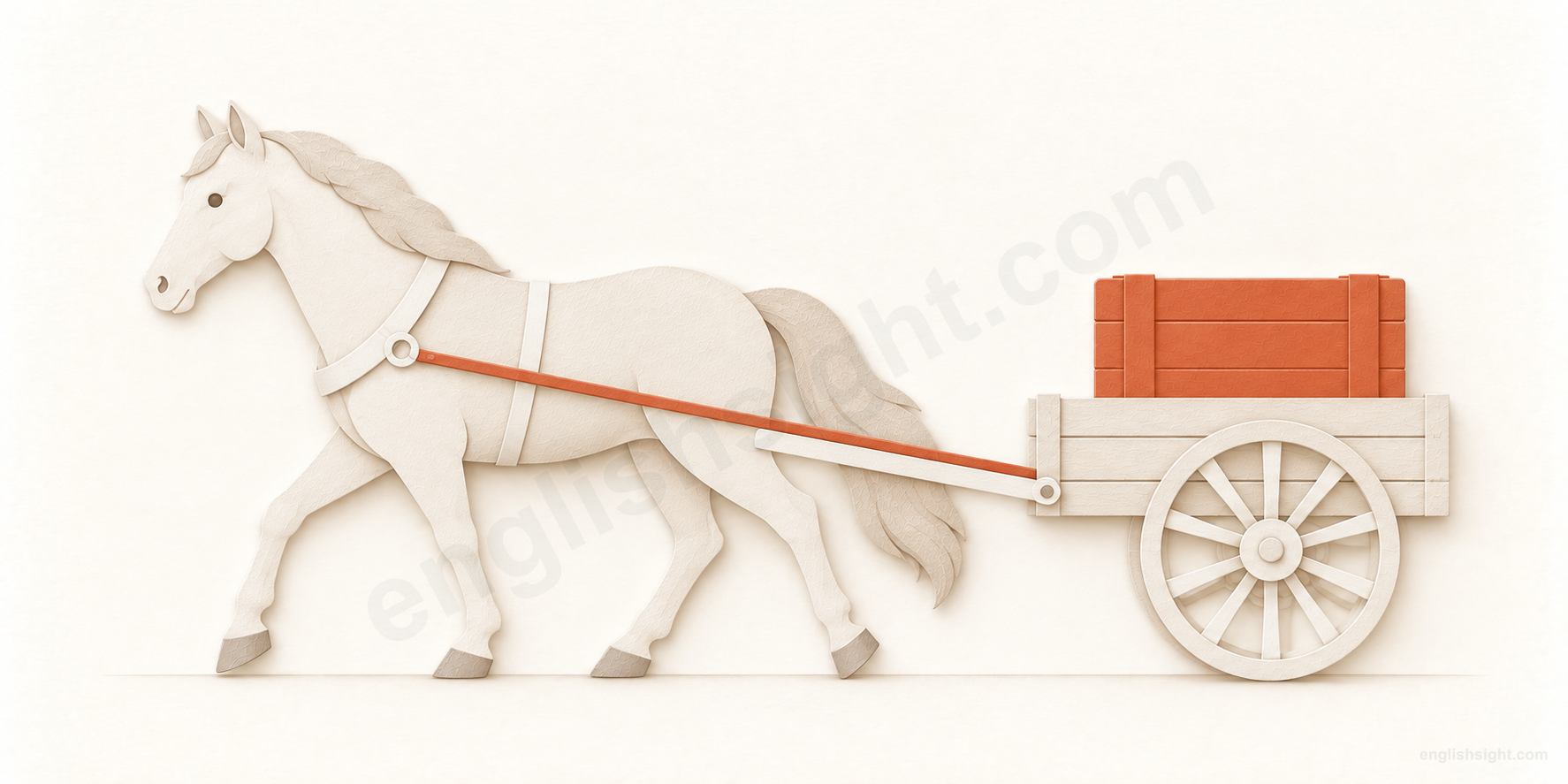
The load rests in the cart behind the horse.
horse
The horse moves the cart; the cart carries the load.
The horse pulls through the connected harness.
The horse provides the pulling force; the cart supports the load.
A horse is a large four-legged animal that can carry a rider or pull a load.
The diagram selects pulling to show the relationship between the animal, its harness, and a load. Riding is another familiar use. The picture identifies a concrete noun and one use of the animal; it does not generate the meanings of the idioms.
Horse usually names the animal: a horse can carry a rider, pull a vehicle, or take part in a race. The noun itself does not specify an action. Verbs such as ride and pull describe the relationship.
English also uses horse in equipment names, established compounds, and vivid expressions about people and choices. These need their own explanations; replacing horse with strength will not explain them. This lesson is a guide to common uses, not a claim about one mental picture shared by all English speakers.
01
The animal, riding, and racing
Start with the countable animal noun. Nearby verbs and prepositions tell you whether someone rides it, it pulls something, or it races.
01
a / the + horse; number + horses
a horse / horses
the animal, without specifying its sex
Situation
You are describing animals in a field.
What the expression conveys
You identify them as horses.
Horse is the ordinary name for the animal; it does not normally mean only a male.
Horse names an animal with hooves, a mane along its neck, and a long tail. Use a horse for one and horses for more than one. Horses can be kept for riding, work, or sport, but the noun does not say that an animal is currently doing any of these things.
A pony is a small type of horse; it is not simply a baby horse. A very young horse is a foal. These distinctions identify type or age, whereas horse is the broader everyday word.
In a sentence
Two horses were resting beside the fence.
Watch the difference The ordinary plural is horses, not horse. Horse is countable: I saw a horse, not I saw horse.
02
ride + a horse; be / get on a horse; get off a horse; on horseback; go horse riding / horseback riding
ride a horse / on horseback
sit on a horse and travel or ride for sport
Situation
You choose a riding activity.
What the expression conveys
You travel sitting on the animal’s back.
The person rides; the horse carries the rider.
Ride a horse takes the animal as the object of ride. Be on a horse describes your position; get on or get off describes entering or leaving that position. On horseback describes the way you travel and needs no article.
Go horse riding is British usage; go horseback riding is a North American alternative. These name an activity, so neither means that you own a horse. Compare drive a horse-drawn carriage: the person controls a vehicle pulled by the horse rather than riding the animal itself.
In a sentence
We explored the valley on horseback.
Watch the difference Say on horseback, not on a horseback. In ride a horse, horse is a noun; ride expresses the action.
03
horse + noun; a horse and cart; horse-drawn + vehicle
a horse and cart / a horse-drawn carriage
a horse provides the force that moves a vehicle
Situation
A cart contains a load.
What the expression conveys
A harnessed horse pulls the cart.
The horse pulls; the cart carries the load.
A horse can pull a cart or carriage. A horse and cart names the connected animal-and-vehicle arrangement. In a horse-drawn carriage, drawn means pulled; it does not mean that someone made a picture of a horse.
Horse also comes before a noun in combinations such as horse trainer and horse trailer. The second noun names the person or thing; horse identifies its connection with horses. The core diagram shows one actual working relationship, not a rule that every compound means pulling.
In a sentence
A horse-drawn carriage waited outside the station.
Watch the difference Keep horse singular in horse trainer, even when the trainer works with several horses.
04
the horses; bet / lose money on the horses; bet on + a horse
the horses / bet on a horse
horse racing, especially in talk about betting
Situation
People are discussing a race meeting.
What the expression conveys
The horses refers to racing rather than a particular herd.
The context distinguishes the sport from the animals.
In informal talk, the horses can stand for horse racing: someone who loses money on the horses has lost it through race betting. Bet on a horse names the animal selected in a particular race.
The horses are in the field is different: there the same plural phrase simply identifies animals. Horse racing names the sport more explicitly. Neither horse racing nor watching a race necessarily involves gambling.
In a sentence
He lost twenty pounds on the horses last weekend.
Watch the difference Read the surrounding verbs. Feeding the horses concerns animals; losing money on the horses concerns race betting.
05
a one-horse / two-horse race
a two-horse race
a contest with only two realistic possible winners
Situation
Several candidates enter an election.
What the expression conveys
Only two have a serious chance of winning.
The number counts serious contenders, not necessarily all entrants.
A two-horse race can describe an election or another competition, without any real horses. It says that two competitors dominate the chances of success. A one-horse race suggests that one competitor is overwhelmingly likely to win.
This is an established racing metaphor. It is not a prediction that two people will both win. When writing the expression before race, hyphenate two-horse and keep horse singular.
In a sentence
The election has become a two-horse race between Patel and Green.
Watch the difference A two-horse race need not have exactly two candidates; it concerns realistic chances.
02
Equipment and established compound nouns
Some names refer to things shaped or used like a horse. Others have separate, conventional meanings: learn the whole compound.
06
be + a workhorse; the workhorse of + a team / system
a workhorse
a working horse, or a dependable person or machine that does much routine work
Situation
A reliable worker or machine handles the everyday load.
What the expression conveys
You emphasize sustained useful work rather than glamour.
The working animal provides a comparison for dependable performance.
A workhorse can literally be a horse used for work, such as pulling a plough. Figuratively it is a person, machine, or vehicle relied on to do a large amount of work, especially routine work.
Our old printer is the office workhorse praises its dependable everyday service. When used about a person, the word can recognize hard work, but it may also suggest that others leave the routine workload to that person. This is an established compound, written as one word.
In a sentence
This small van is the workhorse of our delivery service.
Watch the difference Workhorse does not mean that a machine is the most exciting or advanced model; it emphasizes useful, dependable work.
07
a pommel horse; a vaulting horse; practise on + the horse
a pommel horse / a vaulting horse
a piece of gymnastics equipment
Situation
A sports report mentions a horse.
What the expression conveys
The gymnastics context identifies an apparatus.
This horse is an object used in sport, not an animal.
In gymnastics, a horse is a raised, padded apparatus on legs. A pommel horse has handles that a gymnast supports the body on while moving the legs around. A vaulting horse is equipment used for jumping over.
The longer names distinguish kinds of apparatus. The animal picture offers a rough resemblance in shape and support, but it does not tell you how each event works; learn the sport’s full equipment name.
In a sentence
The gymnast practised a new routine on the pommel horse.
Watch the difference Do not treat pommel horse and vaulting horse as names for the same exercise.
08
a rocking horse; a hobby horse; plural rocking horses / hobby horses
a rocking horse / a hobby horse
toys on which children pretend to ride
Situation
A child wants to play at riding.
What the expression conveys
The child rides a toy rather than a living animal.
The toy imitates the shape or riding role of a horse.
A rocking horse is a horse-shaped toy that moves backwards and forwards as a child sits on it. A hobby horse can instead be a stick with a horse’s head at one end, held between the legs for pretend riding.
These are countable compound nouns: two rocking horses, with the plural ending on horses. Hobby horse also has a figurative topic meaning, taught separately below. A rocking horse does not normally have that figurative meaning.
In a sentence
The child rocked gently on her wooden rocking horse.
Watch the difference A hobby horse toy is not simply any hobby connected with horses.
09
a clothes horse; put clothes on + a clothes horse; be + a clothes horse
a clothes horse
a drying frame, or a person strongly interested in fashionable clothes
Situation
You read a household description or a comment about someone.
What the expression conveys
The context chooses between a rack and a person.
The same compound has two established meanings.
In British English, a clothes horse is a folding frame used to dry washed clothes indoors. For example, We put the wet towels on the clothes horse. Drying rack is an alternative name that makes the function explicit.
A person called a clothes horse is very interested in wearing fashionable clothes: Bea is a real clothes horse; she loves putting outfits together. That label comments on someone’s image and can sound dismissive; it does not mean a person employed to wash clothes.
In a sentence
We unfolded the clothes horse beside the window.
Watch the difference Keep clothes in the compound. A cloth horse would suggest a horse made of fabric.
10
get / have + a charley horse; a charley horse in + a muscle or body part
a charley horse
an informal North American name for a muscle cramp
Situation
Someone reports sudden tight muscle pain.
What the expression conveys
The phrase names a cramp rather than an animal.
This compound has its own meaning; horse alone cannot predict it.
A charley horse is a muscle cramp, often mentioned in connection with a leg. It is North American informal English, so cramp is a more widely understood choice across regions.
For this meaning, use the complete expression with an article: I got a charley horse. Learning its meaning lets you understand someone’s description; the expression itself gives no explanation of the cause or what to do about it.
In a sentence
I got a charley horse in my calf during the game.
Watch the difference A charley horse is not a kind of horse or a general name for any leg injury.
11
a Trojan horse; a Trojan horse for + a hidden purpose
a Trojan horse
something accepted under a harmless appearance that hides a harmful purpose
Situation
An apparently useful offer gains someone’s trust.
What the expression conveys
It enables an unwanted hidden action.
The whole compound expresses concealed danger behind an acceptable appearance.
A Trojan horse can be a person or thing used to gain access or achieve a hidden purpose through deception. In computing it is a program that appears useful but is designed to do harm. For example, The free game turned out to contain a Trojan horse.
The expression recalls the story of soldiers hidden inside a wooden horse brought into Troy. Its meaning depends on that established story, not on a general meaning of horse as dangerous. A merely disappointing product is not automatically a Trojan horse: concealment and deception matter.
In a sentence
Critics called the proposal a Trojan horse for removing local control.
Watch the difference Do not use Trojan horse for every computer fault; the phrase concerns a deceptive harmful program or a comparable concealed purpose.
12
be + someone’s hobby horse; get on + one’s hobby horse
a hobby horse
a favourite subject someone repeatedly talks about
Situation
A familiar subject comes up again.
What the expression conveys
Someone returns to their strongly held concern.
The topic meaning is distinct from the riding toy.
A hobby horse is a subject that someone feels strongly about and returns to in conversation. Saying Parking is his hobby horse suggests that he talks about parking a great deal, sometimes more than others welcome.
Get on your hobby horse means start talking about that favourite concern. Compare get on your high horse, which criticizes a superior attitude instead. A hobby horse need not be a leisure activity, so it is not interchangeable with hobby.
In a sentence
The bus timetable is her hobby horse; she brings it up at every meeting.
Watch the difference This can sound disapproving. Do not use it as a neutral label for every topic someone enjoys.
13
have / show / use + horse sense; some horse sense
horse sense
practical good judgment about everyday situations
Situation
A decision needs a sensible, practical response.
What the expression conveys
You praise sound judgment rather than specialist knowledge.
The whole compound means common sense, not knowledge of horses.
Horse sense is an informal expression for common sense: practical judgment that helps someone handle ordinary situations. The American dictionary labels it US informal; common sense is the more neutral alternative.
Use horse sense as an uncountable noun: She showed horse sense by checking the cost first. Have some horse sense asks someone to be sensible and may sound impatient. The meaning belongs to the whole compound; the animal-and-cart diagram does not explain a theory of intelligence.
In a sentence
It was simple horse sense to check the weather before setting out.
Watch the difference Say some horse sense, not a horse sense, for this meaning. It does not mean expertise in riding or caring for horses.
14
a one-horse town; describe + a place + as a one-horse town
a one-horse town
an informal, dismissive description of a small town with little to do
Situation
Someone finds a small town dull or lacking facilities.
What the expression conveys
They describe it from that negative viewpoint.
One-horse describes limited activity, not the town’s actual number of horses.
A one-horse town is a small town with few interesting places or activities. Calling a place this suggests that the speaker finds it dull or unimportant, so it can offend people who live there.
This is a fixed informal description, not an objective term for every small town. Compare a one-horse race: that expression concerns one likely winner, whereas a one-horse town concerns a place with little going on. The shared words do not make the meanings interchangeable.
In a sentence
He called it a one-horse town because there was nowhere to go in the evening.
Watch the difference Keep horse singular in one-horse, but put the plural on town: two one-horse towns. A small town need not deserve this critical label.
03
Play, appetite, information, and attitude
These familiar expressions solve different conversational tasks. Most are informal; their meanings belong to the whole phrase.
15
horse around / about; horse around with + someone; stop + horsing around; horseplay (uncountable noun)
horse around / horse about
play roughly or fool about instead of being serious
Situation
People are joking and pushing each other.
What the expression conveys
Their careless play risks damage or injury.
Horse is a verb here; around is part of the established expression.
Horse around is informal and usually describes noisy, rough, or careless play. Horse about is also used in British English. Horse around with someone names the other participants; it does not take them as a direct object.
American usage can also mean spending time in pointless fooling about: Stop horsing around and finish the packing. The forms are horses around, horsed around, and horsing around. Unlike the ordinary animal noun, this is a genuine phrasal verb.
Horseplay is the related uncountable noun for rough, noisy play: The teacher stopped the horseplay near the stairs. Use horseplay to name the activity and horse around to say what people are doing; do not say a horseplay for this meaning.
In a sentence
Please stop horsing around near the glass table.
Watch the difference Say They were horsing around with us, not They were horsing us around for this meaning.
16
hold + possessive + horses
Hold your horses!
wait and avoid rushing into action
Situation
Someone is about to act too quickly.
What the expression conveys
You ask them to pause.
The whole imperative slows a person down; no real horses are needed.
Hold your horses! is an informal way to tell someone to wait, calm down, or think before acting. The possessive matches the person: tell Leo to hold his horses, but say Hold your horses! when speaking directly to him.
The picture of restraining horses can help you remember the pause. It does not mean stop everything permanently. Depending on tone and relationship, the phrase can sound friendly, teasing, or impatient; Please wait a moment is more neutral.
In a sentence
Hold your horses—we haven’t checked the address yet!
Watch the difference Use plural horses in the idiom. Hold your horse could instead be a literal instruction about one animal.
17
eat like + a horse; I could eat + a horse
eat like a horse / I could eat a horse
eat a lot, or say you are extremely hungry
Situation
You discuss someone’s appetite or your own hunger.
What the expression conveys
The horse comparison exaggerates quantity.
Eating a large amount and feeling very hungry are related but different claims.
Eat like a horse describes eating a lot: After training, Maya eats like a horse. It can describe a habit or a particular meal; it does not mean eating grass or eating without table manners.
I could eat a horse is humorous exaggeration meaning I am extremely hungry. For example, We have walked all morning; I could eat a horse. Could does not report a real plan to eat an animal. Both expressions are informal.
In a sentence
After the long hike, I could eat a horse.
Watch the difference He eats like a horse describes how much he eats; He could eat a horse emphasizes his hunger at that moment.
18
hear / get + information + (straight) from the horse’s mouth
(straight) from the horse’s mouth
information directly from someone in a position to know
Situation
You hear a report from the person concerned.
What the expression conveys
You emphasize that it did not come through a chain of gossip.
The expression identifies the source of information.
Hear or get something straight from the horse’s mouth presents it as coming from the person involved or an authoritative original source. Straight strengthens the idea of directness; it is optional.
The horse in this fixed phrase is not a label you normally use for that person outside the expression. The phrase supports a claim of reliable access, but it is not evidence that the source is incapable of making a mistake.
In a sentence
I heard straight from the horse’s mouth that Jo is moving abroad—Jo told me herself.
Watch the difference Keep from and the possessive horse’s mouth. This means a direct source, not merely a story about horses.
19
be / get on + possessive + high horse; about + a topic; get off + possessive + high horse
be / get on your high horse; get off your high horse
act superior, or stop acting that way
Situation
Someone criticizes others from a superior position.
What the expression conveys
You object to the attitude.
High is part of a fixed expression about superiority, not physical height.
Be on your high horse describes acting as if you are better than other people. Get on your high horse describes starting to adopt that attitude. It often appears when someone makes self-righteous criticisms.
The possessive follows the person: He got on his high horse. This is a critical description, not praise for confidence. Compare her hobby horse, a topic she repeatedly discusses; one phrase concerns attitude and the other a favourite subject.
Get off your high horse asks someone to stop acting superior: Get off your high horse and listen to their side. Off reverses the attitude described by on in this established expression; it is not a literal instruction to dismount. The direct command can sound confrontational.
In a sentence
He got on his high horse about punctuality, although he had arrived late himself.
Watch the difference Calling someone self-righteous can provoke an argument; use this informal criticism with awareness of tone.
20
be + a dark horse; a dark horse for + a prize or position
a dark horse
a little-known person with surprising qualities or chances
Situation
You know little about someone’s abilities.
What the expression conveys
They reveal an unexpected talent or become a serious contender.
Dark refers to what is not widely known, not to appearance or dishonesty.
In a contest, a dark horse is a little-known contender who may surprise people by succeeding: The new team is a dark horse for the title. The phrase describes expectations, not a guarantee that the team will win.
Especially in British conversation, a person can also be a dark horse because they keep interesting abilities or facts private: You’re a dark horse—I had no idea you played the violin. No competition is needed in this second use.
In a sentence
Rina is a dark horse—I only just learned that she has written two novels.
Watch the difference A dark horse is not necessarily dishonest or dangerous. Do not confuse it with a black horse, which describes an animal’s colour.
04
Choices, order, and the limits of effort
Horse imagery appears in advice about planning and people. Read the complete expression rather than translating horse as a general word for strength.
21
put + the cart + before the horse; doing X before Y + is putting the cart before the horse
put the cart before the horse
do things in the wrong practical or logical order
Situation
A plan skips a necessary earlier step.
What the expression conveys
You point out that the sequence needs changing.
The full idiom concerns order, not simply a bad decision.
Putting the cart before the horse means doing a later step before something that should come first. The literal horse-and-cart arrangement makes the order memorable, but the idiom can describe money, planning, learning, or reasoning.
The person or action causing the wrong order can be the subject. Booking a large hall before checking attendance is putting the cart before the horse. This criticizes the sequence, without necessarily rejecting the final goal.
In a sentence
Ordering equipment before we know the room size is putting the cart before the horse.
Watch the difference Before is essential: the problem is doing the later step too early.
22
not / never + look a gift horse in the mouth
Don’t look a gift horse in the mouth.
avoid finding fault with a free gift or benefit
Situation
Someone receives something without paying.
What the expression conveys
You encourage appreciation rather than complaint.
This is a conventional warning about criticizing a gift.
Look a gift horse in the mouth means examine or criticize a free gift in a way that seems ungrateful. It is usually used negatively: I won’t look a gift horse in the mouth. The familiar instruction tells someone not to complain.
The expression recalls checking a horse’s teeth to judge its age. You can use it about a free ticket or an unexpected opportunity, but it does not make every free offer valuable or trustworthy.
In a sentence
The free seat was near the back, but I wasn’t going to look a gift horse in the mouth.
Watch the difference Keep the negative when giving the familiar advice. Looking a gift horse in the mouth names the criticism, not the gratitude.
23
be + flogging / beating a dead horse
flog / beat a dead horse
keep wasting effort on something that cannot now be changed or achieved
Situation
People keep pushing a failed proposal or repeating a settled argument.
What the expression conveys
You say further effort will get nowhere.
The dead-horse image represents effort that cannot produce the intended response.
Flog a dead horse, particularly British English, and beat a dead horse, especially North American English, describe futile persistence. They can concern an impossible goal or endlessly returning to an issue that is already finished.
The full phrase is a criticism of continuing, not a claim that all difficult work is pointless. In We’re beating a dead horse by asking again after the final rejection, the finality of the decision explains why the effort is futile.
In a sentence
They have permanently closed the grant scheme; another appeal would be flogging a dead horse.
Watch the difference A hard but achievable task is not automatically a dead horse. The expression suggests that further effort cannot usefully succeed.
24
back + the wrong horse
back the wrong horse
support the person or option that fails
Situation
You choose a candidate or plan to support.
What the expression conveys
That choice turns out badly.
Back means support here; horse supplies the racing comparison.
Literally, backing the wrong horse can mean betting on a horse that loses. Figuratively, it means supporting the losing or unsuccessful side, such as a candidate, organization, or project.
We backed the wrong horse is usually a judgment about the choice in light of results. It does not describe physically standing behind a horse, and it does not necessarily accuse the chosen person of behaving wrongly.
In a sentence
We backed the wrong horse when we invested in the firm that later collapsed.
Watch the difference Wrong describes the unsuccessful choice from the supporter’s viewpoint; it need not mean immoral.
25
it’s horses for courses; a case of horses for courses
horses for courses
choose people or approaches that suit particular tasks
Situation
Different tasks require different abilities.
What the expression conveys
You match the choice to the situation.
Suitability depends on the task; one choice need not be best for everything.
Horses for courses is a British expression used when different people or things are suitable for different situations. It can explain why one person is chosen for a presentation and another for detailed research.
Learn it as a fixed plural expression, often in It’s horses for courses or a case of horses for courses. Courses here belongs to the racing image, not a literal claim about taking educational courses. The expression can support a sensible match rather than rank one person as better overall.
In a sentence
It’s horses for courses: Sam handles live demos, while Lee writes the technical guides.
Watch the difference Do not change the fixed plurals to horse for course. This is about matching, not simply choosing a winner.
26
change horses in midstream
change horses in midstream
change a plan, system, or allegiance after work has begun
Situation
A project is already underway.
What the expression conveys
Someone proposes switching the method or person being supported.
Midstream places the switch in the middle of an existing undertaking.
The expression can describe changing systems, leaders, or support while something is already in progress. A warning not to change horses in midstream highlights disruption or risk from switching at that stage.
The idiom does not prove that a change would be wrong: We had to change horses in midstream can report a necessary switch. What matters is that the work or commitment has begun, unlike a choice made before starting.
In a sentence
We kept the same booking system rather than change horses in midstream.
Watch the difference The plural horses is fixed. Midstream is figurative; no actual river is required.
27
close / lock the stable door after the horse has bolted; close the barn door after the horse has escaped
close the stable door after the horse has bolted
try to prevent a problem after it has already happened
Situation
A loss or failure has occurred.
What the expression conveys
Someone introduces the measure that could have prevented it.
The contrast is between useful prevention beforehand and an action taken too late.
This British saying criticizes prevention that comes after the damage. A North American version uses the barn door after the horse has escaped. Bolted means ran away here; it does not mean the door was fastened with a bolt.
The saying can describe introducing a rule after a loss that the rule would have prevented. It does not necessarily mean the rule can never protect anyone in the future; it emphasizes that it cannot prevent the particular event that has already happened.
In a sentence
Installing the alarm after the tools were stolen felt like closing the stable door after the horse had bolted.
Watch the difference The event comes before the attempted prevention. Do not read bolted as a description of a locked door.
28
wild horses couldn’t / wouldn’t drag + person + place; wild horses wouldn’t make + person + verb
Wild horses couldn’t drag me…
nothing would persuade me to go or take part
Situation
Someone suggests an activity you strongly reject.
What the expression conveys
You emphasize your refusal.
Wild horses intensifies the imagined force; the expression is emphatic exaggeration.
Wild horses couldn’t drag me there means I am completely unwilling to go. Related forms use wouldn’t and make someone do something. The context supplies the unwanted place or action.
For example, Wild horses wouldn’t make me enter that singing contest expresses a strong refusal, not literal resistance to animals. This is vivid informal language; it is stronger than I’d rather not.
In a sentence
Wild horses couldn’t drag me onto that stage.
Watch the difference Keep the negative. Wild horses could drag me says something different and loses the usual emphatic refusal.
29
you can lead a horse to water, but you can’t make it drink
You can lead a horse to water, but you can’t make it drink.
providing an opportunity does not ensure someone will choose to use it
Situation
You offer help, access, or an opportunity.
What the expression conveys
The other person still has to be willing to act.
The proverb separates what a helper can provide from another person’s willingness.
This saying comments on the limits of helping or persuading someone. In a learning context, providing books or arranging a class does not ensure that the learner will want to participate.
Learn the whole proverb. Lead someone to an opportunity and make someone act have different roles in it. Its general point is about willingness; it does not say that support is useless or that every failure proves a lack of effort.
In a sentence
I offered Dan free lessons, but he never came—you can lead a horse to water, but you can’t make it drink.
Watch the difference In make it drink, use the bare verb drink, not to drink. The proverb describes a limit of persuasion, not a universal explanation of failure.
30
that’s / X is + a horse of another / a different colour (US color)
a horse of a different colour
a substantially different matter
Situation
Two situations initially seem comparable.
What the expression conveys
You mark a difference that changes how they should be considered.
The complete idiom signals a different issue, not a different opinion about an animal.
A horse of another colour or a horse of a different colour means a different matter. The American spelling is color. It is often introduced by That’s to contrast a new situation with the one just discussed.
For example, Borrowing the hall is easy; paying to renovate it is a horse of a different colour contrasts permission with a much larger financial commitment. The expression itself does not say the second situation is better or worse, only substantially different.
In a sentence
A short visit is easy, but moving there permanently is a horse of a different colour.
Watch the difference Learn the complete phrase. Different colour alone normally describes an actual colour difference.
Keep the noun, the grammar, and the idiom apart
A horse is not a general verb for riding
Say I ride a horse or I go horse riding. The everyday verb expression horse around means fool about; it does not mean travel on a horse. Older or specialist standalone verb senses such as supplying horses are outside this course.
Count and pronunciation
The ordinary singular is horse and plural horses. British horse is /hɔːs/; American horse is /hɔːrs/, with a pronounced r in typical rhotic speech. Horses adds a syllable, /ɪz/. Do not confuse the noun horse with hoarse, an adjective describing a rough voice.
Not every meaning follows from a picture
Carrying, pulling, and racing make several expressions memorable. Charley horse and Trojan horse have established compound meanings; the idioms also need to be learned as whole phrases. The drawing shows one concrete relationship and does not explain every expression.
Scope and tone
This lesson includes everyday animal uses, racing, gymnastics, useful compounds, and a selection of familiar idioms. It does not cover every breed, riding technique, proverb, or specialist use. Many figurative expressions are informal, and comments such as high horse can sound critical.
Read the whole expression
Choose the expression that matches the situation, then compare the feedback.
1. You traveled through the valley sitting on a horse. Which wording fits?
2. A friend starts booking before you have agreed on the date. You want a brief pause. What fits?
3. The director herself tells you the opening date. How can you describe your source?
4. You are very hungry after a long walk, but have not eaten yet. Which expression states your hunger most directly?
5. A quiet colleague reveals a surprising musical talent. What can a dark horse mean here?
6. Someone orders furniture before measuring the room. Which criticism concerns the order of steps?
Sources and teaching notes
The dictionary pages below support the usages and regional labels. Explanations, situations, examples, and the diagram were created for this lesson; the visual connection is a teaching aid.
The picture explains the animal and a working relationship; idioms need their own context.