Use hospital for the institution, then choose words for getting care, visiting, or describing its services.
Medical care within an institution
Medical care within an institution
A patient needs medical care.
hospital
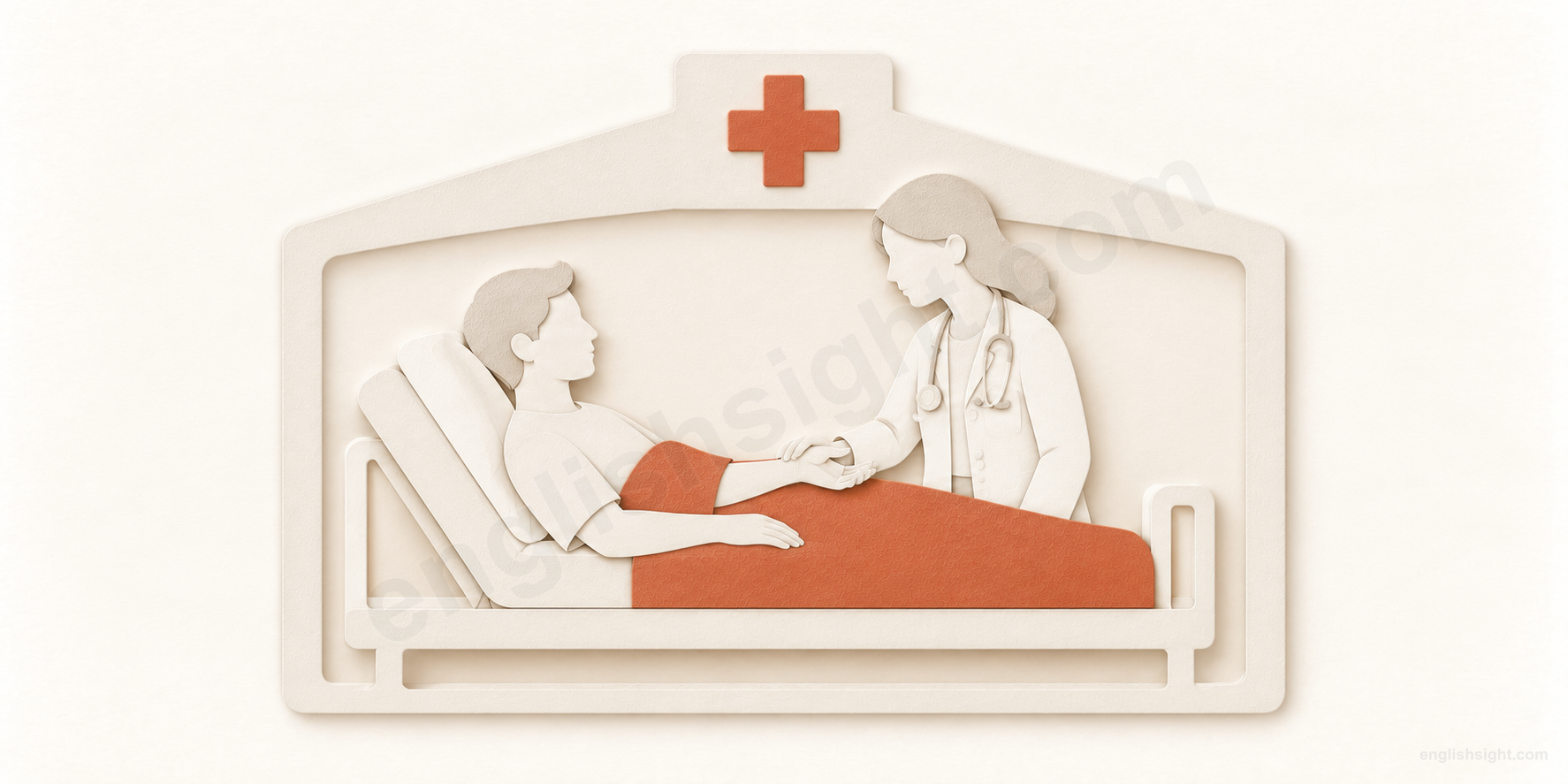
The patient receives care within a medical institution.
A clinician checks the patient’s wrist in a hospital bed.
A hospital brings patients, staff, and facilities together for medical care.
A hospital is an institution where people who are ill or injured receive medical treatment and care.
The bedside scene illustrates one kind of hospital care. Hospitals also provide appointments and tests without an overnight stay. The drawing does not predict recovery or explain every extended shop name.
A hospital brings patients, medical workers, and facilities together for treatment and care. The useful connection is its purpose, not a particular building shape.
Learn the whole expression: going to a hospital, being a patient there, working there, and leaving are different situations. British and American English sometimes choose different articles for the same situation.
01
A place organized for medical care
Hospital names an institution as well as its building. Start with its purpose, then distinguish it from a particular clinic.
01
a / the + hospital; plural hospitals
a hospital / hospitals
an institution providing medical care
Situation / need
Someone needs medical care.
Care / location / result
A hospital provides organized treatment and care.
The defining link is between patients and medical care, not just a large building.
Hospital is a noun. Use a hospital for one unspecified institution, the hospital when the listener can identify it, and hospitals for more than one: Our town has two hospitals.
The institution can also be the subject of an action: The hospital has opened a new wing. Here hospital refers to the organization, not a building acting by itself. The medical sense does not promise a cure.
For directions, ask Where is the nearest hospital? Nearest selects the closest one. Hospital is capitalized when it belongs to an official name; article use with names follows the particular name.
In a sentence
A new hospital is opening near the station.
Watch the difference Say a hospital, not an hospital: the h is pronounced.
02
a hospital clinic; an appointment at the hospital
a hospital clinic
a clinic that forms part of a hospital
Situation / need
A patient has a specialist appointment.
Care / location / result
The patient attends the hospital’s eye clinic.
A clinic can be part of a hospital; the words do not divide all facilities by size.
A clinic can be a place for particular treatment or advice within a hospital, or a separate facility. In some uses it can even mean a private or specialist hospital. Do not learn a rigid rule that every clinic is a small hospital.
Outpatient names a person who receives treatment without staying in hospital. For example: I have an outpatient appointment at the hospital. Going there for care does not necessarily mean spending the night.
In a sentence
My appointment is at the hospital’s eye clinic.
Watch the difference Hospital is the whole institution here; clinic names the particular service or place.
02
Going, staying, visiting, and leaving
The verb gives the event, the preposition gives the relationship, and the article partly depends on British or American usage.
03
go / take someone / be taken + to (the) hospital
go to (the) hospital
go there for medical attention
Situation / need
A person needs examination or treatment.
Care / location / result
The hospital is the destination.
To marks the destination; go does not itself say whether the person will stay.
For a patient’s journey, British English commonly uses go to hospital; American English normally uses go to the hospital. These are two regional patterns for the same purpose.
Take someone to hospital / to the hospital identifies someone who transports or accompanies the patient. Be taken to uses the passive; be rushed to adds urgency. None of these makes hospital a verb.
In a sentence
The ambulance took Leo to the hospital for tests.
Watch the difference The hospital is also normal British English when a particular hospital is meant. The is not proof that someone is only visiting.
04
be / stay in (the) hospital; spend + time + in (the) hospital
be / stay in (the) hospital
receive care while staying there
Situation / need
A patient has begun a period of hospital care.
Care / location / result
The patient remains there for treatment.
In (the) hospital commonly describes the patient’s situation.
British She is in hospital and American She is in the hospital can both mean that she is there as a patient. Stay in and spend time in describe the duration: He spent three nights in the hospital.
In the hospital can also mean physically inside the building: I left my umbrella in the hospital. Read the subject and context; the article alone does not identify a patient. Staying there does not necessarily mean the condition is getting worse.
In a sentence
Maya spent two nights in hospital after the operation.
Watch the difference Use in for this patient-status pattern; do not replace it mechanically with to.
05
at a / the hospital; work in a hospital; visit someone in (the) hospital
at the hospital / in a hospital
identify a location for work or a visit
Situation / need
A visitor needs to find a friend.
Care / location / result
The friend is identified by the hospital location.
Being at a hospital does not by itself say why a person is there.
At the hospital treats the hospital as a location: I’ll meet you at the hospital. A patient, employee, or visitor could be there. In a hospital can describe a workplace or the inside of a building: My sister works in a hospital.
When a British speaker goes there to visit someone, going to the hospital is natural. Compare visiting the hospital with visiting a patient in hospital: one names the destination; the other identifies the person’s situation.
In a sentence
I’m at the hospital to visit my aunt.
Watch the difference At does not mean outside, and in does not always mean receiving treatment. Context matters.
06
admit someone to / into (the) hospital; be admitted to / into (the) hospital
be admitted to (the) hospital
be formally received as a patient
Situation / need
The hospital assesses someone’s need for care.
Care / location / result
The person is accepted as a patient.
Admission concerns receiving someone for care, not simply walking through the entrance.
The hospital admitted her to the ward focuses on the institution’s action. She was admitted to the hospital focuses on the patient. In this medical use, admit is not confessing something.
Admission to hospital / admission to the hospital is the related noun phrase. British go into hospital can describe entering for a period of care. Merely visiting a reception desk does not establish that someone has been admitted.
In a sentence
They admitted Rosa to the hospital on Monday.
Watch the difference Say admitted to the hospital, not admitted in the hospital, when naming the institution receiving the patient.
07
leave (the) hospital; be discharged / released from (the) hospital; be out of (the) hospital
leave / be discharged from (the) hospital
end a hospital stay
Situation / need
A patient is staying under the hospital’s care.
Care / location / result
The hospital authorizes departure, or the patient leaves.
Leave describes departure; discharge identifies an official decision to release a patient.
The hospital discharged him and He was discharged from the hospital describe the same event from different viewpoints. Leave hospital / leave the hospital is less specific about authorization; a visitor can leave too.
Be out of hospital / out of the hospital can report that a patient’s stay has ended. It need not mean standing outside the door. Discharge does not by itself say that every health problem has disappeared or that no further care is needed.
In a sentence
Omar was discharged from the hospital, but he still needs follow-up visits.
Watch the difference Use from after discharged when naming the hospital being left. Do not confuse discharge with admission.
03
People, spaces, stays, and hospital types
Hospital can identify what another noun relates to. Words before hospital can identify patients, services, or a special role.
08
hospital + staff / worker / ward / room
hospital staff / a hospital ward
name workers and spaces associated with a hospital
Situation / need
You need to ask about a patient.
Care / location / result
Hospital staff direct you to the appropriate ward.
The second noun says whether you mean people or part of the institution.
Hospital staff are the people who work for the hospital. Hospital does not limit this expression to doctors: the staff also includes people with other jobs.
A hospital ward is a room or area for a group of patients, often with a shared type of condition. A hospital room is a room in the hospital; it is not another word for the whole hospital. Hospital stays singular before these nouns: hospital workers, not hospitals workers.
In a sentence
A member of the hospital staff showed us the children’s ward.
Watch the difference A hospital worker works for the institution; a hospital patient receives its care.
09
a hospital bed; number + hospital beds
a hospital bed
a bed for a patient, or a measure of hospital capacity
Situation / need
A report discusses the resources available for patients.
Care / location / result
Beds are counted as part of that capacity.
A hospital bed can be furniture or a unit in reporting care resources.
A hospital bed is a bed used for patient care; the expression can also name the adjustable type of bed even when it is used elsewhere.
In a report about hospital resources, more hospital beds concerns capacity for patients. In this example, thirty hospital beds does not mean thirty hospitals: the plural noun being counted is beds.
In a sentence
The new wing will have thirty hospital beds.
Watch the difference Do not assume that counting beds gives the number of buildings.
10
a + adjective + hospital stay; hospital care / treatment / visit / bill
a hospital stay / hospital care
describe time spent there and the care provided
Situation / need
You explain someone’s recent treatment experience.
Care / location / result
You name a period of care and what it involved.
Stay counts a period; care names the service.
A hospital stay is a period spent there as a patient: She had a short hospital stay. Stay is countable here. Hospital care and hospital treatment describe care or treatment provided in the hospital setting.
Hospital visit is broader than hospital stay: someone might attend an appointment or visit a relative and leave the same day. Hospital bill names the charges; a bill is not itself treatment. The relationship comes from the second noun, not a new meaning of hospital for each combination.
In a sentence
The insurance paid for her hospital care during a three-day hospital stay.
Watch the difference Say a three-day hospital stay, with day singular in the duration modifier.
specify a hospital’s patients, services, or additional role
Situation / need
You need to describe what kind of hospital it is.
Care / location / result
A modifier identifies the relevant group or purpose.
Modifiers narrow the institution’s role without changing the central medical meaning.
A children’s hospital treats children. A maternity hospital specializes in care connected with pregnancy and childbirth; a psychiatric hospital provides care for mental health conditions. These modifiers distinguish services or patients.
A teaching hospital is linked to a medical school and provides medical education as well as care. It is still a hospital that treats patients. Local and private describe other aspects of an institution, rather than a different treatment action.
In a sentence
She works at a teaching hospital linked to the university.
Watch the difference A children’s ward is part of a hospital; a children’s hospital is an institution.
04
Care for animals and a repair-shop extension
The ordinary medical meaning extends to animal care. A doll hospital uses an established repair metaphor, not literal medical treatment.
12
an animal / veterinary hospital; take an animal to a veterinary hospital
an animal / veterinary hospital
a hospital for animals
Situation / need
An animal needs treatment.
Care / location / result
A veterinary facility provides care.
The patient group changes from people to animals.
Animal hospital and veterinary hospital make the patient group explicit. The care relationship is still medical: veterinary professionals treat animals.
For example, We took our cat to an animal hospital names the destination. The phrase does not mean a hospital staffed by animals. In ordinary conversation about a person’s care, hospital alone normally has the human medical meaning.
In a sentence
We took our injured cat to a veterinary hospital.
Watch the difference Veterinary describes animal medical care; do not use doll hospital for this meaning.
13
doll / clock + hospital
a doll / clock hospital
a repair shop for a specified kind of object
Situation / need
A small object is damaged.
Care / location / result
A specialist repairs it.
Care for a damaged object is compared with care for a patient.
Doll hospital and clock hospital can name repair businesses. This is an established extension of hospital, not medical treatment of a living patient. The object modifier makes the repair meaning clear.
This use is worth recognizing in a shop name, but repair shop is a more straightforward general description. Do not assume that any noun placed before hospital automatically makes an established expression.
In a sentence
The doll hospital repaired the toy’s broken arm.
Watch the difference Hospital by itself usually suggests medical care, not a general repair business.
Keep the institution and the construction distinct
British and American articles
British in hospital and to hospital commonly concern being or becoming a patient. American English normally uses the in these patterns. Both varieties use ordinary a / the when describing particular institutions; do not treat the as a universal visitor signal.
Noun grammar
Hospital is a noun, plural hospitals. Before another noun it usually stays singular: hospital rooms. The verbs in be admitted, be taken, and be discharged supply the actions. These are not phrasal verbs made from hospital.
A useful picture with limits
A patient receiving care explains the main medical meaning. Animal hospitals change the patient group; doll hospitals use a repair metaphor. Older charitable-institution senses and specialist terms such as hospital pass and hospital corners are outside this everyday lesson.
Choose the expression for the situation
Look at the person’s role, the regional pattern, and what the sentence actually says.
1. In ordinary American English, say that your brother is staying as a patient. Which expression fits?
2. A British speaker is going to visit a relative, rather than receive treatment. Which sentence states that purpose clearly?
3. The hospital formally receives Noor as a patient. Which sentence describes that event?
4. A report says a new wing has twenty hospital beds. What does twenty count?
5. A doll hospital fixes a toy’s damaged hand. What does hospital mean here?
Sources and teaching notes
Dictionary entries support the uses listed here. Explanations, examples, and the visual model were written for this lesson. Related entries clarify admission, discharge, clinics, and hospital compounds.
The diagram is a teaching aid, not a shared mental picture attributed to every English speaker.