Start with sixty minutes, then distinguish durations, clock times, schedules, and important occasions.
One interval, sixty minutes
One interval, sixty minutes
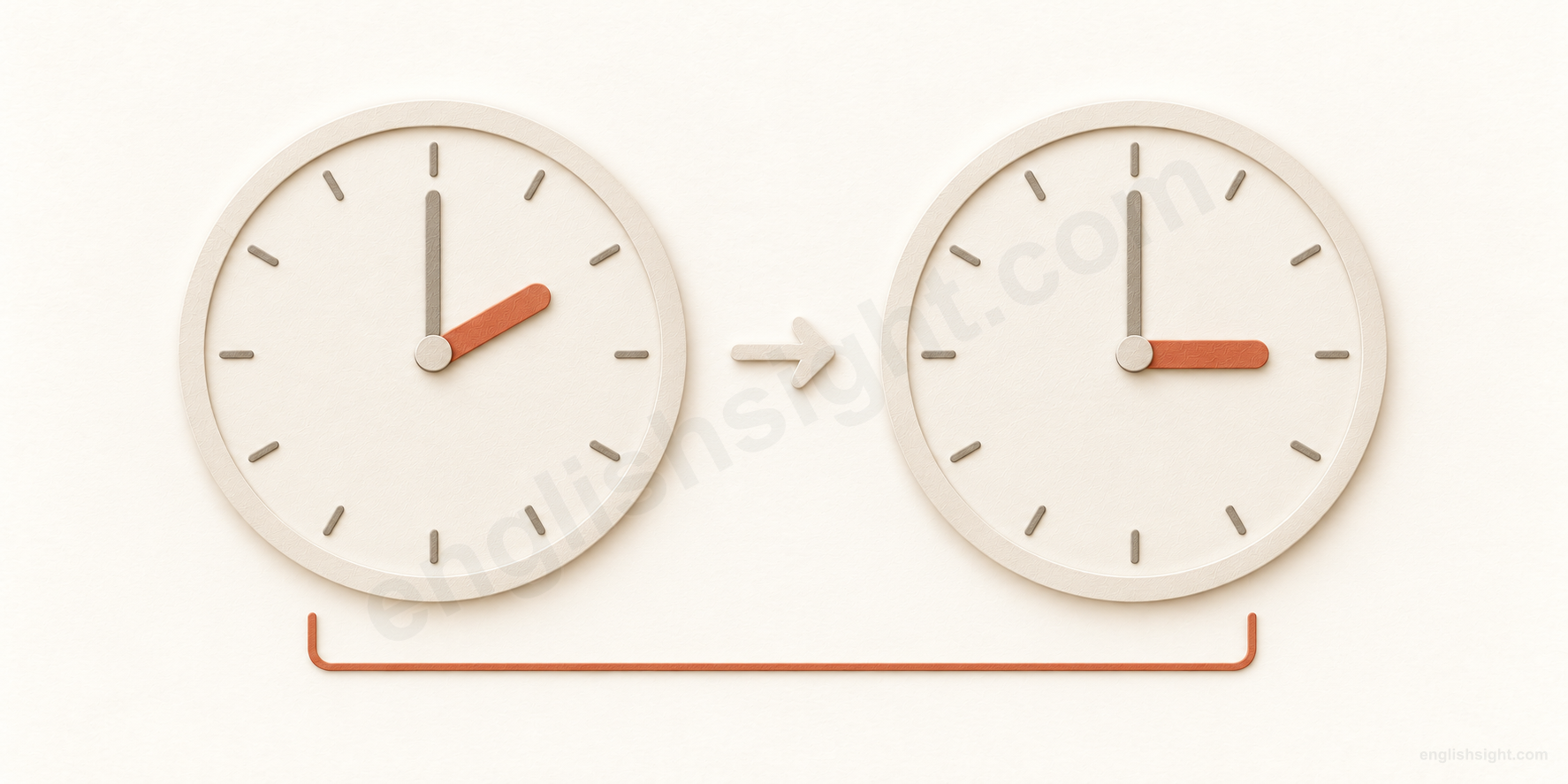
The clock shows two o’clock.
hour
The same clock shows three o’clock.
Sixty minutes pass.
From two to three: one sixty-minute interval.
An hour is a sixty-minute unit of time. It can measure an interval; established expressions also use it to identify a time slot, a clock boundary, or a significant period.
Read the clocks as two states of the same clock: two o’clock, then three o’clock after sixty minutes. The diagram explains the unit, not every idiom in the lesson.
You can wait for an hour, return in an hour, pay by the hour, or meet during office hours. Hour connects these expressions with time, while the surrounding grammar tells you what kind of time relationship is intended.
The diagram gives a concrete model of one measured interval. Named time slots and established idioms extend beyond exact sixty-minute measurement; they need their own contexts and explanations.
01
Measure and arrange time
An hour supplies a time unit. The verb, preposition, number, or position before a noun tells us how to use that unit.
01
an / one hour; number + hours; about + time expression
an hour / two hours
count time in sixty-minute units
Situation
A lesson starts at two and ends at three.
Meaning in context
Its length is one hour.
Hour names the length of the interval, rather than either clock reading.
Hour is a countable noun: one hour, two hours. One ordinary day contains twenty-four hours. You can have an hour of rest or two hours of practice; the of-phrase tells us what fills the time.
The initial h is silent, so say an hour. About an hour gives an estimate rather than a promise of exactly sixty minutes. The two clocks in the diagram illustrate the exact unit; everyday estimates may be less precise.
In a sentence
We have an hour before the next lesson.
Watch the difference Use hours after two or more: two hours, not two hour when the noun stands alone.
02
half an hour; a quarter of an hour / a quarter-hour; an hour and a half; one and a half hours
half an hour / an hour and a half
name parts of an hour and mixed amounts
Situation
A journey takes ninety minutes.
Meaning in context
You describe it as an hour and a half.
A fraction changes the amount of time, not the meaning of the unit.
Half an hour is thirty minutes; a quarter of an hour is fifteen. An hour and a half and one and a half hours both mean ninety minutes. In the second form, hours follows the whole number-and-fraction expression.
Compare a half-hour walk, with the time expression before a noun, and a walk of half an hour. A half hour is also a noun phrase. A quarter of an hour and a quarter-hour both name a fifteen-minute duration.
In a sentence
The walk takes an hour and a half.
Watch the difference Use one and a half hours, not one and a half hour. In an hour and a half, hour stays singular because an belongs directly to it.
03
verb + for + time amount
for an hour
say how long a state or activity continues
Situation
Mia starts waiting at two and stops at three.
Meaning in context
The waiting continues for an hour.
For marks the duration of waiting; it does not set a future starting time.
For an hour measures a stretch of activity or a continuing situation. We talked for an hour and The door stayed open for an hour describe what continued throughout that period.
Compare I’ll wait for an hour with I’ll call in an hour: the first gives the length of the wait, while the second places the call later. With verbs such as wait, a time amount can sometimes appear without for: We waited an hour.
In a sentence
Mia waited outside for an hour.
Watch the difference Use for an hour to give duration. Since two o’clock gives a starting point; since an hour does not express the same thing.
04
it takes + person + an hour + to-infinitive; spend an hour + -ing / on + noun; last an hour
take / spend / last an hour
choose how a sentence presents time used
Situation
You finish a repair after sixty minutes of work.
Meaning in context
You can describe the task’s time requirement or your use of time.
The verb assigns the roles; hour simply supplies the amount.
It took me an hour to fix it presents the time needed. I spent an hour fixing it presents my activity, without by itself guaranteeing a successful repair. The meeting lasted an hour reports the length of an event.
You can save an hour, waste an hour, or have an hour to spare. Kill an hour means occupy spare time while waiting, often with an unimportant activity: We killed an hour browsing in a shop. The waiting meaning belongs to kill an hour, not to hour alone.
In a sentence
It took me an hour to fix the lock.
Watch the difference Say spent an hour fixing it or spent an hour on it, not spent an hour to fix it.
05
future event + in an hour; in an hour’s time
in an hour / in an hour’s time
place an event about sixty minutes after the reference time
Situation
It is two o’clock now.
Meaning in context
A planned call is at about three.
In measures forward to the event; it does not say how long the event lasts.
With a future event, in an hour normally counts forward from now. In an hour’s time is another way to express that interval. In a past narrative, an hour later can locate the same kind of gap from an earlier event.
Compare I’ll call for an hour: that gives the length of the call. I’ll call at three gives a clock time instead of a gap. The distinction comes from the prepositions and the event being described.
In a sentence
I’ll call you in an hour.
Watch the difference An hour’s time takes an apostrophe before s. In two hours’ time takes it after the plural s.
06
complete a task + in an hour; finish / arrive + within an hour / within the hour
finish in an hour / within an hour
give a completion time or an upper limit
Situation
A task starts at two.
Meaning in context
You report the time used or require completion by three.
A completed task makes in an hour a measure of time taken.
I assembled it in an hour describes the time needed to reach completion. I worked on it for an hour describes time spent and leaves open whether I finished. This is why in an hour does not always mean an hour from now.
Please finish within an hour sets an upper limit: finish before that interval has run out, possibly much earlier. Within the hour commonly means within the next sixty minutes, not necessarily before the current clock hour ends. A deadline is different from predicting an event at about the end of the interval.
In a sentence
I assembled the chair in an hour.
Watch the difference I’ll start in an hour postpones the start. I’ll finish within an hour promises completion within the limit.
07
amount + an hour / per hour; pay / charge / rent + by the hour
an hour / per hour / by the hour
use an hour as the unit for a rate or charge
Situation
A service charges for each hour of use.
Meaning in context
Its price can be stated as an hourly rate.
Per and rate-use an mean for each unit; by identifies the charging basis.
Twelve euros an hour and twelve euros per hour state the same kind of rate. Miles per hour and kilometres per hour measure speed. Per hour is especially useful in figures and technical descriptions; an hour is ordinary in conversation.
The studio is rented by the hour says the bill depends on hours of use, rather than, for example, days. Every hour instead describes how often something happens: a bus every hour is a frequency, not a price.
In a sentence
The studio costs twelve euros an hour.
Watch the difference Use per hour with singular hour, not per hours. By the hour is a fixed measurement expression; by an hour does not state the same charging basis.
08
be + an hour away / from + place; an hour’s drive / walk
an hour away / an hour’s drive
describe distance through usual travel time
Situation
You plan a ferry journey to an island.
Meaning in context
The usual journey takes about an hour.
Time stands for the journey required, so the means of travel matters.
An hour away or an hour from the city gives travel time, not a fixed number of kilometres. An hour’s drive names the mode of travel; a one-hour drive is an alternative construction. Traffic and transport can change the estimate.
Two hours ahead or two hours behind can instead compare clock readings. If one clock shows three while another shows one, the first is two hours ahead. That comparison is not a two-hour journey.
In a sentence
The island is an hour away by ferry.
Watch the difference Give the travel context when needed. An hour away by car need not be an hour away on foot.
09
a / an + number-hour + noun; an hour’s + noun; two hours’ + noun
a two-hour lesson / two hours’ work
use a time measure before another noun
Situation
A lesson lasts two hours.
Meaning in context
Its duration becomes part of the noun description.
A compound modifier and a possessive time phrase have different forms.
In a two-hour lesson and a twenty-four-hour service, hour stays singular inside the compound modifier. Compare The lesson lasts two hours, where hours is the ordinary plural noun. A twenty-four-hour service is available throughout the day and night.
An hour’s work and two hours’ work measure an amount of work using a possessive time construction. Compare a two-hour break with two hours’ rest: the apostrophe belongs to the possessive form, not to the hyphenated compound. An hour-long break is another useful modifier.
In a sentence
We booked a two-hour lesson.
Watch the difference Write a two-hour lesson, not a two-hours lesson or a two-hour’s lesson. Choose a or an by the next sound: a two-hour lesson, an hour-long lesson.
02
Find a point on the clock
An interval and a clock reading answer different questions. These expressions identify clock boundaries or use a formal time notation.
10
on the hour; every hour; every two hours
on the hour / every hour
distinguish an exact clock boundary from a repeating interval
Situation
A shuttle leaves at 9:00, 10:00, and 11:00.
Meaning in context
Its departures are every hour on the hour.
The hour here is a whole-number clock boundary, not an elapsed duration.
On the hour identifies :00, such as 9:00. Every hour adds the idea of repetition. A shuttle at 9:15, 10:15, and 11:15 also runs every hour, but it does not leave on the hour. Every two hours doubles the interval.
A clock can strike the hour, sounding to mark the clock boundary. The hour hand is the shorter hand indicating the hour; it moves gradually between hour marks. In the diagram, the minute hand returns to the top while the hour hand moves from two to three.
In a sentence
The shuttle leaves every hour on the hour.
Watch the difference Do not replace on the hour with in an hour: one identifies a clock position, while the other can identify a delay.
11
number of minutes + past / before / to the hour
ten minutes past the hour
locate minutes relative to a known clock hour
Situation
The hour being discussed is four o’clock.
Meaning in context
Ten minutes past that hour is 4:10.
The context supplies the numbered hour; the phrase locates a point relative to it.
Past the hour counts minutes after the clock boundary. Before the hour or to the hour counts backward from the coming boundary. Ten minutes to the hour could mean 4:50 when the next boundary is five.
These expressions are useful in schedules and announcements where the numbered hour is already clear. In an ordinary conversation, ten past four or four ten often supplies the time more directly. A quarter of an hour names a duration; a quarter past four names 4:15.
In a sentence
The update came ten minutes past the hour.
Watch the difference Ten minutes past the hour is a clock position, not necessarily ten minutes after the current moment.
12
at + four-digit clock time + hours
at 1800 hours
recognize a formal twenty-four-hour clock reading
Situation
A formal notice gives the time as 1800 hours.
Meaning in context
The ordinary clock equivalent is 6 p.m.
Hours after the four-digit number belongs to a formal time notation.
Official and military-style English may place hours after a four-digit time. Eighteen hundred hours is a reading of 1800 hours. It is not a duration of eighteen hundred hours.
Ordinary conversation usually uses at six, at six p.m., or another familiar clock reading. You can understand the formal notation without adopting it for casual arrangements.
In a sentence
The notice says, “Report at 1800 hours.”
Watch the difference At 1800 hours gives a time of day. For eighteen hours gives a length of time.
03
Work, services, and daily routines
A named hour or a set of hours can be a time slot defined by an activity. Its actual length depends on the schedule.
13
opening / business / visiting hours + are…; during / outside + specified hours
opening / business / visiting hours
identify when a place or service is available
Situation
A museum admits visitors from ten until six.
Meaning in context
Those times are its opening hours.
Plural hours can refer to a timetable, not just a total number.
The phrase opening hours names the times when a place is open. Business hours are the normal times for business, while visiting hours are the periods when visitors are allowed, for example in a hospital. The word before hours identifies the activity or service.
What are your opening hours? asks for a schedule. How many hours are you open? asks for a total duration. These may have related answers, but they are different questions. During visiting hours places an event inside the permitted period.
In a sentence
The museum’s opening hours are ten to six.
Watch the difference Use the plural verb with hours: The opening hours are…, not the opening hours is….
14
during office hours; a professor’s / doctor’s office hours
office hours
identify regular office work or a consultation period
Situation
A student wants to ask a professor a question.
Meaning in context
The professor offers a scheduled time for such meetings.
The setting tells you what kind of availability office hours describes.
The phrase office hours commonly means the normal times when an office is operating or its staff are working. In American educational and professional contexts it can also mean scheduled periods for consulting a professor, doctor, or dentist.
A professor’s office hours are not necessarily all the hours she works. They indicate availability for students. This is an established use of the whole noun phrase, with hours identifying a service window.
In a sentence
You can ask the professor during her office hours.
Watch the difference Check the context: office hours can be a consultation schedule, rather than the length of someone’s working day.
15
work + long / short / flexible / irregular / unsocial hours
work long / flexible / unsocial hours
describe the amount and timing of work
Situation
A worker regularly stays until late in the evening.
Meaning in context
Her job involves long or inconvenient working periods.
An adjective can describe total work time or the way it is arranged.
The phrase long hours usually emphasizes a large amount of working time. Flexible hours allow some freedom about timing. Irregular hours vary from day to day or week to week; they do not automatically mean the total is large.
Unsocial hours, particularly in British usage, are work times that interfere with ordinary social life, such as nights or weekends. The adjective supplies this evaluation; hour itself remains a reference to work time.
In a sentence
She works long hours during the festival.
Watch the difference Work long hours concerns the work schedule or amount. It does not mean an individual hour contains more than sixty minutes.
describe habitual times for sleeping or daily activities
Situation
A person usually goes to bed very late.
Meaning in context
You describe that person as keeping late hours.
Keep relates the person to a recurring routine, rather than preserving time.
Keep regular hours means follow a fairly consistent daily pattern, especially for getting up and going to bed. Keep late hours typically means stay up late as a habit. It does not mean keep a collection of hours.
Compare work late hours, which locates working time late in the day. A person can keep late hours for social reasons without working at night. The choice of verb changes the activity being described.
In a sentence
During the holidays, we kept late hours.
Watch the difference The phrase late hours describes the timing of the routine, not necessarily many hours of sleep.
17
after hours; out of hours; after-hours / out-of-hours + noun
after hours / out of hours
place an activity outside normal business or work times
Situation
The office’s usual working day has ended.
Meaning in context
Staff meet socially outside the normal schedule.
Hours refers to the established schedule that the event falls outside.
After hours commonly means after normal working or opening times. Out of hours, especially British, means outside the usual business or work schedule, which may include evenings, early mornings, or weekends.
Before another noun, the expressions can be hyphenated: an after-hours meeting or an out-of-hours service. These describe when an activity is available or happens; they do not mean that all available time has been used up.
In a sentence
We sometimes meet for dinner after hours.
Watch the difference Out of hours is a time expression. We’ve run out of time means no time remains; that is a different construction.
18
my / your + lunch hour; during / in + a possessive lunch hour
lunch hour
name a midday meal break or the usual lunch period
Situation
A worker pauses work around midday.
Meaning in context
That meal break is her lunch hour.
The activity names the time slot; its exact duration follows the local routine.
A lunch hour is the period set aside for lunch in the working day, often about an hour. It can also refer to the usual time for lunch. You do not have to spend the whole break eating.
The expression connects a measured interval with its usual purpose. In a real workplace the break may be shorter or longer, so do not calculate its exact length from the word hour alone.
In a sentence
I went for a walk during my lunch hour.
Watch the difference My lunch hour names my break. An hour for lunch explicitly allocates an amount of time.
19
at / during rush hour; the morning / evening rush hour; rush-hour + noun
rush hour
identify the busy commuting period
Situation
Many people travel home from work at similar times.
Meaning in context
Roads and trains are especially busy.
Hour names a familiar part of the daily pattern, not a guaranteed sixty-minute limit.
Rush hour is the busy period when many people travel to or from work. The morning rush hour and the evening rush hour distinguish the two usual commuting periods.
At rush hour and during rush hour both place an event in that period. Rush-hour traffic uses the whole expression before a noun. The period can last more than one hour; the conventional name is not an exact measurement.
In a sentence
The trains are crowded during the evening rush hour.
Watch the difference Do not interpret rush as an instruction to hurry here. Rush hour names a traffic and commuting period.
20
at / during happy hour; happy hour + starts / ends
happy hour
recognize a venue’s reduced-price drinks period
Situation
A bar advertises lower drink prices from five until seven.
Meaning in context
That promotion is called happy hour.
The whole expression names a commercial offer, not an emotion or an exact length.
Happy hour is an informal name for a period when a bar or pub sells drinks at lower prices than usual, commonly in the early evening. The setting and the price offer are part of its conventional meaning.
It can last longer than sixty minutes. Saying I had a happy hour at home can literally describe a pleasant hour, but that is different from a bar advertising happy hour.
In a sentence
Happy hour at that bar runs from five to seven.
Watch the difference Do not use happy hour as a general translation for any happy time; learn the established promotion meaning with its context.
04
Long waits, repeated hours, and inconvenient times
Some expressions emphasize how time feels or when an event occurs. Learn the whole expression rather than counting sixty minutes each time.
21
for hours; take hours; hours and hours
for hours / hours and hours
emphasize a long stretch of time
Situation
A queue moves very slowly.
Meaning in context
The speaker emphasizes how long the wait feels.
An unnumbered plural can foreground length rather than a measured total.
Hours can refer literally to several hours, but it also serves as an everyday emphasis: It took hours! The speaker highlights a long or apparently long time without supplying an exact count.
Hours and hours strengthens that emphasis. Compare three hours, which gives a number, and a whole hour, which stresses that the entire hour was used. The context determines whether a precise measurement is intended.
In a sentence
We waited for hours without any news.
Watch the difference Hours can be emphatic, but it is not always an exaggeration. Do not assign it a fixed hidden number.
22
hour after hour; hour by hour
hour after hour / hour by hour
emphasize continuation or follow successive time units
Situation
A team monitors a changing situation across the afternoon.
Meaning in context
They can focus on uninterrupted effort or on each successive stage.
After highlights repeated continuation; by can organize the view into successive hours.
Hour after hour emphasizes something continuing for a long time: We listened to the rain, hour after hour. It often brings attention to endurance or repetition, without giving an exact number.
Hour by hour considers time one hour at a time, often while following changes or progress. It can overlap with the repeated-time idea, but a changing forecast illustrates its stepwise viewpoint. Neither expression says that an event happens only once per hour.
In a sentence
The forecast changed hour by hour.
Watch the difference Keep the fixed singular forms hour after hour and hour by hour; do not pluralize each occurrence.
23
in / into / until + the small / early hours; the early hours of + day
the small / early / wee hours
name the period after midnight and before ordinary morning activity
Situation
A conversation continues past midnight.
Meaning in context
It carries on into the early morning.
The conventional expression identifies part of the night, not small units of time.
The small hours and the early hours refer to the early morning after midnight. Into the small hours emphasizes continuation into that period; in the early hours of Monday locates an event within it.
The wee hours is a familiar variant, especially in North American English; wee small hours is also used, especially in Scotland. Small and wee belong to an established expression here, rather than shortening an hour.
In a sentence
We talked well into the small hours.
Watch the difference The early hours of Monday belong to Monday after midnight, even if the evening activity began on Sunday.
24
at all hours (of the day and night); stay out till / until all hours
at all hours / till all hours
describe unrestricted or inconvenient times, often very late
Situation
Notifications repeatedly arrive during the night.
Meaning in context
You complain that they arrive at unsuitable times.
All hours highlights the range or inconvenience of the times, not a measured duration.
At all hours can mean at any time, often with annoyance or disapproval when timing is unreasonable. It does not require something to happen literally during every hour without interruption.
Stay out till all hours means stay out very late. Compare a service available twenty-four hours a day: that directly describes continuous availability and need not carry disapproval.
In a sentence
His phone rings at all hours of the night.
Watch the difference At all hours gives irregular or unrestricted timing. For hours gives the length of an activity.
25
at an unearthly hour; at this / some ungodly hour
at an unearthly / ungodly hour
complain about an extremely early or otherwise unreasonable time
Situation
A train departure requires getting up at four in the morning.
Meaning in context
You call the waking time unpleasantly early.
The adjective expresses a judgment about timing.
At an unearthly hour is an informal way to complain about a very early time. At an ungodly hour can describe an inconveniently early or late time. These are expressive judgments, not exact clock readings.
Hour is being used as a time point here. The expression does not say you were awake for sixty minutes, and the adjectives do not describe something supernatural in the situation.
In a sentence
We had to get up at an unearthly hour to catch the train.
Watch the difference Use these expressions when the evaluative tone fits. At four in the morning gives a neutral time without the complaint.
05
Important moments and established idioms
Hour can identify an occasion or a significant period. These uses retain a connection to time, but do not give an exact duration.
26
at this / that hour (of the night); the hour has come to + verb / for + noun / for + person + to-infinitive
at this hour / the hour has come
refer to a particular time or an appointed moment
Situation
It is late at night and someone knocks.
Meaning in context
You draw attention to the lateness of this particular moment.
Hour can select a time in the situation instead of measuring a duration.
At this hour of the night points to the current time and often suggests that it is late or unsuitable. In more formal or literary language, the hour of departure can identify the appointed time for leaving.
The hour has come for us to leave means the relevant moment has arrived. The expression is more solemn than It’s time to leave. The time-point sense is connected to dividing the day, but the phrase need not specify a whole clock hour.
In a sentence
Who could be calling at this hour of the night?
Watch the difference Hour is not a universal replacement for time. What time is it? is the ordinary everyday question for a clock reading.
27
in someone’s hour of need; someone’s finest / darkest hour
an hour of need / someone’s finest or darkest hour
describe a period by its emotional or historical importance
Situation
Someone faces a serious difficulty and receives support.
Meaning in context
They remember the help as arriving when it mattered most.
The situation defines the period; its importance matters more than its measured length.
An hour of need is a time when help is especially needed. Someone’s finest hour is a time of exceptional achievement or admirable behavior; a darkest hour is an exceptionally difficult period. The wording is often dramatic or literary.
These periods need not last sixty minutes. The adjective or of-phrase supplies the kind of experience. The core connection is an identifiable stretch of time, not an exact prediction from the clock diagram.
In a sentence
Our neighbours supported us in our hour of need.
Watch the difference Do not infer that finest hour means someone’s favourite clock time, or that help lasted only one hour.
28
at the eleventh hour; an eleventh-hour + noun
at the eleventh hour
say that something happens at the last possible moment
Situation
A deadline is almost upon the team.
Meaning in context
They reach an agreement just before it is too late.
The timing comes from the whole idiom, not an eleven-hour calculation.
At the eleventh hour places an event very close to the final opportunity or deadline. It can be a decision, cancellation, agreement, or other late development; it need not describe a successful rescue.
Before a noun, write an eleventh-hour agreement or an eleventh-hour change. There is no claim that the event happened at eleven o’clock or exactly eleven hours after anything.
In a sentence
They reached an agreement at the eleventh hour.
Watch the difference Learn at the eleventh hour as a fixed expression, including the. Eleven hours is a duration with a different meaning.
29
the person / man / woman / hero of the hour
the person / hero of the hour
identify who is receiving attention or praise at the moment
Situation
A volunteer solves a problem for the whole group.
Meaning in context
Everyone praises that volunteer after the event.
Of the hour links prominence to the current occasion, not to a sixty-minute appointment.
Of the hour describes someone or something especially prominent at that time. Hero of the hour usually adds praise for a useful achievement; man or woman of the hour may identify the person receiving attention at an event.
The connection is to the current occasion. It does not promise that attention ends after sixty minutes. The expression is a familiar rhetorical way of highlighting someone, rather than a literal time measurement.
In a sentence
After finding the missing keys, Sam was the hero of the hour.
Watch the difference Of the hour is not the same as per hour. A person of the hour receives attention; a price per hour states a rate.
Keep the time relationship clear
Pronunciation and articles
Hour begins with a vowel sound because h is silent: British /ˈaʊə(r)/, American /ˈaʊər/. Say an hour. In a two-hour lesson, a follows the consonant sound at the start of two. In a half-hour break, the h in half is sounded.
Length, delay, completion, and deadline
I waited for an hour gives duration. I’ll leave in an hour places a future departure. I finished it in an hour gives time taken. I’ll finish within an hour sets a maximum interval. The preposition and the event work together; hour alone does not decide the relationship.
Hour, time, and o’clock
An hour measures sixty minutes; time is the broader word for duration or a point in a situation. Say It’s three o’clock for the clock reading and It takes three hours for a duration. It’s three hours does not normally mean that the clock reads 3:00.
Ordinary plurals, modifiers, and possessives
Keep two hours, a two-hour lesson, and two hours’ work distinct. The first is an ordinary plural, the second a singular-form compound modifier, and the third a plural possessive time phrase. Common abbreviations include hr and hr.; their formatting follows the context.
The model has limits
Rush hour, happy hour, and a person’s finest hour do not guarantee sixty minutes. The meanings of the whole expressions are established usage. The diagram is a teaching aid, not a claim about an identical image in every English speaker’s mind.
Scope of this lesson
The lesson teaches the everyday noun, common time constructions, and selected fixed expressions. There is no productive everyday family of hour particle verbs to learn here. Astronomical angle measures, religious offices, academic credit hours, and other specialist uses are outside this introductory lesson.
Choose the time relationship
Use the situation, the verb, and the surrounding words to decide what hour means.
1. You start waiting at two and stop at three. Which sentence gives the length of the wait?
2. It is two now. You plan to phone at about three. Which expression fits?
3. A task must be complete no later than sixty minutes from now. Which instruction states the limit?
4. A lesson lasts two hours. Which noun phrase is correctly formed?
5. A bus departs at 9:15, 10:15, and 11:15. Which description is accurate?
6. A professor advertises office hours from two to three on Tuesdays. What does that normally identify?
7. A sign advertises happy hour from five to seven. What is the best reading?
8. A team agrees to a change just before the deadline. Which phrase emphasizes how late the agreement was?
Sources and teaching notes
Usage was checked against Oxford and Collins dictionary entries and the time-expression note in the UCAS style guide. The explanations and examples are original teaching material. The diagram illustrates one measured interval; it does not derive every fixed expression.
The diagram is a teaching model of elapsed time; English speakers need not share one mental picture.