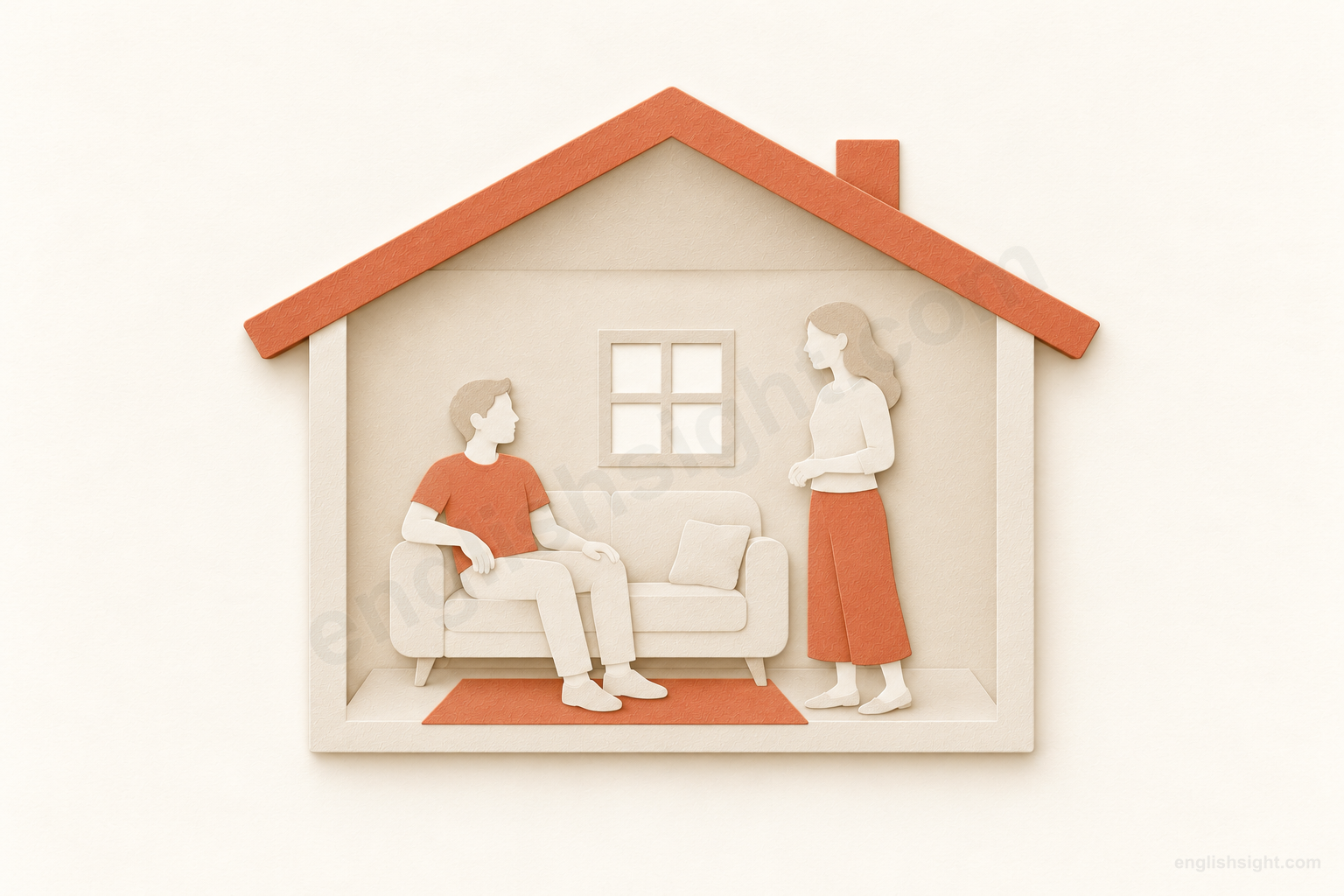
A place to live, and the people or activity within.
Understand the dwelling, the groups associated with it, the verb /haʊz/, and familiar expressions.
A dwelling and the life within
A dwelling and the life within
A residential building
house
The residents within
The walls enclose a space where people live.
A dwelling and its residents: a starting point, not a rule for every expression.
A house is a building where people live. In related uses, the place can stand for its residents or for an activity and the group organized around it.
The picture shows a stable dwelling relationship, not a before-and-after event. It supports the residential starting point and the place-to-people connection; it does not predict every compound or idiom.
Start with a residential building and the life within it. English can then use house for an associated group, business, venue, or institution. The context and complete expression decide which meaning is intended.
The dwelling sketch is a teaching model for a useful connection, not a claim about one picture in every speaker’s mind. Fixed idioms and the musical genre need their own explanations.
01
A dwelling, its location, and its residents
Start with the residential building. Determiners and prepositions then tell us which house, where someone is, or how someone moves relative to it.
01
a / the / my + house; adjective + house; verb + a house
a house / houses
a residential building
Situation / reference
You are choosing somewhere to live.
What is meant
You describe a building intended for living in.
House usually identifies the building rather than a feeling of belonging.
A house is normally a building for one family, though a shared house can have unrelated residents. You can buy, rent, build, or share a house: the verb tells us the relationship to the property.
A two-bedroom house describes its rooms. A detached house stands separately; a semi-detached house shares a wall with one other house; a terraced house is part of a connected row, also called a row house especially in North America. These descriptions do not create different meanings of house.
In a sentence
We rent a small house near the station.
Watch the difference Use a determiner with a singular ordinary dwelling: a house, the house, or our house. Renting does not mean owning.
02
at + person’s house; in / inside / outside + the house; to + my house
at my house / in the house
locate someone at a home or inside a building
Situation / reference
Friends need a place to meet.
What is meant
You name the home as a meeting location.
At treats the home as a location; in emphasizes being inside.
Come to my house gives a destination. Meet me at my house identifies the place, without insisting on a precise room or position inside. I am in the house emphasizes the interior rather than the garden or street.
A possessive already specifies the house: at Maya’s house or at her house. At home refers to someone’s own living place, which can be an apartment; the normal expression has no article.
In a sentence
Let’s meet at my house after lunch.
Watch the difference Say at my house, not at the my house. In the house and at home overlap in some contexts but focus on different things.
03
leave + the house; into / out of + the house; from house to house
leave the house / from house to house
describe leaving a dwelling or visiting dwellings in turn
Situation / reference
A volunteer is visiting residents.
What is meant
She visits one dwelling and then another.
The motion comes from the verb and prepositions; house names the locations.
Leave the house means go out of the building. Go into the house and come out of the house specify crossing its boundary. House itself does not mean entering or leaving.
From house to house names a repeated sequence: one home after another. The bare singulars belong to this particular from…to… pattern. They do not license I live in house.
In a sentence
The volunteers went from house to house collecting old coats.
Watch the difference Leave the house may be a short outing; it does not by itself mean move to a new home permanently.
04
move house (British English); move into / out of + a house
move house
change the place where you live
Situation / reference
Your current home is too far from work.
What is meant
You begin living at a different address.
This British expression concerns a change of residence.
In British English, move house means relocate to another home. It is not normally about lifting or transporting the building. In American English, We’re moving is a straightforward equivalent.
Move into a house names the new residence; move out of a house names the one you leave. A person can move house from one flat to another: the fixed expression does not require either home to be a separate house.
In a sentence
We’re moving house next month to be closer to work.
Watch the difference There is no article in move house. Move the house can instead mean physically relocate a particular building.
05
wake / disturb + the whole house
the whole house
everyone living in a particular house
Situation / reference
An alarm rings while the residents are asleep.
What is meant
All the residents wake up.
The place stands for its occupants.
A house can refer to its residents as a group. Waking the whole house means waking the people, since walls do not sleep. Household is a more explicit noun for the people living together.
In The whole house needs painting, the same words refer to the building. The predicate and situation decide whether the intended referent is people or a physical structure.
In a sentence
The smoke alarm woke the whole house at dawn.
Watch the difference Do not assume every use of the house means a family; it may mean residents who are not related.
06
house + noun; do + (the) housework
house prices / house rules
relate another noun to a dwelling or establishment
Situation / reference
You discuss the cost of homes or the rules of a place.
What is meant
House identifies what the following noun relates to.
The head noun carries the main meaning: prices are prices, rules are rules.
House prices means prices of residential property. A house key opens a house; house rules are the rules for the home, club, or other establishment in question. The relationship varies with the noun.
House commonly stays singular before another noun, even when many houses are involved. Learn the spelling of compounds individually: house prices is two words, while housework is one. Do the housework means do domestic chores; it does not mean do homework for school.
In a sentence
Please read the house rules before using the shared kitchen.
Watch the difference A modifier is not a possessive plural: house prices, not houses prices. Homework and housework are different words.
02
Making and managing a home
These combinations describe domestic life and welcoming visitors. They are established expressions, not new meanings of a particle added to the verb house.
07
keep house; keep house for + person
keep house
run the practical domestic work of a home
Situation / reference
A home needs meals, cleaning, and regular care.
What is meant
Someone manages those domestic tasks.
Keep refers to maintaining domestic life, not simply keeping possession of a building.
Keep house means do the cooking, cleaning, and related work involved in running a home. Keep house for someone adds the person whose domestic needs you look after.
This expression can sound more traditional than do the housework or run the household. It says nothing about which gender should do those jobs. Keep a house can instead mean retain a property, so the article changes the likely reading.
In a sentence
My grandfather kept house while my grandmother ran the shop.
Watch the difference Keep house is not a phrasal verb: house is the noun in an established verb–noun expression.
08
set up house + together / in + place
set up house
establish a home
Situation / reference
Two people decide to live together.
What is meant
They establish their shared home.
The whole expression concerns beginning domestic life in a place.
Set up house means make a place your home, often when beginning to live with someone. It can refer to a flat, rented rooms, or a separate house.
Building a house is construction work; setting up house is establishing a household. The home may already be fully built. Together and a place phrase add who shares the home and where it is.
In a sentence
They set up house together in a flat above the bakery.
Watch the difference Use no article in this idiom. Set up a house can suggest arranging or constructing a particular house in another context.
09
play house; play in + the house
play house
pretend to be a family at home
Situation / reference
Children arrange dolls around a small table.
What is meant
They act out family life.
House names the domestic situation being imitated.
Children play house when they pretend to be people in a family, acting out meals, caring for dolls, and similar activities. The expression names a type of imaginative play.
They play in the house merely locates their play indoors. Adding in changes the grammatical relationship: the house becomes the location, not the pretend activity.
In a sentence
The children played house and served pretend soup to their dolls.
Watch the difference Play house does not mean every kind of play that happens indoors.
10
hold / host / attend + an open house; keep open house
an open house
a time or event for welcoming visitors
Situation / reference
A school invites prospective families to visit.
What is meant
Visitors can look around and learn about the school.
Open house is an established event label, not just an unlocked building.
An open house can be a gathering at which guests are welcome to drop in. In North American English it also names an event for visiting a school or organization; British English often uses open day for that event.
In property advertising, an open house is a scheduled chance for potential buyers to view a home. Compare We keep open house, meaning we welcome visitors freely. None of these expressions promises unrestricted public entry at any hour.
In a sentence
The school is holding an open house for new families on Saturday.
Watch the difference The event may be at a school or an apartment. House here does not require a detached dwelling.
03
Places, organizations, and groups
A place can lend its name to the activity or people associated with it. Some uses are conventional names; house music must be learned as a separate established label.
11
activity / occupant + house; proper name + House
an opera house / a coffee house
a building or venue associated with a particular activity
Situation / reference
You want to name a venue by its purpose.
What is meant
A conventional compound identifies what happens there.
The first element specifies an established use of the place.
An opera house is a performance venue; a coffee house or steakhouse is a place serving food or drink. A henhouse shelters hens. House extends from dwelling to a building serving a particular activity or need.
These are established compound words, not permission to attach house to any noun. Spelling varies: opera house and coffee house are commonly separate words, while henhouse and steakhouse are commonly written together. A name such as Cedar House may also label an office building, especially in Britain.
In a sentence
The concert will take place at the restored opera house.
Watch the difference An opera house is not an opera singer’s private home. Check each compound’s meaning and spelling.
12
a publishing / fashion / banking house; house + style
a publishing house / house style
a company or the standards belonging to it
Situation / reference
An editor joins a book company.
What is meant
She follows that company’s editorial conventions.
House can identify an organization rather than its premises.
A publishing house is a publisher; a fashion house is a fashion business. The expression can refer to a company with several buildings, so it is not simply an address.
House style means the organization’s own agreed writing or presentation conventions. In this use house is a modifier: style is the main noun, and house tells us whose standards they are.
In a sentence
The publishing house uses its own house style for headings.
Watch the difference Not every company is naturally called a house. Learn established business combinations instead of freely replacing company.
13
do / produce / develop + something + in-house
do something in-house
use the organization’s own resources or staff
Situation / reference
A company needs a new website.
What is meant
Its own team does the work.
The relevant boundary is organizational, not the walls of someone’s home.
Work done in-house is carried out within an organization rather than handed to an outside supplier. The team can still work remotely: the expression concerns who provides the work.
Compare We do the design in-house with We do the design in the house. The second phrase is an ordinary location phrase and says where the work happens.
In a sentence
We develop the software in-house instead of hiring an outside agency.
Watch the difference Keep the hyphen in in-house. In the house normally refers to a physical building, not internal company responsibility.
14
house + wine / red / white / specialty / cocktail
house wine / house specialty
a restaurant’s standard or characteristic offering
Situation / reference
You ask which wine the restaurant normally serves.
What is meant
The waiter suggests its house wine.
House relates the item to this establishment.
House wine is a restaurant’s standard wine, often its inexpensive choice, rather than a specific named bottle you select from a long list. House red and house white shorten house red wine and house white wine.
A house specialty is a dish the establishment is known for; a house cocktail is its own characteristic cocktail. The modifier does not by itself mean homemade, free, or served in a private house.
In a sentence
We ordered two glasses of the house white.
Watch the difference House wine still costs money unless the restaurant says it is on the house.
15
play to + a full / packed / empty house; house lights
a packed house / house lights
a theatre’s audience or audience area
Situation / reference
A show has sold nearly all its tickets.
What is meant
The performers face a large audience.
The performance venue stands for its audience and seating area.
Play to a full or packed house means perform for a capacity or very large audience. An empty house is a performance with little or no audience, not necessarily an abandoned building.
House lights illuminate the audience area, as opposed to the stage. A full house also names a poker hand of three cards of one rank and two of another; that is a separate game-specific meaning, not an audience metaphor to apply freely.
Front of house names the areas used by the audience and the work of dealing with visitors, especially in British theatre usage. For example, The front-of-house staff checked our tickets describes audience service, in contrast to work backstage. It does not mean the front wall of a private home.
In a sentence
The dancers performed to a packed house on opening night.
Watch the difference Identify the setting: a packed house at a show refers to spectators, not people sharing a home.
16
the House; the House of + name; both houses of + legislature
the House / both houses
a legislative chamber or its members
Situation / reference
A bill is being debated in a legislature.
What is meant
One chamber votes on it.
House here names an institution empowered to debate and legislate.
A legislature may have an upper house and a lower house. Both houses means the two chambers, including the groups of legislators, not two residential buildings.
The House can shorten the House of Representatives in a United States context, or a specified parliamentary House in a British context. In formal debating, This house believes… introduces the motion on behalf of the debating assembly. The surrounding institutional context supplies the reference.
In a sentence
The proposal needs approval from both houses of parliament.
Watch the difference Capitalization often marks a particular named House. A bare reference to the House needs context; it does not name the same institution everywhere.
17
be in + a named house; house captain / competition
be in a house at school
an organized group of students within a school
Situation / reference
Students belong to named teams at school.
What is meant
Their teams compete in school events.
House names a continuing membership group, sometimes also linked to accommodation.
In some British schools, students are divided into houses that compete in sports and other activities. The group may contain pupils of different ages; it need not be a separate class.
A house captain leads or represents the group. In boarding schools a house may also be associated with a building where students live, but residence is not essential to every school house system.
In a sentence
Our house won the school swimming competition.
Watch the difference Do not assume all schools use houses, or that a student’s house is their private family home.
18
the House of + dynastic name
the House of Windsor
a royal or historically important family line
Situation / reference
A history text discusses a royal family across generations.
What is meant
House identifies the dynasty.
The family continues through generations, beyond one household or building.
The House of… can name a royal or important family, such as the House of Windsor or the House of Tudor. It refers to the family line rather than a particular palace.
Ordinary families are not normally introduced this way in everyday conversation. My family or our household is more natural unless you are deliberately using a grand or humorous tone.
In a sentence
The exhibition traces the history of the House of Tudor.
Watch the difference Use a capital H in a named royal house. Do not confuse a dynasty with the people currently sharing a home.
19
listen to / play + house; house music
house / house music
an electronic dance music genre
Situation / reference
A DJ chooses music for a dance floor.
What is meant
The selected style is house.
This is a conventional genre name, not a productive meaning of residential house.
House, also called house music, names an electronic dance music style with a strong regular beat. It is uncountable when naming the genre: I listen to house.
Its meaning cannot be reliably worked out from the dwelling sketch. Music played inside a home can be any genre; it does not become house music because of its location.
In a sentence
The DJ played house until midnight.
Watch the difference A house would normally mean one building. Use house without a for the musical genre.
20
the house; house + limit / advantage
the house
the gambling establishment or its operator
Situation / reference
Players are gambling at a casino.
What is meant
The casino is the business taking the opposing side of some bets.
The house represents the operating business rather than an individual player.
In gambling, the house can mean the casino or its management. A house limit is a limit set by the establishment, not the size of the room.
The saying The house always wins expresses the operator’s overall advantage in games designed with such an advantage. It does not literally assert that every player loses every individual round.
In a sentence
The casino changed its house limit for the evening.
Watch the difference This is a gambling use. It does not mean a residential landlord or a guarantee about any single result.
04
Provide a place to live or keep something
The verb has a voiced final sound, /z/. Its object names the person, animal, collection, or operation given a place.
21
house + person / animal + in + place; be housed + in / at + place
house someone
provide accommodation for a person or animal
Situation / reference
A storm makes several homes unusable.
What is meant
A local organization finds temporary accommodation for the residents.
The subject supplies a place; the object is the person or animal accommodated.
House as a verb ends in /z/: house, houses, housed, housing. To house someone is to provide somewhere to live or stay. This can be temporary, and it need not be a separate house.
The charity housed them in a hotel names the provider, residents, and location. They were housed in a hotel makes the residents the subject of a passive. Animals can be housed too: the farm houses its hens indoors during winter.
In a sentence
The charity housed the families in a nearby hotel after the storm.
Watch the difference Do not say They house in a hotel for ordinary live or stay. The everyday verb normally takes an object or appears in a passive.
22
building / container + houses + thing; thing + is housed in + place
a building houses a museum
contain or provide premises for something
Situation / reference
You describe what occupies an old building.
What is meant
The building contains a museum and its collection.
A place can be the subject that provides space for its contents or activities.
The old station houses a museum means the museum is located and operates there. A cabinet houses equipment means the equipment is kept within it. The subject can be a building or a protective container.
Compare The museum is housed in the old station. The passive puts the institution first while preserving the location. A stable arrangement normally uses a simple tense; We are housing the collection here temporarily emphasizes an ongoing temporary arrangement.
In a sentence
The former station now houses a small transport museum.
Watch the difference House here means provide space for, not own. The building is not itself the collection, and ownership is not specified.
05
Fixed expressions and figurative uses
Read the complete expression and its situation. A useful picture can connect meanings, but it cannot generate these idioms word by word.
23
be / have + something + on the house
on the house
provided free by the establishment
Situation / reference
A restaurant wants to apologize for a delay.
What is meant
It provides dessert without charging for it.
The establishment bears the cost in this fixed expression.
A drink or meal on the house is supplied free by the bar or restaurant. The house refers to the establishment, not its roof. The expression often occurs in offers and apologies.
The dessert is on the house says who pays for that item. It does not imply the entire bill is cancelled. House wine names the standard wine and does not make it free.
In a sentence
“Sorry about the wait. Dessert is on the house.”
Watch the difference Keep the: on the house. On a house would normally describe a location on a building.
24
performer / performance + brings the house down
bring the house down
make an audience laugh or cheer enthusiastically
Situation / reference
A comedian reaches the final joke.
What is meant
The audience erupts in laughter and applause.
The house stands for the audience; the collapse is figurative.
Bring the house down describes a very strong positive audience response, especially laughter or cheering at a performance. The building remains intact.
The idiom is not a general replacement for succeed: use it when the reaction of an audience matters. The literal expression bring a house down can instead describe demolishing or collapsing a building.
In a sentence
Her final joke brought the house down.
Watch the difference Distinguish a theatrical response from literal destruction. The whole idiom carries the meaning.
25
get on / get along + like a house on fire
get on like a house on fire
become friendly very quickly
Situation / reference
Two guests meet for the first time.
What is meant
They immediately enjoy talking together.
The vivid fire comparison belongs to an informal relationship idiom.
Get on like a house on fire is a British informal expression for quickly forming a very friendly relationship. North American English also uses get along like a house on fire.
The sentence concerns how well people relate, not an argument or emergency. The positive meaning comes from the established complete expression; a literal house on fire is a dangerous situation.
In a sentence
Mina and my sister got on like a house on fire.
Watch the difference Do not infer hostility from fire in this idiom. Learn get on or get along with the rest of the expression.
26
put / set + your (own) house + in order
put your house in order
organize your affairs or correct your own problems
Situation / reference
A company criticizes other organizations while its own finances are confused.
What is meant
It is urged to fix its internal affairs first.
House becomes a metaphor for the affairs under your own responsibility.
Put or set your house in order means improve the organization of your own business or behavior. It often implies doing that before criticizing or advising other people.
The phrase need not concern tidying rooms. Our records and payment systems may be the things requiring order. The possessive identifies whose affairs need attention.
In a sentence
The company must put its own house in order before advising others.
Watch the difference Putting the house in order can be literal in another context; business or behavior makes the idiomatic meaning clear.
27
clean house; clean + the house
clean house
clean a home or remove unwanted elements
Situation / reference
A new manager finds wasteful practices and unsuitable arrangements.
What is meant
She removes them as part of a reform.
North American clean house has both a domestic and a figurative reading.
In North American English, clean house can literally mean clean the home. It can also mean remove unwanted people or things from an organization, as in a management overhaul.
We clean the house every Saturday is an ordinary transitive phrase about a specific building’s interior. The organizational idiom can include dismissals, but the words alone do not tell us exactly who or what will be removed.
In a sentence
The new director promised to clean house and end wasteful spending.
Watch the difference Read the context before assuming cleaning or dismissals. Clean house is an idiom in this use, not a house + particle verb.
28
eat + person + out of house and home
eat someone out of house and home
eat a great deal of someone else’s food
Situation / reference
Several hungry guests stay for the week.
What is meant
The host jokes about how much food they consume.
This informal exaggeration expresses the burden of feeding people.
Eat someone out of house and home usually jokes that guests or family members are consuming enormous amounts of food. It does not normally report an actual loss of property.
The person affected goes after eat: They are eating us out of house and home. Keep the full fixed wording. Changing home to apartment loses the recognizable idiom.
In a sentence
Those hungry teenagers are eating us out of house and home.
Watch the difference The sentence is usually humorous exaggeration, not a literal claim that anyone has become homeless.
29
there was not / wasn’t + a dry eye + in the house
not a dry eye in the house
everyone present is deeply moved
Situation / reference
A performer gives an emotional farewell.
What is meant
The audience is described as being in tears.
House refers to the gathered audience; dry eyes stand for an absence of crying.
There wasn’t a dry eye in the house describes a very emotional audience. It is often affectionate or humorous exaggeration rather than a count of every individual’s tears.
The feeling can come from sadness, joy, or a moving occasion. The expression does not say which emotion caused the reaction; the situation supplies that information.
In a sentence
There wasn’t a dry eye in the house after her farewell song.
Watch the difference Keep the negative: a dry eye on its own does not express the collective emotional response.
30
people (who live) in glass houses shouldn’t throw stones
People who live in glass houses shouldn’t throw stones.
do not criticize faults you are vulnerable to yourself
Situation / reference
Someone attacks another person for a fault they also have.
What is meant
A speaker challenges their right to criticize.
The fragile-house image illustrates vulnerability to the same attack.
This saying warns against criticizing others when you have comparable faults or can easily be criticized yourself. The house and stones create a memorable comparison, not a literal instruction about construction materials.
It is often a pointed reply, so it can sound accusatory rather than friendly advice. It does not mean no one may ever make a justified criticism.
In a sentence
“You call her disorganized? People who live in glass houses shouldn’t throw stones.”
Watch the difference Use this as a saying about hypocrisy or vulnerability, not as a claim that every criticism is invalid.
31
be / build + a house of cards; collapse + like a house of cards
a house of cards
a structure or plan that can easily collapse
Situation / reference
A plan depends on one unreliable promise.
What is meant
A small failure could undermine the whole plan.
The fragile arrangement of balanced cards becomes a metaphor for instability.
Literally, a house of cards is a structure made by balancing playing cards. Figuratively, it is an unstable plan, organization, or system likely to fail.
The phrase emphasizes weak support or interdependence. It does not mean merely that a plan is complicated, nor is it the same as a full house, which can name a poker hand.
In a sentence
Without reliable funding, the project is a house of cards.
Watch the difference Use a house of cards for fragility, not a deck of cards or every unsuccessful project.
32
(as) safe as houses
as safe as houses
very safe
Situation / reference
A friend asks whether a storage place is secure.
What is meant
You give an emphatic reassurance.
This British comparison intensifies safe rather than making a technical assessment.
As safe as houses is a British expression meaning very safe. In everyday speech it can offer confident reassurance; it supplies no measured guarantee.
Safe as houses without the first as is also used. A safe house is a different compound: a place used to shelter or hide someone. Do not confuse that singular noun with this plural comparison.
In a sentence
“Will the documents be secure?” “As safe as houses in that locked cabinet.”
Watch the difference An emphatic saying is not evidence that an arrangement has no risk.
33
go (all) round the houses
go all round the houses
take a needlessly complicated route to an answer or result
Situation / reference
Someone gives a long indirect explanation.
What is meant
A listener asks them to get to the point.
The imagined detour becomes a British informal idiom for an indirect method.
Go all round the houses means explain, ask, or do something in an unnecessarily complicated way. The criticism concerns the route taken to the point or result.
The idiom need not describe walking through a neighborhood. It can concern a long explanation or an overcomplicated procedure. It is particularly associated with British informal usage.
In a sentence
We went all round the houses before agreeing on a simple plan.
Watch the difference In literal travel instructions round the houses can have an ordinary spatial meaning; the idiom requires the indirectness judgment.
Choose by meaning, sound, and construction
House and home overlap, but focus differently
House usually names the residential building. Home can be a house, flat, town, or country viewed as where someone lives or belongs. Both can refer to saleable residential property, so “house is physical, home is only emotional” is too absolute. Say go home and at home, but go to my house and at my house.
Two sounds, with regular verb spelling
The singular noun and ordinary house modifier use /haʊs/. The verb uses /haʊz/: house / houses / housed / housing. The standard learner pronunciation of plural houses is /ˈhaʊzɪz/, the same as the verb form houses; some dictionaries also record a plural variant with /s/. Housed is /haʊzd/, not an extra syllable.
Verb grammar follows who provides the space
An organization houses people; a building houses people or things; people and things can be housed in a place. The modern everyday verb is usually transitive. Progressive forms can describe an ongoing housing arrangement, but a stable location normally uses houses or is housed. There is no everyday particle-verb family to generate from house.
Compounds have their own spelling and meaning
Housework means domestic chores, not school homework. House arrest means confinement at one’s residence, commonly in under house arrest; it does not mean arresting a building. The noun housing can mean accommodation collectively, beyond the verb’s -ing form. Such related words are recognized here, not treated as interchangeable with house.
Context limits the picture
A home need not be a separate house; a publishing house can operate in several buildings; a school house need not have shared accommodation. House music is a genre label. Technical astrology, curling, nautical, and carpentry uses are outside this general lesson.
Read the whole expression
Use the situation to choose a natural interpretation or sentence.
1. You want friends to meet at your home. Which sentence is natural?
2. A waiter says the drinks are on the house. What does that mean?
3. A museum operates inside a former factory. Which sentence expresses that relationship?
4. The actor played to a packed house. What was packed?
5. Two people get on like a house on fire. Which interpretation fits?
6. Which statement gives the ordinary learner pronunciations correctly?
Sources and teaching notes
The sources below support the meanings, constructions, and usage notes. The explanations and examples are original; the dwelling-to-people connection is a teaching model, not a claim that all meanings follow from one literal picture.
One dwelling sketch illustrates the starting relationship. Fixed expressions have their own conventional meanings.