How helps you ask for a detail—or highlight it once it is known.
Which detail matters?
Which detail matters?
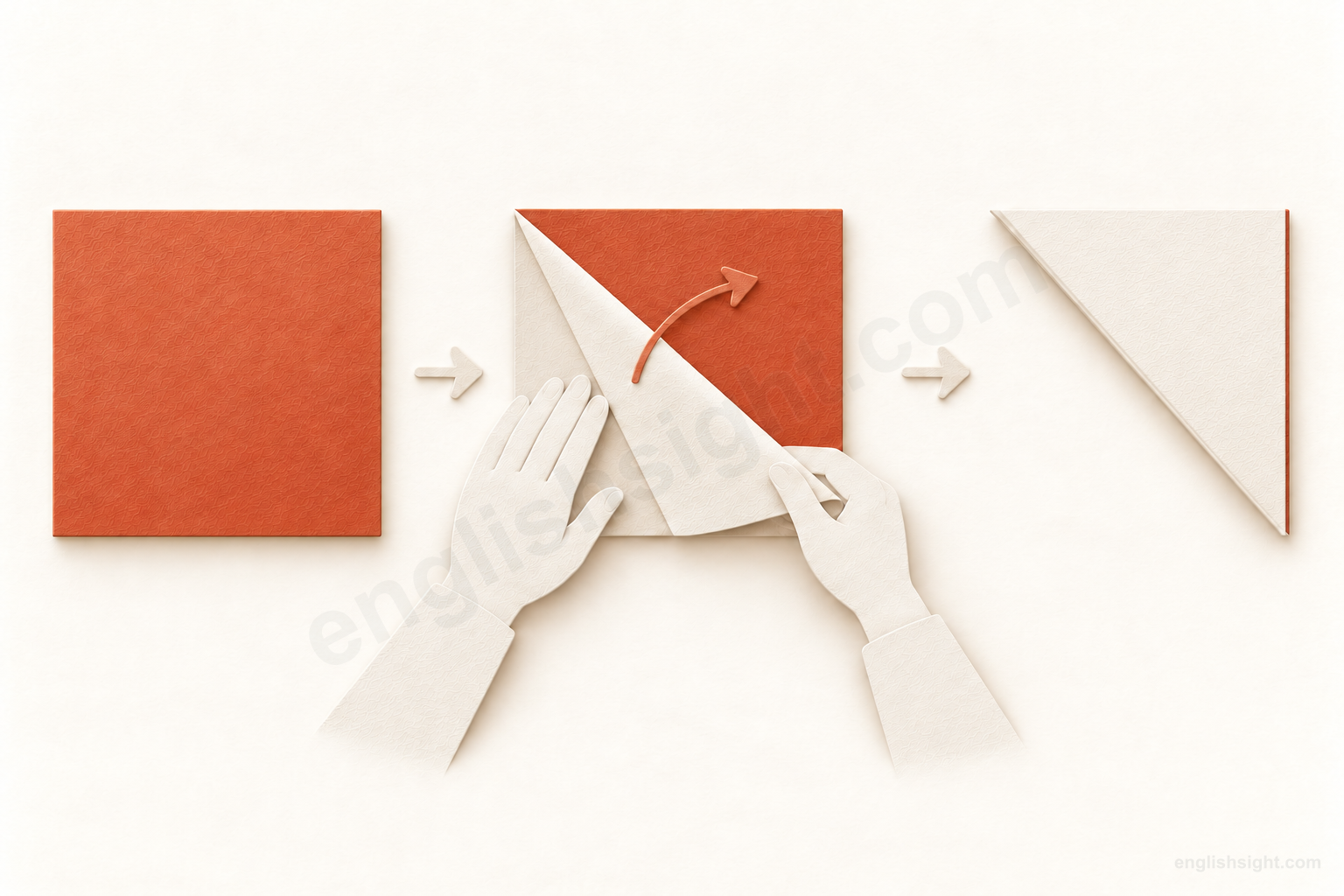
A flat square sheet of paper.
how
The same sheet forms a triangle, with its ivory reverse facing up.
Two hands fold it along a diagonal; the operation is the focus.
How do you fold it? asks for the method shown by the hands and diagonal fold. This picture illustrates the method branch of how.
How focuses on the way something happens, the state it is in, or its degree; the surrounding construction identifies which detail matters.
In questions, that detail is requested. In explanations or exclamations, it can be supplied or emphasized. Fixed expressions such as how come and how about need their own explanations.
How can ask for steps, a means, a condition, or a degree. Read the whole expression: How did you travel? needs a different answer from How tired are you?
The paper-folding sketch illustrates the method branch: the starting sheet and final shape are known, while the folding operation is the focus. It is a teaching example, not a mental picture shared by every speaker or a model for every fixed expression.
01
Ways, means, and conditions
Ask for a procedure, the means used, someone’s condition, or an evaluation. The expected answer changes with the situation.
01
how + auxiliary / modal + subject + verb; how + be + subject
How does it work?
ask about a method, process, or manner
Situation / starting point
You see a paper square and a folded triangle.
Answer / communicative result
You ask for the folding steps.
The result is visible; how asks about the operation that produces it.
In How do you fold this?, you want the procedure, not the name of the object. An answer might be Fold one corner over to the opposite corner. This is the branch shown in the diagram.
How did the window break? asks about the event or circumstances. It need not imply a deliberate action. How did you find out? asks how the information reached you.
How do you say this in English? requests wording; How do you spell it? requests letters. For an object’s name, What do you call this? is the usual question. Do not translate a naming question as How do you call this? How should I address you? is a natural question about the appropriate form of address, such as a name or title.
In a sentence
How do you fold the square into a triangle?
Watch the difference With an ordinary present-tense verb, use do or does: How does it work?, not How it works?
02
how + do / did / can + subject + verb
How did you get here?
ask what means or resources someone used
Situation / starting point
A visitor arrives from the airport.
Answer / communicative result
You learn that she took the train.
A means can answer how without giving a sequence of steps.
An answer to How did you get here? might be By train, On foot, or My sister drove me. How asks about the means; get here supplies the journey.
How can I help? offers assistance by asking what action would be useful. How do you know? requests a basis for a claim. Read the verb and situation before deciding what kind of answer is needed.
In a sentence
How did you get here from the airport?
Watch the difference Why did you come? asks for a reason or purpose, not normally the transport.
03
how + be + person; how + be + subject + doing / feeling
How are you?
ask about someone’s health or current situation
Situation / starting point
You meet a friend after her illness.
Answer / communicative result
She tells you she is feeling better.
How focuses on a condition rather than an identity.
How are you? may be a friendly greeting or a genuine request for news. Context determines how much detail is expected. How are you feeling? makes present health or feelings more explicit.
How are you doing? and How’s it going? are informal ways to ask how life or an activity is progressing. Doing here does not necessarily request a list of current actions; What are you doing? does.
In a sentence
How are you feeling after yesterday’s long journey?
Watch the difference Who are you? asks identity. How are you? asks condition; they are not interchangeable.
04
how + be + event / thing; how + do / did + event + go
How was it? / How did it go?
ask for an evaluation or report on progress
Situation / starting point
Your colleague returns from an interview.
Answer / communicative result
You ask whether it went well.
The event is known; its quality or outcome is the missing detail.
How was the interview? invites a report such as Fine, Difficult, or Much shorter than I expected. How did the interview go? puts the focus on how it proceeded and turned out.
For a general description, What is the new office like? is useful. How is the new office? usually asks how things are going there. How do I look? asks for an assessment of your appearance; What do I look like? asks for a description or resemblance.
In a sentence
How did your interview go this morning?
Watch the difference Do not combine the patterns as How is it like? Use How is it? or What is it like? as appropriate.
05
how + do / did + subject + like + object; how would + subject + like + object
How do you like…?
ask for an opinion or a preferred way of having something
Situation / starting point
A friend has started using a new bicycle.
Answer / communicative result
You ask what they think of it.
Like and the object determine whether the question asks for an evaluation or a preference.
How do you like your new bike? asks whether you find it good or enjoyable. A natural answer is It’s great, though the seat is hard. How did you like the film? asks for a reaction to a past experience.
How do you like your coffee? usually asks how you prefer it prepared or served: Black, please. Here the intended answer is a manner or condition, not a review of one cup. How would you like your coffee? politely asks the current preference.
In a sentence
How do you like your new bike?
Watch the difference What do you like? asks which thing you enjoy. How do you like it? asks for an evaluation or, in a suitable context, a preferred form.
02
Degree, quantity, space, and time
The adjective, adverb, or quantity word after how supplies the dimension: age, speed, amount, duration, frequency, or distance.
06
how + adjective / adverb + question clause; how much + comparative
How old / tall / fast / well…?
ask for a degree on a particular dimension
Situation / starting point
You need a shelf that will fit below a window.
Answer / communicative result
You ask for its height.
The word after how identifies the dimension being measured.
How tall is the shelf? can receive a measurement. How difficult is the test? may receive a judgment rather than a number. How fast can you type? asks about speed; how well asks about quality or skill.
Age uses How old…?; a reply can be She is six or She is six years old. How much taller is this one? adds much to ask about the size of a difference between two things.
In a sentence
How tall is the shelf by the window?
Watch the difference How modifies the adjective or adverb: How old is she?, not How is she old?
07
how much + uncountable noun; how many + plural countable noun
How much / how many…?
ask about an amount or number
Situation / starting point
You are preparing a meal for a group.
Answer / communicative result
You find out the amount of rice and number of guests.
Much and many select different kinds of quantity.
Use how much with an uncountable noun, as in How much rice do we need? Use how many with a plural countable noun, as in How many guests are coming? The noun can be omitted when already understood: How many do we need?
How much do you exercise? asks about the amount of activity. How much do you like it? asks about degree of liking. A number is not the only possible answer to how much.
In a sentence
How many guests are coming, and how much rice do we need?
Watch the difference Say how many chairs but how much furniture. The grammar follows the noun, not the size of the objects.
08
how much + be + item; how much + do / does / did + item + cost
How much is it?
ask the price
Situation / starting point
You want a lamp whose price label is missing.
Answer / communicative result
The seller tells you the cost.
In a buying context, how much can ask for money without naming it.
How much is this lamp? asks what it costs. How much does this lamp cost? makes cost explicit. For several lamps, use How much are these lamps? or How much do these lamps cost?
How much did you pay for it? asks about an actual purchase rather than the current asking price. A reply such as Thirty pounds supplies the understood unit of money.
In a sentence
How much is the lamp in the corner?
Watch the difference How many lamps? asks their number, not their price.
09
how long + question clause; how long + be + object
How long…?
ask about a length of time or a physical length
Situation / starting point
You must plan around a repair appointment.
Answer / communicative result
You learn how much time the repair will take.
Long supplies a length dimension; context decides whether it is time or space.
How long will the repair take? asks for duration, perhaps About an hour. How long have you lived here? asks about time up to now; an answer might be For three years or Since 2023.
How long is the table? asks about physical length. For a scheduled clock time, ask What time does the repair start?, not How long does it start?
In a sentence
How long will the repair take?
Watch the difference Keep duration separate from a point on the clock: two hours answers how long; at two o’clock answers what time.
10
how soon + question clause; how long ago + past-tense question
How soon…? / How long ago…?
ask about time until or since an event
Situation / starting point
You need a replacement part and information about the previous repair.
Answer / communicative result
You distinguish a future wait from elapsed time in the past.
Soon looks ahead; ago measures back from now.
How soon can you send the part? asks how much waiting is necessary before it can be sent. How long ago did you replace it? asks how much time has passed since the replacement.
Compare How long will you stay? with How soon will you leave? A stay has a duration; soon concerns the interval before departure. In two days can answer how soon; two days ago answers how long ago.
In a sentence
How soon can you send a replacement part?
Watch the difference Ago normally goes with a completed past event: How long ago did it happen?, not How long ago has it happened?
11
how often + question clause; how many times + question clause
How often…?
ask how frequently something happens
Situation / starting point
You want to know the bus service pattern.
Answer / communicative result
You receive a frequency such as every twenty minutes.
Often asks about repetition, not the length of one event.
How often does the bus run? invites Every twenty minutes, Six times a day, or another frequency. How many times did you call? instead asks for a count within the relevant occasion or period.
How long is the journey? concerns duration. A service can run every ten minutes while each journey lasts an hour; these answers measure different things.
In a sentence
How often does the bus run on Sundays?
Watch the difference Every twenty minutes answers how often. For twenty minutes describes duration.
12
how far + be + place; how far + question clause
How far…?
ask about distance or extent
Situation / starting point
You are deciding whether to walk to the station.
Answer / communicative result
You learn the distance from your hotel.
Far selects distance; it can also describe the extent of progress.
How far is the station from here? might be answered About two kilometres. How far have you walked? asks about distance already covered.
How far have you got with the report? can ask about progress rather than travel. How long does it take to get there? asks about travel time, which depends on transport as well as distance.
In a sentence
How far is the station from our hotel?
Watch the difference Use where to ask location, how far to ask distance, and how long to ask the travel time.
03
How inside a larger sentence
How can introduce a detail to explain, a skill to learn, a fact to notice, or a range of possibilities. These are not all direct questions.
13
verb / expression + how + subject + verb
Tell me how it works.
put a how question inside a larger sentence
Situation / starting point
A colleague knows how to use a device.
Answer / communicative result
You ask them to explain the method.
Inside the how clause, use statement order.
The direct question is How does it work? In Tell me how it works, the clause follows tell me and does not use question inversion or extra do. The same applies in I wonder how she did it and Do you know how old he is?
The outer sentence controls punctuation. Do you know how it works? is a question; I know how it works. is a statement. The how clause keeps the same order in both.
In a sentence
Could you explain how this lock works?
Watch the difference Use how it works, not how does it work, after explain, know, or tell me in this pattern.
14
know / learn + how to + base verb; show / teach + person + how to + base verb
know / learn / show someone how to…
refer to a method or skill without a full finite clause
Situation / starting point
You cannot adjust the seat.
Answer / communicative result
Someone demonstrates the steps you need.
How to introduces the action whose method is known or taught.
Know how to adjust the seat means know the method or have the relevant skill. Show me how to adjust it requests a demonstration or explanation. A title such as How to adjust your seat names an instructional topic.
In She showed me how to adjust it, me identifies the learner. For a direct question, use How do I adjust it? The shorter How to adjust it? occurs in headings or brief notes but is not the usual full spoken question.
In a sentence
Maya showed me how to adjust the seat.
Watch the difference Use how to adjust, not how to adjusting. How to is not a phrasal verb.
15
it is + evaluative adjective + how-clause; remember / notice / realize + how-clause
It’s interesting how… / remember how…
draw attention to a fact, pattern, or degree
Situation / starting point
You notice that a room becomes quiet when music stops.
Answer / communicative result
You comment on this recurring fact.
How can introduce something noticed, not a question waiting for an answer.
It’s interesting how everyone goes quiet can comment on the fact or pattern itself. It is not necessarily a request to explain the mechanism. Remember how we used to meet here? similarly recalls a shared situation.
In I didn’t realize how quiet it was, how quiet highlights degree. Compare I didn’t realize that it was quiet, which states the fact more plainly. The following words help determine the reading.
In a sentence
It’s interesting how everyone goes quiet when the music stops.
Watch the difference Do not treat every how clause as an indirect request for instructions. Some present a fact or an emphasized degree.
16
verb + how + subject + like / want / please
Do it how you like.
allow a choice of manner
Situation / starting point
A friend wants to arrange the chairs differently.
Answer / communicative result
You let them choose the arrangement.
The how clause can specify any preferred way, not an unknown answer.
Arrange them how you like means arrange them in whatever way you prefer. This is a choice of manner, not a direct question about preferences.
As you like or however you like can express a similar idea. This how pattern is common in informal language. Its freedom comes from the whole clause, especially like, want, or please.
In a sentence
Arrange the chairs how you like.
Watch the difference How you like has statement order here; do not insert do before you.
17
no matter how + adjective / adverb + subject + verb; no matter how + subject + verb
no matter how…
say that a result holds across different degrees or ways
Situation / starting point
Biscuits keep breaking during packing.
Answer / communicative result
You explain that extra care does not prevent all breakage.
No matter makes the stated variation irrelevant to the main outcome.
No matter how carefully I pack it, it breaks says it breaks at every relevant level of care. How carefully supplies the variable; no matter says the main claim holds regardless.
No matter how you arrange them, they won’t fit works with manner rather than degree. However carefully I pack it, it breaks is a possible alternative; however is one word in that construction.
In a sentence
No matter how carefully I pack the biscuits, some of them break.
Watch the difference Use statement order: no matter how carefully I pack them, not no matter how carefully do I pack them.
04
Suggestions, reactions, and follow-up questions
Learn the whole expression. How about, how come, how dare, and familiar greetings have functions that a picture of a method cannot predict.
18
how + adjective / adverb + (subject + verb)!; how + subject + verb!
How lovely! / How quickly it changed!
express a strong reaction or degree
Situation / starting point
You see an unexpectedly beautiful garden.
Answer / communicative result
You express delight rather than ask for a measurement.
Exclamatory how highlights degree without requesting an answer.
How lovely! is a short reaction. How lovely the garden looks! adds a subject and verb in statement order. How quickly it grew! does the same with an adverb. How I missed this place! emphasizes the strength of a feeling.
Compare What a lovely garden! In that pattern what introduces a noun phrase; how normally introduces the adjective or adverb. How kind of you to help! is an established way to express appreciation.
In a sentence
How lovely the garden looks in the evening light!
Watch the difference Use How lovely the garden looks!, not How lovely does the garden look! for the ordinary exclamation.
19
how about + noun / -ing; how about + subject + verb
How about a walk?
offer a possible plan for consideration
Situation / starting point
You and a friend have a free afternoon.
Answer / communicative result
You propose walking by the river.
How about introduces an option, not a request for the walking method.
How about a walk? proposes an activity. How about walking by the river? follows about with an -ing form. How about we walk by the river? is also used, especially in North American English.
A noun can suggest a time, place, or thing too: How about Tuesday? The other person can accept, reject, or propose another option. The suggestion belongs to how about as a whole.
In a sentence
How about walking by the river after lunch?
Watch the difference Say How about walking…?, not How about to walk…?
20
statement / answer + how about + person?
How about you?
turn the same question or topic to another person
Situation / starting point
You have said you prefer the morning class.
Answer / communicative result
You invite your friend’s preference.
The earlier context supplies what is being asked.
I prefer the morning class. How about you? asks which class the listener prefers. After I’m fine, how about you?, it asks about the listener’s condition. It does not always mean the same thing in isolation.
What about you? often serves the same conversational purpose. Neither requires you to repeat the full question, but the preceding topic must make it recoverable.
In a sentence
I’d rather take the morning class. How about you?
Watch the difference Here you is the person invited to answer, not the proposed activity in a suggestion.
21
how would + subject + like + noun / to-infinitive
How would you like to…?
make an invitation or offer
Situation / starting point
You have a spare ticket to a concert.
Answer / communicative result
You invite a friend to join you.
The whole question can offer an experience rather than ask about its method.
How would you like to join us? can mean Would you be interested in joining us? It often presents an appealing possibility. A noun works too: How would you like a free ticket?
Context can restore the literal manner reading: How would you like to pay? asks for a payment method. Compare What would you like to drink?, which asks the person to choose a drink.
In a sentence
How would you like to join us at the concert?
Watch the difference Do not assume every how would you like question is an invitation; pay or travel can make it a question about means.
22
how come + subject + verb; how come?
How come…?
ask informally for a reason or explanation
Situation / starting point
A usual bus service has been cancelled.
Answer / communicative result
You ask why it is not running.
How come is a fixed why-like expression; come is not physical arrival here.
How come the bus isn’t running? asks why the service is unavailable, often with surprise. The clause after how come normally has statement order. How come? can also stand alone after news.
Compare Why isn’t the bus running? and How come the bus isn’t running? Both can ask for a reason, but how come is informal. Do not extend its special word order to ordinary how questions.
How is it that the bus is always late? is another way to ask for an explanation. Here is it is question order in the outer clause; the clause after that keeps its own subject before its verb.
In a sentence
How come the bus isn’t running today?
Watch the difference Say How come she left?, not How come did she leave? in this ordinary fixed pattern.
23
how so?; how do you mean?
How so? / How do you mean?
ask someone to explain a preceding claim
Situation / starting point
A colleague describes the new system as awkward.
Answer / communicative result
You ask which aspect is awkward.
Short follow-up questions recover their topic from the preceding statement.
After This version is easier, How so? asks in what respect or why the speaker says that. It may request evidence or a concrete example rather than a history of events. How should I interpret that remark? similarly asks what meaning to take from it, rather than how the remark was physically produced.
How do you mean? asks for clarification and is especially British and informal. What do you mean? is a more widely useful alternative. A calm tone helps keep either question from sounding like a challenge.
In a sentence
“The new system is awkward.” “How do you mean?”
Watch the difference How so? asks for elaboration on a claim; How come? more typically asks why a situation exists. Context can overlap.
24
how is that?; how is that for + noun?; how about that!
How’s that? / How’s that for…?
ask whether something is satisfactory or draw attention to a quality
Situation / starting point
You move a chair so a friend can see better.
Answer / communicative result
You check whether the new position is suitable.
That refers to a specific proposal, adjustment, or result.
How’s that? after an adjustment asks whether it is now satisfactory. How’s that for speed? can draw attention to an impressively quick result. It can also be ironic when the result is poor.
How’s that? after unexpected news can instead ask for the reason: I got a refund. — How’s that? The conversational position tells you whether it asks for approval or an explanation. How about that! is a different fixed reaction expressing surprise.
In a sentence
I’ve moved your chair closer to the screen. How’s that?
Watch the difference How’s that? does not have one fixed translation for every conversation; identify what that refers to.
25
how can / could + subject + base verb?
How could you…?
express disbelief or disapproval
Situation / starting point
Someone shares a private message without permission.
Answer / communicative result
You challenge that behavior.
The question may condemn the action rather than seek instructions.
How could you share my private message? can express hurt or anger. The speaker is not normally asking which button was pressed. How can you say that? similarly challenges a statement.
Compare the genuine method question How could I share this file securely? There the speaker seeks a practical solution. Context, subject, and tone distinguish the readings; could does not itself make a sentence accusatory.
How would you like it if someone shared your messages? asks the listener to imagine receiving the same treatment. It seeks sympathy or challenges unfair behavior; it is not the attractive invitation in How would you like to join us?
In a sentence
How could you share my private message with everyone?
Watch the difference This use can be forceful. Use a neutral method question when you actually want practical instructions.
26
how dare + subject + base verb!
How dare you…!
express strong anger at someone’s behavior
Situation / starting point
Someone accuses you of dishonesty.
Answer / communicative result
You reject their right to make that accusation.
This is a strong protest, not a request to measure courage.
How dare you accuse me of lying! treats the accusation as outrageous. Dare functions in a modal-like pattern here: How dare she say that! uses dare, not dares, and the next verb has no to.
Contrast the ordinary verb in He didn’t dare to ask, which concerns having enough courage. The whole how dare expression carries the protest and is much stronger than a calm request for an explanation.
In a sentence
How dare you accuse me of lying!
Watch the difference In this fixed protest use How dare you say that!, not How do you dare to say that!
27
how on earth / in the world + question clause; how ever + question clause
How on earth…?
add surprise, frustration, or disbelief to a question
Situation / starting point
A large sofa has appeared in a tiny upstairs room.
Answer / communicative result
You ask with surprise how it was brought inside.
On earth strengthens the question; it does not locate the event on the planet.
How on earth did you get it upstairs? can be a real request for an explanation, strengthened by amazement. How in the world…? has a similar function. These additions can also express anger or frustration.
How ever did you manage that? uses ever for emphasis too. Do not confuse it with however meaning nevertheless. The ordinary question order remains: did you get, not you did get.
In a sentence
How on earth did you get that sofa upstairs?
Watch the difference An emphatic question may sound impatient; choose the tone to fit the relationship.
28
how do you do? — how do you do?
How do you do?
use a formal first-meeting greeting
Situation / starting point
You are introduced at a formal reception.
Answer / communicative result
You exchange a conventional greeting.
The complete formula is a greeting rather than a literal inquiry about doing.
How do you do? is a formal, now rather old-fashioned greeting at a first introduction. A conventional reply is also How do you do? You do not normally explain your daily activities.
Nice to meet you is a useful modern alternative. How are you? asks about condition or serves as a more general greeting and is not restricted to a first meeting.
In a sentence
“Dr Lane, this is Professor Reed.” “How do you do?”
Watch the difference Keep How do you do? separate from the informal How are you doing?
Identify the detail and read the whole pattern
How, what, and why ask different things
How did you do it? requests a way or means; What did you do? requests the action; Why did you do it? requests a reason. Context can blur the boundaries, especially in rhetorical questions and how come. Do not replace one mechanically with another.
Word order belongs to the construction
Compare How does it work? with Tell me how it works. Ordinary direct questions use question order; embedded clauses use statement order. How come, how dare, suggestions with how about, and exclamations have their own patterns. Learn them as constructions.
Word classes and related forms
How is pronounced /haʊ/. Oxford treats the headword as an adverb; Collins and Merriam-Webster also label its clause-linking uses as conjunctions. A noun use appears in the hows and whys, meaning methods and reasons. How-to and know-how are related separate entries, not extra senses taught in depth here. Verb inflections, causatives, passive forms, and particle-verb separability do not apply to how itself.
The picture has a boundary
The folding example explains asking about a method. It does not mean every how expression involves movement, a sequence, or a successful result. Measurements, conditions, and conventional expressions remain distinct branches.
Choose what the speaker needs
Look at the situation and the entire how construction.
1. You politely ask someone to explain a machine. Which sentence has the usual embedded word order?
2. You need a number of separate chairs. Which question fits?
3. You want the time interval before a parcel can be sent, not the length of its journey. Which question fits?
4. You informally ask why the shop is closed. Which pattern fits?
5. You suggest an activity for the afternoon. Which form fits after how about?
6. Someone says “How lovely the garden looks!” What is the main function?
Sources and teaching notes
The sources below support the usage inventory. Explanations, situations, examples, and the paper-folding diagram were created for this lesson. The visual model is a limited teaching illustration.
This diagram illustrates asking about a method; it is not a shared picture in every speaker’s mind.