Talk about amusement, distinguish moods, and understand “Just humor me.”
Something amusing, someone amused
Something amusing, someone amused
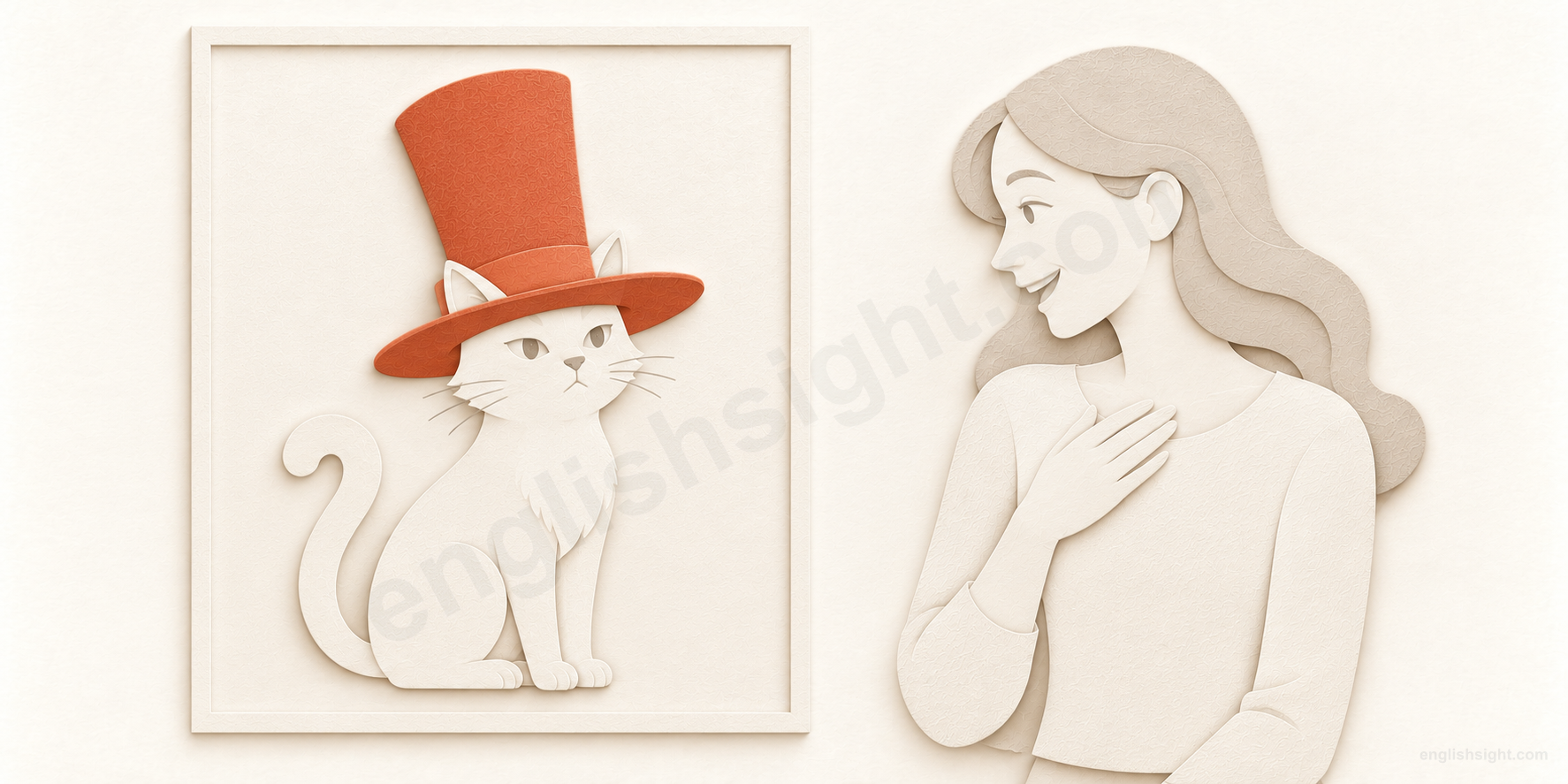
A cartoon cat wears an oversized formal hat.
humor
Her smile shows that she finds the picture funny.
The viewer notices the playful mismatch.
The cat’s absurdly grand hat is the amusing detail; the viewer’s smile shows her response.
In the amusement sense, humor is what makes a remark, picture, or situation funny to someone.
The playful mismatch below illustrates one way humor works. It does not define every joke or explain the separate mood and indulgence uses.
Humor is the usual American spelling; British English normally writes humour. Both spellings can be a noun or a verb. This lesson uses humor throughout its original examples.
The main modern noun family concerns what people find amusing. Mood expressions and the verb need their own explanations; the picture is a teaching example, not a universal picture in English speakers’ minds.
01
Finding and sharing the funny side
Talk about an amusing quality, someone’s response to it, or the ability to create and enjoy it.
01
humor in + work / situation; be full of humor
the humor in a story
the quality that makes something amusing
Situation or intention
A story describes a cat in an enormous formal hat.
Meaning in context
A reader finds the unexpected detail funny.
Humor is the amusing quality, not the physical act of laughing.
Humor can belong to words, behavior, a picture, or an unplanned situation. Here the comic mismatch is one way to create it; not all humor depends on the same device.
It is normally uncountable in this sense: some humor, a little humor, or a story full of humor. For one individual funny item, use a joke rather than a humor.
In a sentence
The humor in the story comes from a cat who takes himself far too seriously.
Watch the difference Humor names a quality or amusing material; laughter names the sound or action of laughing.
02
see / appreciate + the humor + in something; the humor of something
see / appreciate the humor in something
recognize or enjoy what is funny about it
Situation or intention
Two friends accidentally arrive in identical costumes.
Meaning in context
They recognize the funny side of the coincidence.
See means recognize here; a joke can also be heard or read.
See the humor in something means recognize its amusing side. Appreciate the humor adds the idea of understanding or enjoying that quality. The humor of the situation is another established noun phrase.
I don’t see the humor in that can reject a remark as unfunny or inappropriate. It is not necessarily a request for a literal explanation. The words after in or of identify where the amusing quality lies.
In a sentence
Once we saw our matching costumes, we could both see the humor in the mistake.
Watch the difference Finding humor in a mistake does not mean the mistake was deliberate.
03
have / keep / lose + a / your sense of humor
have / keep a sense of humor
be able to notice, enjoy, or express what is funny
Situation or intention
Someone faces a string of small travel problems.
Meaning in context
They still find things to laugh about.
A sense of humor is an ability or disposition, not a single joke.
Have a good sense of humor describes someone who enjoys or produces amusing observations. A good sense of humor need not mean constant joking. Have no sense of humor can sound critical.
Keep your sense of humor asks someone to retain that ability in difficulty. Lose your sense of humor can describe becoming unable to take things lightly. The article belongs with sense: a sense of humor, not a humor.
In a sentence
Even after two missed trains, Maya kept her sense of humor.
Watch the difference A good sense of humor concerns amusement; good humor alone can mean a cheerful mood.
04
use humor; add a touch of humor; an attempt at humor; a brand of humor
use humor / a touch of humor
include something amusing in communication
Situation or intention
A speaker wants an audience to relax.
Meaning in context
A brief funny observation makes the introduction lighter.
Use describes the speaker’s choice; touch indicates a small amount.
Use humor describes a technique in speaking or writing. A touch of humor is a little of that quality; a brand of humor means a distinctive style, not a commercial product in this context.
An attempt at humor is an effort to be funny, whether or not it works. For example, “Her attempt at humor fell flat” says the intended audience did not find it amusing.
In a sentence
Leo added a touch of humor to his otherwise serious introduction.
Watch the difference An attempt at humor reports intention; it does not guarantee that anyone laughed.
02
Different styles of humor
The adjective names the style or subject matter. These combinations describe different ways something can be funny.
05
dry humor; a dry sense of humor
dry humor
quiet, understated humor that is not immediately obvious
Situation or intention
A meeting ends much later than planned.
Meaning in context
A speaker calmly calls it “a brief chat.”
Dry describes restrained delivery, often with irony, rather than a lack of funniness.
A person using dry humor may sound serious while saying something amusing. The listener needs to notice the gap between the words and the situation.
For example, after a three-hour meeting, “Well, that was a brief chat” could be dry humor if said quietly. Dry reading, by contrast, means boring reading; dry has a different sense there.
In a sentence
Her dry humor made even the long planning meetings bearable.
Watch the difference Dry humor can be entertaining. Do not read dry as boring in this combination.
06
wry humor; a wry sense of humor
wry humor
amusement that also acknowledges disappointment or difficulty
Situation or intention
A carefully arranged picnic is spoiled by rain.
Meaning in context
Someone makes a ruefully funny comment about the planning.
The amusement coexists with awareness of what has gone wrong.
Wry humor finds something amusing in an unwelcome situation. It can feel rueful: you recognize the disappointment without discussing it only in an angry or solemn way.
Looking at the rain, “At least we won’t need to water the sandwiches” could be a wry remark. Dry describes the restrained way of expressing humor; wry highlights the mixed response to a bad situation. A remark can be both.
In a sentence
With wry humor, Nina described her holiday as a tour of closed museums.
Watch the difference Wry does not simply mean cruel. Read the speaker’s attitude and the situation.
07
dark / black humor; gallows humor
dark / black humor; gallows humor
humor about disturbing or grim subjects
Situation or intention
A comedy includes jokes about death.
Meaning in context
The audience encounters humor with unsettling subject matter.
The adjective concerns the subject or tone, not the amount of laughter.
Dark humor, also called black humor, treats disturbing subjects such as death in an amusing way. Gallows humor is a related expression for jokes about grim matters, especially death.
For this lesson, the useful contrast is with gentle, lighthearted humor: “The funeral comedy relies on dark humor” tells you what kind of material to expect. Whether a particular joke feels funny depends on the audience and context.
In a sentence
The film’s dark humor will not appeal to viewers who dislike jokes about death.
Watch the difference These are established style labels. Dark does not refer to the lighting, and black does not identify the performers.
03
Cheerfulness and bad moods
In these established expressions, humor concerns someone’s mood or manner. It need not involve jokes.
08
be in (a) good humor; someone’s good humor
be in (a) good humor
be cheerful and pleasant
Situation or intention
A neighbor greets everyone warmly.
Meaning in context
You describe the neighbor’s cheerful mood.
Good humor describes mood; no joke is necessary.
In a good humor and in good humor describe a cheerful state. Mood is usually a simpler everyday alternative: She is in a good mood.
Good humor can also name a pleasant disposition: I admire his patience and good humor. Here you are describing how he treats situations and people, not rating the quality of his jokes.
In a sentence
A restful night had put Sam in a good humor.
Watch the difference A good humor is possible in this mood expression. It does not make the amusement sense generally countable.
09
be in a bad humor; be out of humor; ill humor
be in a bad humor / out of humor
be irritable or in a bad mood
Situation or intention
A delay leaves someone impatient and unfriendly.
Meaning in context
You describe the person’s irritated state.
Bad humor can mean bad temper, not unsuccessful comedy.
In a bad humor describes an unhappy or irritable mood. Out of humor and ill humor belong to the same mood family. These expressions can sound more formal or literary than in a bad mood.
The preposition does not create a new comedy meaning: out of humor is an established expression, not a literal statement that someone has used up all their jokes. Compare bad jokes if you mean jokes that are not funny.
In a sentence
The cancelled flight left him in a bad humor for the rest of the day.
Watch the difference In ordinary conversation, in a bad mood is often the clearest choice.
10
take + remark / teasing / criticism + in good humor; with good humor
take something in good humor
respond cheerfully without taking offense
Situation or intention
Someone gently teases you about being late.
Meaning in context
You accept the teasing pleasantly.
The expression describes how the recipient responds.
Take teasing or criticism in good humor means receive it without becoming angry or offended. Take here means respond to or accept; in good humor supplies the manner.
Similarly, handle a delay with good humor describes a cheerful way of dealing with inconvenience. A cheerful response may include a joke, but making a joke is not required.
In a sentence
Rosa took the teasing about her muddy shoes in good humor.
Watch the difference This says how Rosa reacted; it does not prove that the teasing itself was kind or funny.
04
The verb: going along with someone
Humor someone means accommodate a wish or idea to please them, often despite your own doubts. It does not mean make them laugh.
11
humor + person; humor someone by + -ing
humor someone
go along with a person’s wishes to keep them content
Situation or intention
You do not share someone’s enthusiasm for an idea.
Meaning in context
You accommodate it rather than challenge it.
The person is the direct object; amusement is not the verb’s meaning.
If you humor someone, you comply with a wish or play along with an idea, often because you think resistance would upset them. You need not genuinely agree.
In “Eli humored his aunt by trying on the enormous hat,” Eli is the person accommodating the wish and his aunt is the person being accommodated. By trying on explains what he did. Amuse his aunt would instead mean make her laugh or entertain her.
In a sentence
Eli humored his aunt by trying on the enormous hat she had chosen.
Watch the difference Humor someone does not normally mean tell them a joke. It can sound patronizing when it suggests their wishes are unreasonable.
12
(just) humor me; humor me and + verb
Just humor me.
ask someone to go along with you for now
Situation or intention
You want to test an idea that another person doubts.
Meaning in context
You ask them to cooperate briefly anyway.
Me is the person asking to be indulged, not the person being entertained.
Just humor me can introduce a small request: “I know it looks unnecessary, but just humor me and check the lock again.” The speaker acknowledges that the other person may not see the point.
The request can be friendly or impatient depending on tone. It asks for cooperation, not laughter or sincere agreement. This is the ordinary transitive verb with an imperative, not a phrasal verb.
In a sentence
Just humor me and read the last line once more.
Watch the difference Just can make the request sound small; it does not automatically make the speaker polite.
Keep the three branches distinct
Spelling and word forms
American humor corresponds to British humour. The regular verb forms are humors, humored, humoring (British humours, humoured, humouring). The initial h is normally pronounced in /ˈhjuːmər/. Humorous is the adjective meaning funny; say a humorous story or a story with humor.
Countability depends on the meaning
The amusement sense is normally uncountable. Mood expressions can use a: in a good humor. The plural in the best of humors is a more formal mood expression, not a set of jokes.
Grammar of the verb
Humor takes a direct object: humor him, not humor to him. The action can be ongoing: I’m only humoring him. A passive such as She realized she was being humored means others were going along with her; it does not mean she was laughing. There is no everyday particle-verb family to memorize here.
Related words and the limits of the model
A joke is one funny item; humor is the wider amusing quality or material. Wit often emphasizes clever expression, and sarcasm can hurt. The lesson’s cartoon illustrates a playful mismatch without claiming all humor is harmless, all audiences agree, or all meanings of humor come from that image.
Historical and specialist branches
The old theory of four bodily humors is historical, not modern medical advice. Aqueous humor and vitreous humor are anatomical terms for substances in the eye. These specialist terms, archaic whims, and rare uses meaning adapt oneself to something are outside the everyday lesson.
Read the whole expression
Decide whether the sentence concerns amusement, mood, or cooperation.
1. Which phrase describes someone’s ability to enjoy or create funny things?
2. “Sam was in a bad humor after the delay.” What does this tell you?
3. A colleague says, “Just humor me and check the figures again.” What are they asking?
4. A speaker quietly calls a very long meeting “a brief chat.” Which interpretation fits dry humor?
5. “Rosa took the teasing in good humor.” What does the sentence establish?
Sources and teaching notes
The sources below were checked for meanings, patterns, and usage limits. Explanations, examples, and the visual teaching model were written for this lesson.
The picture illustrates one route to amusement. Humor does not have one universal mental image.