From frozen water to cooling, cake toppings, and familiar idioms.
From flowing water to solid ice
From flowing water to solid ice
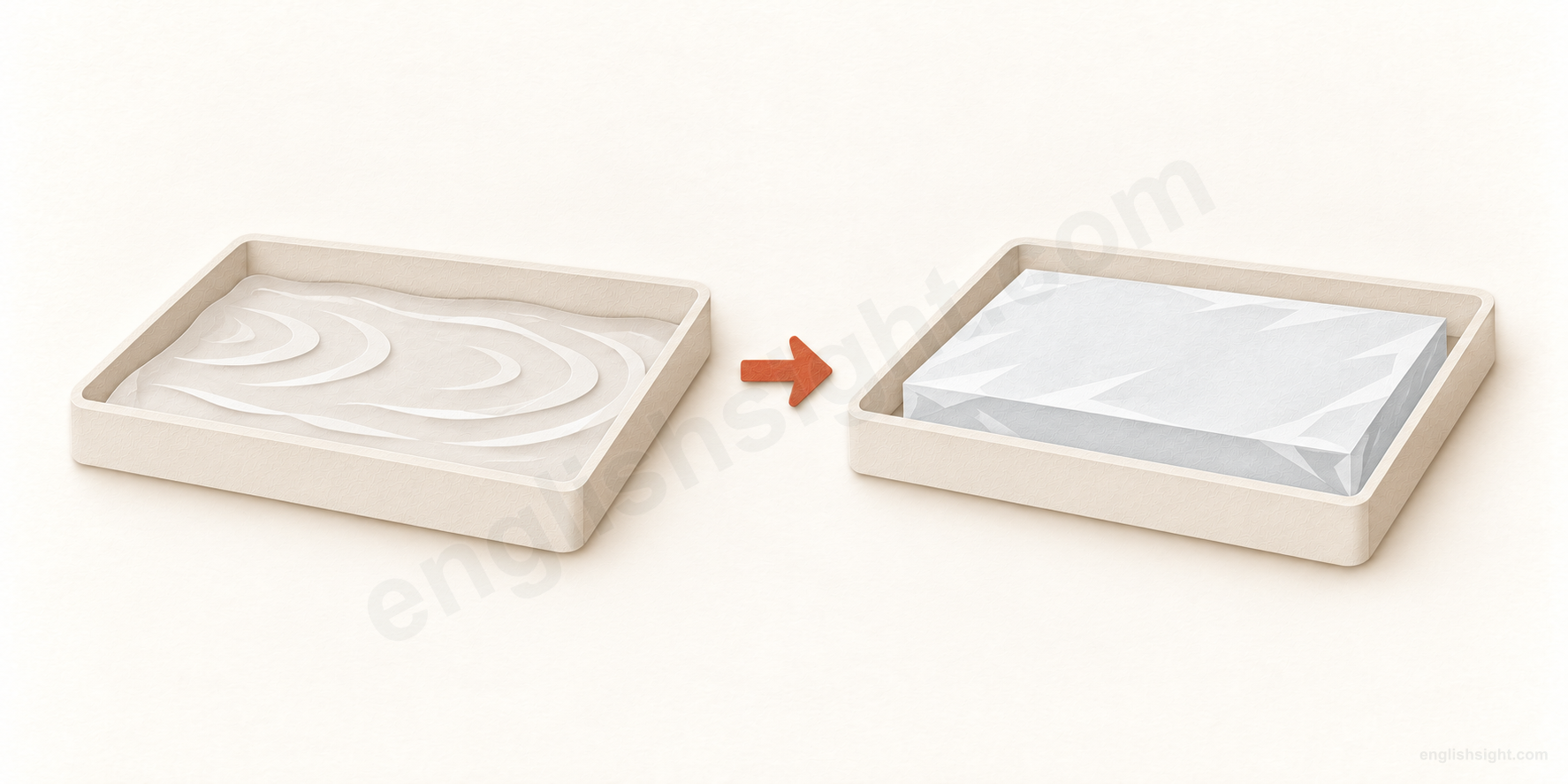
Liquid water ripples inside a shallow tray.
ice
The same tray holds one flat slab of ice.
The water freezes into a solid.
Water freezes into solid ice; the matching trays highlight the change of state.
Ice is water in a solid state: liquid water freezes into a shape-holding solid, and ice can melt back into water.
The sketch anchors the literal material and its formation. It does not show all the dessert, cake-topping, or figurative meanings, and it does not imply that ice must be made in a tray.
Ice begins with a concrete material: water that has become solid. A sheet on a pond, cubes in a drink, and the surface of a rink are different uses of that material.
Other uses need their own explanation. Ice a cake means add a sugar topping; break the ice concerns social ease. Learn what each complete expression contributes.
01
Frozen water, pieces, and surfaces
Start with the material. The surrounding words tell you whether you mean a quantity, a particular surface, or a small piece.
01
ice + forms / melts; a block / sheet / layer of ice
ice forms / ice melts
water in its solid state
Situation
Water is liquid, or ice is still solid.
Meaning or result
Cold can form ice; warmth can melt it.
Ice names a material; freeze and melt name changes.
Ice is the ordinary noun for frozen water. It is not just very cold liquid water. Ice forms when water freezes; ice melts when it changes back into liquid water.
As a material, ice is normally uncountable: some ice, much ice, a lot of ice. Use singular agreement: The ice is melting. Say a block, sheet, or layer of ice when you need a shape or quantity.
The diagram follows water becoming solid. It provides an anchor for the literal uses, not an explanation of every idiom. To name the general change into a solid, freeze is usually more useful than the bare verb ice.
In a sentence
A thin layer of ice formed on the water overnight.
Watch the difference Do not use an ice for an ordinary piece of frozen water; say a piece of ice.
02
some / no / crushed ice; a piece of ice; an ice cube
some ice / two ice cubes
pieces of frozen water, often for a drink
Situation
A drink needs cooling.
Meaning or result
You add a quantity of ice or a counted number of cubes.
Count the pieces, not the material name.
Could I have some ice? asks for frozen water without counting the pieces. Two ice cubes counts small blocks made for drinks. Crushed ice consists of much smaller broken pieces.
Ice before another noun helps name a thing connected with the material: an ice cube is a piece, and an ice bucket is a container. The second noun carries the count: one bucket, two buckets.
In a sentence
Please put two ice cubes in my juice.
Watch the difference Two ices does not normally mean two ice cubes.
03
ice on + surface; slip on the ice; black ice
ice on the road / black ice
a frozen layer on a surface
Situation
Water lies on a surface in cold weather.
Meaning or result
The surface has a layer of ice.
On identifies the surface carrying the frozen layer.
There is ice on the steps describes a material on a particular surface. In I slipped on the ice, the points to the ice relevant in that situation. Ice without the is useful when speaking generally.
Black ice names a thin layer on a road. It is a fixed weather expression, not a request for a black-colored cube. A road can be icy without being a place intended for skating.
In a sentence
There was black ice on the bridge this morning.
Watch the difference On the ice can describe a dangerous surface or a skating surface; the context decides.
04
on / onto the ice; ice + activity noun; a show on ice
on the ice / ice skating
a frozen surface used for skating or hockey
Situation
Skaters or players are beside a rink.
Meaning or result
They move onto its frozen surface.
The ice can mean the playing or skating surface.
In a skating or hockey context, the ice means the particular frozen surface. The players are on the ice describes where they are. Onto the ice describes movement to that surface.
Ice skating and ice hockey name activities done on ice. An ice show can also be described as a show on ice. These noun combinations do not make ice a verb, and on ice here does not mean postponed.
In a sentence
The team came onto the ice for the final period.
Watch the difference Keep on for position and onto for movement onto the surface when that difference matters.
05
(as) cold as ice
as cold as ice
extremely cold, physically or in manner
Situation
You notice an intense lack of warmth.
Meaning or result
You emphasize physical cold or an unfriendly manner.
Ice supplies a comparison, not necessarily a literal temperature.
My feet are as cold as ice emphasizes how cold they feel. It does not make a precise temperature claim. The comparison uses as + adjective + as + noun.
Applied to someone’s voice or manner, cold can mean emotionally distant or unfriendly: Her reply was as cold as ice. This is an extension from physical coldness; it does not necessarily mean the person is calm or frightened.
Ice can itself name emotional coldness: There was ice in her voice describes a distant or hostile tone. The noun is figurative here; nothing in the voice has literally frozen.
In a sentence
His reply was as cold as ice, and he ended the call.
Watch the difference Use the context to distinguish cold skin from a cold manner; neither implies water has frozen.
02
Cooling, food, and drink
Using ice can cool food, drink, or a body part. Icing a cake belongs to a separate food use, so read the object and the complete expression.
06
keep / put + food or drink + on ice; be on ice
keep something on ice
keep something cold using ice
Situation
Food or a drink needs to stay cold.
Meaning or result
Ice surrounds or supports it.
Literal on ice describes cooling, not delay.
Fish on ice and bottles kept on ice describe ice used to keep food or drinks cold. The item can rest on the ice or be surrounded by it; the phrase does not require the food itself to freeze.
Compare The menu changes are on ice: changes are an abstract plan, so the natural reading is postponed. The object and the situation choose between literal cooling and the established figurative use.
In a sentence
The seller kept the fish on ice beside the counter.
Watch the difference On ice does not by itself mean frozen solid or stored in a freezer.
07
ice + drink; iced + drink noun; a drink with / without ice
ice a drink / iced coffee
cool with ice; serve a drink very cold
Situation
You are preparing a cold drink.
Meaning or result
It is chilled, often with ice.
Iced describes preparation; ice names the frozen water.
The verb ice can mean cool something with ice, as in ice the drinks. In everyday ordering, iced coffee and iced tea are useful established names for cold drinks.
Iced is an adjective as well as a past-participle form. An iced drink is cold or contains ice; it need not be frozen into a solid block. Coffee with ice states explicitly that ice is included. Coffee without ice asks for no added cubes.
Write iced coffee with -d in this standard form. Ice water is also an established noun combination; do not infer that every drink name must use exactly the same form.
In a sentence
I ordered iced coffee without any added sugar.
Watch the difference An iced cake has icing on it; it is not necessarily a refrigerated cake.
08
ice + cake; ice it; be iced with + icing
ice a cake
cover a cake with a sweet topping
Situation
A cake is ready for its topping.
Meaning or result
Icing covers the cake.
The object cake selects the sugar-topping meaning.
When you ice a cake, you spread or put icing on it. The direct object is the cake, not the sugar. You can say ice the cake with lemon icing to identify the topping.
The cake was iced yesterday is a normal passive: the cake received the action. She is icing the cake describes an activity in progress. In American English, frost a cake is also used.
This food sense must be learned separately from frozen water. An iced cake does not have to contain ice, and icing a cake does not mean putting it in a freezer.
In a sentence
We iced the cake with a thin layer of lemon icing.
Watch the difference Use freeze the cake for making it frozen; ice the cake refers to its topping.
09
ice + body part; put ice on + body part
ice a body part
apply ice to an area of the body
Situation
Someone is describing the use of ice on a body part.
Meaning or result
Ice is applied to that area.
The body part is the direct object of the action.
Ice your knee means apply ice to your knee. It does not mean turn your knee into ice. In this use the noun has become a verb meaning to apply or use the named material.
You can also say put ice on a knee or use an ice pack. These are alternative ways to describe the action. This lesson explains the wording; the sentence does not establish how, when, or whether a person should use a treatment.
In a sentence
The coach asked whether Maya had iced her ankle.
Watch the difference Do not confuse iced her ankle with an ankle that had frozen.
10
some ice cream; an ice cream; an ice / ices (dessert)
ice cream / an ice
a frozen sweet food or a serving of it
Situation
You are choosing a dessert.
Meaning or result
You order the food or a portion of it.
The dessert name has its own count and regional uses.
Ice cream is a compound naming a sweet frozen food, not plain ice. Some ice cream refers to the food; an ice cream can refer to a serving. For example, We bought an ice cream for each child.
An ice meaning an ice cream is especially British and can sound old-fashioned. Choc ice survives as a familiar product name. In North American food usage, an ice can also be a flavored frozen dessert, often made without milk or cream.
Do not transfer these countable dessert senses to ordinary cubes. Ask for some ice or two ice cubes in a drink, and use the actual dessert name when ordering food.
In a sentence
The café serves a lemon ice made with fruit juice.
Watch the difference An ice can be a dessert in the right context; it is not the general name for a single cube.
03
Becoming covered with ice
Over and up describe ice forming across or around a surface. The surface may be the subject or the object.
11
ice over / up; ice + object + over / up; be iced over / up
ice over / ice up
become covered with ice, or cover something with it
Situation
A surface or part is not yet covered with ice.
Meaning or result
A layer of ice develops on it.
Over and up describe the covering process.
The pond iced over describes ice spreading across a water surface. The lock iced up describes ice forming on or in a part. Over often makes the covering surface prominent; up often occurs with equipment or parts. These are tendencies, not a rule that each object allows only one particle.
The subject may be the thing affected: The windows have iced up. A transitive pattern is possible too: Freezing rain iced the windows up. With a pronoun object, put it between the verb and particle: iced them up.
The pond was iced over can describe the resulting condition. Freeze is broader: it can describe water becoming solid without presenting a covering layer. The reverse action is not ice down; de-ice means remove ice.
In a sentence
The pond iced over during the night.
Watch the difference Iced over does not assert that the pond has frozen solid from top to bottom.
04
Social ease, delay, risk, and influence
These established expressions borrow different features of ice. Learn each whole expression rather than treating ice as one general metaphor.
12
break the ice; break the ice with + person; by + -ing
break the ice
help people begin interacting more comfortably
Situation
People feel awkward at the start of an encounter.
Meaning or result
An opening remark or activity makes interaction easier.
The expression treats initial social reserve as something to break.
At a first meeting, breaking the ice means saying or doing something that helps people feel more relaxed. A question, a shared task, or a light comment can do it; a joke is not required.
The image of a rigid surface can help you remember the change from reserve to easier interaction. This is a teaching comparison, not a claim that every speaker sees ice. It is the complete idiom that carries the social meaning.
The phrase keeps the: break the ice. In We broke the ice by introducing our pets, by + -ing explains how the group became more comfortable. Icebreaker can name an opening activity.
In a sentence
We broke the ice by asking everyone about their first job.
Watch the difference Break ice can refer literally to breaking frozen water; keep the in the social idiom.
13
put / keep + plan + on ice; plan + be / remain on ice
put something on ice
postpone dealing with a plan or project
Situation
A plan is under consideration.
Meaning or result
Work on it is delayed for the time being.
The plan is set aside rather than physically cooled.
Put a project on ice means stop proceeding with it for now. The project can remain on ice or be on ice while another matter is dealt with. The expression leaves open whether and when it will resume.
Put takes the object before the prepositional phrase: put it on ice. Here on ice is a fixed figurative phrase. It does not by itself mean cancel permanently.
The cooling image is a useful memory link, but the idiom has to be learned. Compare bottles on ice, which can literally be kept cold, and a show on ice, which can be performed by skaters.
In a sentence
We put the office move on ice until the budget was clearer.
Watch the difference The phrase can describe delay without promising that work will eventually restart.
14
be / skate / walk on thin ice
be on thin ice
be in a risky or precarious situation
Situation
Someone behaves in a way that may lead to trouble.
Meaning or result
Their position is insecure and consequences are possible.
Thin ice suggests support that might fail.
You are on thin ice can warn that your behavior may bring serious trouble. With a manager or teacher, it can mean you are close to exhausting their patience. It does not necessarily mean punishment has already happened.
Skate or walk on thin ice expresses the same risk while describing someone’s behavior. In You’re skating on thin ice by changing those figures, by + -ing names the risky action.
The link to a thin frozen surface is understandable, but the figurative phrase concerns risk, not a measurement of actual ice. Unlike on ice meaning postponed, thin is essential to this warning.
In a sentence
After missing another deadline, I knew I was on thin ice with my manager.
Watch the difference On thin ice means vulnerable or at risk; it does not mean safely waiting.
15
argument / excuse + cut no ice + with + person
cut no ice with someone
fail to influence or impress someone
Situation
Someone offers an excuse, argument, or appeal.
Meaning or result
It does not change another person’s response.
The subject is the ineffective argument or appeal.
In That excuse cuts no ice with me, the excuse is the subject and me identifies the person it fails to influence. The phrase often sounds firm or dismissive; it is useful to recognize even if you choose a gentler wording.
No is built into this familiar form: cuts no ice, cut no ice, will cut no ice. With identifies the person whose decision or attitude remains unchanged. It is not a statement that the speaker failed to understand the excuse.
Learn this as an established expression. A picture of literally cutting frozen water does not supply a reliable rule for inventing new meanings of cut or ice.
In a sentence
My excuse about traffic cut no ice with the organizer.
Watch the difference Do not change with to for just because the affected person follows the expression.
Read the material, object, and expression together
Noun, verb, and forms
Ice is pronounced /aɪs/. The verb forms are ice, ices, iced, icing; the final e disappears before -ing. Iced is pronounced /aɪst/. The noun for frozen water is normally uncountable, although the verb has an -s form and some dessert senses have the plural ices.
A modifier is not always an adjective meaning cold
Ice often appears before a noun, as in ice cube, ice bucket, ice skating, and ice hockey. Dictionaries differ in treating these as noun modifiers or adjective uses. Their meaning depends on the named object or activity. Icy describes something covered with ice or extremely cold; iced often describes a drink or a cake that has been prepared.
Useful boundaries
This lesson covers everyday material uses, food and drink, ice forming on surfaces, and familiar idioms. Specialist hockey verbs, drug and jewelry slang, and capital-letter ICE abbreviations are outside its teaching scope. The diagram is a learning aid, not a picture assumed to appear in every speaker’s mind.
Choose the meaning in context
Look at the object, the article, and the whole expression.
1. You want two small blocks of frozen water in a drink. Which request is clear?
2. A recipe says to ice the cooled cake. What action is intended?
3. The team puts an expansion plan on ice while waiting for funding. What has happened?
4. People are quiet and awkward at a first meeting. A friendly opening question helps. What did it do?
5. An employee ignores another warning and is now on thin ice. What does that describe?
6. A pond has iced over overnight. What can you conclude from this wording?
Sources and teaching notes
The publisher entries below were consulted for meanings, grammar, and established expressions. The explanations, examples, and visual model were created for this lesson.
The diagram is a teaching aid; it does not represent an image shared by every English speaker.