Separate the urge from the choice to follow it, then recognize shopping and scientific uses.
An urge before a considered decision
The urge comes before the action
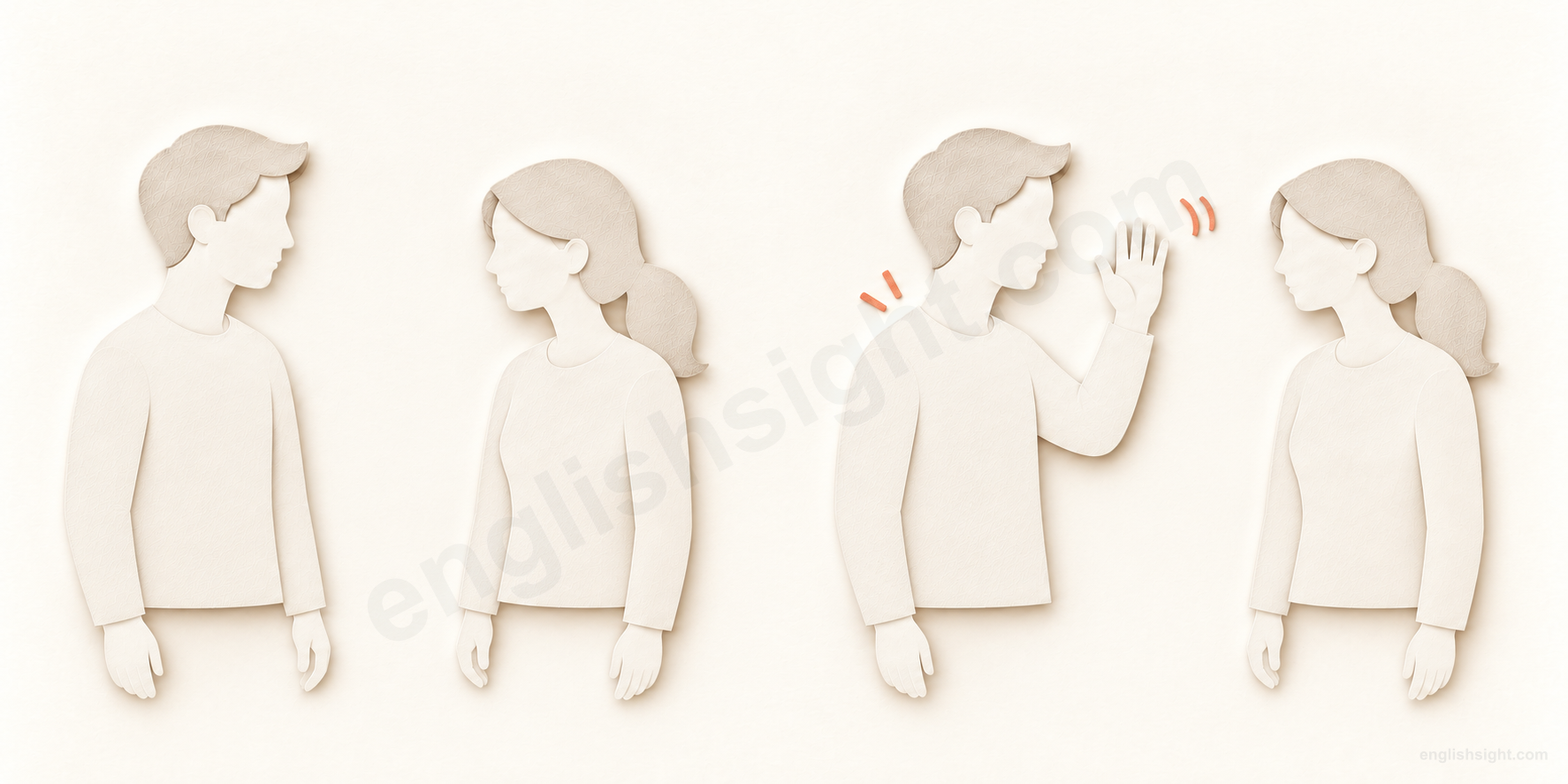
A person notices a friend, with both arms lowered.
impulse
The person raises one hand in an unplanned greeting.
A sudden urge to wave arises.
Here a sudden urge leads to a wave; an impulse can also be resisted.
An impulse is a spontaneous urge that can prompt action before careful consideration.
The picture shows one impulse being followed. An impulse can also be resisted. Longer-lasting drives, signals, and the physics quantity require the separate explanations below.
You notice a friend and suddenly want to wave. That spontaneous wish is an impulse. You might act on it at once, or decide to hold back.
The idea of a push towards a response is a useful teaching link. It does not make every use emotional, momentary, or unplanned: technical signals and formal motivation have their own meanings.
01
A sudden urge and what you do with it
Notice the difference between wanting to act, holding back, and actually acting. Impulse names the urge; the surrounding words tell us your response.
01
have / feel + an impulse + to + verb
have / feel an impulse to…
suddenly want to do something
Situation / starting point
You are looking through some old messages.
Response / result
You suddenly want to contact a friend.
The impulse is the wish to act, even if no action follows.
The person has or feels the impulse; the to-infinitive says what that person wants to do. I felt an impulse to call her reports a sudden urge, not a completed phone call.
Have a sudden impulse, feel a strong impulse, and an irresistible impulse describe its arrival or strength. Irresistible presents it as very hard to resist; it is not a scientific claim that resistance is impossible.
A plan normally involves a decision or preparation. An impulse highlights a spontaneous urge. It can be kind, playful, risky, or unwise; the word alone does not judge the action.
Example in context
I felt an impulse to call an old friend, but it was too late at night.
Watch the difference Use an impulse to call, not an impulse of call. Feeling it does not mean making the call.
02
someone’s first / initial impulse + is / was + to + verb
My first impulse was to…
describe your immediate reaction
Situation / starting point
Someone unexpectedly criticizes your work.
Response / result
You want to argue, before considering a calmer response.
First identifies the initial urge, which may differ from the final choice.
My first impulse was to leave describes the reaction that came before reflection. The subject of was is my first impulse; to leave identifies the action imagined.
First or initial does not imply that you followed the urge. Add but to make a later decision explicit. This is an ordinary noun construction, not a separate idiom with an unrelated meaning.
Example in context
My first impulse was to argue, but I asked her to explain instead.
Watch the difference An initial impulse is not necessarily your final intention.
03
resist / suppress + the impulse to + verb; control + one’s impulses
resist / control an impulse
avoid acting on an urge
Situation / starting point
A joke makes you want to laugh during a quiet talk.
Response / result
You keep yourself from laughing.
Resisting separates the felt urge from the action.
Resist the impulse to laugh means hold back from laughing despite wanting to. Suppress or fight down an impulse similarly emphasizes keeping the urge from being expressed.
Control your impulses describes managing such reactions more generally. Impulse control names this ability: Practising impulse control can help me pause before replying. This is a noun phrase, not a diagnosis.
An impulse to do something uses infinitive to. In resist the impulse to interrupt, resist takes the noun phrase as its object; it is not followed directly by to interrupt.
Example in context
I resisted the impulse to laugh while the speaker was talking.
Watch the difference Say resist laughing or resist the impulse to laugh, not resist to laugh.
04
give in to + an / the impulse + (to + verb)
give in to an impulse
allow an urge to guide your action
Situation / starting point
You want to check your phone while studying.
Response / result
You stop studying and check it.
Give in to marks yielding after some resistance.
The person gives in; to introduces the urge that wins. Give in to an impulse to check your phone suggests that you let the desire guide you rather than continuing to hold back.
In this use, give in is a phrasal verb followed by the preposition to. Compare resist the impulse: that describes holding back. The phrase can imply temptation, but an impulse itself need not be harmful.
Example in context
I gave in to the impulse to check my phone and lost my place in the book.
Watch the difference The first to is a preposition in give in to an impulse; the second begins the action in to check.
05
verb + on (an) impulse; on (an) impulse, + clause
act / decide / buy on impulse
do something spontaneously, without prior planning
Situation / starting point
You pass a small gallery with time to spare.
Response / result
You decide there and then to go inside.
On impulse describes how the decision or action happens.
On impulse and on an impulse describe a spontaneous decision without prior planning. You can put the phrase near the verb or at the start: On impulse, we went inside.
Act on an impulse can also mean follow a particular urge. Compare I had an impulse to go in, which reports the urge only, with I went in on impulse, which reports the action as well.
On impulse is an established prepositional expression. Its on does not describe physical contact or location. Acting quickly after careful preparation is not necessarily acting on impulse.
Example in context
On impulse, we stepped into the gallery and stayed for an hour.
Watch the difference Use the established on impulse, rather than translating your own language’s preposition.
02
Unplanned purchases
Shopping expressions distinguish the thing bought from the activity of buying. Impulse comes before another noun in these familiar combinations.
06
an impulse buy / purchase; plural impulse buys / purchases
an impulse buy / purchase
an item bought without a previous plan
Situation / starting point
You see a bright scarf while browsing.
Response / result
You buy it even though you had not planned to.
Buy is a countable noun here; impulse describes the purchase.
An impulse buy or impulse purchase is something acquired on the spot without advance planning or much consideration. The item may still be useful; regret is not part of the definition.
Say an impulse buy for one item and two impulse buys for two. Impulse remains singular before buy. Collins labels this modifying use adjective; other descriptions treat it as a noun used before another noun. Either way, it belongs before the shopping noun.
For a full sentence with a verb, use I bought it on impulse. For a description of a person’s behavior, impulsive is the usual adjective: an impulsive shopper.
Example in context
The orange scarf was an impulse buy, but I wear it every week.
Watch the difference Say It was an impulse buy, not It was impulse. Impulsive is the ordinary adjective in She is impulsive.
Buying names the activity; buy names a purchased item.
Impulse buying is normally uncountable. Avoid impulse buying advises against the behavior, while avoid an impulse buy refers to a particular purchase.
Compare I do too much impulse buying with These shoes were an impulse buy. In impulse buying, buying is a noun naming an activity; it is not the main verb of a sentence.
Shops may place impulse items near the checkout to encourage such purchases. Impulse items describes goods positioned or suited for spontaneous buying, not items that themselves feel urges. An impulse buyer is someone who buys in this way.
Example in context
I take a shopping list to help me avoid impulse buying.
Watch the difference For the activity, use too much impulse buying, not too many impulse buyings.
03
A tendency or a push towards progress
In more abstract writing, an impulse may be a recurring motivation or something that encourages development. It need not last only a moment.
08
a natural / creative impulse; the impulse behind + noun; an impulse towards + noun
a natural / creative impulse
an inner tendency or motivation
Situation / starting point
You often want to turn everyday observations into art.
Response / result
That desire shapes what you create.
This use can describe a recurring drive rather than a single sudden urge.
A creative impulse can be the urge or inspiration behind creative work. A natural impulse emphasizes a tendency that feels spontaneous or instinctive. Context tells you whether it is a passing urge or a more enduring motivation.
More formal writing uses the impulse behind a movement for its motivating drive, or an impulse towards reform for a tendency in that direction. Behind identifies motivation; towards identifies a direction or goal. The impulse for social reform similarly names the drive to bring about that change; for introduces its aim.
The model of an inner push helps connect these uses, but not every motivation is sudden. Compare a sudden impulse to draw with a lifelong creative impulse: the time scale differs.
Example in context
Her creative impulse led her to turn old boxes into tiny houses.
Watch the difference Do not force the momentary meaning onto every creative or political impulse.
09
give + an impulse + to + noun
give an impulse to…
encourage something to develop or move forward
Situation / starting point
A local project has stalled for lack of funds.
Response / result
New support helps it progress.
The impulse is a stimulus to development, not someone’s sudden wish.
Give an impulse to something is a formal way to say provide a stimulus or impetus. The giver may be an event, a policy, money, or a person; the recipient is often an activity or sector.
This can be understood as a push that helps development along. In everyday conversation, give the project a boost is usually simpler. Giving an impulse to a project does not mean making the project emotionally impulsive.
Example in context
The grant gave a fresh impulse to the town’s restoration project.
Watch the difference This is formal. Do not confuse a boost to progress with a sudden personal urge.
04
Signals and physical effects
Science uses impulse in specific ways. A nerve signal and a change in momentum are not emotions, and their technical meanings must be learned separately.
10
a nerve / electrical impulse; transmit / send + impulses
nerve / electrical impulses
signals that travel through a biological or electrical system
Situation / starting point
A stimulus produces a nerve signal, or a device produces a brief electrical signal.
Response / result
The signal is carried along the relevant system.
In this scientific use, impulse is a countable signal, not an urge.
A nerve impulse is an electrical change that travels along a nerve fiber and carries information. Nerve names the biological pathway; it does not mean nervousness or a sudden wish to move. Neural impulses is another technical way to refer to nerve signals.
An electrical impulse is a brief electrical signal. Equipment can generate, send, or transmit impulses. The plural impulses counts separate signals, often in a series.
These scientific uses share the broad idea of something prompting a response, but they are established technical meanings. The waving scene does not explain the biology or circuitry.
Example in context
Nerve impulses carry information from the skin towards the brain.
Watch the difference A nerve impulse is not the same thing as a nervous impulse to speak or move.
11
apply / impart + an impulse + to + an object
an impulse applied to an object
the change in momentum produced by a force acting over time
Situation / starting point
A bat exerts a force on a moving ball during contact.
Response / result
The ball’s momentum changes.
Physics gives impulse a measurable meaning.
In mechanics, impulse equals the change in momentum produced by a force acting over a time interval. For a constant force, it is force multiplied by the time for which the force acts.
This is a technical noun, not merely a synonym for energy or speed. The short contact between bat and ball is a useful example, but the concept is defined by force over time rather than by emotion or lack of planning.
The everyday push metaphor provides a memory link, not a full physics explanation. A sudden emotional impulse and an impulse measured in newton-seconds belong to different contexts.
Example in context
The bat imparted an impulse to the ball, changing its momentum.
Watch the difference Impulse and force are related but different quantities; do not substitute one for the other.
Choose the meaning from the whole expression
An urge is not a completed act
I had an impulse to shout can be true even if I stayed silent. I shouted on impulse reports the action. Impulse does not automatically mean anger, violence, foolishness, or regret.
Noun forms and countability
The plural is impulses. Use an impulse for a particular urge, your impulses for recurring urges, and on impulse in the established expression. Impulse also occurs without an article for the general idea, as in guided by impulse rather than careful planning. It is pronounced /ˈɪmpʌls/ in the British learner pronunciation, with stress on the first syllable.
Impulse and impulsive
Use impulse in familiar combinations such as impulse buy, impulse buying, and impulse control. Use impulsive for the broader adjective: an impulsive decision or an impulsive person. The existence of these combinations does not make impulse a freely usable adjective in every position. The adverb impulsively describes how someone acts: She bought it impulsively means that she bought it without careful thought.
Scope and register
This lesson focuses on the modern noun and established shopping modifiers. Formal development and scientific meanings are labeled. Merriam-Webster also records a transitive verb impulse; it is outside this beginner course. Passive, causative, tense, and particle-verb families are therefore not expanded for impulse itself.
Urge, action, purchase, or signal?
Choose the expression that fits the situation, paying attention to what actually happened.
1. You suddenly wanted to leave, but you stayed. Which sentence fits?
2. You wanted to interrupt but kept listening. Which expression fits?
3. You bought one lamp without planning to. How can you describe the lamp?
4. In a science lesson, a signal travels along a nerve. What is it called?
Sources and teaching notes
Dictionary meanings and constructions were checked against the publisher pages below. The lesson’s wording, examples, and visual teaching model are original.
The picture is a teaching example, not a shared mental image claimed for every English speaker.