Describe a growing quantity, cause it to grow, or name the change.
A greater amount on the same scale
A greater amount on the same scale
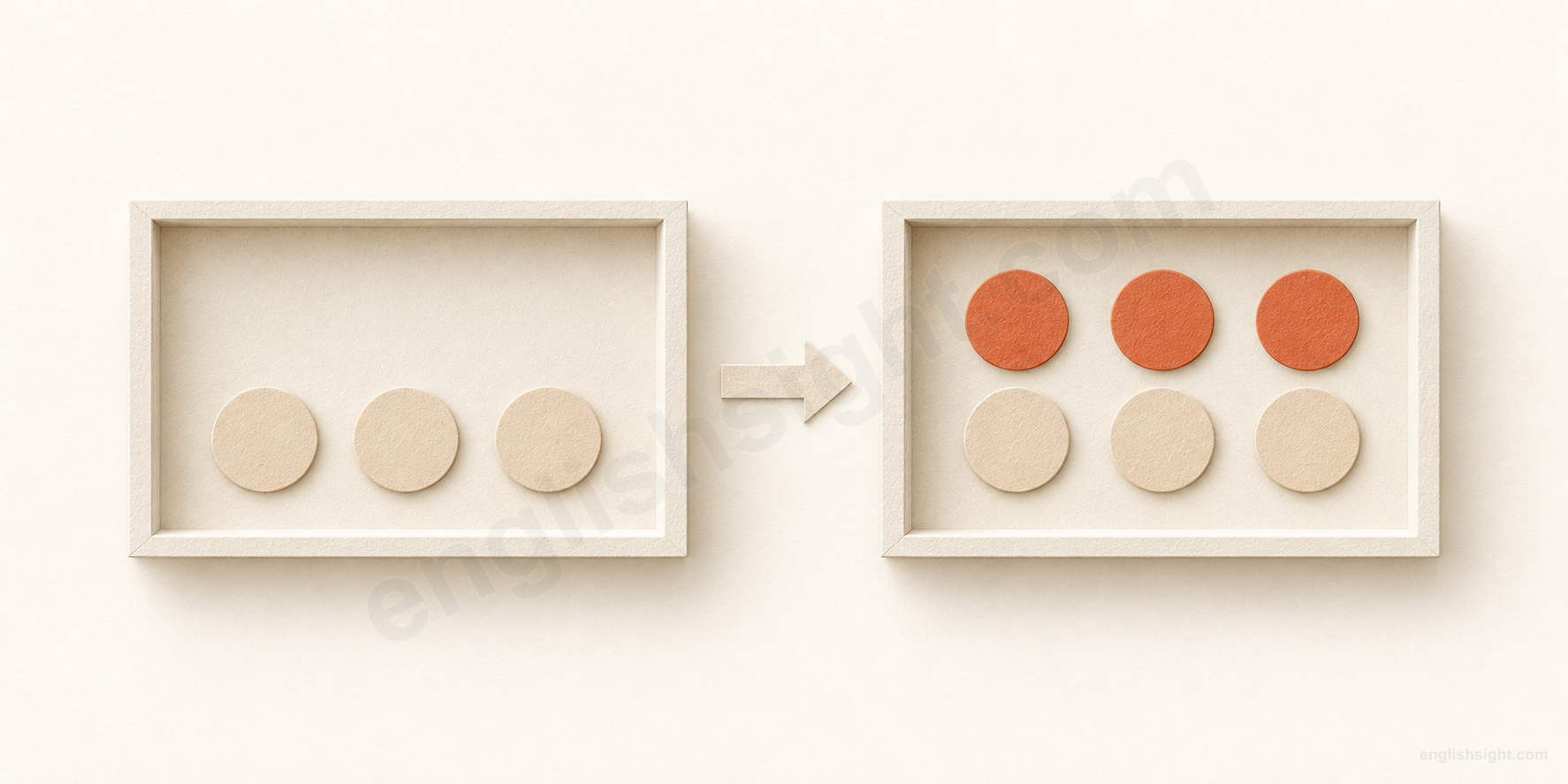
Three counters before
increase
Six counters afterward
The number becomes greater.
Three counters become six. The number increases; each counter stays the same size.
Something becomes greater in number, amount, size, or degree, or a cause makes it greater.
Compare like with like. More objects illustrate number; greater cost, strength, or risk uses an appropriate scale instead. Increase does not mean improvement, and it does not require an intentional agent.
Increase compares levels: a number, amount, size, or degree becomes greater. A person or another cause can also increase it. The word works as both a verb and a noun.
The diagram compares the same kind of quantity at two times. It is a teaching model for the relationship, not a claim about a picture shared by every English speaker.
01
What becomes greater, and what causes it?
Increase describes a change along a scale: more items, a larger amount, or a higher level. The sentence can name just the change or also its cause.
01
thing / quantity + increase
Prices increase
become greater without naming a cause
Starting situation
The tickets cost less last month.
Later situation
They cost more now.
The changing quantity is the subject.
Prices increase reports a change in prices. There is no direct object: prices are what become higher. The same pattern works for numbers, amounts, intensity, and frequency: The noise increased as the train approached.
The number of visitors increased means there were more visitors; it does not mean each visitor grew larger. Increase by itself does not say whether a change was planned or welcome.
Prices are increasing describes a developing trend. Prices have increased looks back at growth up to now. An increase can happen quickly or slowly; it need not continue forever.
In a sentence
Ticket prices have increased since June.
Watch the difference Use Prices increased for the change itself. Prices were increased presents something done to the prices.
02
person / cause + increase + quantity
increase the amount
make something greater
Starting situation
The team has a small advertising budget.
Later situation
The team chooses a larger budget.
The subject causes a quantity named by the object to become greater.
In We increased the budget, we names the decision-makers and the budget is the direct object. No preposition is needed between increase and that object.
The cause need not be a person or a deliberate action: Extra traffic increases noise. Increase your chances of success and increase the risk of failure describe a higher likelihood, not a larger physical object.
More and better are different. Increased costs are normally unwelcome; increased efficiency may be welcome. With skills or the quality of work, improve is often the clearer choice when the intended meaning is better rather than more.
In a sentence
We increased the budget to cover the extra work.
Watch the difference Say increase the budget, not increase to the budget. Use increase the number of staff to specify a larger headcount.
03
quantity + be + increased (+ by + agent / amount)
be increased
present a quantity as something changed by a cause
Starting situation
The speed limit is 40 kilometres per hour.
Later situation
The council sets it at 50.
The affected quantity becomes the grammatical subject.
The limit was increased reports an action affecting the limit. The council increased the limit gives the same action with the council as subject. A by-phrase can identify the agent: The limit was increased by the council.
The limit increased leaves the cause unexpressed and simply reports the change. Was increased is useful for decisions, adjustments, and imposed changes; it does not mean every rising quantity needs a passive.
Do not confuse by the council, which names an agent, with by ten kilometres per hour, which gives the size of the change.
In a sentence
The speed limit was increased from 40 to 50 kilometres per hour.
Watch the difference Increase does not take a person plus to-infinitive as a causative pattern. Say encourage her to work more, not increase her to work.
04
increased / increasing + noun; an increasing number of + plural noun
increased demand / increasing demand
distinguish a higher level from a developing trend
Starting situation
Demand is compared with an earlier level.
Later situation
It is higher, or it is still growing.
The participle changes how we view the growth, not which scale is involved.
Increased demand presents demand as higher than a relevant earlier or usual level. Increasing demand highlights a trend toward more demand. The first expression does not by itself tell us whether growth is continuing.
In an increasing number of people, it is the number that grows. The people do not themselves become bigger. An increased number of seats similarly means a larger total is available.
Compare Demand is increasing, an active progressive, with Capacity is being increased, a passive progressive describing work that raises capacity.
In a sentence
The shop hired more staff to meet increased demand.
Watch the difference Do not assume increased always means still increasing. Use increasingly with an adjective or adverb, as in increasingly expensive; it is a related adverb.
02
Specify the scale, amount, and comparison
The preposition tells us what is measured, how much changes, or which values we compare. These are ordinary grammatical patterns, not a family of phrasal verbs.
05
subject + increase in + dimension
increase in size / value
identify the dimension that grows
Starting situation
A collection has a certain market value.
Later situation
Its market value becomes higher.
In names the scale of change, not the amount added.
The collection increased in value says which property became greater. Its value increased gives a similar message with the property as subject. Size, number, strength, and frequency can also specify dimensions.
If a room increases in size, it becomes larger; if a service increases in frequency, it runs more often. These are applications of the same greater-than-before relationship, not unrelated meanings.
Separate The collection increased in value, a verb followed by a dimension, from an increase in value, a noun phrase naming growth. Both are possible, but their sentence structures differ.
In a sentence
The collection has increased in value over the past year.
Watch the difference In value does not tell us how much was added. Add by £200 or from £800 to £1,000 if those are the intended figures.
06
increase (+ object) + by + amount / percentage
increase by 20%
state the amount or proportion added
Starting situation
A price is £50.
Later situation
It rises by £10 to £60.
By measures the difference from the starting amount.
If a price increases by £10, ten pounds are added to the starting price. Increasing £50 by 20% also gives £60: twenty percent is calculated from the original £50.
Both The price increased by 20% and They increased the price by 20% use by for the change. To 20% instead identifies a final percentage level.
If a rate moves from 10% to 12%, the difference is two percentage points. Relative to its original 10% level, that is a 20% increase. State which measure you mean.
In a sentence
The price increased by 20%, from £50 to £60.
Watch the difference By 20% does not mean to 20%. Percent growth and percentage-point differences are different calculations.
07
increase (+ object) + from + starting value + to + final value
increase from 80 to 100
give the starting and finishing values
Starting situation
A club has 80 members.
Later situation
It has 100 members later.
From gives the baseline; to gives the result.
From 80 to 100 describes two levels. The amount added is 20, so this is an increase by 20 members. Relative to the original 80, it is an increase by 25%.
You can give just the result when the starting point is known: Membership increased to 100. Both the intransitive and transitive forms allow these phrases: They increased capacity from 80 to 100.
An increase to 100 is also possible with the noun when the final level matters. None of these prepositions means that one hundred is the amount added.
In a sentence
Club membership increased from 80 to 100 in a year.
Watch the difference Do not report this as increased by 100: that would add one hundred to the original total.
08
quantity + increase with + factor
increase with age / time
describe growth associated with another changing factor
Starting situation
A repair is simple at first.
Later situation
Longer delays make it more costly.
With links the growth to another factor; it gives no fixed amount.
The cost increases with each delay means further delays are associated with higher costs. With age and with time work similarly when age or time is the relevant factor.
This construction expresses a relationship rather than a destination or an increment. It does not specify a numerical rate, and it does not by itself prove what causes an observed correlation.
The context must make the relationship plausible. Increase does not generally take an arbitrary adjective complement: say The cost becomes higher or The cost increases, not The cost increases higher.
In a sentence
The repair cost increases with each delay.
Watch the difference With time describes the associated factor; by two hours would measure a change in a duration.
09
increase + adverb; adjective + increase; rate of increase
increase sharply / steadily
describe the shape or size of a change
Starting situation
A report compares several monthly totals.
Later situation
It distinguishes a sudden jump from sustained growth.
The adverb supplies information that increase alone does not contain.
Increase sharply describes a marked rise; increase slightly describes a small one. Increase steadily presents relatively regular growth over a period. Increase gradually emphasizes development by small stages rather than a sudden jump.
The related noun phrases are a sharp increase, a slight increase, and a steady increase. Use an adverb with the verb and an adjective with the noun.
A rate of increase tells us how quickly a quantity grows. A lower rate of increase can still mean the total is going up, just more slowly. It does not necessarily mean a decrease.
In a sentence
Orders increased steadily throughout the summer.
Watch the difference Say increased sharply or a sharp increase, not increased sharp or a sharply increase.
03
Name the change and describe a trend
As a noun, increase names growth or the amount added. Learn the information carried by in, of, and comparison phrases, plus the established expression on the increase.
10
an increase in + quantity; pay / price / tax + increase
an increase in demand
name a change and identify what grows
Starting situation
A shop compares demand in two periods.
Later situation
Demand is higher in the later period.
In identifies the changing quantity after the noun.
There was an increase in demand reports that demand grew. There was introduces the event; in demand specifies what changed. There were two increases can distinguish separate rises.
A pay increase, a price increase, and a tax increase put the affected quantity before the noun instead. I got a pay increase means my pay became higher; increase itself does not specify the new salary.
Increase can be countable or uncountable. Use an increase for a particular rise and increases for several rises. In the rate of increase, the noun refers more generally to the process of growth.
In a sentence
There has been an increase in demand for evening classes.
Watch the difference Say an increase when describing one particular rise. Do not omit the article in There was an increase in demand.
11
an increase of + amount + in + quantity; a + amount + increase
an increase of £10
state the size of a rise as a noun phrase
Starting situation
The old fee is £40.
Later situation
The new fee is £50.
Of introduces the amount added; in can then name the changing quantity.
An increase of £10 gives the difference. An increase in the fee names what changed. Combine them as an increase of £10 in the fee, or a £10 increase in the fee.
A 25% increase and an increase of 25% can describe the same change. With the £40 starting fee, the extra £10 is 25% of the original amount.
For a clear default, use in for the thing changing and of for the amount added. Of can also introduce what grows in some established or formal uses, so this is a useful writing pattern rather than a ban on every other use of of.
In a sentence
The new fee represents an increase of £10 on the old £40 fee.
Watch the difference A £10 increase is a ten-pound difference, not necessarily a final price of ten pounds.
12
an increase over / on / from + comparison baseline
an increase over / on last year
name the reference level for a comparison
Starting situation
Last year’s sales provide the baseline.
Later situation
This year’s sales are higher.
Over or on identifies what the current figure is compared with.
A 10% increase over last year compares the present figure with the corresponding figure last year. An increase on last year and an increase from last year are also established comparison patterns. Here on does not mean physically resting on anything.
An increase in sales over the summer can instead give a time period: sales grew during the summer. Read what follows over to tell whether it introduces a comparison baseline or a duration.
These phrases add a reference point, not a second meaning of greater. Keep the comparison consistent: annual sales and monthly sales are not directly comparable without further explanation.
In a sentence
This year’s sales represent a 10% increase over last year.
Watch the difference Do not confuse on last year, a comparison, with on the increase, the fixed expression for a rising trend.
13
subject + be + on the increase
on the increase
be growing or happening more often
Starting situation
The town previously had fewer bicycle thefts.
Later situation
The recorded number is now rising.
The whole expression presents a rising trend.
Bicycle theft is on the increase means it is becoming more frequent or greater in extent. The expression can concern number, frequency, or intensity. It does not supply an exact amount.
Keep on the increase together after be. It is an established noun expression, not a separable phrasal verb and not an instruction to increase something.
Compare Theft has increased, which reports growth up to a reference point. Theft is on the increase presents a current rising trend. Neither sentence explains why the change occurs.
In a sentence
Bicycle theft is on the increase in our town.
Watch the difference Use the in this expression: on the increase, not on increase or in the increase.
Keep the quantity and comparison clear
Verb and noun stress
The usual learner-dictionary contrast is verb in-CREASE /ɪnˈkriːs/ and noun IN-crease /ˈɪnkriːs/. Forms are increase, increases, increased, increasing; the past ending in increased is pronounced /t/. The noun plural is increases.
Increase, rise, raise, and improve
Increase works with or without a direct object: Costs increased; They increased costs. For this change in level, rise has no direct object: Costs rose. Raise takes one: They raised costs. Improve emphasizes becoming better; increasing a quantity does not guarantee that.
Growth need not be physical or permanent
Risk, demand, and tension can increase without a visible object growing. A rise over one period does not imply uninterrupted or permanent growth. A slower increase is still an increase if the quantity continues to grow.
Scope of this lesson
The main verb and noun share the greater-than-before relationship. The prepositions here have grammatical functions; they are not separate phrasal verbs. Historical uses for offspring or agricultural produce, specialized statistical formulas, and a full lesson on increasingly are outside this course.
Choose the meaning and the measure
Check the subject, the preposition, and the comparison level.
1. A fee rises from £50 to £60. Which report gives the amount added?
2. The council made the limit higher. Which sentence explicitly presents the limit as affected by an action?
3. You want to name what became greater: demand for classes. Which noun phrase is the clearest default?
4. A rate moves from 10% to 12%. Which statement gives the difference in percentage points?
5. Reports show bicycle theft happening more often. Which expression describes that trend?
Sources and teaching notes
Verb and noun patterns were checked against the learner dictionaries below. Explanations, examples, numerical illustrations, and the diagram are original teaching material.
The diagram illustrates a comparison; it is not a picture shared by every native speaker.