Use industry for production, a business field, and—in formal English—diligent effort.
A field wider than one workplace
See the field beyond one workplace
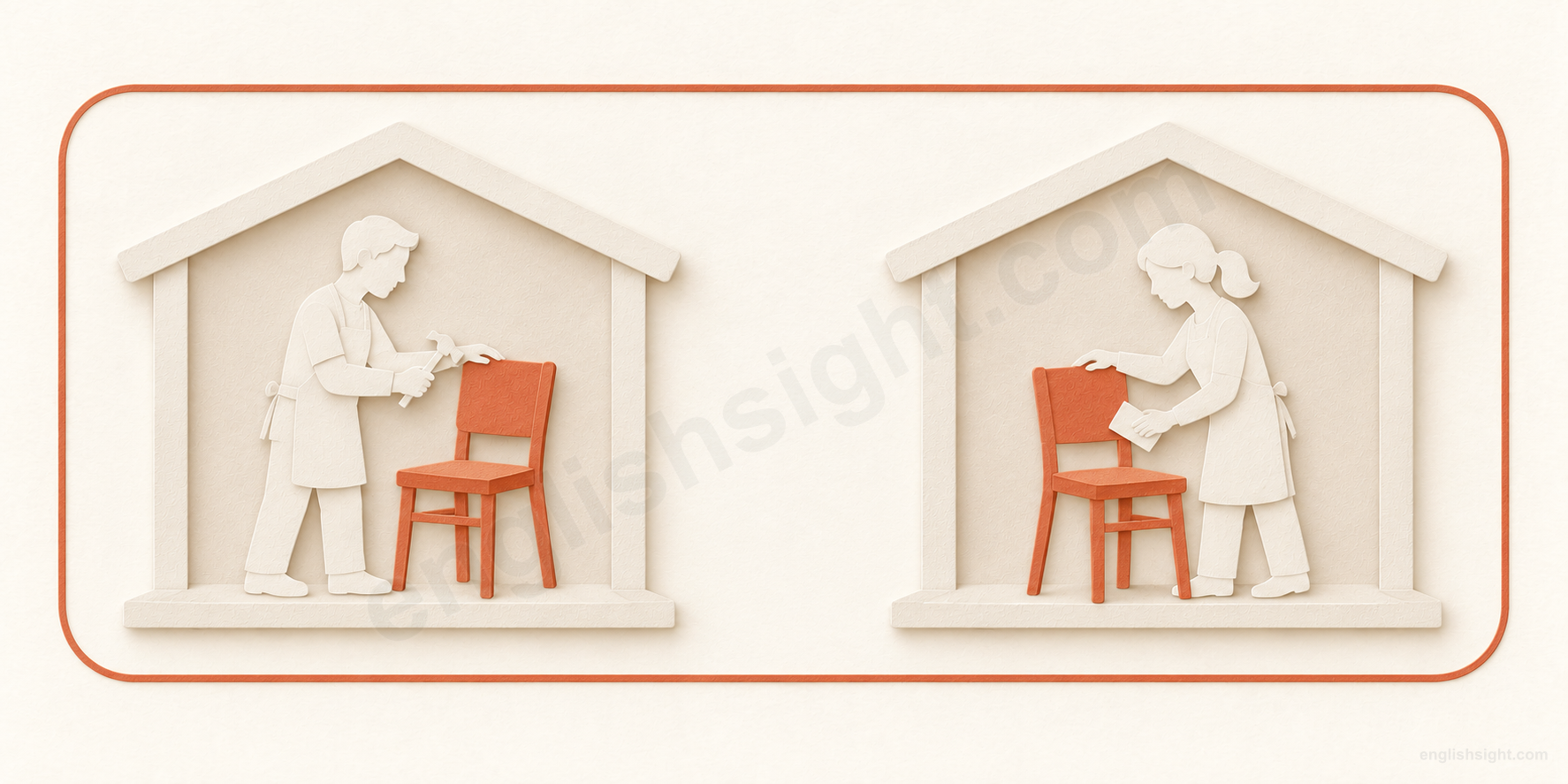
Two separate furniture workshops
industry
One shared field: the furniture industry
Group businesses by the kind of work they do.
Separate furniture businesses belong to one industry.
Industry groups productive activity, or the people and businesses supplying a particular kind of product or service.
The main relationship is membership in a field, not a transfer or a guaranteed change of state. The furniture example illustrates a product field; it does not define all industries.
A factory is one workplace. An industry takes a wider view: it groups productive activity or the people and businesses in a particular field. Different companies can belong to the same industry.
The diagram uses furniture makers to illustrate that grouping. Service industries need no factory, and the formal meaning “hard work” is a separate branch. This is a teaching model, not a shared mental picture attributed to all native speakers.
01
Production, sectors, and working life
First decide whether you mean production generally or a particular field of business. Countability and articles follow that choice.
01
industry; national adjective + industry; industry + singular verb
industry
production considered as a broad economic activity
Situation
You compare the kinds of work that support a region.
What you communicate
You discuss production across businesses, rather than one factory.
Uncountable industry takes a broad view of productive activity.
A discussion of industry may concern factories, materials, machines, investment, and jobs together. The noun packages a wide area of economic activity; it does not name one building.
Use no article for the general activity: Industry needs investment. British industry and domestic industry narrow the reference with a modifier. Here British identifies a national context; it does not turn industry into a countable company.
A sentence such as Industry is expanding describes a change in the activity or its scale. Industry itself does not mean growth or progress.
In discussions of labour and industry, industry can stand collectively for industrial businesses or their owners and managers. The contrast with labour supplies that institutional viewpoint; it is not the personal-effort meaning.
In a sentence
The new railway could help local industry grow.
Watch the difference Use a factory for a production building and a company for one organization. Neither is automatically interchangeable with industry.
02
a/an + adjective + industry; the + field + industry; plural industries
an industry / the food industry / industries
one field of business defined by its output
Situation
Several different businesses produce and sell food.
What you communicate
You discuss them as a field, alongside other fields.
One industry can contain many companies; industries counts different fields.
In the food industry, the word food identifies the field. The speaker groups people and businesses by the kind of product or service they provide, even when those businesses compete.
Use a or an when introducing one field: Food production is an important industry here. Use the with an identified field: the food industry. Several industries compares fields, not several employees or several factories.
Compare Our company sells kitchen equipment with Our industry faces higher material costs. The first concerns one organization; the second looks across its field. Sector is often useful for a division of the economy, but its exact scope depends on the classification being used.
In a sentence
The town depends on two industries: fishing and tourism.
Watch the difference Do not use industries simply because one field includes many companies: ten food companies can all belong to the same industry.
03
the + service/field + industry; service industries
the service industry / service industries
business activity that supplies services
Situation
Customers pay for help, access, or an experience.
What you communicate
You classify the business by the service it supplies.
An industry can provide a service without manufacturing a physical object.
Tourism, banking, and entertainment show why industry is wider than factory production when it names a field. Someone in the music industry might organize concerts or manage recordings rather than manufacture instruments.
Service industries groups fields such as travel and hospitality. The service industry can present service activity collectively, or refer to a particular service field understood from context. Naming the field, as in the banking industry, is often clearer.
A service is what is supplied; an industry is the business activity or field around supplying it. The two nouns answer different questions.
In a sentence
Hotels and tour companies are part of the tourism industry.
Watch the difference Do not assume industry always implies machinery, smoke, or goods leaving a factory.
04
work/have experience + in industry / in the + field + industry
work in industry / in the film industry
locate someone’s work within a field
Situation
Someone asks what kind of work you do.
What you communicate
You identify the economic setting of your work.
In marks membership or participation here, not a room you physically enter.
Work in industry gives a broad employment setting, often with manufacturing in view. Work in the film industry names a specific field. You can also say She works in film when the field name itself is used without industry.
After an industry has been identified, the industry can refer back to it: I started in publishing. I have been in the industry for ten years. The article relies on shared context.
Experience in the industry describes familiarity with that field. It does not necessarily mean employment by the same company throughout that time.
In a sentence
After teaching for five years, Nia moved into the software industry.
Watch the difference Say work in the industry, not work at industry. At normally needs a workplace name or another suitable noun phrase, such as at a factory.
02
Types of industry and established expressions
These combinations describe scale, output, leadership, and shared practices. Read the whole expression; the extra word contributes an important distinction.
05
heavy/light industry; heavy/light industries
heavy industry / light industry
distinguish broad kinds of manufacturing
Situation
One region builds ships; another makes small household products.
What you communicate
You contrast the kinds of production.
Heavy and light classify production; they do not judge how difficult a job feels.
Heavy industry brings large industrial equipment and outputs such as steel or vehicles into view. Light industry is associated with smaller or lighter manufactured goods, including household items.
These are broad economic categories, not a reliable test based only on the weight of one finished object. Context determines where a particular activity is classified.
The phrases can be uncountable when describing activity generally. Countable uses can identify branches: several heavy industries. Do not turn a hard office job into heavy industry just because the work is demanding.
In a sentence
The region is moving from heavy industry toward light industry, including household goods.
Watch the difference Light industry is not the electricity or lighting business; heavy industry is not a synonym for hard work.
06
a cottage industry; a cottage industry in + activity/product
a cottage industry
small-scale production, often based in homes
Situation
People make crafts at home and sell their work.
What you communicate
Their home-based work forms a small business activity.
Cottage industry can be small; industry does not require a large factory.
The established phrase cottage industry is useful for home-based craft production and similar small operations. Cottage does not require a picturesque rural house: the organization of the work matters.
The phrase also extends to a specialized activity pursued by many independent people. A cottage industry in local-history guides need not mean that every guide is printed inside a home.
Keep this distinct from the ordinary name of a field. The publishing industry includes organizations of many sizes; a cottage industry emphasizes a smaller, dispersed pattern of activity.
In a sentence
Making hand-woven baskets has become a cottage industry in the village.
Watch the difference Working from home for a large employer does not by itself make your job a cottage industry.
07
an industry leader; industry leaders; industry + noun
an industry leader
a leading company, product, or influential person in a field
Situation
You compare competitors or identify important decision-makers.
What you communicate
You name an organization, product, or person with a leading position.
The surrounding sentence tells you what kind of leader is meant.
In Our company is an industry leader, leader describes its strong position among competitors. A product can also lead its field: Their editing software is an industry leader.
Industry leaders at a meeting may instead mean senior people who influence decisions in the field. Look at whether the sentence describes products, organizations, or people.
Industry is a noun used before another noun. In industry experts or industry trends it similarly identifies the relevant field. It does not describe a person as hardworking.
In a sentence
Several industry leaders met to discuss training for new employees.
Watch the difference An industry leader need not be a government official or a person who manages every company in that field.
08
become the industry standard; industry standards; industry-standard + noun
the industry standard
a product or system widely used within a field
Situation
Many businesses in a field choose the same system.
What you communicate
That system becomes a normal reference point.
An industry standard concerns established use across a field.
A system can become the industry standard when it is normally used in that field. The phrase helps explain why customers or suppliers expect compatibility with it.
Plural industry standards can refer to the accepted practices or specifications against which work is assessed. Before a noun, the compound is often hyphenated: industry-standard software.
The words do not by themselves say that a law requires the system or that it is the best possible choice. To make either claim, provide further information.
In a sentence
This file format has become the industry standard for exchanging these designs.
Watch the difference Standard here concerns an accepted system or practice; it does not simply mean average quality.
09
a captain of industry; captains of industry
a captain of industry
an important owner or senior manager of an industrial company
Situation
A report describes powerful business figures.
What you communicate
It uses a figurative title for their senior position.
Captain is figurative: no ship or military command is involved.
A captain of industry is a business figure with substantial ownership or management responsibility. The phrase often appears in accounts of prominent industrial figures.
The plural is captains of industry: only captain changes. Compare an industry leader, which can also refer to a company or product; a captain of industry refers to a person.
This is an established expression to recognize in reporting and historical writing. In a simple introduction, stating the actual job, such as company director, is usually more informative.
In a sentence
The exhibition includes portraits of local captains of industry.
Watch the difference Not every employee, factory supervisor, or successful craft seller would naturally be called a captain of industry.
03
An activity viewed as a business, or personal effort
A critical extension and a formal meaning need their own explanations. Neither can be predicted just by picturing a factory.
10
an industry built around + noun/-ing; a whole/entire industry
an industry built around something
an organized activity described as a business, sometimes critically
Situation
Many people offer paid services around a public concern.
What you communicate
A speaker presents the activity as an organized business.
Calling an activity an industry can draw attention to its commercial scale or incentives.
Industry can be extended to an organized field of activity around a subject. Depending on context, this can simply notice its scale, or criticize the activity as self-serving or unnecessary.
In the example, entire and the skeptical context make the criticism clear. The complaint is not a separate meaning of built around: it comes from treating the activity as a business and from the speaker’s wording.
Do not assume that the fitness industry, the film industry, or every other field label is automatically disapproving. A genuine business field can be named neutrally.
In a sentence
An entire industry has grown up around selling miracle diets, the critic complained.
Watch the difference Read the tone and context. Industry alone does not mean fraud, useless work, or an illegal business.
11
someone’s industry; industry and patience; praise + industry
praise someone’s industry
recognize someone’s sustained hard work
Situation
A person keeps working carefully at a demanding task.
What you communicate
You praise the effort they apply.
This formal uncountable meaning describes a personal quality.
In Her industry impressed us, industry means hard work and diligent application. It does not mean the business field she works in. The possessive and the surrounding description help you identify this sense.
This use is formal. In ordinary conversation, Her hard work impressed us is a more direct alternative. A student, artist, or researcher can show industry without working in manufacturing.
Treat this as a separate meaning to learn, rather than forcing it into the diagram’s picture of a whole field. It is uncountable: praise her industry, not her industries when you mean her effort.
In a sentence
The teacher praised Leo’s industry throughout the long project.
Watch the difference Industrial usually relates to industry as economic production. Industrious describes a hardworking person; it is not the same adjective.
Choose the scale and the meaning
Count the fields, not the buildings
General production and diligent effort use uncountable industry. A specific field can be an industry, and several fields are industries. Articles depend on what you identify: industry, an important industry, the film industry.
A noun, not a family of particle verbs
Industry is pronounced /ˈɪndəstri/, with stress on the first syllable. The plural is industries. Verb tense, passive voice, causatives, and separable particle-verb patterns do not apply to this noun. In industry leader, industry remains a noun modifier.
Keep nearby words distinct
Company names an organization; factory names a production site; industry often groups a field. Industrial relates to economic industry; industrious means hardworking. These related words do not replace industry in the same grammatical slot.
Limits of this selection
The lesson covers the main modern noun meanings and useful established combinations. Technical economic classifications, archaeological uses, and obsolete meanings are outside its scope. The entries are organized for learning, not ranked by measured frequency.
Choose the right scale or sense
Check what is being counted and which meaning the situation needs.
1. Ten different companies all manufacture shoes. Which statement identifies their shared field?
2. A friend says an industry must produce goods in factories. Which reply corrects that idea?
3. A town depends on steel production, tourism, and software. Choose the sentence that counts these fields.
4. A formal report praises a student’s industry during a difficult project. What is being praised?
5. A new camera is called an industry leader. Which interpretation fits?
Sources and teaching notes
The linked dictionary entries support the meanings, grammar, and expressions. Explanations and examples are original; the grouping diagram is a teaching interpretation.
The diagram illustrates a relation; it is not a mental picture shared by every native speaker.