From a writing material to drawings, body art, and signed agreements.
From material to visible marks
Material becomes a mark
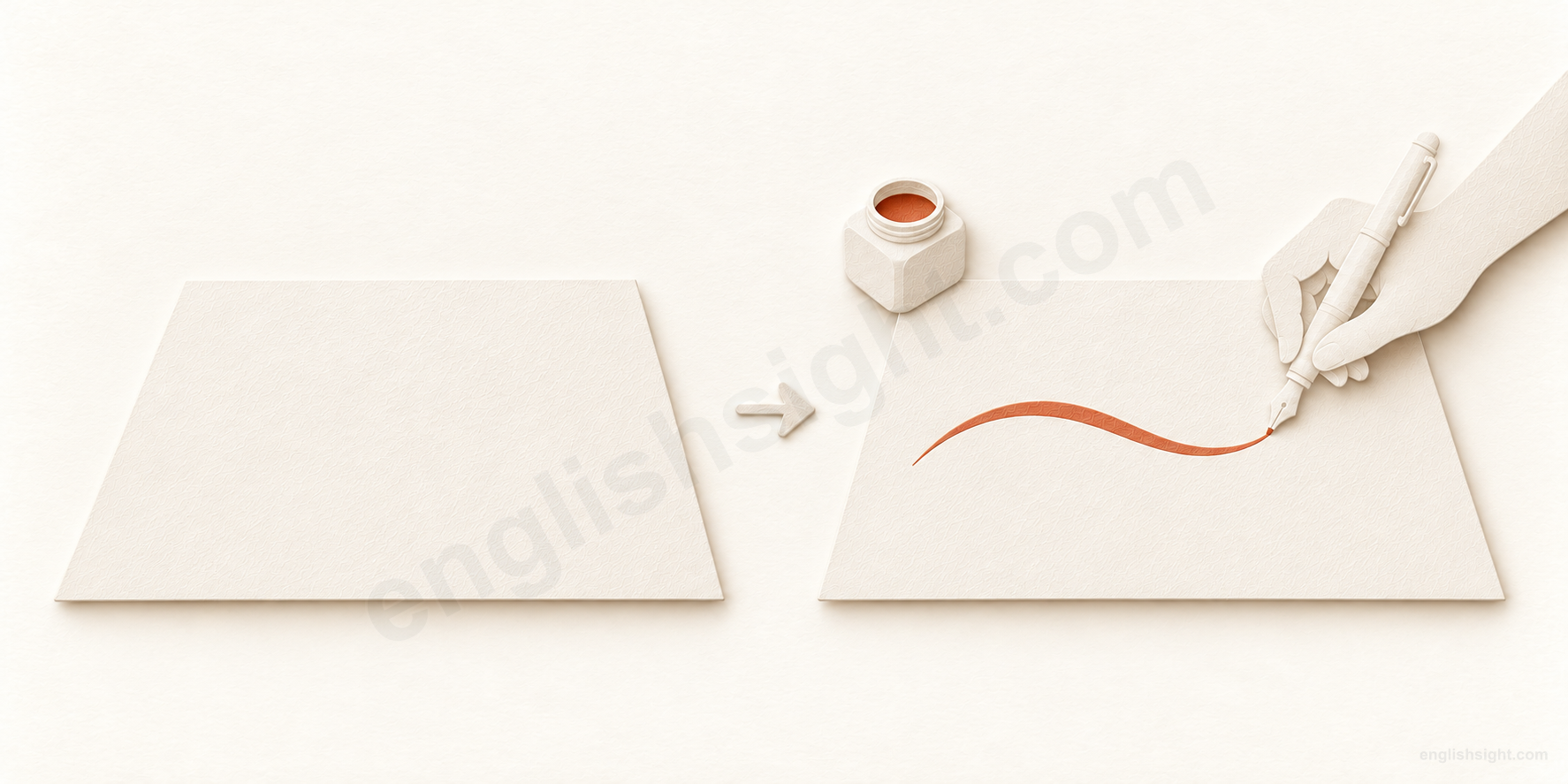
A blank sheet has no ink marks.
ink
A curved ink line is visible on the sheet.
A hand uses a pen to apply ink to the sheet.
Ink is the colored material; the pen applies it, leaving a visible line.
In its writing and printing sense, ink is colored material applied to a surface to leave visible marks.
The sketch contrasts an unmarked sheet with a sheet bearing an ink line. It is a teaching model for writing and printing, not a claim that every ink is permanent or every use involves paper.
A pen is the tool; ink is the material that makes its mark visible. Start with that distinction, then notice when English uses ink as a verb or as part of an established expression.
This lesson connects related uses without claiming one picture explains every meaning. Animal ink and figurative phrases need their own contexts.
01
The material and the marks
Start with the substance, then choose words for its use, supply, and unwanted traces.
01
some / a little ink; a bottle of ink; different inks
some ink; different inks
colored material used to make writing, drawings, or print
Situation / starting point
You need a material that will leave a visible line.
Result / intended meaning
You choose ink for the pen or printing process.
Ink names the material; a pen names a tool.
Ink is usually a mass noun: some ink, much ink, or a little ink. Ask for a bottle of ink when you mean one container. Different inks refers to different colors or formulations, rather than separate drops.
Ink is not necessarily black, and it is not always a thin liquid. Some printing ink is a paste. Its usual practical role is to make visible marks; the noun does not guarantee that those marks will last forever.
In a sentence
We tested three inks before choosing a deep blue.
Watch the difference For an unspecified amount, say I need some ink, rather than I need an ink.
02
write / draw / sign + in + (color) ink
write in ink
use ink as the medium for writing or drawing
Situation / starting point
A form needs a completed written answer.
Result / intended meaning
You use ink rather than pencil.
In ink describes the medium, not a location.
Write in ink tells someone what material to use. Draw in ink works in the same way; in blue ink also specifies the color. With a pen names the tool instead.
Compare Write in pencil if you may need to erase it. In ink often suggests a less easily changed record, but erasable inks exist: permanence is not part of every use of the word.
In a sentence
Please write your address in black ink.
Watch the difference In ink is an ordinary prepositional phrase here, not the phrasal verb ink in.
03
be out of ink; run out of ink; ink + supply noun
run out of ink; an ink cartridge
talk about a pen’s or printer’s supply
Situation / starting point
A printer has too little ink to produce the page.
Result / intended meaning
You replace its supply.
The cartridge holds ink; it is not the ink itself.
The printer is out of ink describes the current lack. We have run out of ink describes reaching that situation. Ink cartridge names a replaceable container; an ink refill replaces a used supply.
Ink comes before another noun in ink cartridge or ink bottle. This noun modifier normally stays singular even when you buy two ink cartridges. Ink is a material word; toner is the powder used in a different printing process.
In a sentence
The printer ran out of ink halfway through the report.
Watch the difference Run out of is the verb expression; ink is its noun complement. It is not a form of the verb ink.
04
the ink is wet / dry; ink on + surface; an ink stain
wet ink; an ink stain
describe ink’s condition or an unwanted mark
Situation / starting point
A freshly written line is still wet.
Result / intended meaning
Touching it may spread the ink.
Wet ink can smudge; an ink stain is an unwanted trace.
Let the ink dry means wait until the fresh marking is no longer wet. Ink can smudge when it spreads and makes a line less clear. An ink blot is a patch of ink; an ink stain is an unwanted mark left by it.
Ink on your sleeve names where the material is. A pen-and-ink drawing names an artwork made with that tool and medium. These are useful combinations around the material sense, not separate meanings for every object.
In a sentence
Leave the page open until the ink is dry.
Watch the difference Dry ink on a page and a pen that has dried out describe different situations.
02
Putting ink on, drawing in, covering out
The object and the particle tell us whether we prepare a surface, strengthen a drawing, or hide existing writing.
05
ink + surface; ink (up) + surface; ink it up
ink a printing block; ink up
put ink on a surface ready for printing
Situation / starting point
A printing block has no ink on its raised design.
Result / intended meaning
Its surface receives ink before it touches paper.
The block is coated; the paper is printed later.
As a verb, ink can mean apply ink to something. The printer inks the block, then presses it onto paper. The passive is natural too: The block is inked before each print.
Ink up is a related printing expression for preparing equipment or a printing surface with ink. Ink the plate up and ink it up allow a separated object; with a pronoun, use ink it up. Up does not mean moving the plate upward.
In a sentence
She inked the block before making the next print.
Watch the difference Inking a block prepares it; it does not by itself say a print has been made.
06
ink in + drawing / lines; ink + object + in; ink it in
ink in a drawing
trace or complete a pencil drawing using ink
Situation / starting point
A design exists in faint pencil lines.
Result / intended meaning
The selected lines are traced in ink.
The same design gains an ink outline.
Ink in commonly describes going over pencil work with ink. The drawing or its lines are the object. In a comic or illustration workflow, the penciled outline can come first and the inked outline later.
You can ink in the outline or ink the outline in. With a pronoun, say ink it in. Compare draw in ink: that simply names the medium and does not require an earlier pencil sketch.
Without the particle, ink a design can also mean draw or write it in ink. The earlier pencil stage is especially associated with ink in, rather than required by every use of the verb ink.
In a sentence
Once the sketch is ready, ink in the outline.
Watch the difference Do not assume ink in means color every empty area; tracing lines is a central use.
07
ink out + word / name; ink + object + out; ink it out
ink out a word
cover writing with ink so it cannot be read
Situation / starting point
A written name must be hidden on a copy.
Result / intended meaning
Dark ink covers the name.
Out marks removal from readable view, not removal of ink.
Ink out means obscure an existing mark by putting ink over it. Ink out the name and ink the name out describe the same operation; ink it out is the pronoun order.
Compare cross out, which marks text as deleted and may leave it readable. Ink out emphasizes covering it. Neither expression promises that sensitive information is securely removed from every copy.
In a sentence
He inked out his old phone number on the notice.
Watch the difference Ink out does not mean wash an ink stain out of clothing.
03
Animal ink and body art
These established noun uses need their own contexts. A protective cloud in water is different from a mark on paper.
08
a squid releases ink; squid ink; squid-ink + food noun
squid ink
a dark substance released by certain sea animals
Situation / starting point
A squid is disturbed in the water.
Result / intended meaning
It releases a dark cloud that can help conceal it.
This ink clouds water rather than writing on a surface.
In nature, ink can name the dark secretion released by squid, octopuses, and related animals. This is an established noun sense. It shares a color-and-liquid resemblance with writing ink, but its immediate role is different.
Squid ink can also be an ingredient named on a menu, as in squid-ink pasta. Context tells you whether the speaker means an animal’s defense or the food ingredient; ink by itself is not a general word for every dark liquid.
In a sentence
The squid released a cloud of ink and disappeared from view.
Watch the difference The surface-marking diagram does not explain the animal’s whole defense behavior.
09
someone’s ink; get inked; have + design + inked on + body part
her ink; get inked
tattoos, or receiving a tattoo
Situation / starting point
Someone chooses a design for their skin.
Result / intended meaning
The design is tattooed on their body.
Informal ink can name body art as well as its material.
Her ink can refer to her tattoos. In a tattoo context, get inked means get a tattoo, not accidentally spill a pen. A design can be inked on an arm; someone can have a design inked on their skin.
These uses belong to informal body-art language. Tattoo is the clearer neutral word when the context is uncertain. New ink may mean a new tattoo or a fresh supply of writing material, depending on the situation.
In a sentence
She had a small leaf inked on her ankle.
Watch the difference Have a design inked describes arranging for the work, not necessarily tattooing yourself.
04
Agreements, publicity, and money
Some expressions connect ink with written records. Learn their conventional meanings and register as complete expressions.
10
ink + deal / contract; ink + person + to a contract / for + work
ink a deal
sign an agreement; in some US contexts, hire under contract
Situation / starting point
Two sides have negotiated a contract.
Result / intended meaning
They sign it and enter the agreement.
Ink stands for signing in informal business and sports language.
To ink a deal or contract is to sign it. This is especially associated with informal North American reporting. We inked a deal last week is more colorful than the neutral We signed a deal.
In US reporting, a company or team may also ink someone to a contract: the person becomes engaged through signing. A studio inked the actor for two films uses the person as object. The two uses have different object roles; neither means physically covering the agreement or person with ink.
In a sentence
The singer inked a two-album deal with a small label.
Watch the difference For neutral instructions and ordinary business messages, sign an agreement is a straightforward choice.
11
ink in + date / appointment; ink it in
ink in a date
treat an arrangement as definite
Situation / starting point
A date is only a possibility in your schedule.
Result / intended meaning
Both sides confirm it as the plan.
The pencil-to-ink contrast becomes a planning metaphor.
Ink in a date extends the drawing-and-writing use: a record in ink is treated as firmer than a pencil note. You can say Let’s ink it in when an appointment is confirmed, even if your calendar is digital.
Compare pencil it in, which commonly signals a tentative arrangement. This is a conventional contrast, not a guarantee that a confirmed event can never change. In is a particle here: ink it in, not ink in it.
In a sentence
We have both agreed on Friday, so let’s ink it in.
Watch the difference This confirms a plan; ink a deal describes signing an agreement.
12
the ink is barely dry on + agreement + before + clause
the ink is barely dry
an agreement has only just been signed
Situation / starting point
A contract has just been signed.
Result / intended meaning
Another development follows almost immediately.
Fresh ink represents how recent the signing is.
The ink is barely dry on an agreement highlights how little time has passed since it was signed. A following before-clause often introduces a surprisingly quick change or problem.
The ink is still wet can be literal when discussing a page. With a recently signed agreement, it can make the same timing point figuratively; no one needs to inspect the actual ink.
In a sentence
The ink was barely dry on our lease before the owner announced a sale.
Watch the difference This does not mean the contract is unsigned or automatically invalid.
13
get / receive + a lot of ink
get a lot of ink
receive press attention
Situation / starting point
A new project attracts journalists’ interest.
Result / intended meaning
Newspapers or other media publish reports about it.
The material stands for the coverage produced with it.
In informal or slang media language, ink can mean publicity, especially newspaper coverage. A project gets a lot of ink when much is written about it. The attention may be favorable or critical.
The expression points to the resulting coverage, not a delivery of printing supplies. In a neutral report, receive press coverage avoids this figurative wording.
In a sentence
The tiny museum got a lot of ink after its unusual discovery.
Watch the difference Publicity does not necessarily mean praise. This use is context-dependent.
14
red ink; a company + bleeds / is bleeding + red ink
red ink; bleed red ink
financial losses or serious money trouble
Situation / starting point
A business spends more than it earns.
Result / intended meaning
Its accounts show a loss.
Red ink is an established financial expression.
In a financial context, red ink means losses or a loss-making condition. The link is the practice of showing losses in red in accounts; the expression can be used when no actual colored ink is involved.
Bleed red ink is a vivid journalistic expression for serious financial trouble. Compare a teacher’s notes in red ink, which may be completely literal. Read the financial context before choosing the figurative meaning.
In a sentence
The factory kept bleeding red ink despite higher sales.
Watch the difference Red ink is not a general expression for every red warning or every kind of difficulty.
Choose the material, action, or expression
Ink, pen, paint, and toner
Ink names a marking material; pen names a tool. Paint commonly covers or colors a surface, while ink is used for writing, drawing, and printing. These purposes overlap in art. Toner names the powder used in laser printing, so a printer’s supply is not always ink.
Countability and forms
Use ink as a mass noun for an amount and inks for kinds or colors. The verb is regular: ink, inks, inked, inking. Inked has one syllable, /ɪŋkt/. Actions can be progressive or passive: She is inking the outline; The block has been inked.
Read the whole construction
In ink names a medium. Ink in, ink out, and ink up are verb expressions with different functions; their pronoun objects come between the verb and particle. Ink is not a general replacement for write, sign, or print in every sentence.
Scope of this lesson
This selection covers practical material uses, major modern noun and verb branches, and useful expressions for recognition. Specialist ink chemistry, exhaustive printing terminology, and every compound containing ink are outside its scope. These uses are not a frequency ranking.
Read the situation, then choose
Decide whether ink names a material, an action, or a conventional expression.
1. You need an unspecified amount for a fountain pen. Which request fits?
2. The form requires ink rather than pencil. Which instruction gives the medium?
3. Friday was tentative, but both sides have now confirmed it. What fits?
4. A sports report says a player inked a new deal. What happened?
5. A company is bleeding red ink. What is the report saying?
Sources and teaching notes
Dictionary entries support the uses below. Explanations and examples are original; the visual connection is a teaching model.
The diagram illustrates a useful relationship; it does not represent a picture shared by every native speaker.