Name insects, describe what they do, and understand everyday insect compounds.
A group with a recognizable body plan
Recognize a group by its body plan
Notice a small animal.
insect
Identify its group: an insect.
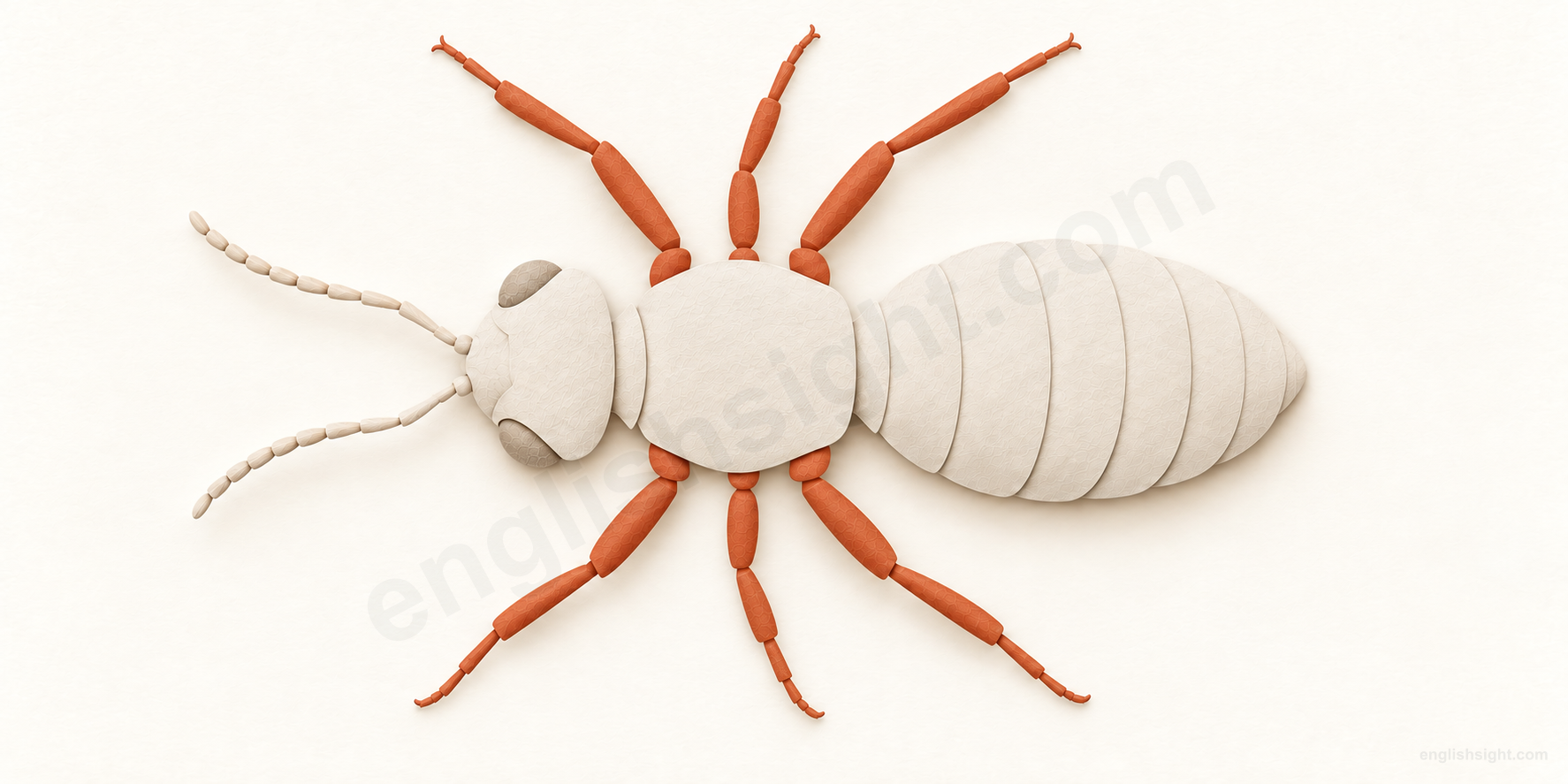
Recognize three main body parts and six legs attached to the thorax.
Adult body plan: three main parts, with six legs on the thorax.
An insect is a small animal whose adult body has three main parts and six legs. Many insects also have wings.
The body plan describes the adult stage; young insects can look very different. The drawing is a teaching aid, not a claim that every speaker imagines the same insect.
An ant, a fly, and a butterfly look different, but each belongs to the insect group. Insect is a category word: it tells you what kind of animal something is, without naming its exact species.
This lesson starts with the adult body plan, then shows how ordinary grammar builds expressions about numbers, behavior, bites, and protection. These are uses of one main noun meaning, not a collection of unrelated senses.
01
Naming and counting
Use insect for the group, an insect for one animal, and insects for several. A kind or species counts a different thing: a type.
01
be + an insect
an insect
name an animal in the insect group
Situation
You see a small animal on the window.
What you say
You identify its broad group.
The noun classifies the animal; it need not name its species.
Is that an insect? asks about membership of the group. It’s an insect gives a broad identification; It’s a beetle is more specific. The two answers can both be true.
The diagram shows adult features rather than a story of movement. A butterfly still counts as an insect even though it looks unlike the wingless animal in the sketch.
In a sentence
The animal on the window is an insect.
Watch the difference Do not use insect to mean every tiny living thing. An insect is also an animal.
02
an / the / this insect; number / some / any + insects
an insect / some insects
count individual animals
Situation
You notice one animal, then several more.
What you say
You choose a singular or plural noun.
An insect counts one animal; insects counts several or speaks about the group.
Insect is countable. Use an insect, the insect, or this insect for one; use two insects, some insects, or many insects for more than one. An is chosen because insect starts with a vowel sound.
Insects are interesting talks about the group generally. The insects are on the curtain points to a particular set. I haven’t seen any insects uses any naturally in a negative sentence.
In a sentence
There are three insects on the curtain.
Watch the difference Say I saw an insect, not I saw insect. Use are with plural insects.
03
a species of insect; insect species; what kind of insect…?
a species of insect
identify or compare kinds
Situation
A guide describes different kinds found in a garden.
What you say
You count types rather than individual animals.
A species is a biological type; an insect is one animal.
A species of insect and an insect species name a biological type. Two insect species may contain many individual insects. Species has the same spelling in the singular and plural.
What kind of insect is it? is an ordinary question when you do not know the name. A flying insect describes a feature instead of giving an exact species. In both flying insects and insect species, extra words narrow the description.
In a sentence
We found three species of insect in the garden.
Watch the difference Three insects may all be the same species; three species means three different types.
02
Observing insects
Verbs describe what insects do; extra nouns describe stages and relationships. The word insect itself does not imply harm.
04
insects + crawl / fly / swarm; feed on insects
insects crawl / fly / swarm
describe actions and feeding relationships
Situation
You watch insects moving near a pond.
What you say
You describe what they are doing.
The action comes from the verb, not from a new meaning of insect.
An insect can crawl across a surface or fly through the air. Insects swarm when many move together in a group. Use a fuller description when needed: Small insects were swarming around the lamp.
Birds feed on insects means that they eat them. The insects are the food in that sentence. In The insects feed on leaves, the insects do the eating. Word order and feed on identify the eater and its food.
In a sentence
The birds feed on insects near the pond.
Watch the difference Swarm describes many moving together. It does not mean every insect can fly.
05
an insect larva; insect larvae; insect life
insect larvae
name a young stage
Situation
You see young insects that do not look like the adults.
What you say
You describe their stage of development.
Insect names the group; larvae names a young form.
Insect larvae are young insects at a larval stage, often very different in shape from the adults. The singular is larva; the plural is larvae. Insect stays singular as a modifier.
Insect life can refer collectively to the insects living in a place: The pond supports insect life. Here life is uncountable. It does not mean one larva, and it is not the plural of insect.
In a sentence
We watched insect larvae moving in the pond.
Watch the difference The diagram shows an adult body plan. Do not expect every larva to look like that adult outline.
03
Bites, protection, and pests
Insect often comes before another noun. Read the final noun to find out whether the phrase names an injury, a product, or an animal causing damage.
06
have / get an insect bite; be bitten / stung by an insect
an insect bite / an insect sting
name an encounter and its effect
Situation
Something bites you while you are outdoors.
What you say
You describe the bite or the animal’s action.
Bite or sting supplies the kind of event; insect identifies the source.
An insect bite can name the biting event or the mark it leaves. Have insect bites describes the resulting marks; be bitten by an insect describes what happened. The animal follows by in the passive construction.
Insect bites and stings is a familiar combined expression. Bite and sting are not always interchangeable: a mosquito bites, while a wasp can sting. General everyday labels may be broader; Collins includes stings in its insect bite entry.
In a sentence
I noticed two insect bites on my ankle after the walk.
Watch the difference In two insect bites, bites is plural and insect stays singular. This phrase alone does not identify the species.
07
some insect repellent; a bottle of insect repellent
insect repellent
name a product that keeps insects away
Situation
You are packing for an evening outdoors.
What you say
You name the product you want to take.
Repellent names the substance; insect identifies what it repels.
Insect repellent names a product intended to keep insects away. The noun repellent can be uncountable when you mean the substance: some insect repellent. A repellent can mean a particular product or kind.
Compare We need insect repellent with We need to repel insects. The first names a product; the second uses a verb for an action. The compound does not promise to kill insects: keeping them away is the meaning of repellent.
In a sentence
Did you pack the insect repellent for our camping trip?
Watch the difference Insect repellent names a product, not an insect. The compound alone does not tell you its exact form or ingredients.
08
an insect pest; insect pests; insect damage; an insect infestation
insect pests
identify insects causing damage
Situation
Some insects are damaging the vegetables.
What you say
You describe them in terms of the problem they cause.
Pest evaluates their effect in a setting; insect identifies their animal group.
An insect pest is an insect that damages something people want to protect, such as crops or stored food. Insect pests is plural because pests is the head noun. Control insect pests describes limiting that problem.
Insect is neutral, while pest adds a damaging role. Not all insects are pests, and not all pests are insects. A farmer may discuss insect damage, where damage names the harm rather than the animals.
An insect infestation means that many insects are living somewhere they are not wanted, often causing damage. Compare The shed has an insect infestation with I saw one insect in the shed: seeing one insect alone does not establish an infestation. Infestation names the unwanted presence, not an individual animal.
In a sentence
The farmer checked the vegetables for insect pests.
Watch the difference Do not use insect and pest as exact synonyms. Insect damage is uncountable in this ordinary sense.
Keep the category and the context separate
Insect, bug, and animal
Insect is a neutral word for this animal group. Bug is a familiar alternative for a small insect, especially in North American English, but also means an illness or a software fault: a stomach bug is not an insect. Insects are animals; animals is a wider category.
Small does not automatically mean insect
A spider is not an insect in biological classification. People sometimes use insect loosely for similar small creatures, as Collins records, but use the precise distinction in nature or science lessons. Not every insect flies, bites, or stings.
Noun modifiers and dictionary labels
In insect bites, insect repellent, and insect larvae, the final noun is the head of the phrase. Insect identifies the connection. Some dictionaries label this modifying use adjectival; it does not require learning a new action meaning or using an insects modifier.
An insulting figurative use
Collins also records insect for a person treated as worthless or insignificant. This is a contemptuous comparison, not a neutral way to address someone. It is included for recognition, not recommended as an everyday expression.
Forms and scope
Say /ˈɪnsekt/, with stress on the first syllable. The ordinary plural is insects. There is no everyday verb insect and no phrasal-verb family to learn here. Technical insect taxonomy, regional synonyms, and derived words such as insecticide are outside this noun lesson.
Choose what the phrase means
Check whether you are naming an animal, counting types, or naming something connected with insects.
1. You notice one tiny animal on the curtain. Which sentence uses the countable noun correctly?
2. A guide lists four different kinds of insect. Which phrase counts kinds, rather than individual animals?
3. You are talking about several marks left by insects biting. Which phrase names the marks?
4. A label says insect repellent. What does the name identify?
5. A nature guide shows a spider with eight legs. Which statement preserves the biological distinction?
Sources and teaching notes
The sources below support the noun, its grammatical forms, and the selected combinations. Explanations and examples were written for this lesson. The body-plan diagram is a teaching representation.
The diagram highlights adult anatomy; young insects may look different.