From making music and measuring to methods and formal documents.
A device, its user, and its function
Use a suitable means to carry out a function
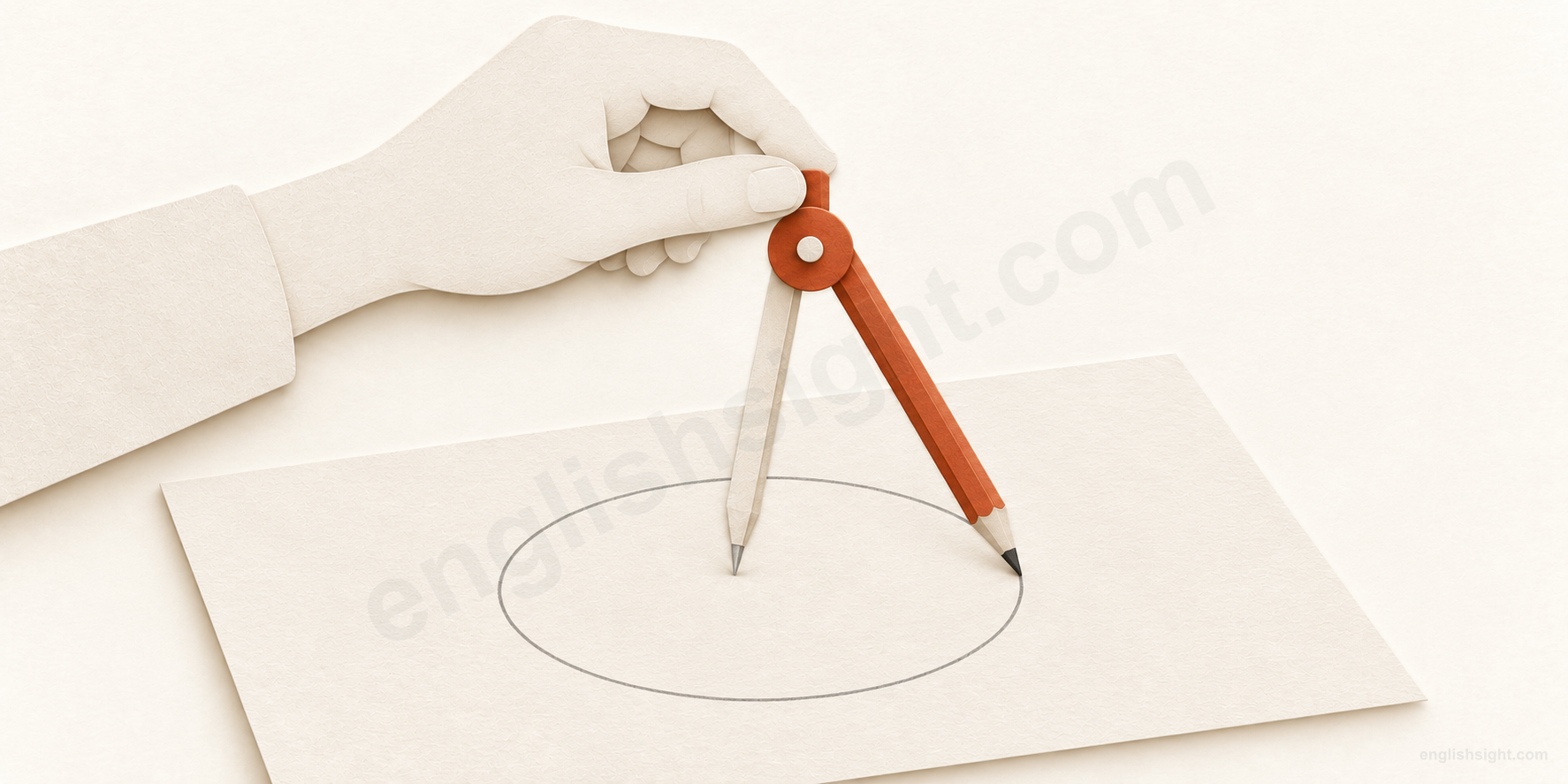
A circle with a chosen radius is needed.
instrument
The pencil point traces a circle at a fixed distance from the centre.
A hand guides the compass with one point fixed at the centre.
The compass provides the means; the hand uses it to draw a circle.
An instrument is a means used to carry out a particular function; in physical uses it is often a device for music, specialized work, or measurement.
The drawing compass illustrates a user, a specialized device, and its function. The abstract means sense extends this relationship; legal and financial meanings need their own context. This is a teaching connection, not a universal mental picture.
An instrument often supplies the means for a particular task: a person plays it, uses it to work, or reads the information it gives. Ask what function is intended before choosing a meaning.
In music, the word commonly means a musical instrument without the adjective. Elsewhere it can name specialized equipment, an abstract means, or a formal document. These uses have connections, but one picture cannot predict every technical term.
01
Making music
Start with the familiar musical meaning, then name the activity or the instrument family.
01
play / learn (to play) + an instrument; play music on + an instrument
play / learn an instrument
make music with a musical device
Situation / need
Someone asks about your musical experience.
Function / outcome
You name the kind of musical activity you can do.
In a music conversation, instrument can stand for musical instrument.
In Do you play an instrument?, instrument means a device for making music. Play describes performing; learn an instrument means learn to play one. Neither expression means merely playing a recording.
Instrument is countable: an instrument, two instruments. You can say learn to play an instrument when you want the action to be explicit. For a particular piece, music can be played on an instrument.
You can tune an instrument by adjusting its pitch, for example before playing a guitar. This is not the same as playing a tune, which means performing a melody.
A singer may also speak of the voice as their instrument. This extends the musical idea to the means the singer uses to perform; the voice is not a manufactured device.
In a sentence
I learned to play an instrument at school.
Watch the difference Use an before instrument. Learn an instrument is natural, but learn a music is not.
The word before instrument tells you which musical category is intended.
A violin is a stringed instrument: its strings are played with a bow or fingers. String instrument is also used. A flute is a wind instrument: you blow to play it. Here wind rhymes with pinned, not find.
You will also meet brass instruments, such as trumpets, and percussion instruments, such as drums. These are established musical category names, not separate meanings of instrument. Learn the category with a familiar example.
In a sentence
She plays a wind instrument, the flute.
Watch the difference Say a musical instrument; musical describes its function. Do not confuse wind instrument with an instrument for measuring wind.
02
Doing precise work and reading information
The task may be drawing, examining, measuring, or navigating. Context tells you which kind of instrument is meant.
03
use + an instrument; an instrument for + noun / -ing
a surgical / scientific instrument
a specialized tool for a task
Situation / need
A specialist needs to examine or work on something carefully.
Function / outcome
A suitable device helps carry out the task.
Instrument often highlights a specialized function or precise work.
A surgical instrument is used in an operation; an optical instrument works with light; drawing instruments include a drawing compass. A precision instrument is designed for accurate work. The description identifies the job or quality of the device.
Tool is a broad everyday choice. Instrument often sounds more specialized, especially in science or medicine, but it does not guarantee that the object is electronic or exceptionally accurate. With names like hammer or spoon, use the ordinary object name unless there is a reason to speak more generally.
A sharp instrument has a sharp edge or point. In instruments of torture, of names the harmful purpose for which the tools are used; it does not name their owner. Recognize the whole expression in historical accounts.
In a sentence
The dentist used a small instrument to examine the tooth.
Watch the difference An instrument for examining teeth names a purpose; it does not mean the instrument acts without a user.
04
a measuring instrument; an instrument for measuring + quantity; read / check + the instrument
a measuring instrument
a device that finds or indicates a quantity
Situation / need
You need to know how thick a sheet of metal is.
Function / outcome
The device gives a measurement.
Here the function is finding a quantity, rather than producing music.
A measuring instrument may measure temperature, speed, distance, or another quantity. We can describe its purpose with for measuring, or say what it does with a relative clause: an instrument that measures thickness.
Read the instrument means interpret its indication or display. Check the instrument means inspect it or its reading; the exact action depends on context. These are ordinary verb–noun combinations, not phrasal verbs.
In a sentence
This instrument measures the thickness of the metal.
Watch the difference A musical instrument can produce sound; a measuring instrument can measure sound. The surrounding words decide the function.
05
the instrument panel; the instruments on + a panel
the instrument panel
the part of a vehicle or machine where instruments are grouped
Situation / need
A driver looks at the displays in front of them.
Function / outcome
The displays provide information about the vehicle.
Instrument modifies panel and stays singular in this compound.
An instrument panel holds or displays instruments that report conditions such as speed. The instruments may have needles or digital displays. Read the instruments means use that displayed information, rather than read a written instruction manual.
The instrument panel is not the same as one instrument. It is the panel where several instruments can appear. The singular form instrument before panel is the usual noun modifier even when several devices are involved.
In a sentence
A warning light appeared on the instrument panel.
Watch the difference Use instrument panel, not instruments panel. A panel is not a musical instrument in this context.
06
fly by instruments; instrument + flying / landing
fly by instruments / instrument flying
guide an aircraft using its instruments
Situation / need
Outside visual references are limited.
Function / outcome
The pilot uses the aircraft’s instrument information.
By names the means of navigation; instrument flying names this mode of flying.
In fly by instruments, the instruments provide the information used to control and navigate the aircraft. Instrument flying relies on them when outside visual references are absent or limited.
Instrument landing is another aviation combination you may encounter. Instrument describes the basis of the operation, not a device that makes music. These are specialist expressions worth recognizing; the lesson does not teach flight procedures.
In a sentence
The pilot practised flying by instruments in a simulator.
Watch the difference By instruments does not mean beside some instruments. By marks the method here.
07
hit / strike + someone or something + with a blunt instrument
a blunt instrument
a heavy object used as a weapon, without a sharp edge or point
Situation / need
A report describes damage caused by an object.
Function / outcome
The object is described by how it struck, rather than cut.
This established expression can refer to an ordinary object used as a weapon.
In a police report, a blunt instrument means a heavy object used to strike, without a sharp cutting edge or point. Instrument here does not have to mean a specially manufactured scientific device.
Blunt contrasts with sharp in this physical use. The phrase does not tell you the exact object: the surrounding report may identify it. This literal meaning is different from a blunt instrument used to criticize a policy.
In a sentence
The report said the lock had been struck with a blunt instrument.
Watch the difference Blunt instrument does not mean a musical instrument that is out of tune.
03
A means of achieving an aim
Formal and figurative uses move from a physical device to a policy, method, or person used for a purpose.
08
an instrument of + noun; an instrument for + -ing; use something as an instrument of + noun; an instrument in + noun / -ing
an instrument of change / for achieving an aim
a means or factor that helps bring about a result
Situation / need
People want to change a situation.
Function / outcome
They use a policy, organization, or other means to help do it.
The abstract instrument is what people use to pursue their aim.
In formal discussion, an instrument can be a means of achieving an aim. In an instrument of change, change names the result or purpose. An instrument for improving education makes the intended action explicit.
Use something as an instrument of control means make it serve that purpose. For plus -ing often spells out the intended activity; of combines naturally with nouns such as change, power, or control. These patterns overlap, so learn the complete expression rather than a rigid of-versus-for rule.
This extends the idea of a useful means beyond a physical device. It does not claim that the means is good, successful, or neutral. Everyday conversation may prefer a way to bring about change.
In formal writing, an instrument in something can also name a factor that helps make it happen: Her testimony was an instrument in securing his release. Here the focus is its contribution to the result, not necessarily a deliberate plan to use a tool. In is a preposition, so it can be followed by a noun or an -ing form.
In a sentence
The group sees education as an instrument of change.
Watch the difference Instrument of change is formal. It does not mean a device that measures how much something has changed.
09
a person as an instrument of + person / force / purpose
an instrument of someone’s will
a person used by a more powerful person or force
Situation / need
Someone has their own plans for others.
Function / outcome
They use another person to carry out those plans.
The person is presented as serving someone else’s purpose.
Calling a person an instrument of someone’s will suggests that the person is being used or controlled. Compare an instrument of change, where the focus can simply be a useful means rather than a person’s lack of independence.
This is a strong, often critical characterization, not a neutral word for a colleague or helper. Literary expressions such as an instrument of fate present someone as serving a larger force; they do not refer to a physical tool.
In a sentence
He refused to become an instrument of the leader’s will.
Watch the difference Being helpful does not by itself make someone an instrument of another person. The phrase suggests use or control.
10
a blunt instrument for + -ing; use something as a blunt instrument
a blunt instrument
a method too crude to handle important differences
Situation / need
A single rule is applied to many different situations.
Function / outcome
It misses the differences that matter.
Blunt criticizes the method’s lack of precision or sensitivity.
An abstract blunt instrument is a method that cannot deal well with fine distinctions or people’s different circumstances. A blanket ban, for example, may treat harmless and harmful cases alike.
This is a figurative evaluation, not a claim that no result is possible. A blunt instrument can affect a situation while still being a poor or insensitive way to handle it. The physical image is a contrast with a finely controlled tool.
In a sentence
A blanket ban is a blunt instrument for dealing with the problem.
Watch the difference In a policy discussion, no one needs to be holding a heavy object. Read the noun being evaluated.
04
Recognizing legal and financial language
These established specialist meanings refer to documents or arrangements rather than equipment.
11
a legal instrument; a statutory instrument
a legal instrument
a formal document with a legal function
Situation / need
An agreement or other legal act needs formal documentation.
Function / outcome
A document records or gives effect to that act.
Instrument has an established document meaning in legal language.
In legal writing, instrument can refer to a formal document, such as a deed or agreement. The precise legal effect depends on the document and the relevant system. It is not a general replacement for every letter or sheet of paper.
A statutory instrument is a legal rule or regulation. Recognize the whole term when reading official material. Do not try to infer its exact legal status from the everyday tool meaning or from a picture of a device.
In a sentence
The archive contains copies of the original legal instruments.
Watch the difference This is a document sense. It does not mean equipment used by a lawyer.
12
a financial instrument; a negotiable instrument
a financial instrument
a financial contract or document representing a financial asset and a corresponding obligation or ownership interest
Situation / need
A finance text discusses contracts that hold monetary value.
Function / outcome
It calls these contracts financial instruments.
Here instrument identifies a financial arrangement, not a measuring machine.
A financial instrument is a document or contract representing financial value and rights or obligations between parties. Bonds and shares are familiar examples. In financial writing, instrument is a technical category, not simply a synonym for cash.
A negotiable instrument is a more specific payment-document term, for example a written promise or order to pay. Learn it as a separate technical expression; do not assume that every financial instrument is a negotiable instrument.
In a sentence
The textbook uses bonds as examples of financial instruments.
Watch the difference A financial instrument need not be a physical machine or a paper object you can hold.
Choose the function and the register
Countable noun, with a vowel sound
Say an instrument, this instrument, or several instruments. The ordinary noun is pronounced /ˈɪnstrəmənt/, with stress on the first syllable. In instrument panel, the singular noun modifies another noun.
Do not replace every tool name
Instrument often suits specialized or precise work, but precision is not a promise built into every use. Tool is broader; device highlights something made for a function. A musical instrument is normally played, a measuring instrument read or used, and a legal instrument issued, signed, or examined as appropriate to the document.
Technical verbs and related words
Specialist English also has the transitive verb instrument: to equip something with measuring devices, or to arrange music for instruments. Forms include instrumented and instrumenting. These uses, the legal verb, and derived instrumental / instrumentation are outside the main noun lesson. Instrument is not a general everyday verb meaning play music.
A relationship, not a single translation
The drawing illustrates a device used for a purpose. It does not turn every instrument into a compass, require a physical user beside every device, or explain the legal details of a document. The intended function and the surrounding construction matter.
Find the intended function
Use the context and the whole expression, not just one familiar meaning.
1. “Do you play an instrument?” You are talking about hobbies. What is being asked?
2. A mechanic points to several gauges in front of the driver. Which phrase names the place where they are grouped?
3. A policy is called “a blunt instrument” because it treats very different cases alike. What is the criticism?
4. An archive lists “legal instruments” alongside deeds and agreements. What does instrument mean here?
5. “They use education as an instrument of change.” What role does education have?
Sources and teaching notes
The sources below support the meanings and expressions. Explanations and examples are original. The visual relationship is a teaching model; specialist document terms have their own conventions.
The diagram illustrates one functional relationship; it is not a picture shared by every English speaker.